

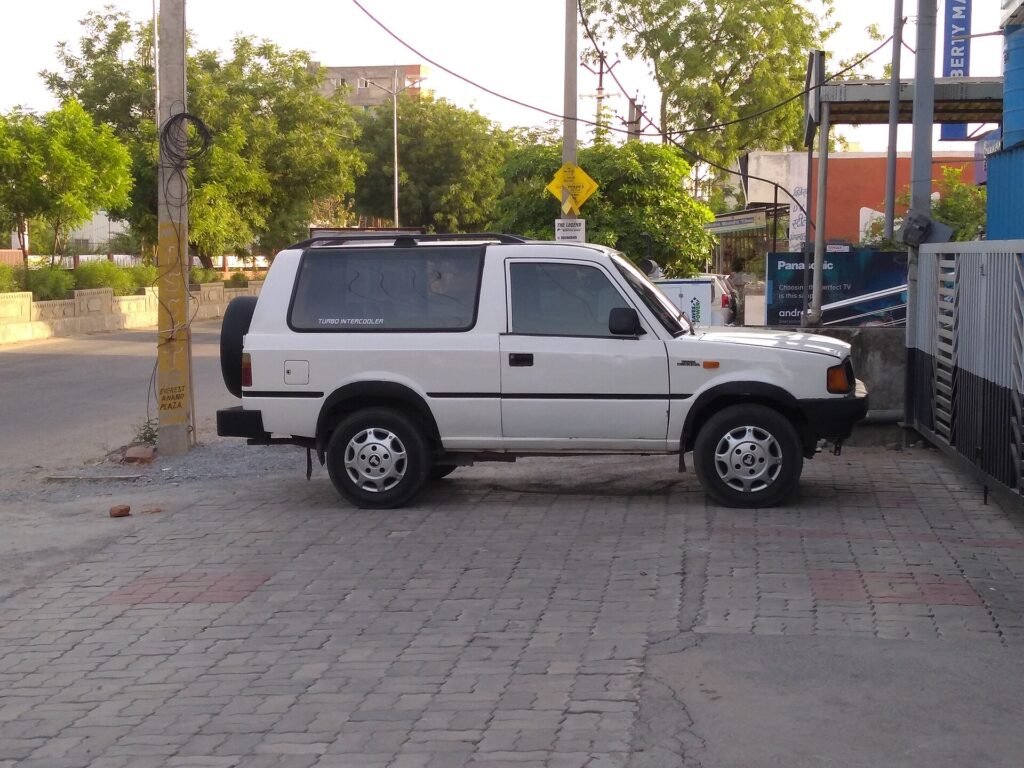
Featured image credit: Image: Raisahabone via Wikimedia Commons (CC BY-SA 4.0). Source
Best value sits in the mid-spec 63 kWh trims rather than the range-topping QWD variant.
Ratings Breakdown
| Range & Efficiency | 8.8/10 |
| Charging | 8.2/10 |
| Performance (on paper) | 7.5/10 |
| Comfort & Features | 7.0/10 |
| Value for Money | 8.0/10 |
Design
The Sierra EV revives Tata’s 1990s nameplate with a boxy, upright silhouette that stands apart from the swoopy-crossover look most rivals have converged on. It’s a deliberate design bet — distinctive rather than safe — and on spec sheet alone it succeeds at looking like nothing else currently on sale in this price band.
Range & Charging
Tata offers two battery options: a 63 kWh pack rated for 565 km and a 75 kWh pack rated for 665 km (claimed, likely MIDC/ARAI-cycle figures rather than real-world). DC fast charging from 20-80% takes about 26 minutes on the larger pack — competitive with, though not class-leading against, the fastest chargers in this segment. Expect real-world range to land meaningfully below the claimed figures, as is standard across all EVs tested under Indian test cycles.
Performance
The top variants get Tata’s QWD (quad-wheel-drive) setup — a first for the brand’s EV lineup — pairing twin motors for genuine all-wheel drive rather than a single-motor FWD/RWD layout. On paper this should meaningfully improve traction and off-road capability versus single-motor rivals, though we have not yet verified this with a physical test.
Interior & Features
Tata’s five-variant, two-battery, two-drivetrain matrix gives buyers real choice, but base variants are likely to miss some of the tech-forward features (large panoramic displays, advanced ADAS) that rivals like the Mahindra BE 6 and Hyundai Creta Electric lead with at similar price points. Buyers prioritizing infotainment and driver-assist tech should cross-shop carefully by variant.
Pros & Cons
Pros
- Class-leading claimed range on the 75 kWh pack (665 km)
- QWD all-wheel-drive option not available on most rivals at this price
- Distinctive design that stands out from crossover-shaped competition
- Fast DC charging (20-80% in ~26 min)
Cons
- Feature set on base variants likely trails tech-forward rivals
- No verified real-world range or road-test data yet
- Retro design won’t appeal to buyers wanting a conventional SUV look
Specifications
| Price (ex-showroom) | Rs 18.79 – 25.99 lakh |
|---|---|
| Battery | 63 kWh / 75 kWh |
| Claimed range | 565 km / 665 km |
| Fast charging | 20-80% in ~26 minutes (DC) |
| Drivetrain | FWD standard; QWD (AWD) on top variants |
| Seating | 5 |
| Variants | 5, across 2 battery and 2 drivetrain options |
Verdict: Should You Buy It?
Yes, if long single-charge range and a distinctive design matter more to you than having the latest infotainment tech, and especially if the QWD variant’s pricing fits your budget for genuine AWD capability. Consider waiting or cross-shopping if you want class-leading cabin tech and ADAS — the Mahindra BE 6 and Hyundai Creta Electric are worth comparing directly. See our EV Compare Tool to check the Sierra EV against its closest rivals side by side.
Related Reading
- Tata Sierra EV Launched at Rs 18.79 Lakh: Variants, Thar.e Timing and the Elevate EV Cancellation
- Tata Motors EV Brand Deep Dive 2026: Every Electric Car, Range and Price
- Complete EV Buying Guide India 2026: Best Electric Car for Every Budget
- Home Charging vs Public Fast Charging: The Real Cost of Running an EV in India
Frequently Asked Questions
What is the range of the Tata Sierra EV?
Tata claims 565 km on the 63 kWh battery and 665 km on the 75 kWh battery. These are manufacturer test-cycle figures; expect lower range in real-world city and highway driving.
Does the Tata Sierra EV have all-wheel drive?
Yes — top variants get Tata’s QWD (quad-wheel-drive) setup with twin motors, a first for the brand’s EV lineup.
How fast does the Tata Sierra EV charge?
Tata claims a 20-80% DC fast charge in approximately 26 minutes on the larger battery pack.
What is the price of the Tata Sierra EV?
The Sierra EV is priced from Rs 18.79 lakh to Rs 25.99 lakh (ex-showroom) across 5 variants.
What is the real-world range of the Tata Sierra EV?
Tata publishes a second, more conservative C75 figure alongside the MIDC claim: 510-530 km for the 75 kWh pack and 440-460 km for the 63 kWh pack, against 665 km and 565 km on the test cycle. Treat the lower end of those bands as realistic with the air-conditioning on in city traffic, and expect roughly 15-20 per cent less again at a sustained 100-110 km/h on the highway.
Should I buy the Tata Sierra EV or the Tata Harrier EV?
The Sierra EV undercuts the Harrier EV by roughly Rs 2.5 to 3 lakh at the entry point — about Rs 18.79 lakh against Rs 21.49 lakh ex-showroom — while using comparable 63 to 75 kWh packs and a similar 20-80 per cent DC fast charge of around 25 minutes. The Harrier EV keeps the advantage on claimed range and outright power and sits a size class above, so it suits buyers who want the bigger car; the Sierra EV is the better value if you want a twin-motor Tata EV for the least money.
What is the battery warranty on the Tata Sierra EV?
Tata covers the high-voltage battery for 15 years from the date of first registration for the first owner, well beyond the 8-year cover that is standard on Indian EVs. It is a warranty against pack defect and failure rather than a guarantee against gradual capacity fade, and because it is tied to the first owner it does not carry over in full if you sell the car inside that window — worth factoring into resale maths.