

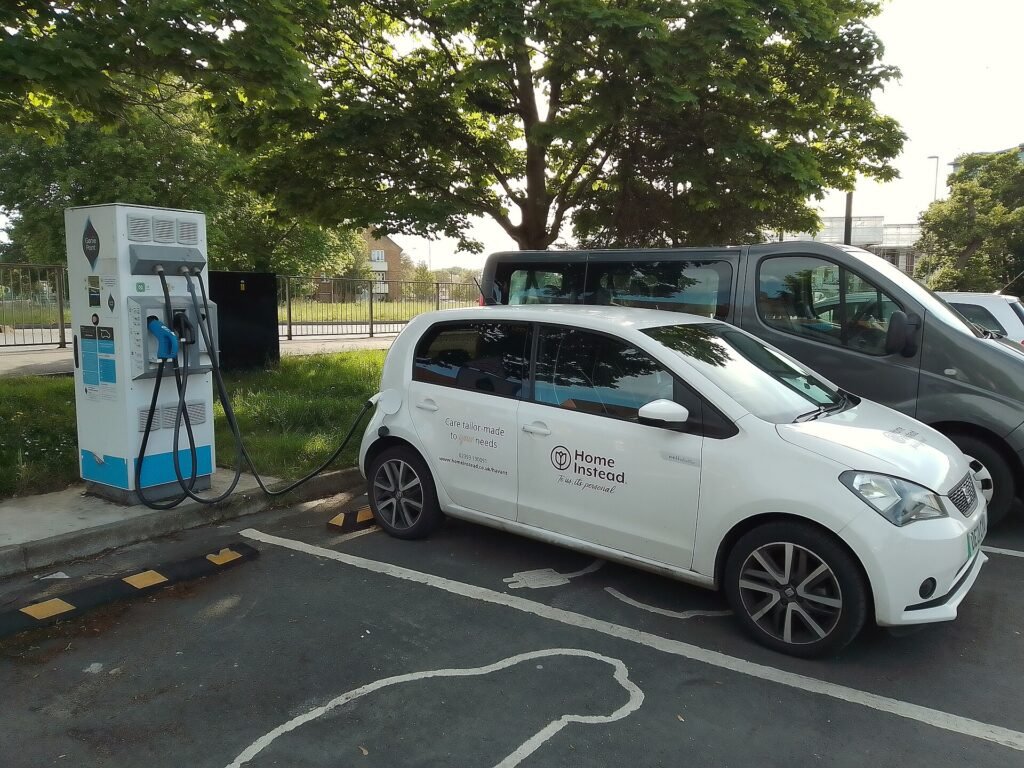
Featured image credit: Image: Djm-leighpark via Wikimedia Commons (CC BY-SA 4.0). Source
With 73% of India’s 67,657 public EV chargers rated below 30 kW as of August 2026, most public charging in India today is still slow charging, not the rapid top-ups EV marketing tends to imply. That has a real cost consequence for buyers: where and how you charge changes your effective per-km running cost far more than most people expect when they’re comparing EVs against petrol cars. By Piyush P. Yadav.
Why Charging Location Changes Your Real Cost
EV running cost calculators usually quote a single “per km” figure, but that number assumes a fixed electricity tariff — almost always the cheapest one, home charging on a domestic tariff. In practice, most EV owners use a mix of home and public charging, and the price gap between the two is large enough to meaningfully shift your total cost of ownership, especially for buyers without dedicated home charging (apartment dwellers, renters, and anyone relying on workplace or public infrastructure).
Home Charging: The Cheapest Option, With Caveats
Charging at home on a standard domestic electricity tariff remains, by a wide margin, the cheapest way to run an EV in India. A typical domestic tariff sits well below what public charging operators charge per unit, since public operators must recover real estate, equipment, and infrastructure costs on top of the electricity itself. The catch is access: home charging requires either a private parking spot with an electrical connection or a housing society willing to install charging points — something still inconsistent across Indian apartment complexes in 2026, even in metro cities.
Public Charging: More Convenient, Meaningfully More Expensive
Public charging operators price per unit (kWh) well above domestic tariffs, and DC fast chargers command a further premium over slower AC public chargers. Given that nearly three-quarters of India’s public charging infrastructure is still sub-30kW as of mid-2026, most public charging sessions today are also slower, meaning you pay more per unit while also spending more time plugged in — a double cost in money and convenience compared to overnight home charging.
Cost Comparison: Home vs Public Charging (Illustrative)
| Charging Method | Typical Cost per Unit | Charging Speed | Best For |
|---|---|---|---|
| Home (domestic tariff) | Lowest — standard domestic electricity rate | Slow (overnight, AC) | Owners with dedicated parking/connection |
| Public AC charging | Moderate premium over domestic tariff | Slow to moderate | Workplace, mall, apartment visitors |
| Public DC fast charging | Highest per-unit cost | Fast (30 min-1 hr for meaningful top-up) | Highway trips, emergency top-ups |
Exact per-unit rates vary significantly by state, electricity board, and charge point operator (CPO) — always check the specific tariff displayed on the charging app or station, including any parking or idle-time fee, before relying on published estimates, as India does not yet have a uniform national EV charging tariff. Some CPOs also charge a separate parking or idle-fee component once your vehicle finishes charging but remains plugged in, which can add unexpected cost if you’re not tracking session time closely — always check the app’s fee structure in full, not just the headline per-unit rate, before relying on a station for a longer stop.
What This Means for Your Buying Decision
If you have reliable home charging access, an EV’s running cost advantage over petrol remains substantial even accounting for occasional public fast-charging premiums on long trips. If you don’t have home charging access — a real constraint for many urban apartment dwellers — you should stress-test the EV vs petrol cost comparison using public charging rates as your baseline, not the optimistic home-charging figure most marketing materials quote. In some cases, heavy reliance on DC fast charging can narrow the cost gap with petrol considerably, even though EVs still generally come out ahead on fuel cost alone.
A Rough Monthly Cost Scenario
Consider a typical urban commuter driving roughly 1,000 km a month. Charged entirely at home on a domestic tariff, that consumption might translate to one of the lowest monthly running costs available for any form of personal transport in India today — often cited as a fraction of the equivalent petrol cost per km. Shift even 30-40% of that same charging to public DC fast chargers — a realistic scenario for someone without guaranteed home charging access, or who occasionally needs a mid-day top-up — and the blended monthly cost rises meaningfully, though it typically still remains below petrol on a like-for-like distance basis. The exact numbers depend heavily on your vehicle’s efficiency, local electricity tariffs, and which CPO’s rates apply in your city, which is why generic “EV running cost” claims should always be treated as a starting estimate rather than a number to budget precisely around.
Fleet operators and gig-economy delivery riders, who often log far higher monthly distances than a typical personal-use commuter, should be especially careful with this math, since their charging mix and utilisation patterns can differ substantially from a private car owner’s, and a wrong assumption about charging cost compounds quickly across thousands of kilometres a month.
Practical Steps Before You Buy
- Confirm with your housing society or landlord whether a home charging point can actually be installed — don’t assume it’s possible just because you have a car park.
- Map the public charging density near your home, workplace, and common routes using apps from major CPOs before committing to a purchase.
- If you’ll rely heavily on public fast charging, factor its higher per-unit cost into your running-cost math rather than using headline “per km” figures that assume home charging.
- Ask your CPO or building society about upcoming rollouts — HPCL’s late-2025 agreement with V-GREEN to deploy EV charging across more than 24,400 fuel retail outlets is expected to steadily improve public fast-charging access nationwide through 2026-27.
How This Changes Over the Vehicle’s Ownership Period
Charging economics are not static over a typical 5-8 year EV ownership period. As India’s public charging network expands — including large-scale rollouts like HPCL’s partnership with V-GREEN to add charging across more than 24,400 fuel retail outlets — public charging availability and, potentially, pricing competition should improve over time, which could narrow the current cost gap between home and public charging somewhat. On the other hand, as more EVs come onto Indian roads and demand for public charging grows faster than supply in some corridors, near-term pricing on high-demand routes could just as easily stay firm or rise. Buyers making a long-term ownership decision should build in some uncertainty on this front rather than assuming today’s charging costs will hold steady for the life of the vehicle.
It’s also worth checking whether your electricity provider or state offers any specific EV charging tariff or off-peak discount for home charging — several Indian states have experimented with lower night-time tariffs specifically to encourage EV owners to charge during off-peak grid hours, which can meaningfully improve the home-charging cost advantage further if available in your area.
Related Reading
- 73% of India’s 67,657 EV Chargers Are Under 30 kW: What the Rubix Report Means for Fast Charging
- HPCL’s 24,400-Outlet EV Charging Rollout With V-GREEN
- India’s EV Charging Network Mid-2026: Rs 503 Crore for 4,874 New Chargers
- EV vs Petrol Car in India: The Real 5-Year Cost Comparison (2026)
Frequently Asked Questions
Is home charging always cheaper than public charging for EVs in India?
Yes, in almost all cases. Home charging on a domestic electricity tariff is significantly cheaper per unit than public charging, which carries a premium to cover the charge point operator’s infrastructure and real estate costs.
How much of India’s public charging network is fast charging?
As of August 2026, about 73% of India’s 67,657 public EV chargers are rated below 30 kW, meaning the majority of public charging capacity is still relatively slow rather than rapid DC fast charging.
Should I buy an EV if I don’t have home charging access?
It can still make sense, but you should calculate running costs using public charging rates rather than home-charging estimates, and check the charging density near your home, workplace, and regular routes before buying.
Will public EV charging get cheaper in India?
As infrastructure scales — including large rollouts like HPCL’s partnership to add charging across more than 24,400 fuel outlets — increased competition among charge point operators could bring per-unit public charging costs down over time, though this is not guaranteed and varies by region.
Are there off-peak electricity tariffs for EV charging in India?
Some Indian states and electricity boards offer lower night-time or off-peak tariffs intended to encourage EV owners to charge during low-demand grid hours. Availability and rates vary by state and utility, so check directly with your local electricity provider rather than assuming a standard national rate applies.
How much will charging an EV at home add to my monthly electricity bill in India?
Calculate it from your own running rather than a headline per-km figure. A typical Indian electric car returns roughly 6-7 km per kWh in mixed city use, so 1,000 km a month consumes about 145-165 units. At a domestic rate of around Rs 8 per unit that is roughly Rs 1,150 to Rs 1,350 a month. The detail most calculators miss is that domestic tariffs in most Indian states are slab-based and progressive, so an extra 150 units can push your household into a higher slab and make the marginal cost of EV charging higher than the average rate printed on your current bill.
Do I need a separate meter or a higher sanctioned load to install a home EV charger in India?
A separate meter is optional. Under the Ministry of Power’s EV charging guidelines, your DISCOM must provide a charging connection either on your existing meter or as a separate connection, at your choice. Sanctioned load is the more common practical obstacle: a 7.4 kW AC wall box generally needs a sanctioned load of about 10 kW, while many Indian homes run single-phase connections sanctioned at 5-8 kW, so a load enhancement and sometimes a three-phase upgrade has to come first. A separate EV meter is usually worth the paperwork in states such as Delhi, Maharashtra and Karnataka, which offer dedicated EV tariffs below the normal domestic slab rate.
Can I charge an electric car from a normal 15A household socket?
Yes. Almost every electric car sold in India ships with a portable cable that plugs into a standard 15A socket and draws about 2.5-3.3 kW, adding roughly 15-18 km of range per hour. That covers a 30-60 km daily commute charged overnight, but a full charge on a 40-50 kWh pack takes 12-17 hours, so treat it as a fallback rather than a substitute for a wall box. Use a dedicated, properly earthed 15/16A socket on its own circuit and never an extension board or a shared kitchen circuit, since the charger pulls close to maximum rated current continuously for many hours.