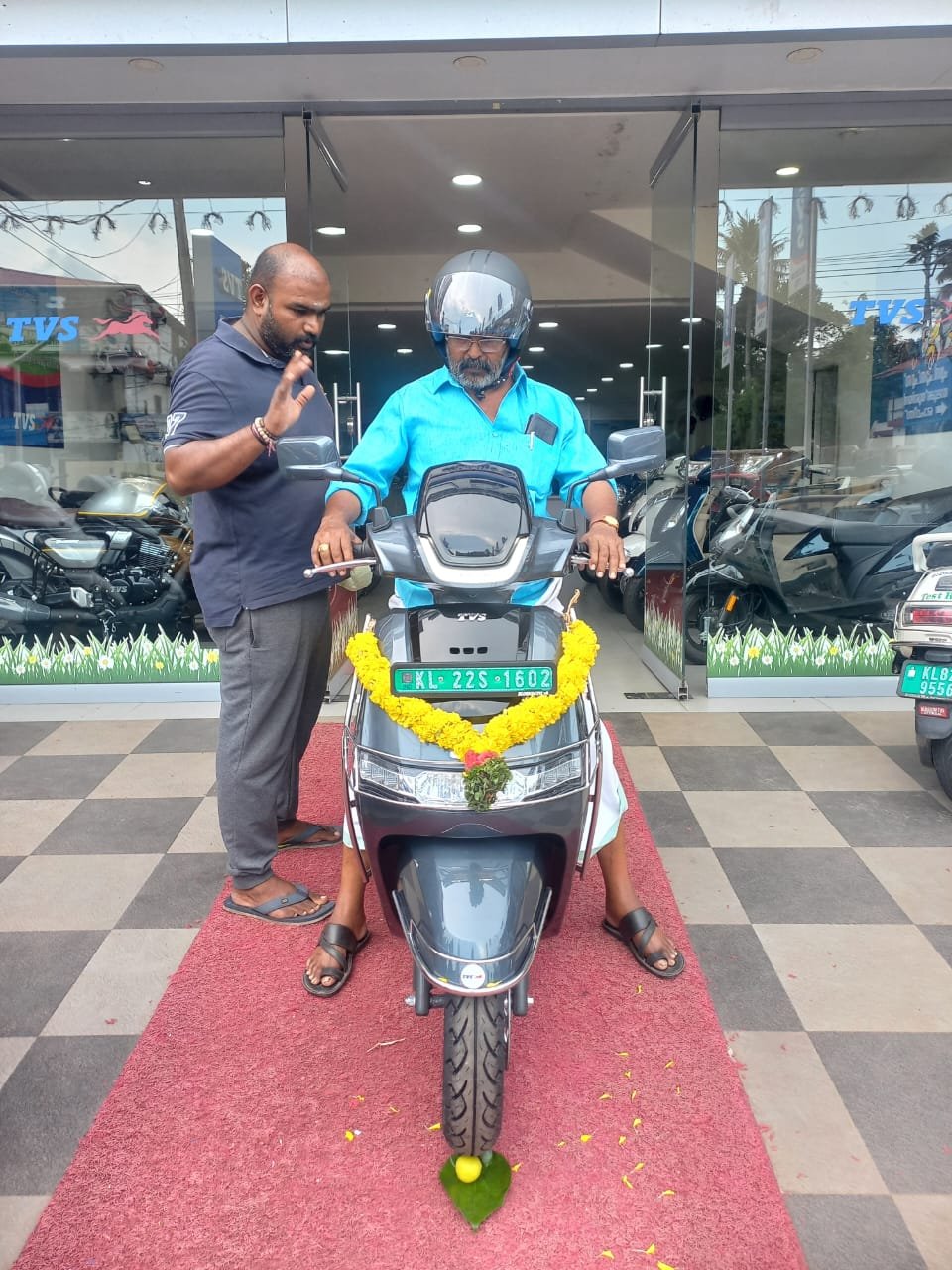
Featured image credit: Image: Maneesh Sreekariyam via Wikimedia Commons (CC BY-SA 4.0). Source
By Piyush P. Yadav
India’s four biggest electric two-wheeler makers have sold more scooters in eight months of 2026 than they did in the whole of 2025. Between January and August, TVS Motor, Bajaj Auto, Ather Energy and Hero MotoCorp’s Vida registered a combined 10,38,973 electric two-wheelers, up 84 per cent on the 5,65,635 they sold in the same months last year and 1.16 lakh units ahead of their full-year 2025 total of 9,22,824. Together they now hold 76 per cent of a segment that itself passed 1.36 million registrations in the same period and is on course for its first two-million-unit calendar year. This is the brand-by-brand scorecard, the months that made the numbers, what the four are doing with their factories for the rest of 2026, and what the shift means for the company that used to lead the market.
The scorecard, January to August 2026
| Brand | Jan-Aug 2026 registrations | Growth on Jan-Aug 2025 | Share of all e2W | Best month of 2026 |
|---|---|---|---|---|
| TVS Motor | 3,56,579 | +77% | 26% | July: 55,823 |
| Bajaj Auto | 3,05,226 | +69% | 22% | March: 47,753 |
| Ather Energy | 2,29,099 | +83% | 17% | August: 28,708 |
| Vida (Hero MotoCorp) | 1,48,069 | +151% | 11% | July: 22,989 |
| Four-brand total | 10,38,973 | +84% | 76% | |
| All electric two-wheelers | About 13.6 lakh | 100% |
Registration data is from VAHAN as compiled by Autocar India; it counts vehicles registered with state transport departments rather than factory dispatches, so it is the closest thing India has to a retail number.
TVS: the first brand past its own 2025 total
TVS’s 3,56,579 units in eight months already exceed its 2025 full-year figure of 3,15,082 by more than 41,000, and its July tally of 55,823 is the highest monthly number any electric two-wheeler brand has recorded in India. The iQube remains the volume product, but the Rs 1 lakh Orbiter, launched with a battery-subscription option, has broadened the base at the price point where the market is growing fastest. We covered how TVS took the cumulative lead in our report on TVS overtaking Ola Electric in cumulative sales.
Bajaj: 3 lakh and a bigger factory
Bajaj’s Chetak has done 3,05,226 units this year, and the company crossed 3 lakh cumulative 2026 sales in the last days of August, a milestone we analysed in our piece on Bajaj crossing 3 lakh EV sales. Its best month was March, when year-end fleet purchases and the Rs 87,100 Chetak 2501 pushed it to 47,753. Bajaj has since raised Chetak production capacity from about 50,000 to 60,000 units a month, which is the clearest sign that it intends to contest the number-one spot rather than settle for second.
Ather: the only brand whose best month was August
Ather’s 2,29,099 units are up 83 per cent, and its 17 per cent share is two points higher than a year ago. Unlike its rivals, Ather’s best month of the year was the most recent one: 28,708 in August, up 49 per cent on August 2025. Part of that is the geographic expansion into Gujarat, Rajasthan, Odisha and the hill states, and part is the Konarc, the Rs 99,999 automatic we reviewed in our Ather Konarc deep dive, which reached showrooms in the last week of August and has only one full month of sales to show so far. Ather’s balance sheet also changed in the same week: Hero MotoCorp bought a further Rs 1,758 crore of shares to take its stake to 32.8 per cent.
Vida: the fastest grower
Vida is fourth on volume but first on growth, its 1,48,069 units up 151 per cent and its share up from 7 per cent to 11 per cent. July’s 22,989 was its record; August’s 18,978 was still 38 per cent higher than a year earlier. The VX2, sold with either a removable or a fixed battery and with a battery-subscription price that starts under Rs 60,000, is the product doing the work. Hero’s chief executive said this month that the company is raising Vida output by 50 per cent in September and intends to double it by December, and that it is “not shy” about aiming for the number-one position.
Why 2026 is the first two-million year
At 1.36 million registrations in eight months, the electric two-wheeler market is averaging about 1.7 lakh a month. The festive quarter is usually the strongest of the year for two-wheelers, and the last four months of 2025 delivered well above the annual average. Even a flat September-to-December would take 2026 past 2 million, and a normal festive lift would take it to 2.1 or 2.2 million. That compares with 1.39 million in the whole of FY2026 and about 1.15 million in calendar 2024.
| Scenario for Sept-Dec 2026 | Monthly average | Full-year 2026 total |
|---|---|---|
| Flat on Jan-Aug run rate | 1.70 lakh | About 20.4 lakh |
| Festive lift of 15% | 1.95 lakh | About 21.4 lakh |
| Festive lift of 25% | 2.12 lakh | About 22.1 lakh |
Three things are driving the volume. The first is price: the mainstream has moved from Rs 1.2 to 1.5 lakh scooters to sub-Rs 1 lakh ones, and our September list of the best electric scooters under Rs 1 lakh now runs to seven credible products. The second is distribution: TVS and Bajaj sell through the same dealers that sell their petrol scooters, which is why they can add volume in towns where a start-up would need to open a store first. The third is the halving of the PM E-DRIVE scooter subsidy to Rs 5,000 this year, which turned out to matter far less than the industry feared because the brands absorbed it and cut prices anyway.
What it means for Ola Electric
The four-brand share of 76 per cent leaves 24 per cent for everyone else, and the largest of the everyone-else is Ola Electric, which led the market as recently as early 2025. Ola is not in the Autocar tally because it is no longer in the top four, and its 2026 story has been about cost: the network was cut from about 4,000 outlets to roughly 550 larger company-run stores in February, and the S1 Z was launched at Rs 79,999 to fight at the price point where TVS and Bajaj now dominate. Our report on the August 2026 electric scooter sales has the month-by-month share picture. The arithmetic is unforgiving: for Ola to regain even a 15 per cent share of a two-million market it would need to sell about 25,000 scooters a month, which is roughly what Ather does today with a fraction of Ola’s installed capacity.
The capacity race for the last four months
- TVS has not published a capacity figure but has been running the Hosur line at record levels since May; the constraint is cell supply rather than assembly.
- Bajaj has moved Chetak capacity to 60,000 a month, which would allow a 50,000-plus month in October if demand holds.
- Ather has the Hosur plant plus its second plant in Maharashtra, and the Konarc gives it a sub-Rs 1 lakh product to fill that capacity with.
- Vida is adding 50 per cent in September and doubling by December, which implies a monthly capability above 40,000 by the year end.
Add those up and the four brands could, in theory, build 1.8 to 2 lakh scooters a month by December. That is more than the entire market absorbed in any month of 2025, and it is why the second half of this year will be decided by demand rather than supply for the first time since the subsidy era.
Sources & Further Reading
- Autocar India: TVS, Bajaj, Ather and Vida cross 1 million combined e2W sales in 2026
- Autocar India: Hero MotoCorp aims to be number one Indian EV seller
- Autopunditz: How Hero MotoCorp is building its EV position
- EMobility+: Hero MotoCorp raises Ather Energy stake to 32.8%
Frequently asked questions
Which is India’s best-selling electric scooter brand in 2026?
TVS Motor, with 3,56,579 registrations between January and August 2026 and a 26 per cent share. Bajaj Auto is second with 3,05,226 and a 22 per cent share.
How many electric two-wheelers has India sold in 2026 so far?
About 1.36 million between January and August 2026, according to VAHAN registration data compiled by Autocar India. The market is on course for its first two-million-unit calendar year.
Which brand is growing fastest?
Hero MotoCorp’s Vida, up 151 per cent to 1,48,069 units, with its share rising from 7 per cent to 11 per cent. Ather is next at 83 per cent growth.
Where does Ola Electric stand?
Outside the top four. The four leading brands hold 76 per cent of the market; Ola’s share is within the remaining 24 per cent after a year of falling volumes and a network cut to about 550 stores.