

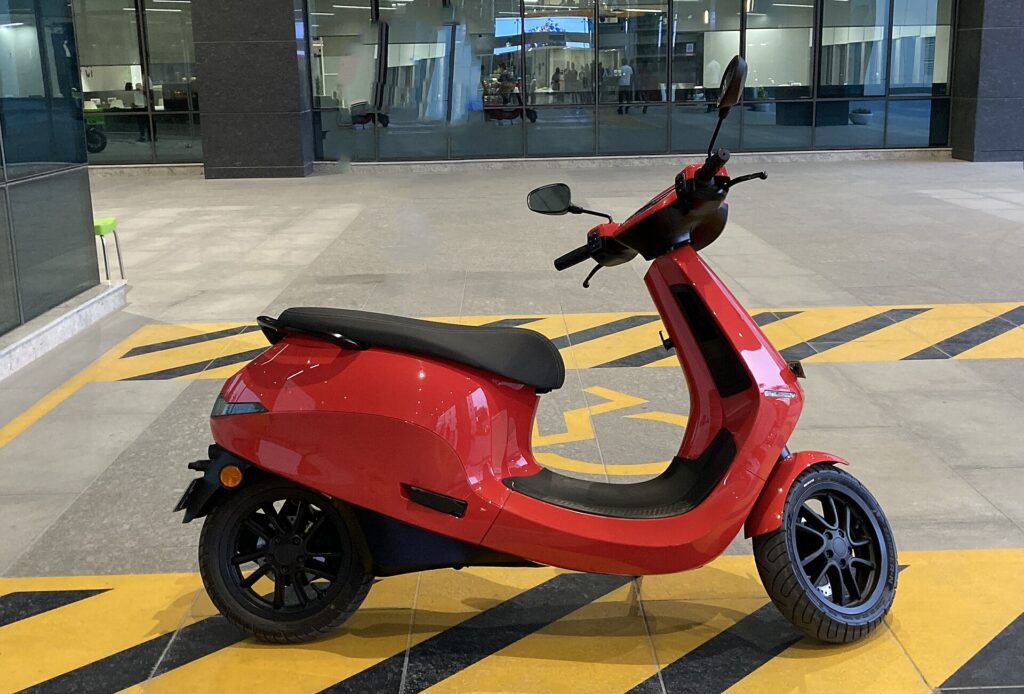
Featured image credit: Image: SnapMeUp via Wikimedia Commons (CC BY-SA 4.0). Source
By Piyush P. Yadav
Petrol in Delhi cost Rs 102.12 a litre on 8 September 2026. A Honda Activa 6G, the scooter India buys more of than any other, returns about 47 km per litre in owners’ hands, which works out to Rs 2.17 per kilometre before you have paid for a single service. An electric scooter charged at home on a Rs 8 per unit domestic tariff costs between 20 and 30 paise per kilometre. That gap is the entire case for going electric, and yet the sticker prices run the other way: the Activa starts at Rs 78,687, while the electric scooters that compete with it on size and speed start at Rs 80,000 to Rs 1 lakh, and the cheapest of those have a battery you rent rather than own. This guide runs the full five-year cost of ownership for a 30 km-a-day commuter, petrol against electric, with every assumption stated, so you can plug in your own distance and see where the break-even actually falls.
The assumptions, stated up front
Total cost of ownership is only as honest as its inputs. The table sets out ours. Where a figure is uncertain we have chosen the value that favours the petrol scooter, so the electric result is conservative.
| Input | Value used | Basis |
|---|---|---|
| Distance | 30 km a day, 300 days a year: 9,000 km a year, 45,000 km over five years | Typical urban commute with errands |
| Petrol price | Rs 102.12 a litre, held flat | Delhi retail price on 8 September 2026 |
| Activa 6G real-world mileage | 47 km per litre | Owner-reported average on listing sites; ARAI figure is higher |
| Home electricity | Rs 8 per unit, held flat | Delhi domestic slab; many states are Rs 6 to 9 |
| Electric scooter efficiency | 30 to 40 Wh per km real-world, model-specific | Derived from certified range and pack size at 65 to 75 per cent of IDC |
| Charging losses | 10 per cent added to electricity use | Charger and battery conversion loss |
| Petrol service | Rs 3,000 a year | Oil, plug, filter, belt; Rs 2,500 to 3,500 typical |
| Electric service | Rs 1,750 a year | Rs 1,000 to 2,500 typical |
| Tyres and brakes | Rs 6,000 over five years, both | One set of tyres; wear is similar |
| Insurance | Petrol Rs 2,000 a year; electric Rs 2,500 a year | Comprehensive; EV premiums run higher on a pricier vehicle despite the 15 per cent third-party discount |
| Resale after five years | Petrol 40 per cent of price; electric 30 per cent | EVs depreciate faster; see our used-EV guidance |
We have not included a battery replacement in the five-year total. Manufacturer warranties on the scooters below run three years or more, and the packs are expected to last five to eight years; the replacement bill is a year-six-to-eight event that we address separately at the end.
The scooters compared
We chose one petrol benchmark and four electric scooters that a buyer cross-shopping an Activa would realistically consider: the two cheapest outright-purchase models from established brands, the best-selling sub-Rs 1 lakh Ola, and the model with the longest range under Rs 1 lakh. Prices are ex-showroom as listed in the first week of September and match those in our September 2026 guide to electric scooters under Rs 1 lakh.
| Scooter | Ex-showroom price | Battery | Certified range | Realistic range used | Energy per km (with losses) |
|---|---|---|---|---|---|
| Honda Activa 6G (petrol, 110 cc) | Rs 78,687 (base) | 5.3-litre tank | About 60 km/l ARAI | 47 km per litre | 21.3 ml per km |
| TVS Orbiter V1 (outright) | Rs 84,500 | 3.1 kWh | 86 km IDC (conservative) | 75 km | 45 Wh |
| Vida VX2 Go (outright) | Rs 84,999 | 2.2 kWh removable | 92 km | 65 km | 37 Wh |
| Ola S1 Z | Rs 79,999 | 3 kWh LFP removable | 179 km | 115 km | 29 Wh |
| Bajaj Chetak 3001 | Rs 99,650 | About 3 kWh | About 127 km | 90 km | 37 Wh |
The energy-per-kilometre column is the number that drives the electricity bill, and it varies more than buyers expect. The Orbiter’s 45 Wh per km reflects TVS’s conservative certification and a heavier pack; the Ola S1 Z’s 29 Wh per km reflects a lighter scooter with a very optimistic IDC figure that we have already discounted by a third. In practice all four will land between 30 and 45 Wh per km depending on rider weight, speed and terrain.
Year-by-year: fuel or electricity
At 9,000 km a year the Activa burns about 191 litres of petrol, which at Rs 102.12 is Rs 19,500 a year and Rs 97,600 over five years. The electric scooters use between 261 kWh (Ola S1 Z) and 405 kWh (Orbiter) a year, which at Rs 8 per unit is Rs 2,100 to Rs 3,250 a year, or Rs 10,400 to Rs 16,200 over five years.
| Scooter | Energy a year | Energy cost a year | Energy cost over five years | Cost per km |
|---|---|---|---|---|
| Honda Activa 6G | 191 litres | Rs 19,550 | Rs 97,750 | Rs 2.17 |
| TVS Orbiter V1 | 405 kWh | Rs 3,240 | Rs 16,200 | Rs 0.36 |
| Vida VX2 Go | 333 kWh | Rs 2,660 | Rs 13,300 | Rs 0.30 |
| Ola S1 Z | 261 kWh | Rs 2,090 | Rs 10,450 | Rs 0.23 |
| Bajaj Chetak 3001 | 333 kWh | Rs 2,660 | Rs 13,300 | Rs 0.30 |
The fuel saving alone is Rs 81,000 to Rs 87,000 over five years for this rider. That is more than the purchase price of any scooter in the table, which is why the total-cost comparison is not close even before service costs are counted.
The five-year total
Adding purchase price, energy, service, tyres, insurance and subtracting resale gives the net five-year cost of ownership. We have used the base Activa price; a top variant adds about Rs 14,000 and does not change the conclusion.
| Cost line (five years) | Activa 6G | TVS Orbiter V1 | Vida VX2 Go | Ola S1 Z | Chetak 3001 |
|---|---|---|---|---|---|
| Purchase (ex-showroom) | Rs 78,687 | Rs 84,500 | Rs 84,999 | Rs 79,999 | Rs 99,650 |
| Fuel or electricity | Rs 97,750 | Rs 16,200 | Rs 13,300 | Rs 10,450 | Rs 13,300 |
| Service | Rs 15,000 | Rs 8,750 | Rs 8,750 | Rs 8,750 | Rs 8,750 |
| Tyres and brakes | Rs 6,000 | Rs 6,000 | Rs 6,000 | Rs 6,000 | Rs 6,000 |
| Insurance | Rs 10,000 | Rs 12,500 | Rs 12,500 | Rs 12,500 | Rs 12,500 |
| Less resale value | -Rs 31,500 | -Rs 25,350 | -Rs 25,500 | -Rs 24,000 | -Rs 29,900 |
| Net five-year cost | Rs 1,75,937 | Rs 1,02,600 | Rs 1,00,049 | Rs 93,699 | Rs 1,10,300 |
| Saving against Activa | – | Rs 73,300 | Rs 75,900 | Rs 82,200 | Rs 65,600 |
| Cost per km, all-in | Rs 3.91 | Rs 2.28 | Rs 2.22 | Rs 2.08 | Rs 2.45 |
Every electric scooter in the table beats the Activa by Rs 65,000 to Rs 82,000 over five years for a 30 km-a-day rider, even after assuming it loses more value at resale. Road tax and registration, which several states waive for electric two-wheelers and charge at 8 to 10 per cent on petrol scooters, would widen the gap further; we have left them out because the exemptions are expiring state by state.
Where the break-even falls
The purchase-price premium for these scooters over an Activa is between Rs 1,300 (Ola S1 Z) and Rs 21,000 (Chetak 3001). Against a running-cost saving of Rs 1.30 to 1.60 per kilometre once service is included, the premium is recovered inside the first year for every model, at somewhere between 1,000 km and 14,000 km. The more interesting question is the rider who does far less distance.
| Daily distance | Annual km | Five-year saving, Ola S1 Z vs Activa | Five-year saving, Chetak 3001 vs Activa |
|---|---|---|---|
| 10 km | 3,000 | Rs 24,000 | Rs 9,400 |
| 20 km | 6,000 | Rs 52,500 | Rs 36,000 |
| 30 km | 9,000 | Rs 82,200 | Rs 65,600 |
| 50 km | 15,000 | Rs 1,40,500 | Rs 1,22,000 |
At 10 km a day the Chetak’s advantage shrinks to under Rs 10,000, and a dealer discount on the Activa would erase it. That is the rider for whom a battery-subscription scooter can make sense, because a low sticker price matters more than the per-kilometre charge; we worked through that trade-off in our battery-subscription cost maths for the Vida VX2 and TVS Orbiter. For everyone riding 20 km a day or more, outright ownership of an electric scooter is cheaper by a margin that no fuel-price dip is going to close.
The battery replacement, honestly
The one cost the petrol rider never faces is a new battery. As we set out in our guide to electric scooter running costs, a 2 to 2.2 kWh pack costs about Rs 45,000 to 50,000 to replace in 2026 and a 2.7 to 3.7 kWh pack roughly Rs 55,000 to 85,000, and packs typically last five to eight years or 50,000 to 80,000 km. For our 45,000 km rider the pack is likely still serviceable at year five, and the manufacturer warranty, which our battery warranty comparison shows runs three years or more on every scooter here, covers a defective pack for most of that period. If the pack does need replacing at year six, the Rs 65,000 to 82,000 saved over the first five years covers it, and the scooter then runs on a fresh warranty. The arithmetic only turns against the electric scooter for a very low-mileage rider who also has to replace the battery early.
What would change the answer
- Public charging instead of home charging. At Rs 11 to 16 per unit on a public charger, electricity costs double but remain under a rupee a kilometre. The saving shrinks by Rs 10,000 to 16,000 over five years.
- Petrol falling. At Rs 90 a litre the Activa’s fuel bill drops to Rs 86,000 and the Ola’s advantage to about Rs 70,000. Petrol has not been at Rs 90 in Delhi since 2021.
- A cheaper petrol scooter. A TVS Jupiter or Hero Pleasure at Rs 70,000 to 75,000 narrows the purchase gap by a few thousand rupees and does nothing to the fuel bill.
- Financing. At the same interest rate a costlier scooter carries a slightly higher EMI, worth Rs 2,000 to 4,000 over a three-year loan on the Chetak, and less on the others.
Sources & Further Reading
- Goodreturns: Petrol price in New Delhi, 8 September 2026
- BikeWale: Honda Activa 6G price and mileage
- Team-BHP: Honda Activa 6G price in September 2026
- ZigWheels: Electric scooters in India 2026, prices and specifications
FAQ
Is an electric scooter cheaper than a Honda Activa over five years?
For a rider covering 30 km a day, yes, by Rs 65,000 to Rs 82,000 depending on the model, even after assuming the electric scooter loses more value at resale. The advantage comes almost entirely from electricity costing 20 to 35 paise per kilometre against about Rs 2.17 for petrol.
How much does it cost per kilometre to run an electric scooter in India?
Charged at home at Rs 8 per unit, between 23 and 36 paise per kilometre for mainstream scooters including charging losses. All-in, with service, insurance and depreciation, about Rs 2.10 to 2.45 per kilometre, against Rs 3.90 for an Activa.
At what daily distance does an electric scooter stop making financial sense?
Below about 10 km a day the saving shrinks to a few thousand rupees over five years for a Rs 1 lakh scooter, and a dealer discount on the petrol scooter could erase it. Above 20 km a day the electric scooter wins by a wide margin.
Does the battery replacement cost cancel the savings?
Not for a typical rider. A replacement pack costs Rs 45,000 to 85,000 depending on size and is usually needed only after five to eight years; the five-year fuel saving covers it, and the scooter then runs on a fresh battery warranty.