

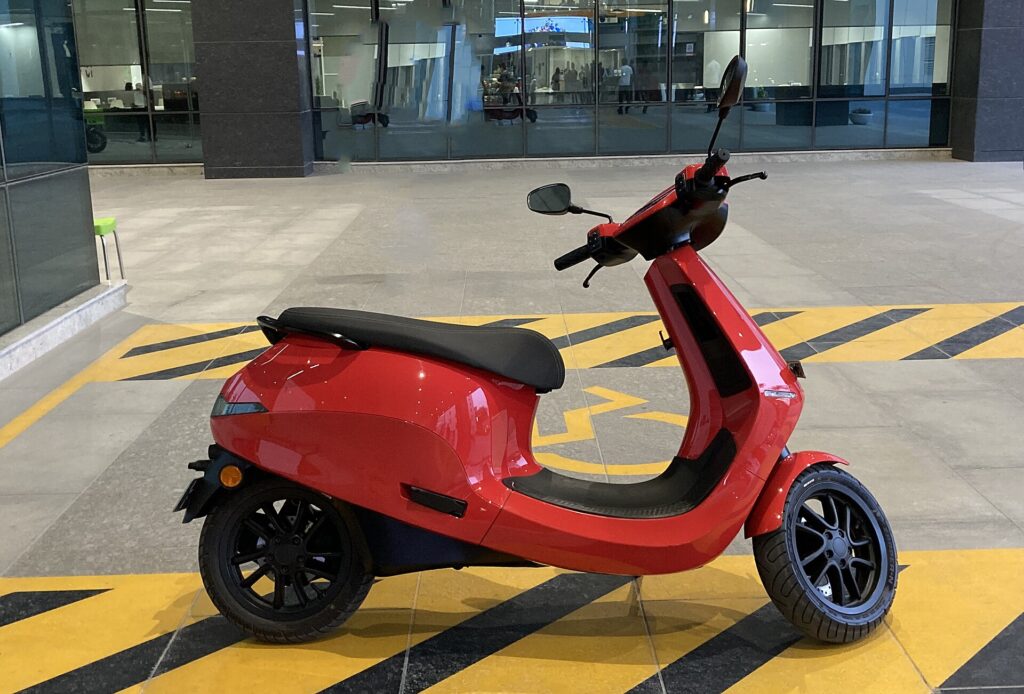
Featured image credit: Image: SnapMeUp via Wikimedia Commons (CC BY-SA 4.0). Source
By Piyush P. Yadav
A year ago, Rs 1 lakh bought a compromised electric scooter: a small battery, a low top speed, or a brand you had not heard of. In September 2026 it buys an Ola with a 301 km claim, a Bajaj Chetak with a metal body, an Ather with the company’s software stack, a Honda with a swappable pack, and a TVS with a battery subscription that puts the sticker under Rs 50,000. The sub-Rs 1 lakh segment is now where the volume is, which is why TVS and Bajaj together hold about half the market and why Ather and Ola both launched sub-lakh models within a week of each other in late August. This guide compares every mainstream scooter you can buy below Rs 1 lakh ex-showroom this month, on battery, range, speed, charging and what the price actually includes.
The shortlist, September 2026
Prices are ex-showroom, typically Delhi or Bengaluru, as listed by the manufacturers and aggregators in the first week of September. State subsidies, which we track in our state-by-state coverage, can lower them further in a few states. Claimed range is the certified IDC figure unless noted.
| Scooter | Ex-showroom price | Battery | Claimed range | Top speed | Motor peak | What stands out |
|---|---|---|---|---|---|---|
| TVS Orbiter V1 (battery subscription) | Rs 49,999 + from Rs 862 a month | 3.1 kWh | 86 km IDC (certified) | Not stated; commuter class | Not stated | Lowest sticker in the market; Rs 84,500 with battery |
| Vida VX2 Go (battery subscription) | Rs 59,490 + Rs 0.96 per km | 2.2 kWh removable | 92 km | 70 km/h | Not stated | Removable pack; Rs 99,490 outright |
| Ola S1 Z | Rs 79,999 | 3 kWh LFP, removable | 179 km | 70 km/h | 4 kW | Ola’s in-house Bharat Cell |
| Vida VX2 Go (outright) | Rs 83,740 to 84,999 | 2.2 kWh removable | 92 km | 70 km/h | Not stated | Hero dealer network |
| Ola S1 X (Gen 3) | Rs 84,999 (2 kWh) upward | 2, 3 or 4 kWh | 108 to 242 km depending on pack | 101 km/h (4 kWh) | 5 kW | Fastest under Rs 1 lakh |
| Honda QC1 | Rs 90,708 | 1.5 kWh fixed | 80 km | 50 km/h | 1.8 kW | Honda badge, 6.5-hour charge |
| TVS Orbiter V1 (outright) | Rs 84,500 to 95,250 | 3.1 kWh | 86 km IDC | Commuter class | Not stated | Jupiter dealer network |
| Ola S1 Z Plus | Rs 99,999 | 5 kWh (two removable packs) | 301 km | 70 km/h | 4 kW | Longest claimed range under Rs 1 lakh |
| Bajaj Chetak 3001 | Rs 99,650 to 99,900 | About 3 kWh | About 127 km | About 63 km/h | Not stated | All-metal body, Bajaj network |
| Ather Konarc | Rs 99,999 | Not confirmed at launch | Not confirmed | Not confirmed | Not confirmed | Ather software and Grid access |
| BGauss C12 | Rs 99,990 | 3.2 kWh | 85 km | Not stated | Not stated | Value brand, limited network |
Below that group sit low-speed and budget models, including the Kinetic Green E-Luna at Rs 69,990 with a 2 kWh pack and about 90 km of range, the Ampere Reo at Rs 71,999 (a 25 km/h, no-licence scooter) and several Komaki models from Rs 34,999. They are fine for what they are, but they compete on price alone and do not offer the service reach or resale of the brands above.
How to read the prices
Three of the entries above carry an asterisk in practice. The Rs 49,999 Orbiter and the Rs 59,490 Vida VX2 Go are battery-subscription prices: you buy the scooter without owning the pack and pay a monthly fee or a per-kilometre charge for the rest of your ownership. We worked through the arithmetic in our battery-subscription electric scooter cost maths; the short version is that the subscription catches up with the outright price in three to four years at typical use, and the outright price is what to compare here. The Ather Konarc at Rs 99,999 is a launch price that Ather has signalled may rise, and the scooter’s certified specifications were not published at launch, which we noted in our Ather Konarc deep dive.
Range: claimed against what you will get
The IDC test used for certification in India runs at low average speeds without a pillion and returns figures that owners rarely see. Across the scooters we have covered, real-world range clusters between 60 and 75 per cent of the IDC number for a solo rider in mixed traffic, and falls further in Eco-off modes or with a pillion. Applying that to the shortlist:
| Scooter | Claimed | Realistic daily range | Enough for |
|---|---|---|---|
| Ola S1 Z Plus, 5 kWh | 301 km | 170 to 200 km | A week of 30 km commutes on one charge |
| Ola S1 X, 4 kWh | 242 km | 140 to 170 km | Four to five days of commuting |
| Ola S1 Z, 3 kWh | 179 km | 105 to 130 km | Three days |
| Bajaj Chetak 3001, about 3 kWh | About 127 km | 85 to 100 km | Two to three days |
| TVS Orbiter, 3.1 kWh | 86 km (conservative certification) | 65 to 80 km | Two days; TVS’s figure is closer to real use than most |
| Vida VX2 Go, 2.2 kWh | 92 km | 60 to 70 km | Two days |
| Honda QC1, 1.5 kWh | 80 km | 50 to 60 km | Two days at low speed |
Note the Orbiter’s 86 km figure. TVS certified the Orbiter conservatively and owners report getting close to it, while Ola’s 301 km is an IDC ceiling. Do not compare the two numbers directly.
Speed and power: two classes in one price band
The shortlist splits into a commuter class limited to about 70 km/h and a performance-lite class that will do 100 km/h. The Ola S1 Z, both Vida VX2 variants, the Orbiter and the Chetak 3001 are in the first group. The Ola S1 X with the 4 kWh pack is the only scooter here with a 101 km/h top speed and a 5 kW motor, and it is the one to buy if your commute includes a ring road or an expressway service road. The Honda QC1 is the outlier at 50 km/h with a 1.8 kW motor; it is a city scooter for short hops and Honda has positioned it against the Activa for buyers who never leave the neighbourhood.
Charging: fixed or removable
The under-Rs 1 lakh segment is where removable batteries are most common, because buyers here are more likely to live in flats without a parking-bay socket. The Ola S1 Z and S1 Z Plus, the Vida VX2 and the Honda QC1 all use packs that can be carried indoors. The Chetak, the Orbiter and the Ather use fixed packs and need a charger where the scooter is parked. Charging times from the manufacturers:
- Vida VX2 Go: about 4 hours 53 minutes to full on the standard charger; the VX2 Plus takes 5 hours 39 minutes.
- TVS Orbiter: zero to 80 per cent in about 2 hours 20 minutes.
- Honda QC1: about 6.5 hours to full.
- Ola S1 Z: each 1.5 kWh pack charges from a wall socket; Ola quotes about 4 hours per pack on the standard adaptor.
- Ather Konarc: compatible with Ather Grid fast chargers, which the Ola and Bajaj are not.
Warranty and service: the part that matters after year two
Battery warranty terms in this segment range from three years to eight years, and the fine print on state-of-health thresholds differs by brand, as we set out in our electric scooter battery warranty comparison. On service reach, TVS and Bajaj have an advantage that no spec sheet captures: the Orbiter is sold and serviced through the same dealers that handle the Jupiter, and the Chetak through Bajaj’s motorcycle network, which means a workshop in almost every district town. Hero’s Vida is sold through a growing share of Hero MotoCorp dealers. Ola relies on company-run service centres that are concentrated in cities, and its service record is the most common complaint in owner forums. Ather’s network is metro-heavy. Honda sells the QC1 through select Honda two-wheeler dealers.
Running costs beyond the battery are similar across the group, in the region of Rs 3,000 to 5,000 a year for scheduled service and consumables, which we broke down in our electric scooter running cost guide.
Which one to buy
- Cheapest way to own an electric scooter outright: the Ola S1 Z at Rs 79,999, provided there is an Ola service centre within reach. The 3 kWh pack and 179 km claim are the best on paper at the price.
- Best for families and small towns: the TVS Orbiter or the Bajaj Chetak 3001. Both give up range and speed to the Ola but are backed by dealer networks that will still be there in five years.
- Best if you need 100 km/h: the Ola S1 X with the 4 kWh pack, the only scooter in this price band with a 5 kW motor. Check whether the 4 kWh variant is still under Rs 1 lakh in your state; it hovers around the line.
- Best for apartment dwellers: the Vida VX2 Go, with a 2.2 kWh removable pack, a Hero dealer, and a subscription option if you want the lowest entry price.
- If brand matters more than range: the Honda QC1. It is slow and short-legged, but it is a Honda.
- If you want Ather’s app and Grid access: the Konarc at Rs 99,999. Wait for the certified specifications before ordering.
The segment will change again by Diwali. Ola’s S1 Z deliveries begin in December, Bajaj has a Chetak refresh due, and Simple’s Wave, which we compared in our Simple Wave versus Orbiter, Chetak and Rizta comparison, sits just above Rs 1 lakh with a 2 kWh pack. If you are buying now, buy from a brand whose service centre you have visited.
Sources & Further Reading
- ZigWheels: Best electric scooters under Rs 1 lakh in India
- 91Wheels: Electric scooters under Rs 1 lakh, prices and specifications
- BikeDekho: Electric scooters in India, prices and offers
- Autocar India: Ather range, prices and reviews
Frequently Asked Questions
Which is the cheapest electric scooter from a major brand in India in September 2026?
On sticker price, the TVS Orbiter V1 at Rs 49,999 on a battery subscription and the Vida VX2 Go at Rs 59,490 on Hero’s subscription plan. Bought outright with the battery, the cheapest mainstream scooter is the Ola S1 Z at Rs 79,999, followed by the Vida VX2 Go at about Rs 84,000 and the TVS Orbiter at Rs 84,500.
Which electric scooter under Rs 1 lakh has the longest range?
The Ola S1 Z Plus at Rs 99,999 claims 301 km IDC from a 5 kWh battery, the highest figure in the segment. Real-world range is likely to be 170 to 200 km. The Ola S1 X with the 4 kWh pack claims 242 km.
Which scooter under Rs 1 lakh is the fastest?
The Ola S1 X with the 4 kWh battery, with a 5 kW motor and a 101 km/h top speed. Every other scooter in the price band is limited to about 70 km/h or lower.
Is a battery-subscription scooter cheaper than buying outright?
Only in the short term. The Rs 35,000 to 45,000 saved upfront is recovered by the manufacturer through monthly or per-kilometre rental, and at typical use of 30 to 40 km a day the subscription total passes the outright price within three to four years. It suits buyers who plan to keep the scooter briefly or who cannot raise the full price.