

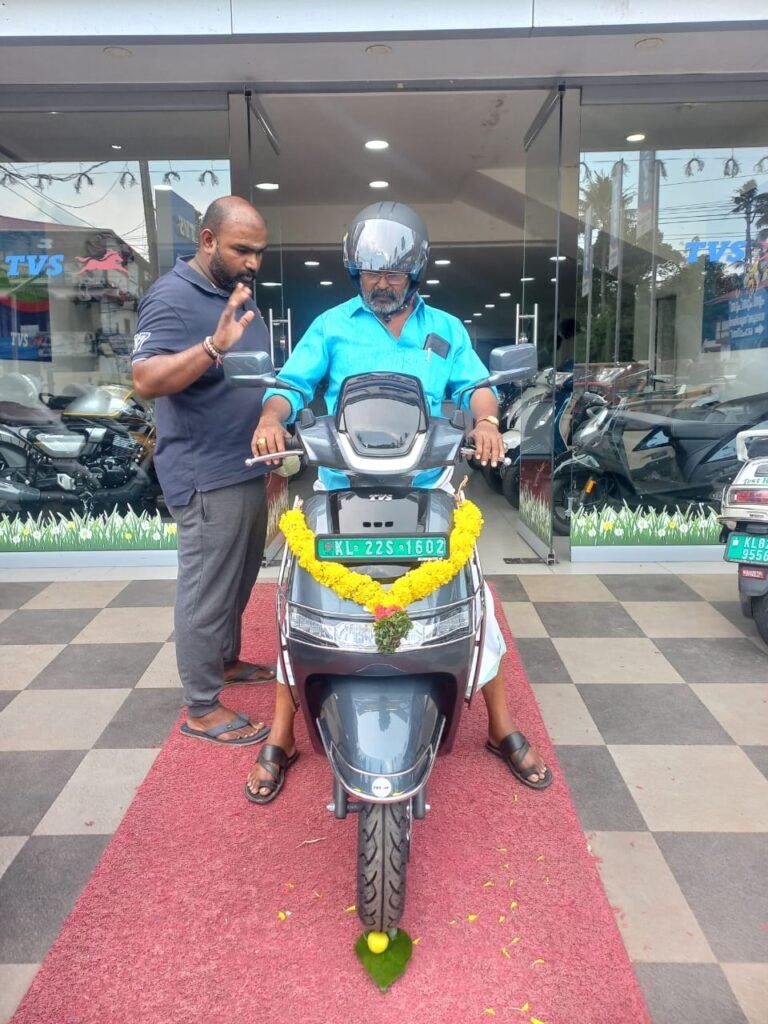
Featured image credit: Image: Maneesh Sreekariyam via Wikimedia Commons (CC BY-SA 4.0). Source
By Piyush P. Yadav
For almost four years the answer to “who has sold the most electric scooters in India” was Ola Electric. That is no longer true. Vahan registration data compiled by Autocar India shows that TVS Motor Company overtook Ola in cumulative electric two-wheeler sales on 24 August 2026, with 11,27,873 units against Ola’s 11,17,031. The crossover matters because it closes the last statistical argument for Ola’s leadership: the Bengaluru company had already lost the monthly crown in April 2025 and slipped to fifth place in 2026 year-to-date sales. Four days after the crossover, Ola launched the S1Z at Rs 79,999, its cheapest scooter yet and the first to use its in-house “Bharat Cell” LFP battery. This article explains how the lead changed hands, what the S1Z is, and whether a Rs 79,999 scooter with deliveries in December can change the trajectory.
How TVS erased a 16,000-unit gap in 24 days
At the end of July 2026 Ola still led cumulative registrations by 15,996 units (11,08,565 to TVS’s 10,92,569). Between 1 and 24 August, TVS registered 35,304 electric scooters and Ola registered 8,466. That is a ratio of more than four to one, and it flipped the cumulative table with a week of the month still to go. TVS is now adding roughly 1,673 electric two-wheelers a day, so the gap will widen every month unless Ola’s volumes recover sharply.
| Metric | TVS Motor | Ola Electric |
|---|---|---|
| Cumulative registrations (to 24 Aug 2026) | 11,27,873 | 11,17,031 |
| Cumulative at end-July 2026 | 10,92,569 | 11,08,565 |
| Registrations 1 to 24 Aug 2026 | 35,304 | 8,466 |
| Calendar 2026 year-to-date | 3,42,958 (up 75%) | 88,910 (about 7% share) |
| Best single month | 55,783 (June 2026) | 53,647 (May 2024) |
| Calendar 2025 sales | Leader from April 2025 | 2,04,542 (15% share) |
| Calendar 2024 sales | Second | 4,29,187 (35% share) |
The scale of Ola’s decline is easiest to see across three calendar years. In 2024 it sold 4.29 lakh scooters and held 35 per cent of the market. In 2025 that halved to 2.05 lakh units and 15 per cent. In the first eight months of 2026 it has managed 88,910 units, roughly 7 per cent, in a market that has itself grown to more than 13 lakh units year-to-date. TVS’s iQube and the newer Orbiter have taken most of that share, alongside Bajaj’s Chetak. We tracked the earlier stages of this shift when Bajaj crossed 3 lakh electric scooter sales in 2026 and when TVS and Bajaj together reached half the market in August.
The 2026 electric two-wheeler pecking order
The year-to-date rankings for calendar 2026 now read: TVS first, Bajaj Auto second, Ather Energy third, Hero MotoCorp (Vida) fourth, and Ola Electric fifth. Ather’s climb into the top three has been driven by the Rizta family scooter and, since August, the Rs 99,999 Konarc, which we assessed in our Ather Konarc deep dive against the Chetak and S1 Pro. Hero’s Vida line took the fourth spot from Ola in November 2025 and has held it since.
What is striking is that TVS and Ola together still account for about 22.45 lakh cumulative registrations, or roughly 40 per cent of every electric two-wheeler sold in India since 2020. The market did not shrink around Ola. It grew past it.
Ola’s response: the S1Z at Rs 79,999
On 28 August 2026, Ola launched the S1Z and S1Z Plus. The pricing is aggressive and deliberately undercuts the Konarc, the Simple Wave (Rs 1.10 lakh) and TVS’s own Orbiter.
| Specification | Ola S1Z | Ola S1Z Plus |
|---|---|---|
| Introductory price (ex-showroom) | Rs 79,999 | Rs 99,999 |
| Battery | 3.1 kWh LFP (Bharat Cell) | 5.1 kWh LFP (Bharat Cell) |
| Claimed IDC range | 179 km | 301 km |
| Peak motor power | 4 kW | 4 kW |
| Top speed | 70 km/h | 70 km/h |
| Software | MoveOS 5 | MoveOS 5 |
| Deliveries begin | December 2026 | March 2027 |
Three details deserve attention. The 4 kW peak motor and 70 km/h top speed put the S1Z in the commuter class, not against the 450X or Chetak’s performance trims. The 301 km IDC claim for the Plus is the highest of any scooter under Rs 1 lakh, but IDC figures are optimistic by design and real-world range on a 5.1 kWh pack is more likely to land between 170 and 200 km. And deliveries are four to seven months away, which means the S1Z will make no difference to the sales tables for the rest of 2026.
The Bharat Cell
The S1Z is the first production vehicle to use Ola’s own lithium iron phosphate cells, made at its Krishnagiri gigafactory in Tamil Nadu in a 46-series cylindrical format. Ola says the cell was developed at its Battery Innovation Centre in Bengaluru, is covered by 426 patents, is rated to operate from minus 30°C to plus 70°C, and is engineered for a usable life beyond 15 years. The company’s stated logic is that the battery accounts for 35 to 45 per cent of an electric scooter’s cost, so owning the cell is the only way to keep pushing prices down. Whether Ola can make cells cheaply enough is a separate question, and one we examine in today’s Battery & Tech article.
Why buyers moved away from Ola
The sales collapse has several well-documented causes. Service complaints and long repair waits through 2024 and 2025 damaged trust. Registration irregularities in early 2025 led to state-level scrutiny. Competitors caught up on product: the iQube, Chetak and Rizta all offer conventional dealer networks with far denser service coverage. And Ola’s own pricing moves, including frequent introductory offers that were later withdrawn, made buyers wary of paying full price. TVS, by contrast, has grown at a measured pace with a dealer network already in place for its petrol scooters.
For a rider choosing between the two brands today, the practical questions are service access and running cost. Our guide to electric scooter running costs and the battery replacement bill covers the ownership side, and the Simple Wave versus Orbiter, Chetak and Rizta comparison lays out the mainstream alternatives at the same price point.
What TVS did differently
TVS’s route to the top was slower and less dramatic than Ola’s rise, and that is the point. The iQube launched in January 2020 in a single city and took more than three years to reach one lakh cumulative sales. It then reached three lakh in April 2024 and moved from three lakh to seven lakh in the following 17 months as production caught up with demand. Rather than one flagship, TVS built a ladder: the iQube in 2.2 kWh, 3.4 kWh and 5.1 kWh battery sizes at different prices, then the Orbiter in 2025 as a cheaper family scooter aimed squarely at the Rs 1 lakh segment. Every one of those scooters is sold and serviced through the same dealer network that handles the Jupiter and Ntorq, which means a buyer in a tier-three town has a service point within reach from day one. Ola built its own network from scratch and, at its peak, had far fewer service touchpoints per scooter on the road.
The other difference is pricing discipline. TVS has raised and lowered iQube prices in line with subsidy changes but has avoided the cycle of deep introductory discounts followed by sharp increases. When the PM E-DRIVE two-wheeler subsidy was halved to Rs 5,000 earlier this year, TVS absorbed part of the change and passed on the rest transparently. Buyers who dislike uncertainty appear to have rewarded that approach: TVS’s 75 per cent year-on-year growth in 2026 has come in a market growing at a slower rate, which means it is still taking share from rivals every month.
Can the S1Z change the picture?
Price alone will bring bookings. Rs 79,999 is roughly Rs 20,000 below the cheapest Konarc and Orbiter variants, and the 3.1 kWh S1Z is enough for a typical 30 to 40 km daily commute with charging every three or four days. But converting bookings into registrations requires two things Ola has struggled with: delivering on the announced timeline, and servicing the scooters once they are on the road. TVS is adding more than 1,600 registrations a day right now. Even a very successful S1Z launch in December will not close a gap that will, by then, exceed one lakh units.
The more realistic reading is that the S1Z is a play to stop the bleeding at the entry level and to prove that Bharat Cell can go into a real product. If both happen, Ola stays relevant as a volume brand in 2027. If either slips, the fifth-place finish in 2026 becomes the new normal.
Sources & Further Reading
- Autocar India: TVS overtakes Ola in cumulative electric two-wheeler sales
- DriveSpark: Ola Electric S1Z launched at Rs 79,999 with in-house LFP battery and 301 km range
- ANI: Ola Electric launches S1Z at Rs 79,999, bets on in-house Bharat Cell
- Autocar Professional: Hero Vida sales and market ranking
Frequently asked questions
Who is the largest electric two-wheeler brand in India?
TVS Motor Company, as of 24 August 2026, with 11,27,873 cumulative electric two-wheeler registrations against Ola Electric’s 11,17,031. TVS has also led monthly sales since April 2025.
What is the price and range of the Ola S1Z?
The S1Z costs Rs 79,999 with a 3.1 kWh battery and 179 km IDC range. The S1Z Plus costs Rs 99,999 with a 5.1 kWh battery and 301 km IDC range. Both are introductory ex-showroom prices.
When will Ola S1Z deliveries start?
Ola has said deliveries of the 3.1 kWh S1Z begin in December 2026 and the 5.1 kWh S1Z Plus in March 2027.
What is Ola’s Bharat Cell?
It is Ola Electric’s in-house lithium iron phosphate (LFP) cell in a 46-series cylindrical format, manufactured at its gigafactory in Tamil Nadu. The S1Z is the first production scooter to use it.