

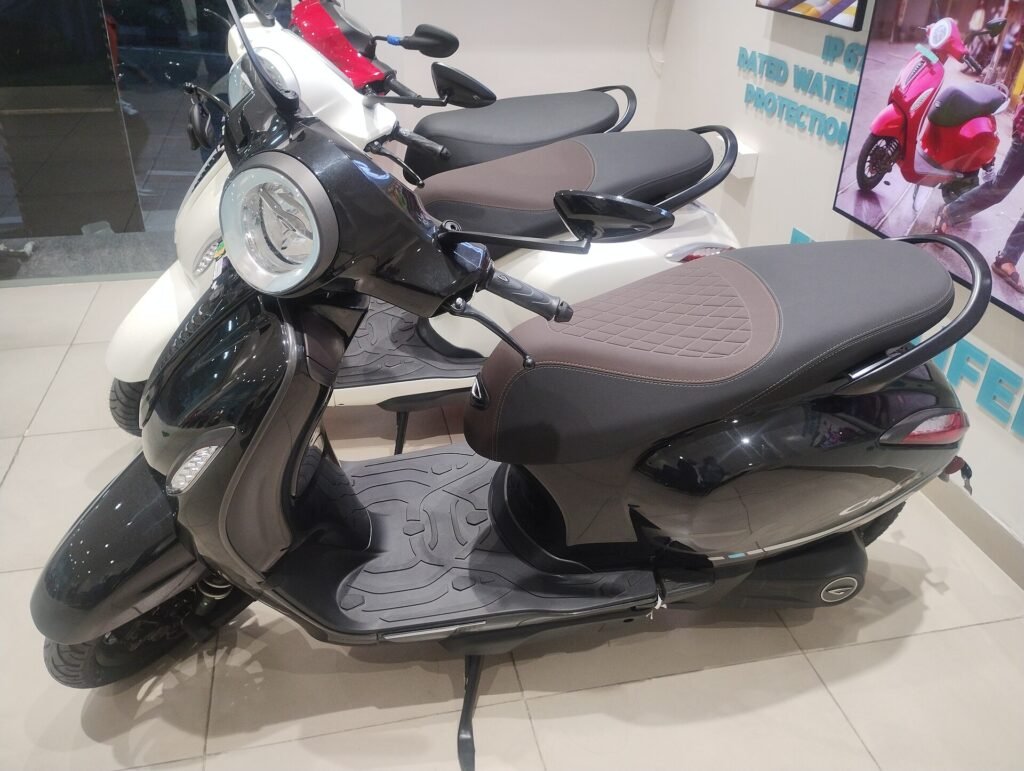
Featured image credit: Image: Gpkp via Wikimedia Commons (CC BY-SA 4.0). Source
By Piyush P. Yadav | September 2, 2026
Bajaj Auto has sold 3.02 lakh electric two-wheelers between January and August 2026 — a 68% jump over the same period last year — making it only the second Indian manufacturer, after TVS, to cross the 3 lakh mark in a single calendar year. For a brand that re-entered the scooter business in 2020 with a single retro-styled Chetak and sold barely 1 lakh EVs in its first three years, it is a remarkable turnaround. This deep dive looks at how Bajaj got here, where the Chetak sits in a market that Ather’s Rs 99,999 Konarc just shook up, and whether Bajaj can close a 51,000-unit gap on TVS by December.
The Milestone in Numbers
| Month (2026) | Bajaj EV sales (units) | YoY growth |
|---|---|---|
| January | 26,575 | +20% |
| February | 26,344 | +18% |
| March | 47,753 | +31% |
| April | 34,600 | +75% |
| May | 39,542 | +75% |
| June | 43,529 | +81% |
| July | 45,860 | +123% |
| August | 37,976 | +210% |
| January-August total | 3,02,179 (approx. 3.02 lakh) | +68% |
Two things stand out. First, the growth rate has accelerated every quarter: from around 20% in January-February to over 120% in July-August. Second, the August year-on-year figure of 210% is inflated by a weak August 2025, when Bajaj’s output was hit by the rare-earth magnet shortage that followed China’s April 2025 export controls. Even so, the trend is unmistakable.
How Bajaj Compares: The 2026 Leaderboard
| Brand | Jan-Aug 2026 sales | Market share | Gap to leader | 2026 full-year outlook |
|---|---|---|---|---|
| TVS Motor | About 3.53 lakh | 26% | — | On course for 5 lakh |
| Bajaj Auto | 3.02 lakh | 22% | About 51,000 behind TVS | 4.25-4.50 lakh |
| Ather Energy | About 2.27 lakh | 17% | About 75,000 behind Bajaj | About 3.5 lakh |
| Hero Vida | Fourth | About 10% | — | Share slipping in August |
| Ola Electric | Fifth | About 7% | — | Down from about 35% in CY2024 |
In August 2026 TVS and Bajaj together held just over 50% of India’s electric two-wheeler market. The two legacy manufacturers have effectively taken the market that Ola Electric dominated in 2024, when it held roughly 35% share. Ola is now at 7%. The story of the last 24 months is the revenge of the incumbents: dealer networks, service reach and financing muscle beat first-mover advantage once the products were competitive. We charted the early stages of this shift in our August 2026 e-scooter update.
Cumulative Sales: 8 Lakh and Counting
By June 27, 2026, Bajaj had sold 8,00,085 Chetaks since the scooter’s relaunch in January 2020. The distribution is telling:
- FY2020-FY2023: 1,07,878 units — 13.5% of the total, across roughly three and a half years
- CY2024 to June 2026: 6,92,207 units — 86% of the total, in two and a half years
In other words, the Chetak spent its first three years as a niche premium product and its last two and a half as a volume seller. The inflection point was the 2024 introduction of cheaper variants and Bajaj’s decision to put the Chetak in its mainstream motorcycle dealerships rather than separate EV outlets. Manufacturing capacity at the Chakan and Akurdi plants now stands at 4,80,000 e-2Ws per year — more than enough for the 4.25-4.5 lakh Bajaj is targeting for 2026.
Bajaj also supplies roughly 30,000 low-speed e-bikes to Yulu, the shared-mobility operator, and its electric three-wheelers (sold as GoGo and now WEGO) added 89,604 units in FY2026 — making Bajaj the number-two e-3W OEM behind Mahindra. Rajiv Bajaj has said that one in three Bajaj vehicles sold in India is now electric.
The Chetak Line-Up in 2026
| Variant | Battery | Claimed range | Top speed | Charging (0-80%) | Positioning |
|---|---|---|---|---|---|
| Chetak C2501 | 2.5 kWh | 113 km | About 63 km/h | 3 h 45 min (full) | Entry; around Rs 1.05 lakh in Delhi, from Rs 91,504 in Bengaluru |
| Chetak C3001 | 3.0 kWh | About 127 km | 70 km/h | 2 h 55 min | Mid-range value |
| Chetak C3503 | 3.5 kWh | About 153 km | 70 km/h | — | Long-range, lower speed |
| Chetak C3502 | 3.5 kWh | About 153 km | 80 km/h | — | Long-range, TFT display |
| Chetak C3501 | 3.5 kWh | About 153 km | 80 km/h | — | Flagship; fast charger, full features |
Ex-showroom prices vary by state; the C2501 spans roughly Rs 91,500 to Rs 1.05 lakh depending on city. Confirm current pricing with a dealer.
Bajaj’s strategy is to cover Rs 90,000 to Rs 1.4 lakh with five closely spaced variants sharing one body and one platform — which keeps manufacturing simple and lets dealers upsell in Rs 10,000 steps. The metal body, 35-litre underseat storage and Bajaj’s service footprint are the brand’s core arguments; software, app features and fast charging are where Ather and TVS have historically led.
The Konarc Threat
Ather’s Konarc, launched August 29 at Rs 99,999 for the S 100 (2.1 kWh, 100 km IDC) and Rs 1,21,999 for the S 125 (2.7 kWh), is aimed directly at the Chetak C2501 and C3001. Autocar India notes the Konarc base model is priced Rs 4,000-5,000 above the entry Chetak. Bajaj’s counters are a bigger battery at the entry point (2.5 kWh vs 2.1 kWh), immediate availability (the Konarc S 100 does not ship until Q1 2027) and a far larger dealer network. Ather’s counters are software, its fast-charging grid and brand cachet with younger buyers. Simple Energy’s Wave, launching today, adds another rival around Rs 1.3 lakh. The full comparison is in our Chetak vs 450X vs Activa e guide.
Can Bajaj Catch TVS?
Not in 2026, on current trends. TVS is around 51,000 units ahead after eight months and is projected to reach 5 lakh for the year, against Bajaj’s 4.25-4.5 lakh. TVS’s July record of 55,823 units — the highest any Indian e-2W maker has ever posted in a month — shows its capacity advantage. TVS also has a broader range (iQube, Orbiter, X) and a stronger export story.
But the gap is narrowing in percentage terms: Bajaj’s Jan-Aug growth of 68% is only slightly behind TVS’s 77%, and Bajaj’s August share gain (+0.5 percentage points to 22.8%) matched TVS’s (+0.4 points to 27.5%). The battle for 2027 will hinge on three things:
- PM E-DRIVE eligibility. With the incentive now Rs 2,500/kWh capped at Rs 5,000 and limited to scooters under Rs 1.5 lakh ex-factory, Bajaj’s entire Chetak range qualifies — a small but consistent edge over premium rivals.
- Rare-earth resilience. Bajaj’s August 2025 output was hit by the magnet shortage. Both TVS and Bajaj have since diversified sourcing; whichever secures supply more reliably will win the festive season.
- The next Chetak. Bajaj has not announced a new model, but the five-variant line-up is now two years old. A family-oriented or performance Chetak in 2027 would be the logical answer to the Konarc and the Wave.
For the broader picture of where each EV brand stands across two- and four-wheelers, see our H1 2026 brand rankings.
Related Reading
- Ather Konarc Deep Dive: Is the Rs 99,999 e-Scooter India’s Best Value Yet?
- Ather Konarc, Simple Wave and August 2026 Electric Scooter Sales
- India Electric Scooter Market: August 2026 Update
- Best Electric Scooters in India 2026: Full Comparison
Frequently Asked Questions
How many electric scooters has Bajaj sold in 2026?
Bajaj Auto sold 3.02 lakh electric two-wheelers between January and August 2026, up 68% year-on-year, giving it a 22% market share. August alone contributed 37,976 units. Bajaj is the second brand after TVS to cross 3 lakh in a calendar year.
What is the total number of Bajaj Chetaks sold since launch?
Bajaj had sold 8,00,085 Chetaks from January 2020 to June 27, 2026. About 86% of those (6,92,207 units) were sold from calendar 2024 onward.
Which is India’s largest electric two-wheeler brand in 2026?
TVS Motor leads with about 3.53 lakh units and a 26% share for January-August 2026, followed by Bajaj Auto at 3.02 lakh (22%) and Ather Energy at about 2.27 lakh (17%). TVS and Bajaj together held just over 50% of the market in August 2026.
What Chetak variants does Bajaj sell?
Five: the entry C2501 (2.5 kWh, 113 km), C3001 (3.0 kWh), and three 3.5 kWh models — C3503, C3502 and the flagship C3501. Ex-showroom prices start from roughly Rs 91,500 to Rs 1.05 lakh for the C2501 depending on city.