

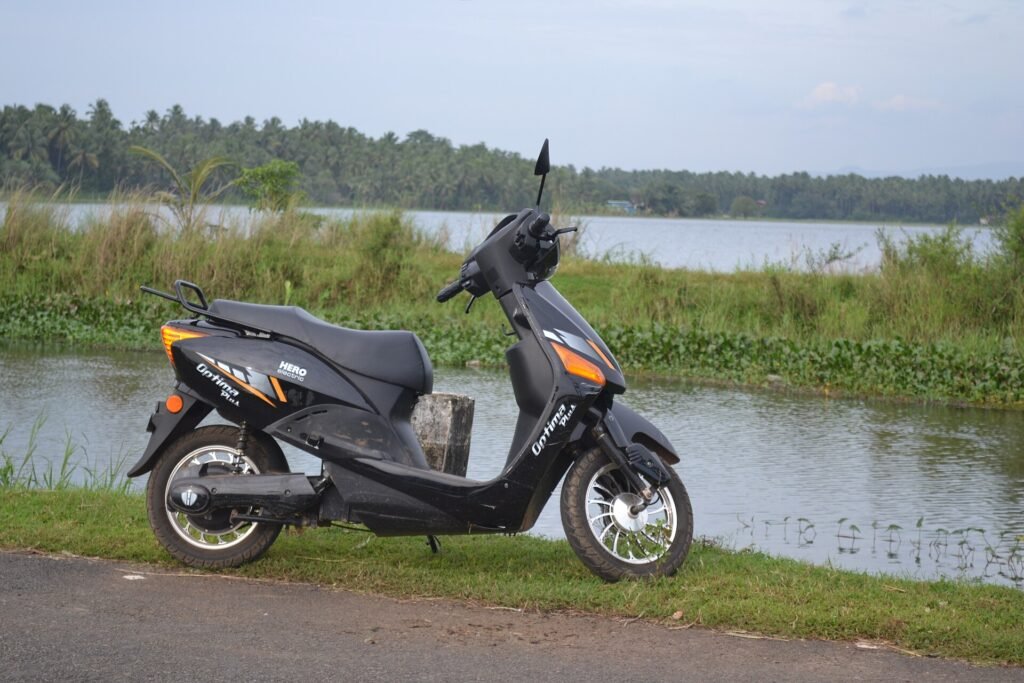
Featured image credit: Image: Viswaprabha via Wikimedia Commons (CC BY-SA 3.0). Source
By Piyush P. Yadav
Which electric scooters in India have a removable battery? Fewer than most buyers assume. Of the six brands that sell three-quarters of India’s electric scooters, only one, Hero’s Vida, builds its mainstream range around packs you can lift out and carry upstairs. Honda’s Activa e uses removable packs too, but they can only be exchanged at Honda’s swap stations, not charged at home. Every Ola, Ather, TVS and Bajaj scooter on sale today has a fixed battery that charges through a cable, and so do River, Simple and Honda’s own QC1. The removable option therefore lives mostly in two places: the Vida VX2 family, and a group of smaller brands, Ampere, Okinawa, Bounce, Komaki, Pure EV and HOP, whose packs range from 2 to 3.3 kWh. This guide lists every current model, explains what a removable pack actually weighs and how long it takes to charge, and sets out who should insist on one and who should not.
How we worked this out
Battery configurations and prices were checked on 10 September 2026 against Autocar India’s variant listing for the Vida VX2, Honda’s official Activa e and QC1 pages, and two dated buyer’s guides to removable-battery scooters published in May 2026 by Drivio and Ecozaar, which we used for the smaller brands and for pack weights. Fixed-battery status for Ola, Ather, TVS and Bajaj is from the manufacturers’ own specification sheets. Ex-showroom prices vary by city and by whether the battery is bought or subscribed; where a listing gives an on-road figure we say so.
Every removable-battery electric scooter on sale
| Model | Battery | Packs and type | Claimed range | Charge or swap | Price (ex-showroom unless stated) |
|---|---|---|---|---|---|
| Vida VX2 Go 2.2 kWh | 2.2 kWh | 1 removable | 93 km | Home socket; 20 to 80 per cent in about 2 h 20 min (1 h 20 min on the RQ fast-charge variant) | From about Rs 85,000; Rs 59,490 with battery subscription |
| Vida VX2 Go / Plus 3.4 kWh | 3.4 kWh | 2 removable | 146 km | Home socket; 20 to 80 per cent in about 3 h 30 min | About Rs 88,000 to 1.00 lakh (on-road, Autocar listing) |
| Vida VX2 Plus 4.4 kWh | 4.4 kWh | 2 removable | 187 km | Home socket; 20 to 80 per cent in about 2 h 30 min | About Rs 1.23 lakh (on-road, Autocar listing) |
| Vida V2 (formerly V1 Pro) | 3.94 kWh | 2 removable | Up to about 165 km | Home socket | About Rs 1.26 to 1.41 lakh |
| Honda Activa e | 3.0 kWh | 2 x 1.5 kWh Mobile Power Pack e, removable | 102 km | Swap only, at Honda e:Swap stations in Bengaluru, Delhi and Mumbai; no home charging | Battery on subscription; scooter price excludes packs |
| Ampere Magnus EX | 2.3 kWh | 1 removable | 100 to 121 km | Home socket; 6 to 7 h | About Rs 94,000 to 1.10 lakh |
| Okinawa Praise Pro / i-Praise+ | 3.3 kWh | 1 removable | 139 km | Home socket; 4 to 5 h | Rs 1.25 to 1.45 lakh |
| Bounce Infinity E1 | 2 kWh | 1 swappable | 85 km | Swap network or home charging | Rs 68,999 with battery subscription |
| Komaki Flora | 3.0 kWh LFP | 1 removable | 100 to 120 km | Home socket; 4 to 5 h | About Rs 89,000 |
| Pure EV ePluto 7G | Not stated | 1 removable | About 120 km | Home socket | About Rs 1.00 lakh |
| HOP LEO V3 | 2.5 kWh (optional second pack) | 1 to 2 removable | 95 km | Home socket; about 4 h | About Rs 97,000 |
And the ones that are fixed
| Model | Battery | Why it matters |
|---|---|---|
| Ola S1 Z, S1 X, S1 Pro (all generations) | Fixed, 1.5 to 5.2 kWh | Ola’s S1 Z was launched with a removable-battery concept but the production scooter sold today is fixed |
| Ather 450 series, Rizta, Konarc | Fixed, 2.1 to 3.7 kWh | Ather has said it does not plan removable packs |
| TVS iQube, Orbiter | Fixed, 2.2 to 5.3 kWh | The Orbiter’s battery subscription is a financing option, not a swap |
| Bajaj Chetak 25 and 35 series | Fixed, 2.9 to 3.5 kWh, floor-mounted | The floor pack is the reason for the Chetak’s large under-seat storage |
| Honda QC1 | Fixed, 1.5 kWh | Honda’s home-charging alternative to the Activa e |
| Simple Wave, Simple One; River Indie | Fixed | Both prioritise storage and range over portability |
What a removable pack really means in daily use
Weight
Manufacturers are reluctant to print pack weights, and it is the single most important number for anyone planning to carry a battery up stairs. The dated guides we checked put a 2.3 kWh Ampere pack at 10 to 12 kg and the 3.3 kWh Okinawa pack at about 20 kg. Vida’s packs are 1.1 to 2.2 kWh each, so a single VX2 Go pack is at the light end and the dual-pack 3.4 and 4.4 kWh variants are two trips or one heavy one. As a rule, anything above 2.5 kWh in a single pack is a two-hand lift and not something to do daily on a third-floor walk-up.
Charging time and the socket you need
Every removable pack in the table charges from a standard 5 A or 16 A domestic socket with its own charger brick; none needs a wall box. Charging times are 4 to 7 hours for a full charge on the smaller brands and 2 to 3.5 hours for 20 to 80 per cent on the Vida. A useful side effect is that a removable pack can be charged at the office, in a shop or at a relative’s house, which turns the scooter’s range problem into a battery-logistics problem.
Storage
Packs live under the seat, so removable-battery scooters have less boot space. Vida quotes 33 litres on the single-pack VX2 and 27.2 litres on the dual-pack versions; a Chetak with its floor battery offers 35 litres. If a full-face helmet under the seat is essential, check the fit before deciding on a dual-pack model.
Warranty and swapping packs between scooters
Removable does not mean interchangeable. A Vida pack fits a Vida; an Ampere pack fits an Ampere. Warranty terms on removable packs are the same as on fixed ones, typically 3 years or 30,000 to 50,000 km, which we compared brand by brand in our electric scooter battery warranty guide. Dropping a pack is the commonest way to void it.
The Honda Activa e case: removable, but not yours
The Activa e deserves its own paragraph because it is the one scooter that confuses this category. Its two 1.5 kWh Mobile Power Pack e batteries lift out in seconds, which is the whole point: the scooter is designed for Honda’s e:Swap network, where a discharged pack is exchanged for a full one at a station. There is no home charger in the box and Honda’s Indian business model, so far, is swap-only, with the packs owned by Honda Power Pack Energy and paid for by subscription. If you live near a swap station in Bengaluru, Delhi or Mumbai it is the fastest “recharge” in the country; if you do not, the QC1, with its fixed 1.5 kWh pack and home charging, is the Honda to buy. We explained how swapping economics work for fleets and why they rarely suit private owners in our report on battery swapping in India.
Who should buy a removable-battery scooter
- Apartment residents without a parking socket. This is the case the category exists for. If the society will not allow a charging point and the scooter parks in the open, a removable pack is the only practical way to own an electric scooter. The single-pack Vida VX2 Go, whose 2.2 kWh pack should weigh in the 10 to 12 kg range of comparable packs, is the easiest to live with.
- Riders who charge at work. A pack that charges under a desk during the day doubles the effective range without a public charger.
- Buyers on the battery-subscription route. Vida’s VX2 at Rs 59,490 with a subscribed battery is the cheapest mainstream electric scooter in India, and the subscription only works because the pack is a separable unit. We costed the subscription against outright purchase in our guide to battery-subscription scooters.
Who should not
- Anyone with a socket where the scooter parks. A fixed-battery scooter charges overnight with no lifting, usually has more storage, and the pack is better protected from drops and water. Most of the best-selling scooters in our list of the best electric scooters under Rs 1 lakh are fixed-battery for that reason.
- Riders who need more than 4 kWh. No removable-battery scooter in India offers more than 4.4 kWh, and the big-battery scooters, TVS iQube ST at 5.3 kWh and Ola S1 Pro at 5.2 kWh, are all fixed.
- Anyone who cannot lift 10 to 20 kg. The convenience is the carry; if the carry is not possible, the feature has no value.
Sources & Further Reading
- Autocar India: Vida VX2 variants, battery configurations and prices
- Honda: Activa e official page (Mobile Power Pack e, swap network)
- Drivio: Electric scooters with removable batteries in India, May 2026
- Ecozaar: Removable-battery electric scooters, pack weights and charging times
People also ask
Which electric scooter in India has a removable battery?
Hero’s Vida VX2 (2.2, 3.4 and 4.4 kWh) and Vida V2 are the mainstream options, all with home-chargeable removable packs. Ampere Magnus EX, Okinawa Praise Pro and i-Praise+, Komaki Flora, Pure EV ePluto 7G and HOP LEO V3 also have removable packs. Honda’s Activa e has removable packs that can only be exchanged at swap stations.
Is the Ola electric scooter battery removable?
No. Every Ola S1 on sale, including the S1 Z, S1 X and S1 Pro, has a fixed battery charged through the scooter’s own port. The same applies to Ather, TVS iQube and Orbiter, Bajaj Chetak, Simple and River scooters.
Which electric scooter battery can be charged at home?
All fixed-battery scooters charge at home through a cable, and all removable-pack scooters from Vida, Ampere, Okinawa, Komaki, Pure EV and HOP charge from a standard domestic socket with a charger brick. The exception is the Honda Activa e, whose packs are swapped at Honda stations and not charged at home.
Is an electric scooter battery replaceable?
Yes, on every scooter, but only a removable-pack scooter lets the owner do it. On a fixed-battery scooter the pack is replaced at a service centre, typically under a 3-year warranty. Packs are brand-specific; a Vida pack does not fit an Ampere.
How do I charge an electric scooter battery at home?
For a fixed battery, plug the supplied charger into a 16 A socket and the scooter’s port; a full charge takes 4 to 6 hours. For a removable pack, lift it out, carry it to any 5 A or 16 A socket and charge on the brick, 4 to 7 hours for a full charge or 2 to 3.5 hours for 20 to 80 per cent on a Vida.
How long does an electric scooter battery last?
Manufacturers warrant packs for about 3 years or 30,000 to 50,000 km, and NMC packs are rated for roughly 1,000 to 1,500 full cycles, LFP packs for 2,500 or more. At 40 km a day that is five to eight years of use before capacity drops to about 70 per cent.