

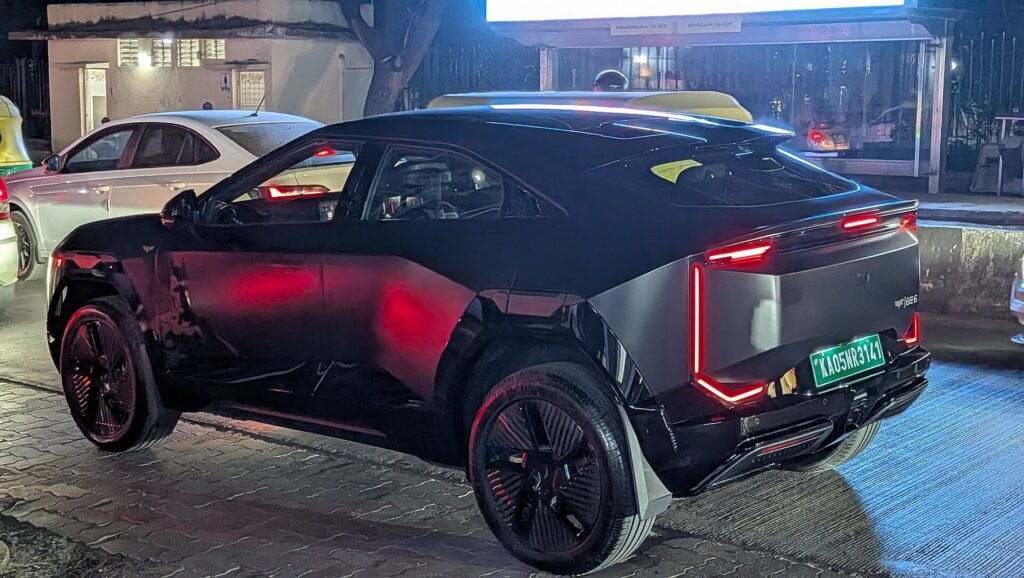
Featured image credit: Image: SerChevalerie via Wikimedia Commons (CC BY-SA 4.0). Source
By Piyush P. Yadav
In three weeks, every new electric car, bus and truck model approved for sale in India will have to make a noise. From 1 October 2026, the Central Motor Vehicles Rules require an Acoustic Vehicle Alerting System, or AVAS, on all newly type-approved electrified vehicles in categories M and N. Existing models get one more year, to 1 October 2027. The rule was notified in January 2026 as the Central Motor Vehicles (First Amendment) Rules, 2026, after a draft published in September 2025, and it references the Automotive Industry Standard AIS-173 for what the sound must be. This explainer sets out what the rule actually requires, how the sound is specified, which cars on sale already comply, why two- and three-wheelers are left out for now, and what it means if you are buying an EV this year.
What the rule says
The notification, G.S.R. 07(E) dated 6 January 2026, amends the Central Motor Vehicles Rules, 1989 to insert a requirement that electrified vehicles of categories M and N be fitted with an AVAS. Category M covers vehicles with at least four wheels used to carry passengers, which means cars, vans and buses. Category N covers goods vehicles from small pickups to heavy trucks. The audibility requirements are those in AIS-173, “as amended from time to time”, until a corresponding Bureau of Indian Standards specification is notified.
| Item | Requirement |
|---|---|
| Legal instrument | Central Motor Vehicles (First Amendment) Rules, 2026, G.S.R. 07(E), 6 January 2026 |
| Draft published | 27 September 2025, with a public comment window |
| Applies to | Electrified vehicles in categories M (passenger, four or more wheels) and N (goods) |
| New models | Mandatory from 1 October 2026 |
| Existing models | Mandatory from 1 October 2027 |
| Technical standard | AIS-173, aligned with UN Regulation No. 138 |
| Not covered | Two-wheelers (L1, L2), three-wheelers including L5 autos, e-rickshaws and e-carts |
“New model” here means a model that receives type approval on or after 1 October 2026. A car already certified and on sale, such as the Nexon EV, is an existing model and has until October 2027, even if it gets a variant update in between. A genuinely new nameplate launched after 1 October, such as the Tata Safari EV expected around Diwali, must have AVAS from day one.
What AIS-173 requires the sound to do
AIS-173 is India’s adoption of UN Regulation No. 138, the global standard for quiet road transport vehicles. The requirements are functional, not musical: the regulation does not say what the sound should be, only how loud it must be at given speeds and that it must change with speed so a pedestrian can tell whether the vehicle is accelerating.
| Condition | Minimum overall level | Maximum level |
|---|---|---|
| Forward at 10 km/h | 50 dB(A) | 75 dB(A) |
| Forward at 20 km/h | 56 dB(A) | 75 dB(A) |
| Reverse at 6 km/h | 47 dB(A) | 75 dB(A) |
| Above 20 km/h | Not required; tyre and wind noise take over | Not applicable |
Key points from the standard that buyers notice in daily use:
- The sound is automatic. It plays whenever the vehicle is in a drive gear and moving below 20 km/h, and whenever it is in reverse at any speed.
- It must shift with speed. The regulation requires a frequency shift of at least 0.8 per cent per km/h so the pitch rises as the car accelerates, which is what gives pedestrians a sense of approach.
- It cannot be switched off. The original UN R138 text allowed a driver-operated pause switch; the 01 series of amendments removed it, and AIS-173 follows the UN text as amended.
- It is measured, not judged. Compliance is tested on a track with microphones at 2 metres, using the same method as pass-by noise tests.
For context, 50 dB(A) is roughly the level of a quiet office. The rule is not asking EVs to imitate a petrol engine; it is asking them to be as audible as a small petrol car idling past at walking pace.
Why the rule exists
An electric car at 10 km/h in a residential lane produces almost no noise from its powertrain. Tyre noise only becomes significant above about 25 to 30 km/h. The problem is not new: Japan required warning sounds on hybrids from 2010, the United States adopted its Federal Motor Vehicle Safety Standard 141 with a 2020 compliance date, and the European Union has required AVAS on all new electric and hybrid cars since July 2021. India’s Ministry of Road Transport and Highways cited studies showing electric vehicles carry roughly 20 per cent higher pedestrian collision risk than internal combustion vehicles, rising to around 50 per cent in low-speed manoeuvres, when it published the draft.
India’s specific exposure is larger than Europe’s because the vehicles are driven in denser, more mixed traffic. The same pedestrian-heavy streets are where e-rickshaws and electric autos operate, which is why the exclusion of three-wheelers from the first version of the rule has drawn criticism from road-safety groups. The ministry’s position is that L-category vehicles will be addressed in a later amendment once a suitable standard is ready. The 2026 amendment does, in a separate provision, expand document exemptions under Rule 138 to cover L5, L7, e-rickshaws and e-carts, but that is unrelated to sound.
Which EVs already have AVAS
Most carmakers selling in India build to global platforms, so the hardware is often already there. Based on published specifications and reviews, the following models on sale in September 2026 already include a low-speed pedestrian warning sound:
| Model | AVAS fitted today | Notes |
|---|---|---|
| Mahindra BE 6, XEV 9e, XEV 9S | Yes | INGLO platform cars ship with a low-speed sound as standard |
| Tata Curvv EV, Harrier EV | Yes | Newer Tata platforms include the system |
| Hyundai Creta Electric | Yes | Uses Hyundai’s global virtual engine sound system |
| MG Comet EV | Yes | Has had a low-speed pedestrian sound since launch |
| Tata Nexon EV, Punch EV, Tiago EV | Not confirmed | Existing models; must comply by 1 October 2027 |
| BYD, VinFast, Kia, Maruti e Vitara | Likely | Global-market designs sold in UN R138 markets; Indian certification status not published |
Compliance is not just about having a speaker. AIS-173 certification requires the specific sound profile to be tested and approved. A car that plays a sound today may still need a software update to hit the 56 dB(A) minimum at 20 km/h or the pitch-shift requirement. Manufacturers have not published which existing models will need updates, and there is no requirement to retrofit vehicles already sold.
What it means for buyers and fleets
- Cars on the road today are unaffected. The rule applies to type approval, not to vehicles already registered. Nobody has to retrofit a sound to a 2024 Nexon EV.
- Cost impact is small. An AVAS unit is a weatherproof speaker, an amplifier and a controller tied into the vehicle network. Industry estimates put the hardware at a few thousand rupees per vehicle. Certification testing adds a fixed cost per model, which is why manufacturers were given a year for existing models.
- Buses and trucks are covered. Category M3 buses and N2 and N3 trucks are in scope. State transport undertakings taking delivery of new e-bus models under PM E-DRIVE after October 2026 will find AVAS in the specification. Our coverage of the September 2026 e-bus and e-truck localisation deadline notes that this is the second new compliance requirement for commercial EV makers this quarter.
- Two-wheelers remain silent by law. An Ola, Ather or TVS scooter has no AVAS requirement. Some manufacturers fit a low-speed sound anyway.
How it fits with the rest of the 2026-27 rulebook
AVAS is one of several regulations arriving for electric vehicles over the next 18 months. The Corporate Average Fuel Efficiency norms in their third phase take effect in April 2027 and treat EVs generously, as we set out in our CAFE-III explainer. The Battery Waste Management Rules impose collection and recovery targets on producers from FY2026-27. PM E-DRIVE’s localisation schedule for traction motors took effect on 1 September. Set against those, AVAS is the least contested: no manufacturer has asked for an extension, and the one-year gap for existing models was accepted in the draft consultation.
The bigger question is when three-wheelers will be included. E-rickshaws and L5 electric autos now account for the majority of three-wheeler sales, and they operate almost entirely at the speeds where AVAS matters. The ministry has indicated a separate standard is being prepared. Until it is, the pedestrian-safety gap the rule was designed to close will remain open in the vehicle category where it is widest. The same tension appears in the state-level subsidy landscape, where incentives are targeted at the same vehicles, as we tracked in our state EV subsidy deadline tracker.
Sources & Further Reading
- TeamLease RegTech: Central Motor Vehicles (01st Amendment) Rules, 2026 summary
- Saur Energy: India to mandate pedestrian alert systems (AVAS) in electric vehicles from 2026
- Autocar India: Mandatory pedestrian warning system in EVs proposed by government
- UNECE: UN Regulation No. 138 on quiet road transport vehicles (full text)
Frequently Asked Questions
When does AVAS become mandatory for electric vehicles in India?
From 1 October 2026 for new models receiving type approval, and from 1 October 2027 for models already on sale. The requirement covers electrified vehicles in categories M (passenger vehicles with four or more wheels, including buses) and N (goods vehicles).
Does my existing electric car need to be retrofitted with a sound system?
No. The rule applies to vehicle type approval, not to vehicles already registered. There is no retrofit requirement for cars sold before the applicable date.
How loud will the AVAS sound be?
AIS-173, following UN Regulation 138, requires a minimum of 50 dB(A) at 10 km/h and 56 dB(A) at 20 km/h in forward motion, 47 dB(A) in reverse, and a maximum of 75 dB(A). The sound stops above 20 km/h. For reference, 50 dB(A) is about the level of a quiet office.
Are electric scooters and e-rickshaws covered by the AVAS rule?
Not yet. The 2026 amendment covers only categories M and N. Two-wheelers, L5 three-wheelers, e-rickshaws and e-carts are excluded. The ministry has indicated that a separate standard for these categories is being prepared.
Are hybrids and plug-in hybrids covered by India’s AVAS rule?
The amendment applies to “electrified vehicles” of categories M and N, and ARAI’s classification of that term covers hybrid electric and fuel-cell vehicles as well as pure battery EVs. That follows the logic of the standard: the hazard being addressed is any four-wheeler that can move below 20 km/h without engine noise, which a strong hybrid or a plug-in hybrid running in EV mode does. Existing hybrid models already on sale get the same one-year grace to 1 October 2027 that battery EVs do, and where a particular mild-hybrid system sits is settled at type approval against AIS-173 rather than by a published carve-out.
Can the AVAS sound be switched off in an electric car?
No. The original text of UN Regulation 138 allowed a driver-operated pause switch, but the 01 series of amendments removed it, and AIS-173 follows the UN regulation as amended. A compliant car therefore has no cabin button to silence the sound: it plays automatically whenever the vehicle is in a drive gear below 20 km/h, and whenever it is in reverse at any speed. Disabling it on a vehicle that was type-approved with it would also put the car out of compliance with the rule it was certified against.
Why does the AVAS sound stop above 20 km/h?
Because above that speed the car is no longer quiet. AIS-173 sets minimum levels only at 10 km/h (50 dB(A)) and 20 km/h (56 dB(A)), plus reverse at 6 km/h (47 dB(A)); tyre and wind noise become the dominant source at roughly 25 to 30 km/h, so an artificial sound adds nothing a pedestrian can use. Below that threshold the regulation also requires the pitch to shift by at least 0.8 per cent per km/h, which is what lets someone on foot hear whether the car is accelerating towards them.