

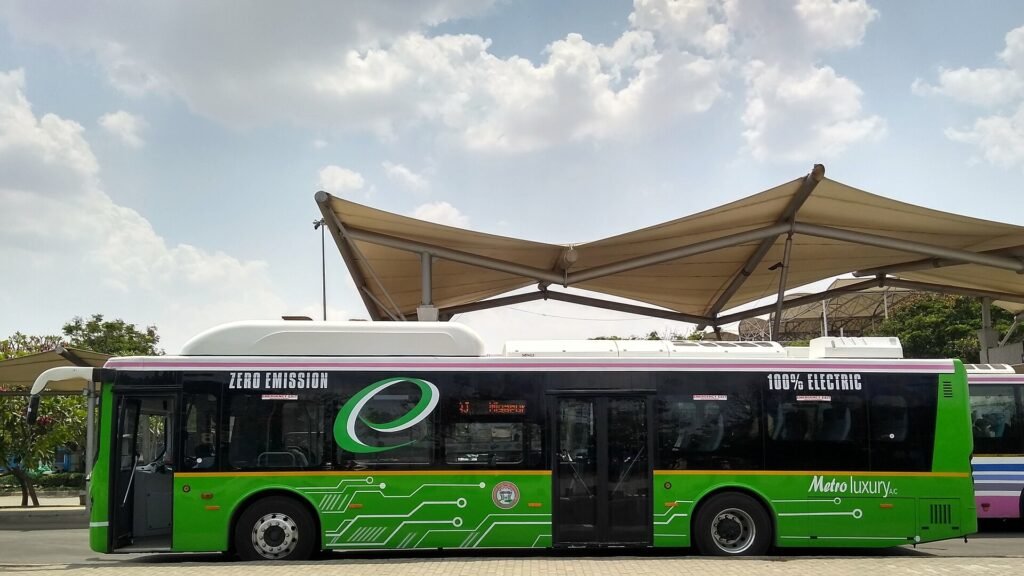
Featured image credit: Image: LoveofZ via Wikimedia Commons (CC BY-SA 4.0). Source
On 1 September 2026, a set of rules took effect that will decide which electric buses and trucks can claim government incentives in India, and which cannot. They are not about range, emissions or price. They are about where the electric motor was built.
Under the Phased Manufacturing Programme attached to PM E-DRIVE, manufacturers of eligible electric buses and trucks must now perform specified traction-motor manufacturing and assembly operations inside India. Miss one of the listed processes and the vehicle falls outside the incentive net, which in a segment where subsidy often determines whether a tender is winnable is close to fatal.
This explainer sets out exactly what the rules require, why the government wrote them this way, and what they mean for a supply chain that has leaned heavily on imported components. By Piyush P. Yadav.
What the rules actually require
The Phased Manufacturing Programme works by naming specific physical operations that must happen on Indian soil. It is not a percentage-of-value test that can be satisfied through accounting. It is a list of things that must be done in an Indian factory.
For traction motors in eligible electric buses and trucks, the specified processes are:
- Magnet fitment into the rotor assembly.
- Rotor assembly, building the rotating element of the motor.
- Stator assembly, building the stationary winding element.
- Shaft and bearing fitment.
- Motor enclosure fitment, housing the assembled motor.
- Connector and cable fitment, the electrical interface to the vehicle.
Read that list carefully and a pattern emerges. It covers the full assembly of a traction motor from component level, not simply the final bolt-on of an imported unit. A manufacturer cannot import a finished motor, attach a bracket in India and claim localisation.
Why magnet fitment is the hard one
Of the six processes, magnet fitment is the one that exposes India’s real vulnerability, and it is almost certainly why it appears first on the list.
Permanent-magnet traction motors depend on rare-earth magnets, and the global supply of those magnets is overwhelmingly concentrated in China. Requiring magnet fitment in India forces manufacturers to import the magnets themselves rather than finished rotors, which pulls a step of value into the country but also exposes them directly to any restriction on magnet exports.
The government has been working the other end of this problem simultaneously. Our coverage of India’s Rs 7,280 crore rare-earth magnet scheme and the roughly 20 bids it attracted explains the plan to build domestic magnet production. The localisation rules and the magnet scheme are two halves of the same strategy: mandate the assembly here, then build the input supply here too.
The sequencing is uncomfortable, though. The assembly mandate is live now. Domestic magnet production is years away. In between sits a period where Indian manufacturers must assemble motors locally using magnets they still have to import.
Why the government wrote the rules this way
Three motivations are visible in the design.
Subsidy should buy Indian manufacturing
PM E-DRIVE is public money. If an incentive paid on an electric bus simply flows through to an overseas motor supplier, the scheme has subsidised a foreign supply chain rather than an Indian one. Process-level localisation conditions are the standard instrument for preventing that.
Heavy vehicles are the right place to start
Buses and trucks are bought in fleets, often through government or large corporate tenders, which makes the buyer base concentrated and the policy lever effective. They also use large, expensive motors where localised assembly carries real value. Our analysis of the proposed heavy-duty EV scheme covering 50,000 electric buses and trucks shows the scale of demand the government is trying to direct.
Process tests are harder to game
Value-addition percentages invite creative transfer pricing. A list of physical operations either happened in your plant or it did not, and it can be verified by inspection.
What this means for manufacturers
The impact splits sharply depending on where a company already stands.
| Manufacturer position | Effect of the rules |
|---|---|
| Already assembles motors in India from components | Largely compliant, modest documentation burden |
| Imports finished motors and fits them locally | Must build assembly capability or lose eligibility |
| Sources motors from an Indian tier-one supplier | Depends entirely on whether that supplier performs the listed processes |
| New entrant or importer | Significant barrier; capital and time required before incentives are accessible |
The third row is where most of the practical difficulty sits. A vehicle maker buying from an Indian supplier cannot simply assume compliance. It has to verify that its supplier physically performs magnet fitment, rotor and stator assembly and the rest, and be able to evidence that to the scheme administrators.
The cost question
Local assembly at low initial volumes is rarely cheaper than importing a finished motor from an established high-volume plant. In the near term, these rules likely raise input costs for some manufacturers.
The policy bet is that this is a transitional cost. As volumes rise and domestic magnet supply comes online, per-unit costs should fall and the country retains the manufacturing value permanently. Whether that bet pays depends on whether volumes actually materialise, which brings us back to demand.
Electric bus registrations reached 4,615 units in 2025, up 18.2% from 3,905 in 2024. That is healthy growth but a small absolute base on which to build motor manufacturing scale. Our piece on what an electric bus actually costs in India, price list versus per-km contract explains how the procurement model shapes those volumes.
How this fits India’s wider EV policy architecture
The traction-motor rules are one piece of a policy structure that has been assembling steadily.
| Policy instrument | What it targets | Status |
|---|---|---|
| PM E-DRIVE incentives | Demand for e-buses, e-trucks, three-wheelers | Active; two-wheeler cash subsidy closed 31 July 2026 |
| Phased Manufacturing Programme | Where components are made | Traction-motor rules live from 1 September 2026 |
| Rare-earth magnet scheme | Upstream magnet supply | Bidding stage |
| Battery cell PLI | Domestic cell manufacturing | Capacity ramping |
Taken together the direction is unambiguous: subsidy is increasingly conditional on manufacturing location, and the conditions tighten over time. Any manufacturer planning around Indian EV incentives should assume further localisation requirements rather than treating the current list as final. The debate over a possible zero-emission vehicle mandate for India points to where regulatory pressure may go next.
What fleet buyers should do now
Operators procuring electric buses or trucks are the party most exposed to these rules, because a supplier’s non-compliance becomes the buyer’s pricing problem. A few practical steps reduce that exposure.
- Ask for process-level evidence, not a compliance letter. Request confirmation of where each of the six listed operations is performed, and by which entity. A general assurance of Indian manufacturing does not answer the question the scheme asks.
- Trace the motor to its actual assembler. If your vehicle maker buys motors from a tier-one supplier, compliance depends on that supplier’s plant, not the vehicle maker’s.
- Write eligibility into the contract. Make incentive eligibility a supplier warranty with a price adjustment if it fails, rather than a risk you discover after delivery.
- Check magnet sourcing continuity. Ask what happens to delivery schedules if magnet imports are disrupted, since that is the live vulnerability in the chain.
- Plan for cost pass-through. Local assembly at early volumes may carry a premium. Establish whether your supplier absorbs it or bills it.
The same diligence applies in reverse for component suppliers. A motor manufacturer that can demonstrate all six processes in an Indian plant now has a commercial advantage over one that cannot, and that advantage is worth marketing explicitly to vehicle makers who need documented eligibility.
What to watch next
- Compliance verification detail. How rigorously the listed processes are audited will determine whether the rules bite or become a paperwork exercise.
- Whether the list extends to other components, and to lighter vehicle categories.
- Magnet scheme progress, since domestic magnet supply is the binding constraint on the whole structure.
- Tender outcomes over the coming months, which will reveal which manufacturers were ready and which were not.
The bottom line
India has decided that incentive money for heavy electric vehicles should buy Indian manufacturing capability, not just Indian-registered vehicles. The traction-motor rules are a precise, verifiable way of enforcing that.
The risk is one of sequencing. The assembly mandate arrived before the domestic magnet supply it depends on, which means manufacturers carry the cost of localisation while still importing the hardest input. If the magnet scheme delivers, that gap closes and the policy looks well-judged. If it does not, these rules will have raised costs in a segment that is still fighting for volume.
Sources & Further Reading
- Coach Builders India: E-bus localisation rules take effect
- Electrive: India weighs new scheme to support heavy-duty EVs
- Sustainable Bus: Indian electric commercial vehicle order intake and registrations
Frequently Asked Questions
What changed for electric buses and trucks on 1 September 2026?
Stricter traction-motor localisation requirements took effect under the Phased Manufacturing Programme attached to PM E-DRIVE. Eligible e-bus and e-truck makers must now perform specified motor manufacturing and assembly processes in India to qualify for scheme incentives.
Which traction-motor processes must be done in India?
Six operations are specified: magnet fitment, rotor assembly, stator assembly, shaft and bearing fitment, motor enclosure fitment, and connector and cable fitment. Together these cover assembly of the motor from component level rather than final fitting of an imported unit.
Why is magnet fitment the difficult requirement?
Permanent-magnet traction motors need rare-earth magnets, and global magnet supply is heavily concentrated in China. Requiring magnet fitment in India means manufacturers must import magnets rather than finished rotors, which localises value but leaves them exposed to magnet export restrictions until India’s own magnet production, backed by a Rs 7,280 crore scheme, comes online.
What happens if a manufacturer does not comply?
Vehicles that do not meet the specified localisation processes fall outside PM E-DRIVE eligibility and cannot claim scheme incentives. In a segment where fleet and government tenders are often priced assuming subsidy, losing eligibility can make a bid uncompetitive.
Does PM E-DRIVE give a subsidy on electric cars?
No. PM E-DRIVE’s purchase incentives under its Rs 10,900 crore outlay cover electric two-wheelers, three-wheelers, ambulances and trucks, with a separate Rs 4,391 crore capital allocation for 14,028 electric buses procured by state transport undertakings. Electric passenger cars receive no purchase support under the scheme. They benefit only indirectly, through the roughly Rs 2,000 crore charging-infrastructure allocation, part of which is earmarked for fast chargers serving electric four-wheelers.
Do the traction-motor localisation rules apply to electric cars, scooters and three-wheelers?
No. The six specified processes that took effect on 1 September 2026 apply to eligible electric buses and trucks under the Phased Manufacturing Programme attached to PM E-DRIVE. Other vehicle categories sit under their own PMP conditions, and electric cars are outside PM E-DRIVE’s incentive net altogether. The direction of policy is clear, though: localisation conditions have tightened at each revision, so manufacturers planning around Indian incentives should assume the list widens rather than treating the current one as final.
How long does PM E-DRIVE support for electric buses and trucks run?
The two-wheeler cash subsidy closed on 31 July 2026, but support for electric trucks, buses, charging infrastructure and testing-agency upgrades was extended to 31 March 2028, subject to fund availability. That leaves roughly 17 months in which the traction-motor conditions govern incentive-backed procurement. For a fleet buyer the practical implication is timing: building or qualifying Indian motor assembly capability takes quarters, not weeks, so a supplier that is not compliant now may not become compliant inside the scheme window.