

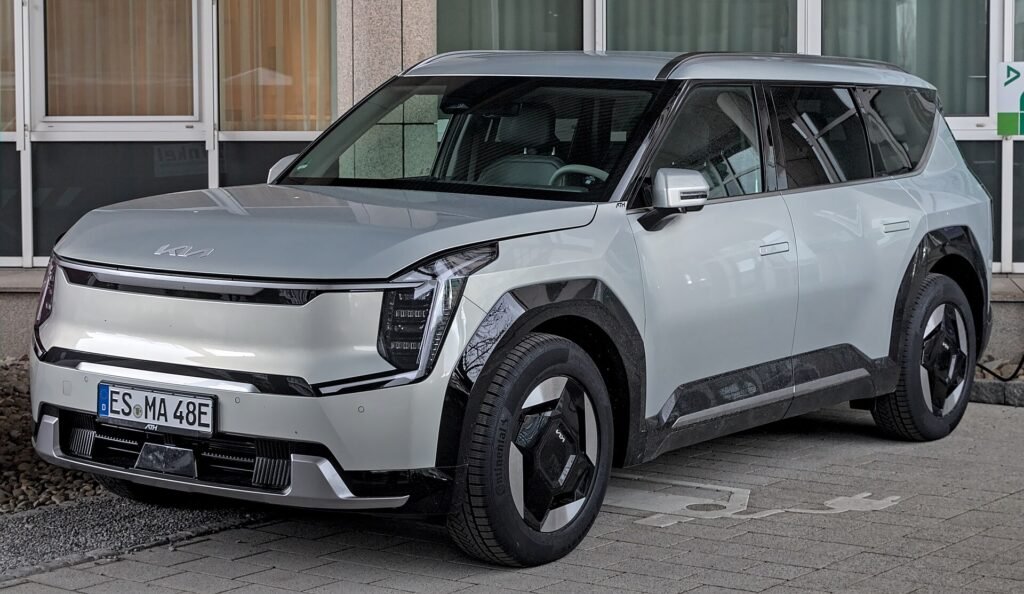
Featured image credit: Image: Alexander-93 via Wikimedia Commons (CC BY-SA 4.0). Source
India’s 7-seater electric car segment has finally arrived. In 2026, families no longer have to choose between going electric and having space for extended family. With five credible 7-seater EVs now available — from the ₹17.99 lakh Kia Carens Clavis EV to the ₹72 lakh Mercedes-Benz EQB — Indian families spanning all budgets can go electric without compromise.
This guide covers every 7-seater electric car on sale in India, real-world running costs, and which one fits your specific family needs.
Every 7-Seater Electric Car in India 2026
Kia Carens Clavis EV — Best Value
The Carens Clavis EV is India’s most affordable 7-seater electric car and the sweet spot for most Indian families. Based on the popular Kia Carens MPV platform, it offers a proven cabin layout, familiar Kia ergonomics, and modern connected features. The 490 km claimed range comfortably handles daily school runs, office commutes, and weekend family trips.
Best for: Middle-income families making their first EV purchase; existing Carens owners who love the layout; buyers who prioritise value over premium features.
Mahindra XEV 9S — Longest Range
Mahindra’s XEV 9S is the segment’s technology showcase and range champion. Three battery options let you calibrate range to your budget — the 59 kWh entry variant offers 500+ km, while the top-spec 79 kWh version claims 679 km (India’s longest 7-seater EV range). The 175 kW DC fast charging capability adds 200+ km in just 20 minutes at compatible chargers.
Best for: Families who take regular inter-city trips; buyers wanting future-proof range; those who value cutting-edge Mahindra design and Level 2 ADAS.
BYD eMax7 — Chinese Premium
BYD brings global manufacturing scale to India’s 7-seater EV segment. The eMax7 uses BYD’s celebrated Blade Battery technology (LFP chemistry, superior safety) and offers premium cabin materials that punch above its price point. Vehicle-to-Load (V2L) capability lets you power external appliances — useful for family picnics or emergencies.
Best for: Buyers who prioritise battery safety (Blade tech), premium interior finishes, and BYD’s global engineering pedigree.
VinFast VF MPV 7 — Newcomer
Vietnamese carmaker VinFast has entered India with the VF MPV 7 as one of the most promising newcomers in this segment. Positioned between the Kia Carens Clavis EV and BYD eMax7, it aims to disrupt with strong warranties and modern design. Service network is still building out, so buyers should verify VinFast dealer presence in their city.
Best for: Early adopters willing to try a new brand for competitive pricing and features; buyers in cities where VinFast has established service.
Mercedes-Benz EQB — Luxury 7-Seater
For luxury buyers, the Mercedes EQB is the only established premium 7-seater EV in India. It delivers Mercedes’ hallmark refinement, brand prestige, and a mature dealer/service network. The 530 km range and 190 hp output make it a comfortable long-distance family cruiser. At ₹72 lakh, it’s a significant investment but competes with luxury ICE 7-seaters like the GLB and Audi Q7.
Best for: Luxury buyers wanting a three-pointed star; families who value premium materials, ride refinement, and established luxury dealer support.
Side-by-Side Specifications Comparison
| Model | Starting Price | Battery | Range (Claimed) | Fast Charge | Best Attribute |
|---|---|---|---|---|---|
| Kia Carens Clavis EV | ₹17.99 Lakh | ~51 kWh | ~490 km | DC 50 kW+ | Best value |
| Mahindra XEV 9S | ₹19.95 Lakh | 59/70/79 kWh | Up to 679 km | 175 kW DC | Longest range |
| BYD eMax7 | ₹26.90 Lakh | 71.8 kWh (Blade) | ~530 km | Fast DC | Battery safety |
| VinFast VF MPV 7 | ₹24.49 Lakh | ~50 kWh | ~450 km | DC support | New entrant value |
| Mercedes-Benz EQB | ₹72.20 Lakh | 66.5 kWh | ~530 km | DC 100 kW | Luxury & brand |
Running Cost: 7-Seater EV vs Diesel MPV (Real Numbers)
The biggest advantage of a family 7-seater EV isn’t just eco-credentials — it’s the massive running cost savings. Here’s what a typical Indian family driving 1,500 km/month can expect:
| Cost Factor | 7-Seater EV (Home Charging) | Diesel MPV (₹95/L) | Monthly Saving |
|---|---|---|---|
| Fuel/Electricity (1,500 km) | ₹1,800 (₹1.20/km) | ₹10,500 (₹7/km) | ₹8,700 |
| Service (avg monthly) | ₹500 | ₹1,500 | ₹1,000 |
| Road tax (annualised) | ₹0-500 (state-dependent) | ₹1,500-3,000 | ₹1,000-2,500 |
| Total Monthly | ₹2,300-2,800 | ₹13,500-15,000 | ₹10,700-12,200 |
| 5-Year Savings | ₹6.4-7.3 lakh (offsets much of EV price premium) | ||
Which 7-Seater EV Should Your Family Buy?
For Middle-Income Families (₹18-22 Lakh Budget)
Buy: Kia Carens Clavis EV or Mahindra XEV 9S (base variant)
Both offer excellent value, family-friendly cabins, and adequate range. The Carens wins on brand familiarity and value; the XEV 9S wins on technology and longer range.
For Buyers Prioritising Range and Tech (₹22-28 Lakh)
Buy: Mahindra XEV 9S (70 or 79 kWh variant)
The best-in-class 679 km range and 175 kW DC fast charging make regular inter-city trips practical. Level 2 ADAS adds safety for family highway journeys.
For Buyers Wanting Battery Safety and Premium Feel (₹27-30 Lakh)
Buy: BYD eMax7
Blade Battery technology’s safety credentials and BYD’s premium interior make it appealing for buyers wary of thermal-runaway concerns with NMC batteries.
For Luxury Buyers (₹70 Lakh+)
Buy: Mercedes-Benz EQB
The only established luxury 7-seater EV in India. Brand prestige, refined ride, and Mercedes’ mature service network justify the premium.
What’s Coming: Upcoming 7-Seater EVs
- Maruti e Vitara — Launched January 2026; while 5-seater, expected to spawn a 7-seater variant by 2027
- Hyundai Ioniq 7 (or Creta 7 EV) — Expected 2027; will bring Hyundai’s tech and refinement to the segment
- Tata Sierra EV (7-seat variant) — Late 2026 launch; possibility of a 6/7-seat variant later
Frequently Asked Questions
Which is the best 7-seater electric car in India in 2026?
The Kia Carens Clavis EV at ₹17.99 lakh is the best-value 7-seater EV for most families. The Mahindra XEV 9S (₹19.95 lakh, up to 679 km range) is the best pick for those wanting maximum range. BYD eMax7 wins on battery safety and premium interior. Mercedes EQB is the only luxury option at ₹72 lakh.
What is the cheapest 7-seater electric car in India?
The Kia Carens Clavis EV is the most affordable 7-seater electric car in India at ₹17.99 lakh (ex-showroom). It offers a family-friendly cabin, modern connected features, and approximately 490 km claimed range.
Are 7-seater electric cars practical for Indian families?
Yes, with 500-700 km real-world range on top variants, 29,000+ public charging stations, and running costs of ₹1-1.5/km (vs ₹6-8/km for diesel MPVs), 7-seater EVs are highly practical for Indian families. Typical savings: ₹1-1.2 lakh per year on running costs alone.
Which 7-seater EV has the longest range in India?
The Mahindra XEV 9S (79 kWh variant) claims up to 679 km — the longest range among 7-seater EVs in India. Real-world range under mixed driving is approximately 520-570 km. This makes it capable of Delhi-Jaipur-Delhi round trips on a single charge.
How long does it take to fast-charge a 7-seater electric car in India?
Charging speed varies far more between these cars than range does. The Mahindra XEV 9S supports up to 175 kW DC and Mahindra claims 20-80% in about 20 minutes on the 79 kWh pack. The Kia Carens Clavis EV is notably slower in practice – instrumented testing shows it averaging around 42 kW, taking roughly 39 minutes for 10-80% even when plugged into a 100 kW charger. On the 30-60 kW chargers that make up most of India’s public network, budget 60-90 minutes for either car.
Can adults actually sit in the third row of these 7-seater EVs?
For occasional use, yes – all three mainstream options seat average-sized adults in row three acceptably. Between the two mass-market cars, the Kia Carens Clavis EV has the roomier and more comfortable third row, while the Mahindra XEV 9S’s is better suited to children on longer journeys. If adults will be back there regularly, the BYD eMax7 is the more comfortable choice. The XEV 9S does claw back practicality elsewhere with a 150-litre frunk on top of its boot.
Do 7-seater electric cars still get road tax and registration exemptions in India?
It depends on your state and, increasingly, on the price of the car. Delhi exempts road tax and registration for electric cars priced up to ₹30 lakh ex-showroom, while Maharashtra and Tamil Nadu (extended to 31 December 2027) still offer 100% exemption. Karnataka has ended its holiday: under the Karnataka Motor Vehicles Taxation (Amendment) Act, 2026, notified on 10 April, electric cars pay a lifetime tax of 5% up to ₹10 lakh, 8% from ₹10-25 lakh and 10% above ₹25 lakh – so a ₹27 lakh BYD eMax7 attracts roughly ₹2.7 lakh of lifetime tax there. GST on electric vehicles remains 5% nationwide.
Related Reading on EV Auto India
- Complete EV Buying Guide India 2026: Best Electric Car for Every Budget
- Best-Selling Electric Cars in India July 2026
- EV Charging Infrastructure India 2026: Complete Guide
Compare 7-seater EVs side-by-side with our Vehicle Compare tool → evautoindia.co.in/tools