

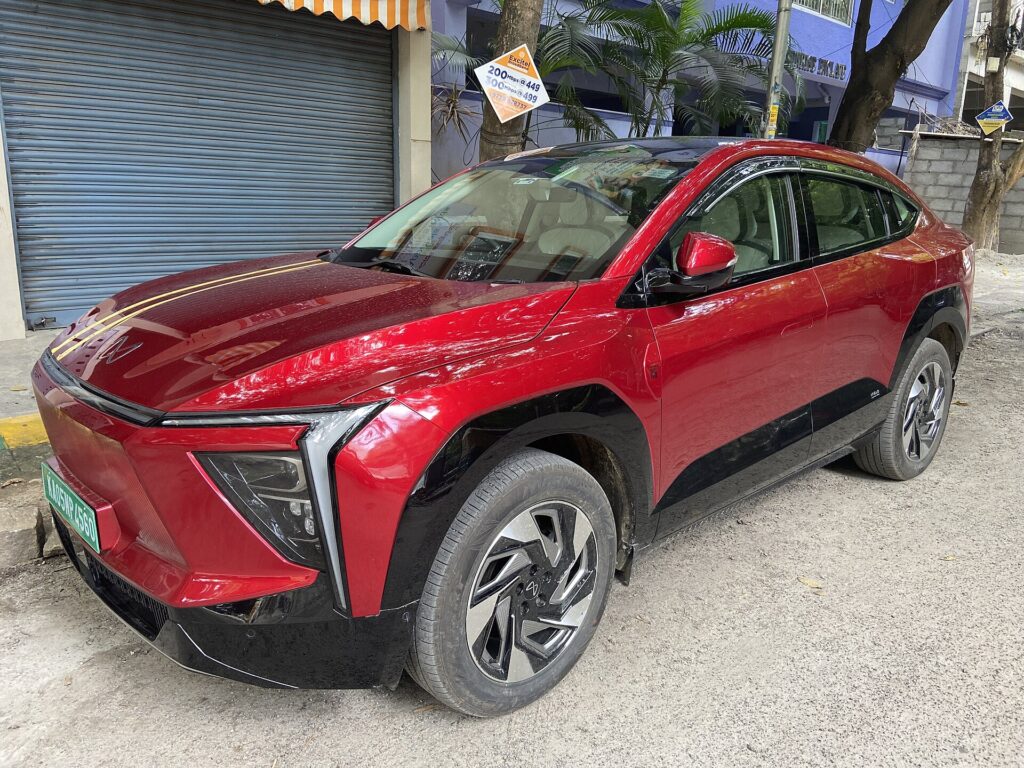
Featured image credit: Image: Cppfront via Wikimedia Commons (CC0). Source
Ask an Indian car buyer why they hesitate over an electric vehicle and you will eventually arrive at the same question: what will it be worth in five years? It is a fair question, and for most of the last decade the honest answer was that nobody knew. There were not enough used electric cars in the market to establish a pattern.
That has changed. India now has a meaningful population of three- and four-year-old electric cars changing hands, and the resale data is finally saying something coherent. What it says is more encouraging than the pessimists expected and more varied than any single headline number can capture.
This guide sets out what the numbers actually show, why some models hold value far better than others, and what you can do at purchase to protect your own resale position. By Piyush P. Yadav.
The headline numbers
Average annual depreciation across Indian electric cars runs at roughly 14% per year. That figure conceals enormous spread, so treat it as a starting point rather than a prediction for any particular car.
The first year is always the harshest. Mass-market EVs typically shed 20-30% of their original value within twelve months, which is broadly comparable to what petrol and diesel cars do. The divergence appears later.
| Age | Typical ICE value retained | Typical EV value retained | Strong-performing EV |
|---|---|---|---|
| 1 year | Roughly 75-80% | Roughly 70-80% | Roughly 80-85% |
| 3 years | Roughly 55-65% | Roughly 40-55% | Roughly 70-75% |
| 5 years | Roughly 40-50% | Roughly 30-40% | Roughly 55-65% |
The figures above are indicative bands drawn from market reporting rather than guaranteed outcomes, and they vary by city, variant and condition. The important structural point is the one in the third and fourth columns. The average electric car retains less than the average petrol car at three years, but a well-chosen electric car from Tata, MG or Mahindra in a metro market can hold 70-75%, which is competitive with its petrol equivalent.
In other words, the EV depreciation problem in India is not a category-wide problem. It is a model-selection problem.
Best and worst performers
The spread between the strongest and weakest electric cars on resale is far wider than anything in the petrol market.
| Model | Reported annual depreciation | Interpretation |
|---|---|---|
| MG M9 | About 1.4% | Exceptionally strong, low-volume premium segment |
| MG Windsor EV | About 2.2% | Very strong, high demand relative to supply |
| BYD Seal | About 4.7% | Strong for a premium import |
| Tata Curvv EV | About 42.3% | Weakest reported performer |
Those top-end figures deserve scepticism, and it is worth saying so plainly. Depreciation as low as 1.4% a year usually reflects a thin used market with few transactions, or a model so new that genuine multi-year resale data does not yet exist. Low-volume premium cars can post flattering numbers simply because the handful of examples that sell are unrepresentative.
The Curvv EV figure at the other end is similarly worth interrogating. A newly launched model that sees early discounting or a subsequent price revision can show severe first-period depreciation that normalises later. Our coverage of Tata and Hyundai EV price movements in September 2026 shows how quickly list prices shift in this market, and every list-price change immediately repositions every used example.
What actually drives EV resale value
Five factors explain most of the variation, and they are not the same five that drive petrol car values.
1. Battery health, and whether it can be proven
This is the dominant factor and the most distinctive one. A petrol car’s condition can be estimated from age, odometer and a test drive. An electric car’s value is bound up with the remaining life of a component the buyer cannot see or easily assess.
In the absence of a trusted, standardised state-of-health report, used buyers price in the worst case, and sellers absorb that discount. This is the single biggest structural drag on Indian EV resale values, and it is being addressed. Our reporting on India’s proposed battery health disclosure standard for used EVs explains the framework under consideration and why it should lift values once in place.
2. New-car price stability
Every price cut on a new model instantly devalues every used one. The Indian EV market has seen repeated price movements as manufacturers compete and input costs shift. Models with stable pricing histories hold value better, almost mechanically.
3. Warranty transferability
A battery warranty that transfers to the second owner is worth real money, because it removes the buyer’s largest risk. A warranty that lapses on transfer, or is restricted to the first owner, costs you at resale. Check this before you buy, not when you sell.
4. Charging infrastructure in the resale market
A used EV is easier to sell where charging is convenient. Metro markets with dense public charging support stronger values than smaller cities. This is why the same car can fetch noticeably different prices in different places, and why network expansion matters to owners as much as to new buyers.
5. Model demand and volume
Cars that sold well new have deeper used markets, more comparable transactions and more confident pricing. Popular mass-market models generally resell more predictably than niche ones, even if the niche ones occasionally post better headline percentages.
Indicative used prices in 2026
Current market reporting puts some common examples in the following ranges. These are broad indications that vary substantially with condition, variant, city and battery health.
| Model | Typical used price band | Notes |
|---|---|---|
| Tata Tiago EV | Around Rs 5-7 lakh | Entry point into used electric cars |
| Tata Nexon EV (2-3 years old) | Around Rs 9-13 lakh | Deepest used EV market in India |
The Nexon EV is the reference point for the whole segment simply because there are more of them. If you want a used electric car with predictable pricing and established service knowledge, this is where the market is thickest. Buyers should still budget for an independent battery assessment, and our guide to verified EV battery replacement costs across the Nexon, Tiago, Punch, Curvv, ZS EV and Creta sets out the downside exposure if a pack does need replacing.
How to protect your resale value
Most of the levers are pulled at purchase, not at sale.
- Buy a high-volume model. Deeper used markets mean better liquidity and less price uncertainty.
- Confirm warranty transferability in writing before you sign, including any conditions on service history.
- Keep every service record. A complete, dealer-stamped history is worth more on an EV than on a petrol car precisely because so much else is unverifiable.
- Charge sensibly. Routine DC fast charging to 100% and habitually sitting at very high or very low states of charge accelerate degradation. Our guide to leaving an electric car parked for long periods covers the storage state of charge to aim for.
- Obtain a battery health report before listing. Documented proof of a healthy pack directly counters the buyer’s worst-case assumption.
- Avoid buying at a price peak. If a segment is being discounted heavily, your car will be measured against those discounted prices.
Should depreciation stop you buying an EV?
Depreciation is only one line in the ownership equation. An electric car with higher depreciation but much lower running and maintenance cost can still finish ahead of a petrol equivalent over a five-year hold.
The calculation that matters is total cost of ownership: purchase price, minus resale value, plus energy, maintenance, insurance and taxes over your holding period. Running cost differences of two to four rupees per kilometre compound substantially over 60,000-75,000 km. Our detailed comparison of five-year costs for electric cars against strong hybrids works through exactly this arithmetic.
Where depreciation should genuinely change your decision is in the choice of model and the choice of holding period. Buying a low-volume electric car and selling it at three years is the expensive path. Buying a high-volume one and keeping it seven or more years is the cheap one.
The bottom line
Indian EV resale values have improved and are still improving, driven by rising used-market demand, expanding charging infrastructure and manufacturers offering longer, transferable battery warranties. The regulatory push toward mandatory battery health disclosure should compress the uncertainty discount further.
The average annual depreciation figure of around 14% is a reasonable planning assumption. But the gap between the best and worst performers is far larger than that average implies, and the difference is largely determined at the showroom. Choose a model with volume, stable pricing and a transferable battery warranty, keep the records, treat the battery well, and the resale outcome takes care of most of itself.
Sources & Further Reading
- Business Standard: India’s challenge of valuing used electric cars
- CarArth: Resale value of used EV passenger cars in India
- EV Cars in India: EV resale value and depreciation guide 2026
- CarArth: Should you buy a used EV in India in 2026
Frequently Asked Questions
How much do electric cars depreciate in India?
Average annual depreciation across Indian EVs is around 14%, with 20-30% typically lost in the first year. After three years, average EVs retain roughly 40-55% of original value, but strong performers from Tata, MG and Mahindra in metro markets can retain 70-75%, which is close to comparable petrol cars.
Which electric cars hold their value best in India?
Reported figures place the MG M9 at about 1.4% annual depreciation, the MG Windsor EV at about 2.2% and the BYD Seal at about 4.7%. Treat very low figures cautiously, since low-volume or recently launched models can produce unrepresentative numbers from a thin used market.
Why do used EV buyers discount for battery health?
Unlike a petrol car, where age and odometer indicate condition, an EV’s value depends on remaining battery life that a buyer cannot easily verify. Without a trusted state-of-health report, buyers price in the worst case. India is developing a battery health disclosure standard that should reduce this discount.
Does high depreciation mean I should avoid buying an EV?
Not necessarily. Depreciation is one component of total ownership cost, and lower running and maintenance costs can offset it over a five-year hold. The bigger lever is model choice and holding period: a high-volume model kept seven or more years is far cheaper per year than a niche model sold at three.
How much is an electric car worth after five years in India?
Five years is where the spread gets widest. Strong, high-volume models in good condition are retaining roughly 55-60% of original value, which is now ahead of the 45-50% typical of comparable petrol cars, mainly because EV running costs keep demand up. But real used listings show falls of anywhere from 26% to over 50% within one to six years, so a thin-selling or ex-fleet model can easily be worth half that of a Nexon EV or Punch EV bought the same week.
Does an EV battery warranty transfer to the second owner in India?
The standard 8-year pack warranty transfers with the vehicle, so a five-year-old privately owned EV normally arrives with about three years of battery cover still running — which is a large part of why warranty-backed used EVs sell at a premium. The catch is “lifetime” battery cover: it is usually first-owner-only and reverts to the standard 8-10 year term on resale, and vehicles registered commercially carry shorter terms. Get the remaining cover confirmed in writing by the manufacturer against that specific registration number before any money changes hands.
What battery state of health should I accept when buying a used electric car?
Treat 80% state of health as the line between normal ageing and a priced problem. Above 80% is ordinary for a well-kept car with years of life left; 70-80% is usable but should be negotiated down for the lost range; below 70% means walking away unless you are deliberately pricing in module-level repair. Ask for a dealer or OBD-based SoH report rather than accepting a dashboard range estimate, and remember most pack warranties only trigger once capacity falls under about 70%.