

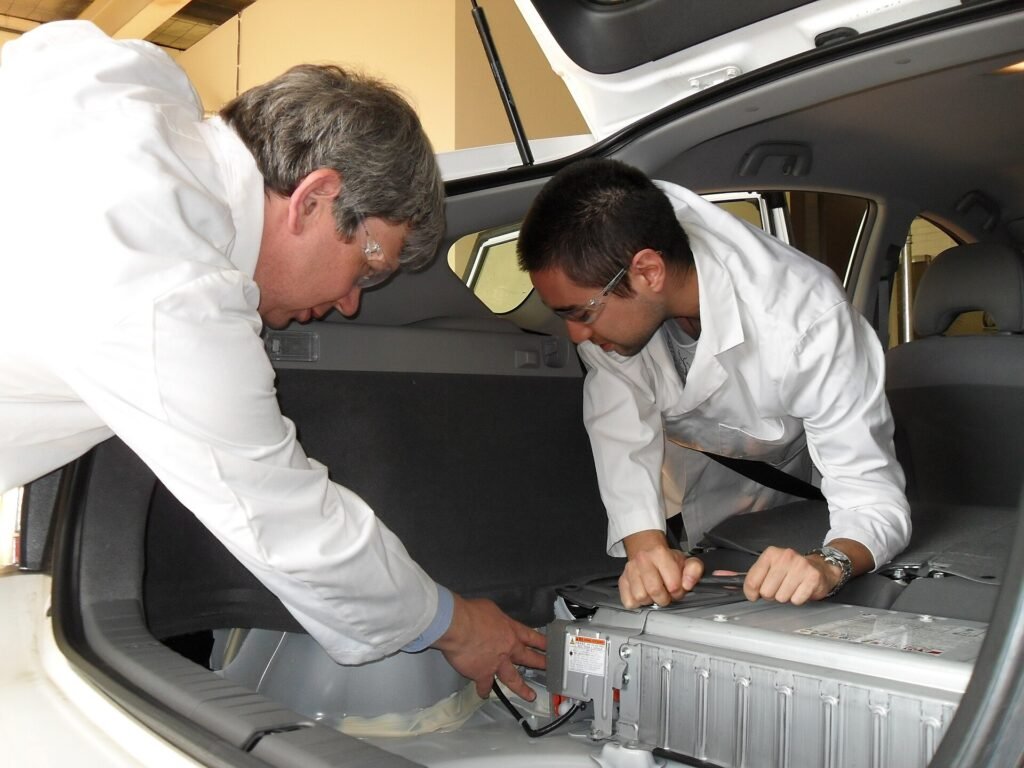
Featured image credit: Image: division, CSIRO via Wikimedia Commons (CC BY 3.0). Source
Every electric car sold in India advertises a battery warranty, and several now advertise a lifetime battery warranty. Almost none of the marketing explains the three conditions that decide whether you will ever be able to claim it: who owns the car, how the car is registered, and what counts as a failure.
This is a working guide to what Indian EV battery warranties actually cover in September 2026, where the real differences are, and the clauses that quietly void cover.
By Piyush P. Yadav
The industry standard, and who deviates from it
The baseline across most mass-market electric cars in India is 8 years or 160,000 kilometres, whichever comes first, with a state-of-health floor of 70 per cent. Two manufacturers have gone beyond it, and one sits slightly below.
| Model | Battery warranty | Notes |
|---|---|---|
| Tata Nexon EV | 8 years / 1,60,000 km | 45 kWh variant offers lifetime terms |
| Tata Tiago EV | 8 years / 1,60,000 km | Standard terms |
| Tata Punch EV | 8 years / 1,60,000 km | Standard terms |
| Hyundai Creta Electric | 8 years / 1,60,000 km | Standard terms |
| BYD Atto 3 | 8 years / 1,60,000 km | Standard terms |
| Mahindra XUV400 | 8 years / 1,60,000 km | Standard terms |
| MG ZS EV | 8 years / 1,50,000 km | Below the 1,60,000 km norm |
| MG Comet EV | 8 years / 1,20,000 km | Lowest km cap; lifetime terms offered |
| Mahindra BE 6 | 10 years / 2,00,000 km | First private owner |
| Tata Curvv EV | Lifetime terms available | First individual owner, private use |
Read the MG Comet line carefully. A 120,000 kilometre cap sounds distant until you remember that the Comet is a city car often bought as a second vehicle and sometimes used for short-hop commercial work. If you drive 25,000 km a year, you reach the cap in under five years, and the eight-year figure becomes irrelevant.
What “lifetime” actually means
Tata has gone furthest, offering a lifetime battery warranty on specific models including the Nexon EV in 45 kWh form, the Curvv EV and the Harrier EV. Mahindra offers extended terms on the BE 6, and MG offers lifetime terms on the Windsor and the Comet.
Lifetime does not mean forever. In Tata’s case it is defined as 15 years from the date of first registration, with unlimited kilometres. That is a genuinely strong offer. It is also conditional in two ways that exclude a large share of buyers.
Condition one: first individual owner only
The warranty does not transfer. If you buy the car second-hand, the lifetime cover is gone and you fall back to whatever standard terms remain, or to nothing.
This has a direct effect on the used EV market. A three-year-old Curvv EV bought from its first owner is not the same product as a new one, because the most expensive component is no longer covered the same way. Anyone weighing electric car resale values in India should treat non-transferable battery cover as a real depreciation driver rather than a footnote.
Condition two: private registration only
Lifetime terms apply to private, non-commercial registration. Register the car commercially, run it on a taxi permit, or attach it to a fleet, and you get the standard commercial terms instead, which are typically shorter.
This matters to a specific and growing group: people buying an EV partly to run on a ride-hailing platform. Delhi’s aggregator mandate is pushing fleets electric, and we covered the deadlines facing Ola, Uber, Rapido and Zomato separately. If your EV will earn money, assume the headline warranty does not apply to you and check the commercial terms before you sign.
The state-of-health floor is the clause that decides claims
This is the part buyers most often misunderstand. A battery warranty does not promise your battery keeps performing. It promises the battery will not fall below a defined capacity threshold, almost always 70 per cent state of health, within the warranty period.
Work through what that means in practice. A car with a certified 450 km range that degrades to 71 per cent capacity now delivers roughly 320 km. That is a substantial loss. It is also not a warranty claim, because 71 per cent is above the floor.
| State of health | Range on a 450 km car | Warranty position |
|---|---|---|
| 100 per cent | 450 km | As delivered |
| 90 per cent | 405 km | Normal, no claim |
| 80 per cent | 360 km | Normal, no claim |
| 71 per cent | 320 km | Above floor, no claim |
| 69 per cent | 310 km | Below floor, claim valid |
Typical degradation on a well-managed modern pack runs a few per cent in the first year and then roughly 1 to 2 per cent annually. Most cars will not reach 70 per cent inside eight years under normal use. That is why the warranty is offered: it is priced on the expectation that it rarely pays out. The cover is real, but it is insurance against premature failure, not against ordinary ageing.
What voids cover
The exclusions are broadly consistent across manufacturers. The ones that catch people out:
- Unauthorised service or repair. Getting high-voltage work done outside the authorised network typically voids battery cover entirely, not just the affected part.
- Non-compliant charging equipment. Using a non-approved home charger or an improvised connection is an exclusion in most policies, and it is the one people trip over when installing a charger themselves.
- Water ingress and flood damage. Usually excluded from warranty and pushed to insurance instead. Given Indian monsoon flooding, this is a live risk, and it is why what your EV battery insurance actually covers deserves a separate reading.
- Missed scheduled servicing. Skipping the service schedule gives the manufacturer grounds to decline.
- Software tampering. Modifying the battery management system or vehicle software.
- Prolonged storage at extreme charge. Some policies reference leaving the car parked at very high or very low state of charge for extended periods.
Battery-as-a-service changes the question entirely
Mahindra offers a battery subscription on the XEV 9S, where you buy the car and rent the battery. Under that structure the battery is not yours, so battery degradation is not your financial risk at all. You pay a monthly fee and the provider owns the replacement obligation.
That is a genuinely different proposition from a warranty, and it changes the total cost calculation rather than simplifying it. We worked through the numbers in what Mahindra’s Rs 12.65 lakh XEV 9S really costs under battery subscription.
The five questions to ask in the showroom
Marketing material will not answer these. A sales executive with the policy document will.
- Is the battery warranty transferable to a second owner? If not, ask what cover a buyer of your car in year four inherits.
- What is the state-of-health threshold, and how is it measured? Ask specifically which diagnostic tool the service centre uses and whether you can get a reading on demand.
- Does commercial registration change the terms? Get the commercial terms in writing if there is any chance the car earns money.
- Is the remedy repair, module replacement or full pack replacement? Most policies allow the manufacturer to repair or replace modules rather than supply a new pack, which is a materially cheaper outcome for them.
- What home charging equipment is approved? Get this before you install anything, because retrofitting compliance after a claim is refused is not possible.
How to read the warranty against your actual usage
The right warranty depends on how you will use the car, not on which number is biggest.
| Your situation | What matters most | What to watch |
|---|---|---|
| Low annual mileage, keeping the car long | The years figure | Km caps are irrelevant to you |
| High annual mileage, 25,000 km plus | The kilometre cap | MG Comet’s 1,20,000 km cap arrives fast |
| Planning to sell in 3 to 4 years | Transferability | Non-transferable lifetime cover hurts resale |
| Commercial or ride-hailing use | Commercial terms | Headline warranty likely does not apply |
| Buying used | Remaining cover and measured SoH | Get an SoH reading before purchase |
If you are buying used, insist on a state-of-health reading from an authorised service centre rather than trusting the dashboard range estimate, which reflects recent driving conditions rather than pack capacity. The same principle applies to two-wheelers, and we set out how to check an electric scooter’s battery health in India in a separate guide.
The bottom line
India’s EV battery warranties are better than they were three years ago and better than most buyers assume. The 8 year and 160,000 km baseline with a 70 per cent floor is a reasonable protection against premature failure, and the extended and lifetime offers from Tata, Mahindra and MG are real.
The gap between the marketing and the policy sits in three places: transferability, registration type, and the difference between degradation and failure. A buyer who checks those three before signing is buying what they think they are buying. A buyer who reads only the headline number is not.
Sources & Further Reading
- EVSelect — EV Battery Warranty in India: lifetime cover and what voids it
- VahanBazaar — EV battery warranty terms: years, km, state of health and exclusions
- ev.care — EV warranty in India: what is and is not covered
- Digit — Electric cars offering lifetime battery warranty in India
Frequently Asked Questions
What is the standard EV battery warranty in India?
The industry norm for electric cars in 2026 is 8 years or 1,60,000 kilometres, whichever comes first, with a state-of-health floor of 70 per cent. Tata, Hyundai, BYD and Mahindra largely follow this, while MG covers the ZS EV for 8 years or 1,50,000 km and the Comet EV for 8 years or 1,20,000 km.
Does a lifetime EV battery warranty transfer to the next owner?
Generally no. Tata’s lifetime battery warranty, defined as 15 years from first registration with unlimited kilometres, applies only to the first individual owner and only on private, non-commercial registration. A second-hand buyer falls back to standard terms or to no cover.
If my EV range drops a lot, can I claim on the battery warranty?
Only if capacity falls below the stated threshold, typically 70 per cent state of health, within the warranty period. A pack at 75 per cent capacity has lost a quarter of its range but is above the floor and is not a valid claim. The warranty protects against premature failure, not gradual degradation.
Does the battery warranty still apply if I use my EV as a taxi?
Usually not on the headline terms. Extended and lifetime battery warranties are typically restricted to private, non-commercial registration. Commercial or ride-hailing registration normally attracts shorter commercial warranty terms, so ask for those terms in writing before purchase.
Does DC fast charging void an EV battery warranty in India?
No mainstream Indian manufacturer lists ordinary DC fast charging as a warranty-voiding act. What the booklets actually exclude is the use of non-approved chargers or connectors, tampering with the battery management system, unauthorised software modification and sustained operation outside specified conditions. Heavy fast charging does add some extra degradation over the years, so it affects how quickly you approach the state-of-health floor rather than whether cover exists at all.
How do you actually claim on an EV battery warranty?
Claims run through an authorised service centre, because the assessment needs manufacturer diagnostic tools to read the pack’s state of health and stored fault history. Carry the registration certificate, the warranty booklet and the complete service record, and keep connected-car services active where your terms require them. The workshop first establishes whether the fault is a manufacturing defect or external damage — flood ingress, impact, third-party high-voltage work — and only a defect finding opens a job card under warranty.
Is the EV battery warranty separate from the car’s main warranty?
Yes, and the two expire at different times. The vehicle warranty typically runs around three years with a kilometre cap that varies by brand, the high-voltage battery carries its own longer schedule — the 2026 industry norm being 8 years or 1,60,000 km — and the motor, inverter and other electronics may sit on a third term again. Check each one separately when buying used: a car well past its vehicle warranty can still have five or more years of battery cover left on it.