

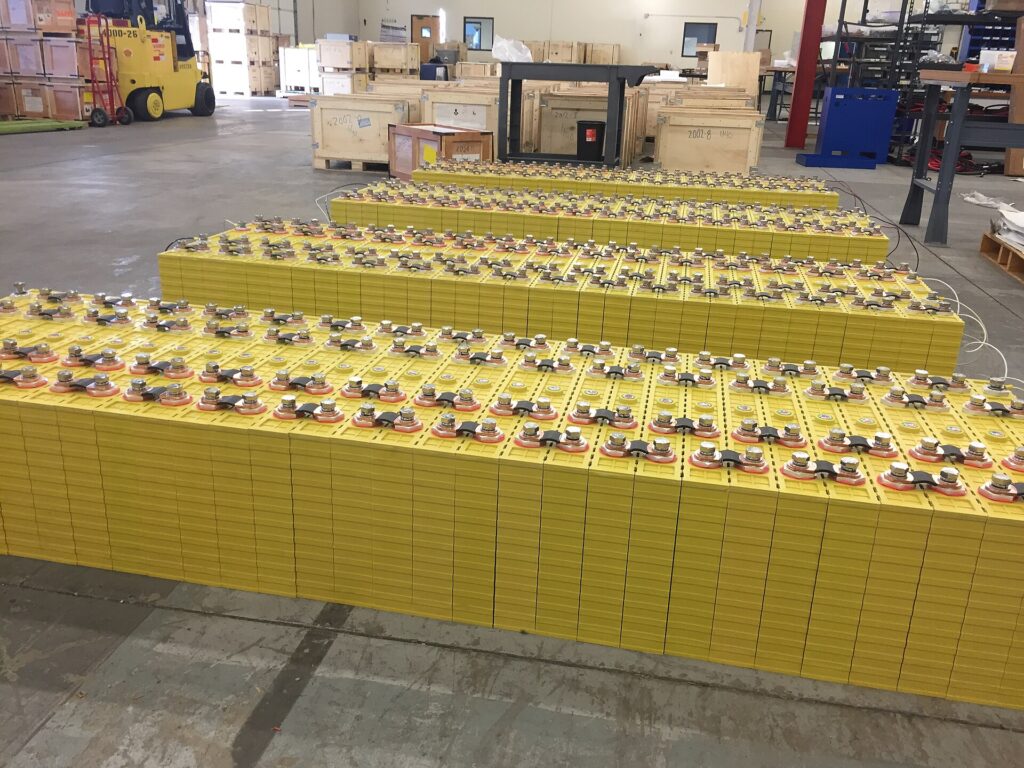
Featured image credit: Image: Yo-Co-Man via Wikimedia Commons (CC BY-SA 4.0). Source
India has been promising domestic battery cell manufacturing since 2021. In September 2026 the promise is finally close enough to check. Four large cell projects are at different stages of commissioning, one company is already selling a vehicle running on cells it made in India, and the rest of the industry is still buying cells from abroad.
This is a status report on where each project actually stands, what chemistry it will produce, and when the cells realistically reach vehicles. The short version: 2027 is the year that matters, and almost nothing arrives before it.
By Piyush P. Yadav
Why domestic cells matter more than they sound
A battery cell is the single most expensive component in an electric vehicle, typically 30 to 40 per cent of the cost of the car. India assembles battery packs domestically at reasonable scale. It does not yet make the cells that go inside them in meaningful volume.
That distinction has three consequences.
- Cost is set outside India. Cell prices move on global lithium, nickel and manufacturing economics. Indian manufacturers are price takers.
- Supply is a strategic exposure. The 2025 rare-earth episode, when magnet supply disruption forced scooter production cuts, demonstrated how a single upstream chokepoint propagates.
- Export economics stay thin. Exporting a car built from imported cells generates less domestic value than exporting one built from local content.
This is the same structural question we examined when looking at who actually makes the battery cells in Indian electric cars. The answer then was almost entirely foreign suppliers. The projects below are the attempt to change that answer.
The scoreboard
| Project | Location | Phase 1 capacity | Chemistry | Commercial production |
|---|---|---|---|---|
| Agratas (Tata) | Sanand, Gujarat | 20 GWh, toward 40 GWh | LFP and NMC | Targeting early 2027 |
| Amara Raja | Giga Corridor, Telangana | 4 to 6 GWh | LFP | Slipped to FY 2027 |
| Exide | Bengaluru region | 4 to 6 GWh | LFP | Plant operational 2026 |
| Reliance New Energy | Jamnagar, Gujarat | Not disclosed in detail | LFP focus | Late 2026 to 2027 |
| Ola Electric | Krishnagiri, Tamil Nadu | Ramping | LFP, 46-series | Cells already in a product |
Agratas: the biggest bet
Agratas is the Tata group’s dedicated battery business, and the Sanand plant is the largest single cell project in India. The scale is easier to grasp physically than in gigawatt-hours. The completed steel frame runs 700 metres long, 150 metres wide and 34 metres at its highest point, covering 105,000 square metres of built-up area.
Phase one is 20 GWh, with the site planned to reach 40 GWh in phases. Commercial production is targeted for early 2027.
The chemistry strategy is the interesting part. Agratas is developing LFP internally while licensing mature NMC technology from Japan’s Automotive Energy Supply Corporation. That is a sensible split. LFP is where the volume and the cost advantage sit for Indian conditions. NMC is where the energy density is, and buying proven technology for it is faster and less risky than developing it from scratch.
The strategic significance for Tata is obvious. Tata Motors is India’s largest electric car manufacturer. A captive cell supply removes its single biggest cost and supply exposure at a stroke.
Amara Raja: the delay that tells a story
Amara Raja has committed over Rs 1,000 crore to lithium-ion cell manufacturing and is building out its Giga Corridor in Telangana. The battery pack assembly plant is inaugurated and a customer qualification plant has broken ground.
Cell production, however, has slipped to FY 2027.
That slip is worth understanding rather than dismissing. Cell manufacturing is not assembly. It is a precision chemical process where contamination control, electrode coating uniformity and moisture management determine whether your yield is 95 per cent or 40 per cent. Companies that have never made cells routinely underestimate the qualification period, which is why the customer qualification plant exists as a separate step. You do not simply switch a gigafactory on.
Amara Raja’s target of 4 to 6 GWh of LFP capacity is aimed at two-wheelers, three-wheelers and commercial vehicles rather than passenger cars. That is the right first market. Those applications are more tolerant of the energy density penalty LFP carries, and they value the thermal safety and cycle life LFP gives in return.
Exide: the incumbent advantage
Exide is approaching this from a different direction. It has decades of lead-acid battery manufacturing in India, which means existing plants, an existing distribution network, existing relationships with every vehicle manufacturer in the country, and an existing recycling and reverse logistics system.
None of that makes lithium cells. All of it makes selling lithium cells easier once you can make them. Exide’s Li-ion cell plant is operational in 2026 with a 4 to 6 GWh LFP target, and it has already been in discussions to supply two-wheeler manufacturers.
Together Amara Raja and Exide have committed something in the order of Rs 16,000 crore to battery gigafactories. Both are betting that being an Indian cell supplier to Indian vehicle makers is a better business than being an Indian lead-acid supplier in a market that is electrifying.
Ola: first to a product, smallest to prove
Ola Electric is the only company on this list that has put cells it manufactured in India into a vehicle a customer can order. The S1 Z, launched on 28 August 2026 at Rs 79,999, runs on its Bharat Cell LFP cells made at the Krishnagiri Gigafactory.
That is a genuine first. It is also the smallest-format, lowest-stakes version of the problem. A scooter cell pack is a few kilowatt-hours. A car pack is ten to twenty times larger, faces harder thermal management, and has to survive a warranty that now routinely runs eight years or longer.
The honest assessment is that Ola has proven it can make cells, not yet that it can make cells that last. Deliveries begin in December 2026. Field data arrives in 2028.
Why everyone chose LFP
Notice that four of the five projects lead with lithium iron phosphate. That convergence is not coincidence.
| Factor | LFP | NMC |
|---|---|---|
| Energy density | Lower, heavier pack | Higher, lighter pack |
| Thermal stability | Better, higher thermal runaway threshold | Lower |
| Cycle life | Longer | Shorter |
| Raw material exposure | No cobalt or nickel | Cobalt and nickel dependent |
| Cost per kWh | Lower | Higher |
| Cold weather performance | Weaker | Better |
For India specifically, LFP wins on almost every axis that matters. Ambient temperatures are high, so thermal stability is worth paying weight for. Cost sensitivity is extreme. The cold-weather weakness affects a small slice of the country. And avoiding cobalt and nickel removes exposure to the most geopolitically fraught parts of the battery supply chain.
The remaining question is whether LFP is the end point or a waypoint. Sodium-ion is progressing, and we covered what CATL’s 175 Wh/kg sodium-ion milestone means for India separately. If sodium-ion matures, India’s LFP capacity could find itself competing with a chemistry that removes lithium exposure entirely.
What is still missing
Cells are one layer. Three others remain substantially imported.
Cathode and anode active materials. A cell plant that imports its cathode powder has localised assembly, not chemistry. This is the next layer of the problem and almost nobody is addressing it at scale in India yet.
Separators and electrolyte. Specialised chemical products with concentrated global supply, largely in East Asia.
Rare-earth magnets for motors. A separate supply chain from cells, and a live vulnerability. India’s Rs 7,280 crore rare-earth magnet scheme attracted 20 bidders but has not yet delivered magnets into vehicles.
What this means for buyers
Practically, very little changes in 2026. The electric car or scooter you buy this festive season almost certainly runs on imported cells, with the single exception of an Ola S1 Z you will not receive until December.
From 2027 the picture shifts. Expect three effects, in this order:
- Replacement battery availability improves first. Domestic cell supply makes out-of-warranty pack replacement more practical and less dependent on import lead times.
- Price pressure follows, slowly. Cell cost reductions reach showroom prices with a lag, and only where competition forces them through.
- Supply resilience improves last but matters most. The scenario domestic cells protect against is a global disruption that halts Indian production, which is a low-probability, high-consequence risk.
The realistic timeline
If you want one sentence: India will have meaningful domestic cell production from 2027, at a scale that covers a fraction of demand, in one chemistry, using largely imported active materials.
That is a real achievement and a long way from self-sufficiency. The gigafactory announcements were made in 2021 and 2022 with timelines that have almost universally slipped by two to three years. That is normal for first-of-a-kind chemical manufacturing and it is worth remembering when the next set of dates is announced.
Sources & Further Reading
- pv magazine India — Agratas advances 20 GWh Sanand battery facility
- Energetica India — Agratas reaches construction milestone at Sanand, on track for 2027 output
- Amara Raja — Battery pack assembly plant and customer qualification plant at Giga Corridor
- Observer Research Foundation — Powering Ahead: The Future of EV Battery Manufacturing in India
Frequently Asked Questions
Does India make its own EV battery cells yet?
Barely. Ola Electric is the only company with cells it manufactured in India inside a vehicle customers can order, and those deliveries begin in December 2026. Agratas, Amara Raja, Exide and Reliance are all building capacity, with commercial production concentrated in the 2026 to 2027 window.
When will Tata’s Agratas battery plant start production?
Agratas is targeting commercial production at its Sanand facility in Gujarat by early 2027. Phase one capacity is 20 GWh, with the site planned to reach 40 GWh in phases. It will produce both LFP cells developed in-house and NMC cells under licence from Japan’s Automotive Energy Supply Corporation.
Why are Indian cell makers all choosing LFP chemistry?
LFP suits Indian conditions. It offers better thermal stability at high ambient temperatures, longer cycle life, lower cost per kWh, and no dependence on cobalt or nickel. The trade-off is lower energy density, meaning heavier packs, and weaker cold-weather performance, which affects only a small part of India.
Will domestic cells make electric cars cheaper in India?
Eventually, and less than people expect. Cells are 30 to 40 per cent of vehicle cost, so domestic supply helps, but Indian plants will initially import cathode and anode active materials, which limits the cost benefit. The more immediate gains are in replacement battery availability and supply security rather than showroom price.
How much of India’s lithium-ion cell supply is still imported?
Effectively all of what goes into vehicles on sale today. Commerce ministry data put India’s lithium-ion cell imports at about Rs 41,667 crore in FY26, up 64 per cent year on year and roughly five times the level of five years earlier, with China supplying around 84 per cent of that volume. Set against commissioned domestic cell capacity still measured in low single-digit GWh, the import share is not a rounding error to be closed in one year.
How much cell capacity has the PLI scheme actually awarded so far?
The ACC PLI scheme was built around 50 GWh of domestic cell capacity, of which 40 GWh has been awarded to successful bidders and the remaining 10 GWh was re-tendered during 2026 for grid-scale stationary storage. The number that matters is the gap between awarded and commissioned: the allocations are years old, while actual commissioned output is still a fraction of a single plant’s phase one, which is why the 2027 start dates in this scoreboard carry more weight than the headline GWh figures.
Does India mine the lithium that goes into these cells?
Not in any commercial sense yet. The Geological Survey of India reported a 5.9 million tonne inferred lithium resource in the Salal-Haimna block of Reasi, Jammu and Kashmir, but that block’s auction was annulled twice for want of bidders and higher-grade G2 exploration was still being completed. India stays close to fully import-dependent for lithium, cobalt, nickel and graphite, which is the reason a domestic cell plant reduces import exposure at the cell stage without removing it upstream.