

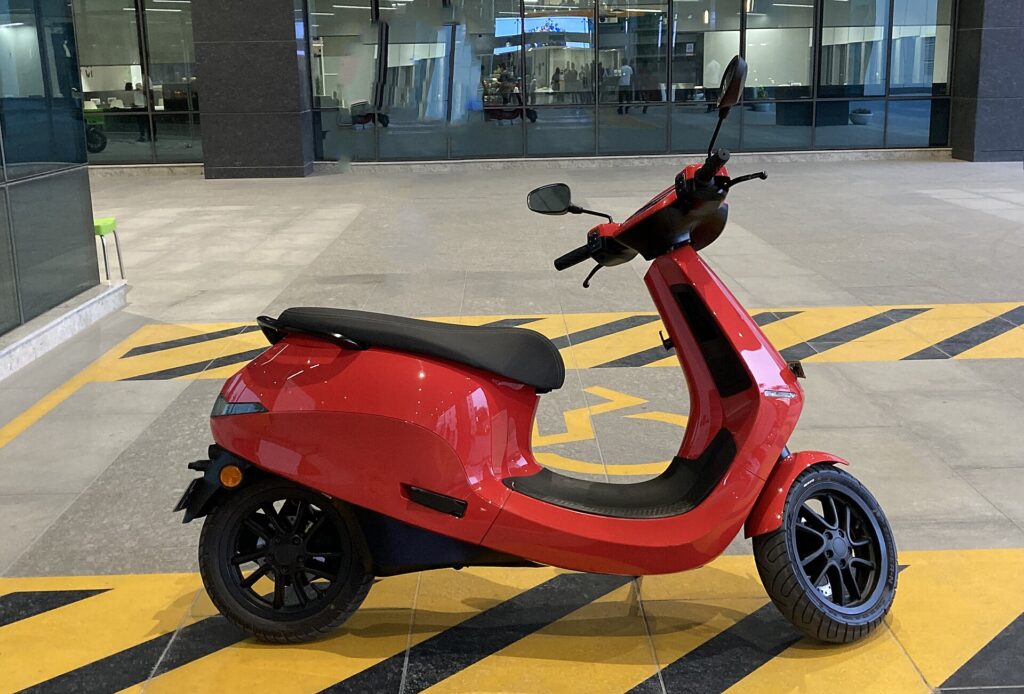
Featured image credit: Image: SnapMeUp via Wikimedia Commons (CC BY-SA 4.0). Source
Ola Electric launched the S1 Z on 28 August 2026 at an introductory Rs 79,999, and the price is not the interesting part. The interesting part is what is inside the battery pack. The S1 Z is the first electric scooter sold in India running on lithium iron phosphate cells that Ola designed, engineered and manufactured itself, under the name Bharat Cell.
That matters because almost every electric two-wheeler sold in India until now has been an Indian vehicle wrapped around an imported cell. If Ola’s cells work as claimed, the company has removed the single largest imported component from its cost structure at exactly the moment the central subsidy disappeared.
By Piyush P. Yadav
What the S1 Z actually is
The S1 Z sits below Ola’s performance range. It is a practical, high-range commuter scooter with a 4 kW peak motor and a top speed of 70 kmph in both variants. That top speed is a deliberate choice. It keeps the scooter in a simpler regulatory and component class than the 90-plus kmph performance machines, and it suits the delivery and daily-commute use case Ola is aiming at.
| Specification | S1 Z 3.1 kWh | S1 Z 5.1 kWh |
|---|---|---|
| Introductory price (ex-showroom) | Rs 79,999 | Rs 99,999 |
| Battery capacity | 3.1 kWh | 5.1 kWh |
| Claimed IDC range | 179 km | 301 km |
| Peak motor power | 4 kW | 4 kW |
| Top speed | 70 kmph | 70 kmph |
| Wheel size | 12 inch | 12 inch |
| Cell chemistry | Bharat Cell LFP | Bharat Cell LFP |
| Deliveries begin | December 2026 | March 2027 |
Colours are White, Anthracite, Sky Splash Blue and Matcha Green. The scooter runs MoveOS 5 and carries cruise control, regenerative braking, reverse mode, GPS, over-the-air updates, and geo, time and mode fencing through the Ola Electric app. That fencing feature set is squarely aimed at fleet operators who want to cap speed or restrict a rider to a delivery zone.
Read the range numbers properly
A claimed 301 km from a 5.1 kWh pack is a headline number and it deserves the usual caution. That figure is an IDC rating, measured on a standardised test cycle at low average speed. It is not what you will see on a Mumbai flyover with a pillion and a delivery box.
The practical rule of thumb that has held up across Indian electric scooters is roughly 0.7 of the IDC claim in mixed real-world riding, and less in heavy traffic, on hills, or with the rider using full throttle. Applied here:
| Variant | IDC claim | Realistic mixed riding | Hard use estimate |
|---|---|---|---|
| S1 Z 3.1 kWh | 179 km | Around 125 km | Around 100 km |
| S1 Z 5.1 kWh | 301 km | Around 210 km | Around 170 km |
Even discounted, those are substantial numbers for a commuter scooter. The 5.1 kWh variant in particular is carrying a pack larger than many electric scooters sold in India, which is the whole point of the commercial and gig-worker positioning. A delivery rider doing 150 km a day can finish a shift without a mid-day charge. If you want the full explanation of why the same scooter can honestly carry three different range numbers, we covered IDC range, TrueRange and real range in detail.
The Bharat Cell claim, examined
Ola says the Bharat Cell is designed, engineered and manufactured in India, covered by 426 patents, built at its Gigafactory, and developed at its Battery Innovation Centre in Bengaluru. The company claims an operating range from minus 30 to plus 70 degrees Celsius and a battery life beyond 15 years.
Three of those claims are worth separating.
The chemistry choice is sound
LFP is the right chemistry for this application in India. It gives up energy density compared with nickel-based chemistries, which is why the packs are physically larger for the same range, but it buys thermal stability, long cycle life and tolerance of Indian ambient temperatures. For a scooter that will sit in 45 degree summer parking and get fast-charged repeatedly by a fleet operator, that trade is clearly correct.
The temperature range is a cell specification, not a scooter specification
Minus 30 to plus 70 degrees describes what the cell can survive. It does not mean the scooter delivers full performance across that band. Every lithium chemistry loses usable capacity and charge acceptance at low temperature. In practical Indian terms this is a non-issue for most of the country and a mild winter consideration in the far north.
The 15-year life claim needs field data
LFP cells genuinely do achieve high cycle counts in laboratory conditions. Whether a pack in an Indian scooter, charged on domestic wiring, ridden hard and parked in the sun, reaches 15 years is a question that only time answers. Ola has been in the market long enough to have a service reputation, and that reputation is the reason many buyers will wait for owner data before committing.
Why the timing matters
The central two-wheeler incentive under PM E-DRIVE closed on 31 July 2026. Electric scooters bought from 1 August 2026 receive no central cash subsidy. Ola launched the S1 Z four weeks after that cliff.
That sequencing is not coincidence. Once the subsidy disappears, the only way to hold a price point is to take cost out of the vehicle, and in an electric scooter the cell pack is the largest single cost line. A manufacturer that makes its own cells has a lever nobody buying cells on the open market has. Every other major player is still exposed to cell pricing set outside India, which is why the diverging state incentive picture now matters more than it did a year ago.
The Rs 79,999 introductory price puts the base S1 Z within reach of petrol scooter money. That is the threshold the industry has been chasing since 2019.
Where this leaves Ola competitively
Ola’s market position has deteriorated sharply. The company that held close to half the electric two-wheeler market and sold over 50,000 scooters a month at its peak fell to a small fraction of that by early 2026, overtaken by TVS, Bajaj and Ather. We examined whether the Q1 FY27 numbers point to a shutdown and concluded they point to something more specific: a company that scaled distribution faster than service.
The S1 Z does not fix that. Service network quality, spare parts availability and repair turnaround were the failures that cost Ola its lead, and a better battery does not repair a service centre. What the S1 Z does is give Ola a structural cost advantage that its rivals cannot quickly copy, because building a cell plant takes years.
| Player | Cell sourcing | Strategic position |
|---|---|---|
| Ola Electric | In-house Bharat Cell LFP | Cost control, weak service reputation |
| TVS | External cell supply | Volume leader, strong dealer network |
| Bajaj | External cell supply | Close second, strong brand trust |
| Ather | External cell supply | Fast growth, premium positioning |
The competitive battle between those four has been the defining story of the segment this year, and we broke down the TVS, Bajaj and Ather brand war in August 2026 separately.
Should you buy one?
Three honest positions, depending on who you are.
If you are a delivery or fleet operator
The 5.1 kWh variant is genuinely compelling. The range covers a full shift, the fencing and telematics features are built for fleet control, and LFP chemistry suits the duty cycle. The caution is service uptime. A scooter that is off the road waiting for a part costs a commercial operator far more than the purchase price difference. Ask local operators about repair turnaround in your city before you commit a fleet.
If you are a private commuter
The base variant at Rs 79,999 is strong value with a realistic 125 km of range. The obvious catch is that deliveries only start in December 2026, and March 2027 for the larger pack. You are committing money now against a scooter you receive months later, from a company whose delivery timelines have slipped before.
If you want certainty today
Buy from a manufacturer with a proven service network and take delivery this month. The Chetak, iQube, Rizta and the recently launched Konarc are all available now with established support. You will pay more per kilometre of range, and you will get a scooter you can actually ride in September.
The bigger significance
Strip away the Ola-specific questions and one fact remains. An Indian company is now selling a vehicle powered by cells it manufactured in India. That has not been true before at this price point or this volume ambition.
India’s cell manufacturing effort has been running for years through production-linked incentive schemes, with Agratas, Amara Raja, Exide and Reliance all building capacity toward commercial production in the 2026 to 2027 window. Ola got a product to market first. Whether the cells perform as claimed over a decade is the question that decides whether this is a milestone or a marketing exercise, and the answer will come from owners, not press releases.
Sources & Further Reading
- Business Standard — Ola Electric launches S1Z with homegrown LFP cells
- Business Today — Ola Electric launches S1Z with indigenous Bharat Cell LFP technology
- Electrive — Ola Electric launches e-scooter with indigenous LFP cells
- Ola Electric — S1 Z official product page
Frequently Asked Questions
What is the Ola S1 Z price and when can I get one?
The introductory ex-showroom price is Rs 79,999 for the 3.1 kWh variant and Rs 99,999 for the 5.1 kWh variant. Deliveries of the 3.1 kWh version are scheduled to begin in December 2026, and the 5.1 kWh version from March 2027.
What is Ola’s Bharat Cell and how is it different?
Bharat Cell is Ola’s own lithium iron phosphate cell, designed and manufactured in India at the company’s Gigafactory and developed at its Battery Innovation Centre in Bengaluru. It differs from most Indian electric scooters, which use imported cells. LFP chemistry trades energy density for thermal stability and long cycle life.
Is the claimed 301 km range realistic?
No, not in normal riding. That is an IDC test-cycle figure. A practical expectation for mixed Indian riding is roughly 70 per cent of the claim, so around 210 km for the 5.1 kWh variant and around 125 km for the 3.1 kWh variant, with less in heavy traffic or hilly terrain.
Is there still a government subsidy on electric scooters?
Not from the centre. The PM E-DRIVE two-wheeler incentive closed on 31 July 2026, so electric scooters bought from 1 August 2026 receive no central cash subsidy. Some state-level benefits such as road tax and registration concessions continue, and they vary considerably by state.