

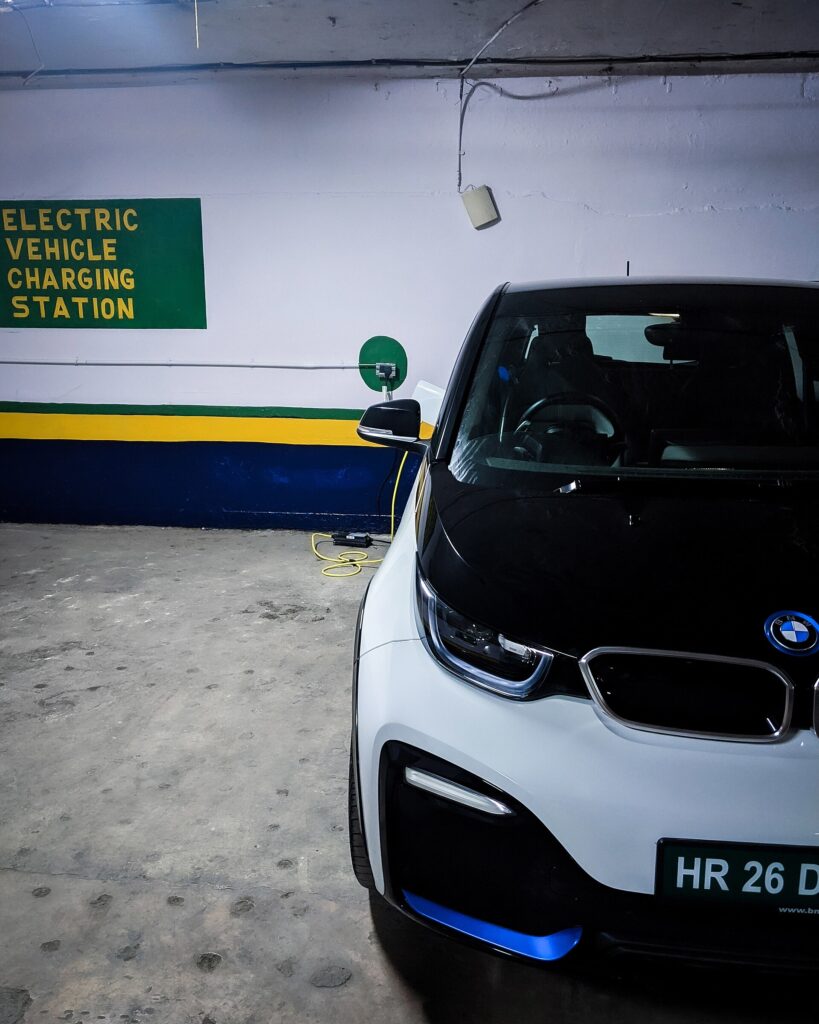
Featured image credit: Image: Paranjaygulati via Wikimedia Commons (CC BY-SA 4.0). Source
By Piyush P. Yadav | 11 September 2026
“Mandates drive scale. Subsidies will drive initial adoption. But scale cannot come through subsidies, so it only needs regulation.” That was Amit Bhatt, managing director for India at the International Council on Clean Transportation (ICCT), speaking at the India Clean Transportation Summit in New Delhi on 9 September 2026. It is the clearest public call yet from a major policy body for India to move from paying people to buy electric vehicles to requiring carmakers to sell them. This article explains what a zero-emission vehicle (ZEV) mandate actually is, how the three big versions in the UK, California and China work, what India has today instead of one, why the widely quoted 30 per cent target for 2030 is not an official target at all, and what a mandate would mean for the price and choice of EVs on Indian roads.
What Amit Bhatt actually said
Bhatt’s argument, reported by electrive, was built on where India’s transition stands by segment. Electric two-wheelers, he said, have a shelf life of about four days at dealerships before they sell. Three-wheelers are “doing exceptionally well”, and India already accounts for more than half of the world’s electric three-wheeler sales. Cars have “increased, but have to do more”: electric car penetration is around 8 per cent of sales, up roughly 80 per cent in 2025 on the back of new models. Medium and heavy trucks are “still starting”, with only about 570 electric trucks registered in 2025, double the previous year but negligible against a market of several lakh trucks.
The number everyone quotes for 2030, that 30 per cent of new car sales should be electric, is, in Bhatt’s words, “not an official target” but a figure that entered public discourse through NITI Aayog presentations and has never been written into any regulation. Against 8 per cent today, 30 per cent in four years would need sales to nearly quadruple, and Bhatt’s point is that no subsidy budget can buy that. The one place India has tried a mandate, he noted, is Delhi, whose 2026 EV policy stops registration of new petrol and CNG three-wheelers from 1 January 2027 and new petrol two-wheelers from 1 April 2028. That, he said, has already caused “a massive shift” in how manufacturers plan their Delhi line-ups.
What a ZEV mandate is, in plain terms
A ZEV mandate is a rule that says a minimum share of the vehicles each manufacturer sells in a year must be zero-emission. The share rises every year on a published schedule. A manufacturer that beats its target earns credits; one that misses it must buy credits from a manufacturer with a surplus or pay a fine per vehicle. The key features are that the obligation sits on the manufacturer, not the buyer; that the schedule is known years ahead so factories and supply chains can be planned; and that the government does not have to spend money, because the cost is carried inside the industry through cross-subsidy between electric and petrol models.
That is different from everything India does today. PM E-DRIVE pays a subsidy per vehicle to the buyer. The PLI schemes pay manufacturers for building vehicles and cells. GST at 5 per cent on EVs against 28 per cent-plus on petrol cars is a tax preference. State policies waive road tax. CAFE norms cap average fleet CO2 but, as we explained in our piece on CAFE-III and its EV super-credits, they can be met without selling many EVs at all. None of these tells a carmaker it must sell a certain number of electric cars.
The three mandates the world already runs
India would not be inventing anything. Three large markets already operate ZEV mandates, and each solves the design questions differently.
| Feature | United Kingdom | California (ACC II) | China (dual-credit) |
|---|---|---|---|
| Started | January 2024 | Model year 2026 | 2019 |
| Target now | 33 per cent of new cars in 2026 | 35 per cent of new cars in 2026 | NEV credit ratio of 18 per cent by 2023, rising since |
| Target 2030 | 80 per cent | 68 per cent | Not fixed; set in phases |
| End point | 100 per cent in 2035 | 100 per cent in 2035 | No stated end date |
| Hybrids allowed | Plug-in hybrids until 2035 under 2025 revision | Up to 20 per cent of the quota can be plug-in hybrids | Plug-in hybrids earn reduced credits |
| Penalty | About 15,000 pounds per non-compliant car | Credit purchase or state enforcement | Credit purchase; production restrictions for deficit makers |
| Flexibility | Credits, borrowing, CO2 offset trading | Credits, pooling | Credit pool and trading between makers |
The UK schedule is the most relevant template because it started from a market share similar to where India’s car segment is now. The mandate began at 22 per cent in 2024, rose to 28 per cent in 2025 and 33 per cent in 2026, and climbs to 38, 52, 66 and 80 per cent through 2030. The UK government opened a review of the mandate in August 2026 after carmakers argued the targets were outrunning demand, which is a warning that a mandate set too steeply invites lobbying to weaken it. China’s system is the oldest and the most complex: it combines a fuel-economy credit with a new-energy-vehicle credit and lets manufacturers trade both, and in 2023 it cut the credits earned per vehicle by around 40 per cent to keep the pressure on as EV sales grew. California’s rule, adopted in 2022, is the most straightforward: a share of new car sales that reaches 100 per cent zero-emission in 2035, with a fifth of the quota fillable by plug-in hybrids.
What India has instead
India’s current toolkit is entirely demand-side and fiscal. It has worked well for two- and three-wheelers, where the purchase price gap has closed, and it is failing for trucks, where it has not. The table sets out the instruments.
| Instrument | Type | What it does | Who pays |
|---|---|---|---|
| PM E-DRIVE (2024 to 2028) | Purchase subsidy | Rs 5,000 per two-wheeler in FY26, up to Rs 25,000 per three-wheeler, incentives for buses and trucks | Central budget, Rs 10,900 crore |
| 5 per cent GST on EVs | Tax preference | Cuts the price gap against 28 per cent-plus on petrol cars | Forgone revenue |
| State road-tax waivers | Tax preference | Zero road tax and registration in most states, capped by price in some | State budgets |
| PLI for autos and cells | Manufacturing subsidy | Pays a share of sales value for eligible EVs and components | Central budget |
| CAFE-III (from April 2027) | Fleet CO2 standard | Caps average emissions; EVs earn 3x super-credits | Manufacturers |
| Delhi EV Policy 2026 | Registration ban | No new petrol or CNG 3W from January 2027, no new petrol 2W from April 2028 | Manufacturers and buyers |
Delhi’s policy is the only true mandate in the country, and it is a blunt one: rather than a rising percentage, it is a hard stop on a date. That is why manufacturers have reacted so sharply. A percentage mandate is gentler on both sides, because it lets a carmaker keep selling petrol models as long as it sells enough electric ones alongside. Our explainer on the current status of PM E-DRIVE shows how thin the subsidy has become for two-wheelers, which is itself an argument that the subsidy era is ending whether a mandate replaces it or not.
What a mandate would change for Indian buyers
The honest answer is that a mandate raises petrol car prices and lowers electric car prices, because manufacturers meet the target by shifting margin between the two. That is exactly what happened in the UK, where dealers discounted EVs heavily in 2024 and 2025 to hit their quotas while petrol list prices crept up. It is the mechanism by which the transition gets paid for without a government cheque.
The second effect is choice. ZEV mandates force every manufacturer, not just the willing ones, to bring electric models. In India today Tata and Mahindra account for roughly two-thirds of electric car sales, and several large carmakers sell one electric model or none. A mandate at even 15 per cent would oblige Maruti Suzuki, Hyundai, Toyota, Honda and the Renault-Nissan alliance to have volume electric products in every segment they compete in, which is the surest way to get an electric hatchback under Rs 8 lakh.
The third effect is on trucks, which is where Bhatt was most pointed. He identified the scrapping-certificate requirement, under which incentives for a new electric truck are tied to scrapping an old one, as the main barrier, because the 55-tonne trucks in highest demand only arrived in India in 2018 and are nowhere near end of life. A sales mandate on truck makers would sidestep that entirely. The government’s own thinking, as we reported in our piece on the proposed Rs 9,852 crore heavy-duty EV scheme, is still financing-led: interest subvention and credit guarantees rather than obligations.
The arguments against, and they are real
India’s carmakers will make three objections, and each has substance. First, a mandate in a price-sensitive market can push up the cost of the small petrol cars that most Indians actually buy, which is politically difficult. Second, charging: a mandate that outruns public charging infrastructure produces unhappy owners, and India has about 67,000 public chargers for a fleet heading toward 1 crore EVs across all categories. Bhatt himself paired mandates with “charging rights”, meaning a legal entitlement for apartment residents to install a charger, which India does not yet have nationally. Third, timing against CAFE-III: the industry is already absorbing a tighter CO2 standard from April 2027, and layering a sales quota on top would need to be sequenced carefully. Our guide to GST on electric vehicles explains the fiscal preference that a mandate would eventually have to replace, because the 5 per cent rate cannot survive EVs becoming a majority of sales.
What to watch
- The NITI Aayog and MoRTH response to the summit, including whether “30 per cent by 2030” is ever formalised into anything binding.
- CAFE-III notification, which is the nearest thing India has to a supply-side EV push and is due to take effect in April 2027.
- State mandates beyond Delhi: Karnataka has been discussing a ZEV mandate since 2025 and any second state adopting a registration cut-off would create a de facto national schedule.
- The UK review, due to conclude later in 2026, which will show how a mandate survives contact with a slowing market.
Sources & Further Reading
- electrive: “Mandates drive scale”, ICCT India’s Amit Bhatt calls for a policy-led EV push
- Driving ZEV: UK ZEV mandate explained, targets, rules and flexibilities
- California Air Resources Board: Advanced Clean Cars II
- Outlook India: Delhi’s EV Policy, a guide to subsidies, tax waivers and bans
Frequently Asked Questions
What is a ZEV mandate?
A zero-emission vehicle mandate is a regulation requiring each vehicle manufacturer to make a minimum, rising share of its annual sales zero-emission. Manufacturers that fall short buy credits from those that exceed the target or pay penalties. The UK, California and China all run versions of it.
Does India have a ZEV mandate?
Not at the national level. India relies on purchase subsidies, GST and road-tax preferences, PLI manufacturing incentives and the CAFE fuel-economy standard. The only mandate-style rule is Delhi’s 2026 EV policy, which ends new petrol and CNG three-wheeler registrations from January 2027 and new petrol two-wheeler registrations from April 2028.
Is 30 per cent EV sales by 2030 an official Indian target?
No. ICCT India’s Amit Bhatt said at the India Clean Transportation Summit on 9 September 2026 that the figure is part of public discourse but has never been written into any regulation. Electric car penetration is currently around 8 per cent.
Would a ZEV mandate make electric cars cheaper in India?
Typically yes for EVs and no for petrol cars. Manufacturers meet quotas by discounting electric models and recovering margin on petrol ones, which is what happened in the UK after its mandate began in 2024. A mandate also forces every carmaker to offer EVs, widening choice.
Is India banning petrol cars?
Not nationally, and no notified rule does so. NITI Aayog floated a full transition to electric sales by 2030 in presentations years ago, but it was never adopted as policy, and CAFE-III from April 2027 is a fleet fuel-efficiency standard rather than a ban. The only binding cut-offs are local: Delhi’s 2026 EV policy ends new petrol and CNG three-wheeler registrations from January 2027 and new petrol two-wheeler registrations from April 2028.
What is the difference between a ZEV mandate and CAFE norms?
CAFE caps the average CO2 of everything a manufacturer sells, so it can be met with more efficient petrol engines, hybrids and a handful of electric models, which earn three times the weighting as super-credits under CAFE-III. A ZEV mandate instead sets a floor on the number of zero-emission cars themselves, enforced through tradable credits and a penalty per non-compliant vehicle. India gets the first from April 2027 and has no proposal for the second.
Which countries have a ZEV mandate?
The United Kingdom has run one since January 2024, at 33 per cent of new cars in 2026, rising to 80 per cent in 2030 and 100 per cent in 2035. California’s Advanced Clean Cars II rule begins with model year 2026 at 35 per cent and also reaches 100 per cent in 2035, with up to a fifth of the quota fillable by plug-in hybrids. China’s dual-credit system, in force since 2019, sets a new-energy-vehicle credit ratio rather than a flat sales percentage and lets manufacturers trade credits between themselves.