

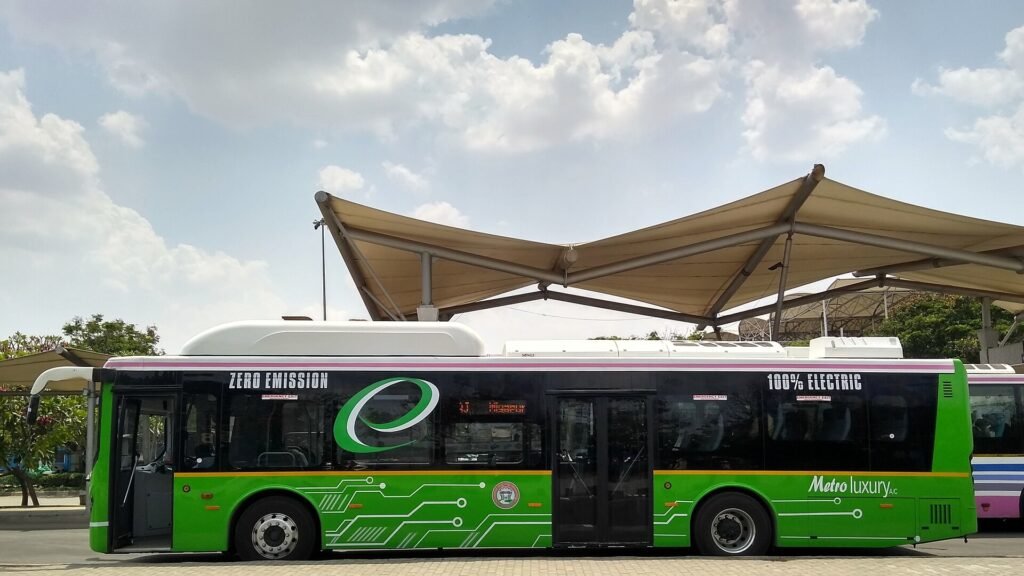
Featured image credit: Image: LoveofZ via Wikimedia Commons (CC BY-SA 4.0). Source
By Piyush P. Yadav
How much does an electric bus cost in India? The list price of a full-size 12-metre electric city bus runs from about Rs 1 crore for a Switch EiV 12 or an EKA 9-metre to Rs 2.2 crore for a Tata Starbus EV low-floor, and smaller electric buses start around Rs 35 lakh. But almost no Indian city buys a bus at list price. The overwhelming majority of the country’s electric buses are procured under gross cost contracts, in which the operator supplies the bus, the driver, the energy and the maintenance for a fixed fee of roughly Rs 55 per kilometre over 10 to 12 years, and the Centre pays a per-bus incentive averaging about Rs 31 lakh under PM E-DRIVE. This guide gives the list prices where they exist, explains why they matter less than the per-kilometre rate, works out what a Rs 55 per kilometre contract is worth over its life, and sets out what the two central schemes actually pay.
How we worked this out
List prices are from 91Trucks’ electric bus listings dated 31 August 2026, cross-checked against manufacturer pages and reports on 10 September 2026; where listing sites disagree we say so. Scheme figures are from the Ministry of Heavy Industries’ PM E-DRIVE notification as reported by the Press Information Bureau, and the PM-eBus Sewa approval as reported by Business Standard. Per-kilometre rates are those discovered in CESL’s aggregated tenders and the Mumbai and Pune contracts we analysed in our report on Switch Mobility’s 650-bus order. The lifetime contract calculation uses stated assumptions so it can be re-run for a different route.
List prices, where they are published
| Model | Maker | Length and seating | Battery | Listed price (ex-showroom) |
|---|---|---|---|---|
| Starbus EV 4/12 low-floor | Tata Motors | 12 m, 35 seats | Not listed | Rs 2.20 crore |
| EiV 12 | Switch Mobility (Ashok Leyland) | 12 m, 35 seats | Not listed | Rs 1.00 crore |
| 9M | EKA Mobility | 9 m | 200 kWh | Rs 1.00 crore |
| C9 / X2 range | Olectra Greentech | 9 m and 12 m | Varies | About Rs 1.6 to 1.75 crore reported |
| EcoLife range | JBM Auto | 9 m and 12 m | Varies | From about Rs 1.8 crore reported |
| Hiroi.ev | SML Isuzu | Midi, 33 seats | Not listed | Rs 26.10 lakh listed; treat as indicative |
| Ultra EV 9, Intercity EV 2.0 | Tata Motors | 9 m and 12 m | Not listed | Listing-site figures are unreliable; Tata quotes to fleets only |
Two cautions. First, the spread between the Switch and Tata 12-metre figures, more than double, reflects specification rather than pricing policy: a low-floor bus with air-conditioning, a 300-plus kWh pack and automatic passenger counting costs far more than a high-floor standard-floor bus with a 200 kWh pack. Second, listing sites publish whatever a dealer or an old tender once quoted, and several figures are internally inconsistent. For an actual purchase, a fleet buyer gets a quote against a specification, not a sticker.
Why the sticker price is the wrong number
Indian state transport undertakings almost never buy electric buses outright. They sign gross cost contracts, under which a private operator owns the buses and is paid per kilometre operated, with a minimum assured kilometre per bus per day and penalties for breakdowns. We explained the mechanism, the diesel comparison and the Rs 3,435 crore central payment-security fund in our guide to how electric bus contracts work in India. What matters here is the arithmetic: the bus’s price is one input into a rate that also covers the driver, the electricity, the depot charger, the maintenance, a mid-life battery replacement and the operator’s return.
| Contract benchmark | Rate | Source |
|---|---|---|
| CESL aggregated tender benchmark, 12 m AC | About Rs 54 per km | Our GCC guide |
| Switch Mobility, Mumbai (BEST), 2026 | Rs 55.55 per km | Our Switch 650-bus report |
| Switch Mobility, Pune (PMPML), 2026 | Rs 60.99 per km | Our Switch 650-bus report |
What a Rs 55 per km contract is worth over its life
Assumptions: 200 km assured per bus per day, 330 operating days a year, 12-year contract, flat rate. A real contract has an annual escalation clause and the assured kilometres vary by city, so treat this as the order of magnitude.
| Line | Calculation | Value |
|---|---|---|
| Kilometres over the contract | 200 x 330 x 12 | 7,92,000 km |
| Gross payment to operator | 7,92,000 x Rs 55 | About Rs 4.36 crore |
| Of which the bus, at a Rs 1.5 crore fleet price less a Rs 31 lakh incentive | About Rs 1.19 crore, or 27 per cent | |
| Electricity, at 1.2 kWh per km and Rs 7 per unit | 7,92,000 x 1.2 x 7 | About Rs 66 lakh, or 15 per cent |
| Driver, maintenance, battery replacement, depot charger, financing, margin | Remainder | About Rs 2.5 crore, or 58 per cent |
The bus itself is about a quarter of the money. That is why manufacturers compete on the per-kilometre bid rather than the list price, why financing cost and battery life move the economics more than a 10 per cent discount on the vehicle, and why the Centre’s incentive is structured as a share of the vehicle price rather than a subsidy on the contract rate.
What the central schemes pay
| Scheme | Outlay | Buses | What it pays per bus | Who gets it |
|---|---|---|---|---|
| PM E-DRIVE (e-bus component) | Rs 4,391 crore | 14,028 | Average about Rs 31.3 lakh; capped at 20 per cent of the CESL-discovered price, which implies full incentive on buses priced at Rs 1.56 crore or more | State transport undertakings in nine cities of over 40 lakh population, via CESL aggregation |
| PM-eBus Sewa | Rs 57,613 crore total, of which Rs 20,000 crore central support | 10,000 | Rs 5.76 crore per bus over the contract life, covering operations, not just the vehicle; central share about Rs 2 crore per bus | 169 cities of 3 lakh-plus population, on a public-private partnership model |
| Payment security mechanism | Rs 3,435 crore | 38,000 | Guarantees operator payments if a transport undertaking defaults | Operators under both schemes |
The PM-eBus Sewa number is the one most often misread. Rs 5.76 crore per bus is not the price of a bus; it is the estimated cost of buying and running one for the contract period, with the Centre funding roughly a third. Read against the Rs 4.36 crore lifetime value of a Rs 55 per km contract above, the two figures describe the same economics from opposite ends. On top of both, the proposed Rs 9,852 crore heavy-duty scheme, which we covered in our report on the Rs 9,852 crore e-bus and e-truck plan, would add another 50,000 buses with a credit guarantee if notified.
What decides the price of a specific bus
- Length and floor height. A 9-metre standard-floor bus is the cheapest full-size configuration; a 12-metre low-floor bus for metro cities is the dearest, as the Tata Starbus EV listing shows.
- Battery size. Packs run from about 200 kWh on a 9-metre bus to well over 300 kWh on a 12-metre intercity bus. At current cell prices each additional 100 kWh adds roughly Rs 10 to 15 lakh to the vehicle and adds range that the assured-kilometre schedule may or may not need.
- Localisation. Since 1 September 2026 buses claiming PM E-DRIVE incentives must use traction motors assembled in India to the ministry’s process list, which we set out in our report on the e-bus and e-truck localisation deadline. Imported-motor buses are cheaper to build but no longer eligible.
- Air-conditioning, ITS and passenger counting. Specified by the transport undertaking and worth Rs 10 to 20 lakh on a 12-metre bus.
- Order size. CESL’s 6,230-bus tender and the 650-bus Mumbai-Pune order were priced per kilometre, but the volume is what allowed Switch to bid Rs 55.55 in Mumbai; a single-bus buyer pays list.
Who this is for, and the limits
This guide is for transport planners, fleet operators and anyone trying to make sense of a headline such as “Rs 57,613 crore for 10,000 buses”. It is not a price list for buying one bus; for that, a manufacturer quote against a specification is the only reliable figure. The lifetime calculation uses a flat Rs 55 rate and 200 km a day; both vary by contract, and escalation clauses typically raise the rate 3 to 5 per cent a year. Electricity is assumed at Rs 7 per unit at the depot, which is within the state EV tariff range but not universal. School, staff and intercity coaches, which are bought outright, follow list-price economics and are outside the scope of this piece.
Sources & Further Reading
- 91Trucks: Electric buses price in India 2026, model listings
- Press Information Bureau: PM E-DRIVE scheme, component-wise outlay including Rs 4,391 crore for 14,028 e-buses
- Business Standard: PM-eBus Sewa, Cabinet approves Rs 57,613 crore for 10,000 e-buses
- News On AIR: Cabinet approves Rs 3,435 crore payment security scheme for 38,000 electric buses
People also ask
How much does an electric bus cost in India?
List prices run from about Rs 35 lakh for small city buses to Rs 1 crore for a Switch EiV 12 or EKA 9-metre and Rs 2.2 crore for a Tata Starbus EV 12-metre low-floor. Most are bought under gross cost contracts at about Rs 55 per kilometre rather than at list price.
Which companies make electric buses in India?
Tata Motors, Switch Mobility (Ashok Leyland), Olectra Greentech, JBM Auto, PMI Electro Mobility, EKA Mobility, Eicher (VE Commercial Vehicles) and SML Isuzu. Tata, Switch, Olectra, JBM and PMI account for most of the buses in state transport fleets.
How many electric buses are there in India?
Several thousand are in service, and more than 24,000 have been sanctioned under the two central schemes: 10,000 under PM-eBus Sewa across 169 cities and 14,028 under PM E-DRIVE in nine large cities. CESL’s 6,230-bus tender and the proposed 50,000-bus heavy-duty scheme would add to that.
What is the cost of an electric bus under a gross cost contract?
About Rs 54 to 61 per kilometre in 2026 tenders, covering the bus, driver, electricity and maintenance. At 200 km a day for 12 years that is roughly Rs 4.4 crore per bus, of which the vehicle itself is about a quarter.
Which electric bus is best in India?
There is no single answer; transport undertakings specify length, floor height, battery and features, and award on price per kilometre and reliability. Tata’s Starbus EV and Switch’s EiV range dominate metro low-floor orders; Olectra, JBM and PMI have large standard-floor fleets in Hyderabad, Delhi and Uttar Pradesh.
Are electric buses cheaper to run than diesel?
Per kilometre, yes: electricity at 1.2 kWh per km and Rs 7 a unit costs about Rs 8.40 per km against Rs 25 to 30 for diesel at 3.5 km per litre. The higher purchase price is recovered through the contract, which is why gross cost bids for electric buses now undercut diesel in most large-city tenders.