

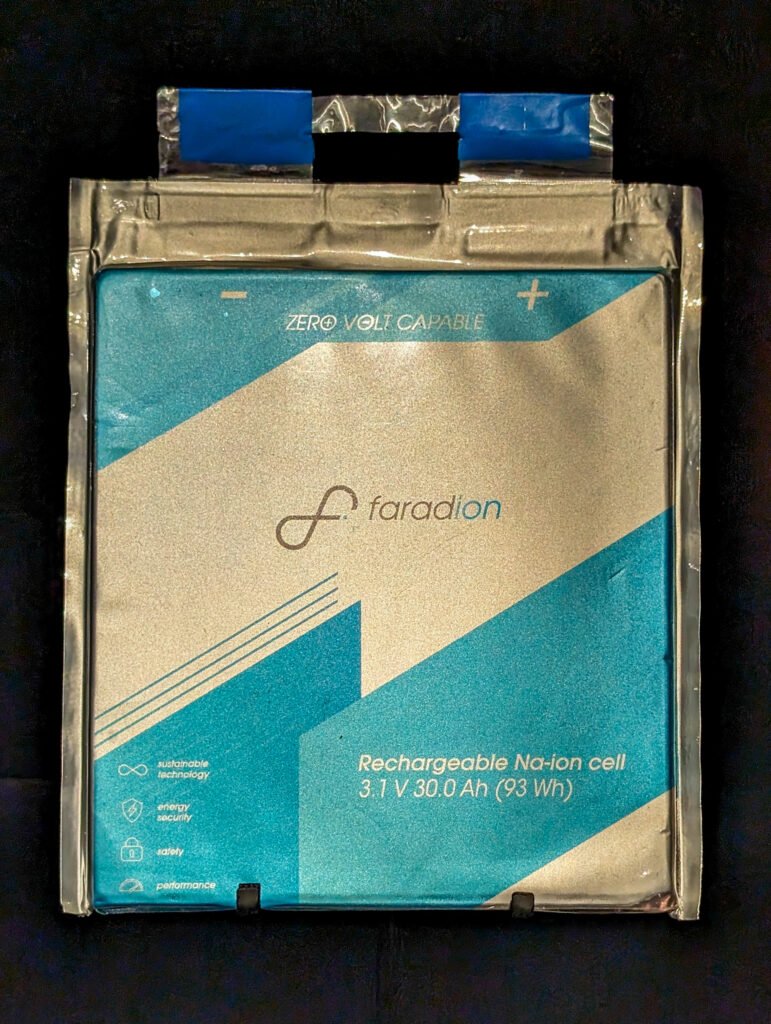
Featured image credit: Image: The wub via Wikimedia Commons (CC BY-SA 4.0).
India’s electric vehicle revolution has a critical vulnerability: heavy reliance on imported battery cells, lithium, and semiconductor chips — largely from China. Battery costs account for 35-40% of an EV’s price, and lithium price volatility directly impacts what Indian consumers pay for electric vehicles.
But a technological shift is underway that could change everything. Sodium-ion batteries — using one of Earth’s most abundant elements — are entering mass production in 2026, promising to slash EV battery costs by 15-20% while reducing India’s import dependence. Here’s what this means for India’s EV market.
Battery Technologies Compared: A Complete Guide
| Parameter | Lithium-Ion (NMC) | LFP (LiFePO₄) | Sodium-Ion | Solid-State |
|---|---|---|---|---|
| Energy Density | 200-300 Wh/kg | 150-200 Wh/kg | 120-160 Wh/kg | 300-500 Wh/kg |
| Cost (2026) | $120-150/kWh | $80-100/kWh | $60-80/kWh | $300+/kWh |
| Cycle Life | 1,500-3,000 | 3,000-5,000 | 2,000-4,000 | 10,000+ |
| Safety | Moderate (thermal runaway risk) | High | Very High | Highest (no liquid electrolyte) |
| Temperature Range | -20 to 60°C | -20 to 60°C | -40 to 80°C | -30 to 100°C |
| Key Materials | Lithium, Cobalt, Nickel | Lithium, Iron, Phosphate | Sodium, Iron, Manganese | Lithium, Ceramic/Polymer |
| India Availability | Now (imported) | Now (growing domestic) | 2026-2028 | 2030-2032 |
| Best For | Premium EVs, long range | Mass-market EVs, buses | 2W, 3W, short-range, storage | Premium EVs, aerospace |
Why Sodium-Ion Matters for India
1. Abundant Raw Materials
Sodium is 1,000 times more abundant than lithium and can be extracted from seawater — India has 7,517 km of coastline. Unlike lithium (concentrated in Chile, Australia, Argentina) and cobalt (70% from Congo), sodium faces no geopolitical supply risks. India could become self-sufficient in sodium-ion battery raw materials.
2. 15-20% Lower Cost
Sodium-ion batteries eliminate the need for cobalt and nickel — the two most expensive and ethically problematic battery materials. At current projections, sodium-ion battery packs could reach $60-80/kWh by late 2026, compared to $120-150/kWh for NMC lithium-ion. This translates to approximately ₹30,000-50,000 savings on an electric two-wheeler and ₹1-2 lakh on an electric car.
3. Superior Performance in Indian Conditions
India’s extreme temperatures — from -10°C in Kashmir to 50°C in Rajasthan — are a challenge for lithium-ion batteries, which lose significant capacity below 0°C. Sodium-ion batteries operate across a -40°C to 80°C range, making them inherently better suited for India’s diverse climate.
4. Manufacturing Opportunity
Sodium-ion technology presents India with a rare opportunity to leapfrog in battery manufacturing rather than playing catch-up in lithium-ion, where China dominates with 80%+ global capacity. Several Indian startups and established companies are already exploring sodium-ion manufacturing.
Global Sodium-Ion Progress in 2026
- CATL (China) — Began commercial deployment of Naxtra sodium-ion batteries in real-world vehicles. First sodium-ion powered EV by mid-2026, battery costs approaching $100/kWh
- BYD (China) — Developing sodium-ion packs for budget electric vehicles
- Reliance Industries (India) — Invested in sodium-ion research through Faradion acquisition
- Greater Bay Technology — Developed all-solid-state cells with energy densities of 260-500 Wh/kg
The Road Ahead: When Will India See Sodium-Ion EVs?
Phase 1: 2026-2027 — Two-Wheelers and Three-Wheelers
The first sodium-ion powered vehicles in India will be electric scooters, bikes, and auto-rickshaws. These vehicles need smaller battery packs (2-5 kWh) where sodium-ion’s lower energy density is less of a disadvantage, and the cost savings are most impactful in the price-sensitive mass market.
Phase 2: 2027-2028 — Stationary Storage and Commercial Vehicles
Home energy storage systems and commercial fleet vehicles (delivery vans, city buses) will adopt sodium-ion, where weight is less critical than cost and cycle life. India’s growing solar energy sector is a massive market for affordable battery storage.
Phase 3: 2028-2030 — Passenger Cars
As energy density improves beyond 200 Wh/kg, sodium-ion batteries will enter the compact electric car segment, potentially enabling a sub-₹6 lakh electric car — a true mass-market breakthrough for India.
What About Solid-State Batteries?
Solid-state batteries are the ultimate goal — 2x energy density, zero thermal runaway risk, and 10,000+ cycle life. But they remain expensive ($300+/kWh) and difficult to manufacture at scale. India can expect solid-state batteries in premium EVs by 2030-2032 and mass-market applications by 2033-2035.
For the next 5 years, the practical battery evolution for India is: LFP lithium-ion (now) → Sodium-ion (2026-2028) → Solid-state (2030+).
Frequently Asked Questions
What is a sodium-ion battery?
A sodium-ion battery uses sodium ions instead of lithium ions to store energy. Sodium is 1,000 times more abundant than lithium and can be extracted from seawater, making these batteries 15-20% cheaper. They work on the same basic principle as lithium-ion but use different electrode materials.
When will sodium-ion batteries be available in India?
Large-scale deployment is expected between 2026 and 2028, starting with electric two-wheelers, three-wheelers, and stationary energy storage. CATL began commercial production in 2026. Indian manufacturers like Reliance (through Faradion) are developing domestic production capabilities.
Are sodium-ion batteries better than lithium-ion?
They’re cheaper and use more abundant materials, but currently have lower energy density (120-160 Wh/kg vs 200-300 Wh/kg). This means more weight for the same range. They’re ideal for short-range EVs, two-wheelers, and energy storage, but not yet suitable for premium long-range cars.
Will solid-state batteries come to India?
Yes, but not until 2030-2032 for premium vehicles and even later for mass-market. Solid-state offers 2x energy density and superior safety, but manufacturing costs are currently 2-3x higher than lithium-ion. India will likely see a transition from LFP → sodium-ion → solid-state over the next decade.
Are sodium-ion batteries safer than lithium-ion batteries?
Yes. Sodium-ion cells show significantly lower peak temperatures during thermal runaway and are inherently more thermally stable, making them less prone to the fires that occasionally affect lithium-ion packs. This safety margin is a key reason they are being rolled out first for two-wheelers and stationary storage rather than premium long-range cars.
Does India need to import sodium the way it imports lithium?
No, and that is the strategic appeal. India has almost no domestic lithium reserves and imports nearly all of it, while sodium is abundant domestically from seawater and limestone deposits in Rajasthan, Chhattisgarh, and Jharkhand. Capturing this advantage still requires India to build out cathode, anode, and electrolyte manufacturing capacity, which is currently limited.
What is currently holding back sodium-ion battery adoption in India?
The gap is manufacturing ecosystem, not chemistry: India lacks mature domestic production of battery-grade sodium-ion materials, and current incentive schemes remain lithium-centric with no dedicated targets or safety certification standards yet for sodium-ion cells. This is expected to improve as Reliance (via Faradion) and other players scale up domestic production through 2026-2028.
Stay updated on EV battery breakthroughs → evautoindia.co.in/news
Related Reading