

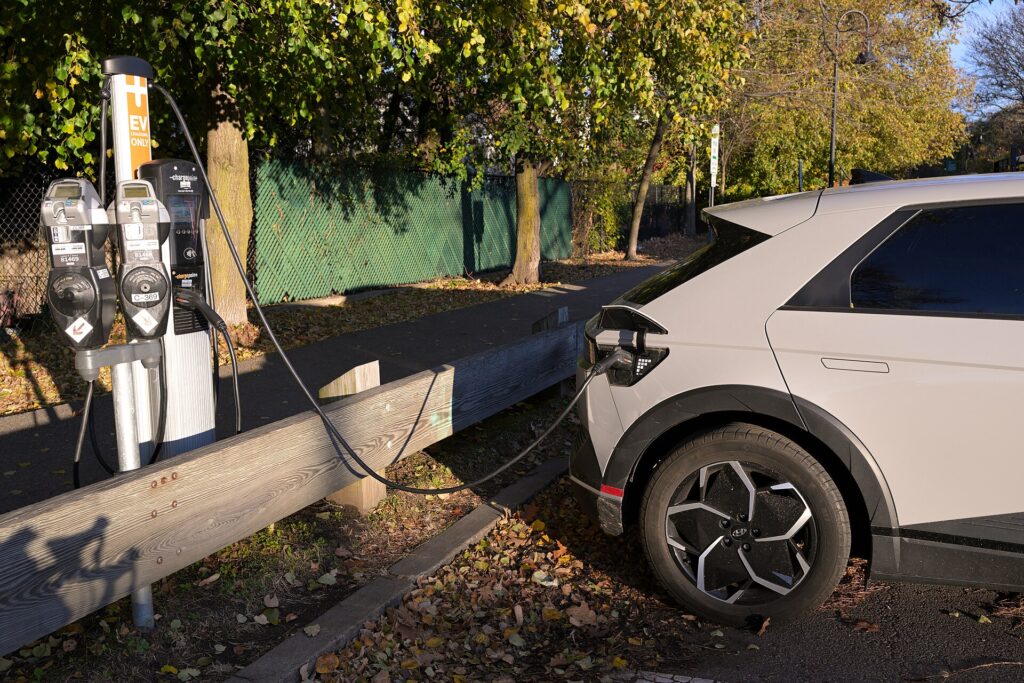
Featured image credit: Image: 4300streetcar via Wikimedia Commons (CC BY 4.0). Source
By Piyush P. Yadav
Six of the electric cars launching or opening bookings in India this autumn advertise an 800-volt system: the Porsche Cayenne Electric, the Range Rover Electric, the Volvo EX90 and ES90, and the Hyundai Ioniq 5 and Kia EV6 that preceded them. Every Tata, Mahindra, MG, Maruti and mass-market Hyundai EV runs at roughly 400 volts. The number is starting to appear in brochures as if it were a range figure, and buyers are asking whether a 400V car is already obsolete. It is not, and this explainer sets out why: what the voltage actually changes, why it matters for charging speed and cable weight but barely at all for range, which cars sold in India use which system, what a 400V car can and cannot do on India’s chargers, and why Mahindra chose 400V for a platform it says can charge in 20 minutes.
What the voltage is, and what it is not
An EV battery is a stack of cells wired in series and parallel. Series connections add voltage; parallel connections add capacity. A “400V” pack typically sits between 350 and 450 volts depending on state of charge, and an “800V” pack between 700 and 900. The pack’s energy in kilowatt-hours is voltage multiplied by amp-hours, so the same 80 kWh can be built as 400V and 200 Ah or as 800V and 100 Ah. Voltage on its own says nothing about how far the car goes.
What voltage changes is current. Power is voltage times current, so delivering 200 kW into a 400V pack needs 500 amps, while the same 200 kW into an 800V pack needs 250. Current is what heats cables, connectors and busbars, and heat rises with the square of current. Halving the current cuts resistive losses by three-quarters for the same conductor, or allows conductors half the weight for the same loss. That single fact drives every advantage of 800V.
The advantages, honestly sized
| Benefit | What 800V delivers | How much it matters in India |
|---|---|---|
| Peak DC charging power | 350 to 400 kW without exotic cooling; 400V cars top out around 150 to 250 kW | Only on 240 kW and 350 kW chargers, of which India has a few dozen |
| Cable and connector heat | Half the current for the same power; liquid-cooled cables handle 500 A, but 250 A is far easier | Relevant at the charger, not to the owner |
| Wiring weight | Thinner high-voltage harness, saving perhaps 10 to 20 kg on a large car | Marginal; under 1 per cent of vehicle mass |
| Motor and inverter efficiency | Lower current means lower losses in the inverter and motor windings; silicon carbide inverters suit 800V | Perhaps 1 to 3 per cent better efficiency at high load; small on a city commute |
| Range | No direct effect; range is set by pack energy, mass and drag | None. A 400V Nexon EV and an 800V Ioniq 5 both go as far as their kWh allow |
The efficiency benefit is real but small, and it shows up on the highway rather than in traffic. The charging benefit is large but conditional on the charger. A Kia EV6 that claims 18 minutes from 10 to 80 per cent on a 350 kW unit will take over 50 minutes on a 120 kW unit and close to an hour and a half on a 60 kW unit, just like a 400V car with the same battery, because the charger, not the car, is the limit. We explained the shape of that curve in our guide to why EVs never charge at the charger’s rated speed.
The costs of going to 800V
If 800V were free, every car would use it. It is not. Every component that touches the high-voltage bus must be rated for it: the inverter’s power switches, the on-board charger, the DC-DC converter that feeds the 12V system, the compressor for the air-conditioning and the battery heater. Silicon-carbide inverters, which are what make 800V efficient, cost more than the silicon IGBTs used at 400V. Contactors and fuses rated for 800V are larger and dearer. Insulation and creepage distances grow. For a car with a 30 to 60 kWh pack that will rarely see a charger above 60 kW, the money is better spent on the pack itself. That is why every Indian car below about Rs 50 lakh runs at 400V, and why a Tata engineer will tell you, correctly, that a Rs 15 lakh EV at 800V would be a worse car.
There is also a compatibility cost. Most public DC chargers in India were designed around 400V cars and deliver their rated power at 400 to 500V. An 800V car plugged into a 500V-limited charger either charges very slowly or has to convert the voltage on board. Hyundai and Kia fit a boost converter using the rear motor’s inverter for exactly this reason; the Porsche Taycan can split its pack into two 400V halves. Both solutions add cost and lose a little energy.
Which cars in India use which system
The table lists the electrical architecture, peak DC rate and claimed 10-to-80 per cent time for the main models on sale or arriving this quarter. The mass-market figures are those we verified for our charging-curve guide; the flagship figures are from the manufacturers’ launch material.
| Model | Architecture | Battery | Peak DC | Claimed 10-80 per cent | Ex-showroom price |
|---|---|---|---|---|---|
| Porsche Cayenne Electric | 800V | 113 kWh | 390-400 kW | About 16 min | Rs 1.77 crore |
| Porsche Taycan | 800V | Up to 105 kWh | 320 kW | 18 min | Rs 1.53 to 2.54 crore |
| Porsche Macan Electric | 800V | 100 kWh | 270 kW | About 21 min | Rs 1.22 to 1.73 crore |
| Range Rover Electric | 800V | 118.5 kWh | 350 kW | 22 min | Rs 3.5 to 3.7 crore (expected) |
| Volvo EX90 / ES90 | 800V | 92 / 106 kWh | 350 kW | 22 min | Launch 12 October |
| Hyundai Ioniq 5 (2026) | 800V | 84 kWh | 350 kW | 18 min | Rs 55.71 lakh |
| Kia EV6 | 800V | 84 kWh | 350 kW | 18 min | Rs 65.98 lakh |
| BMW i7 facelift | 400V | 112.4 kWh | 250 kW | 28 min | About Rs 2.10 crore (expected) |
| Mahindra BE 6 / XEV 9e / XEV 9S | 400V (INGLO) | 59 / 79 kWh | 175 kW | About 20 min (20-80) | Rs 18.90 lakh upward |
| Tata Harrier EV | 400V | 65 / 75 kWh | 120 kW | About 25 min (20-80) | Rs 21.49 lakh upward |
| Hyundai Creta Electric (updated) | 400V | 42 / 51.4 kWh | 100 kW | 39 min | Rs 18.20 lakh upward |
| Tata Curvv EV | 400V | 45 / 55 kWh | 70 kW | 40 min | Rs 17.19 lakh upward |
| Maruti e Vitara | 400V | 49 / 61 kWh | 70 kW | 45 min | Rs 17.49 lakh upward |
Two things are visible in the table. The 800V cars cluster above Rs 55 lakh, and the cheapest of them, the Ioniq 5, is a global platform whose voltage was chosen for European and Korean networks. And the BMW i7, at Rs 2 crore, proves that 400V is not a budget compromise: BMW gets 250 kW out of a 400V pack by using very high current through liquid-cooled connectors, and its 28-minute claim is respectable against the Cayenne Electric’s 16 minutes.
The Mahindra case: 400V, 175 kW, 20 minutes
Mahindra’s INGLO platform is the most instructive example in the Indian market. It is a 400V architecture, yet the BE 6 and XEV 9e accept 175 kW and claim 20 to 80 per cent in about 20 minutes on a 79 kWh pack, faster than several 800V cars manage on the chargers India actually has. Mahindra did this with a liquid-cooled pack of prismatic LFP cells from BYD, a pack designed to accept high current across a wide state-of-charge window, and a charging port and cable rated for the current involved. The lesson is that peak power depends on cell chemistry, thermal management and pack design at least as much as on voltage. An 800V pack with poorly cooled cells will taper early; a well-engineered 400V pack will hold its rate. Our guide to LFP and NMC chemistry in Indian EVs covers the cell side of that equation.
Mahindra has said INGLO was designed with headroom for higher voltage in future variants. Tata’s Avinya-based premium cars, due from late 2026, are also expected to sit above 400V. Neither company has confirmed a production 800V car yet.
What 800V gets you on India’s charger network
The honest answer is: not much, yet. The public network is dominated by units under 30 kW, and even the highway hubs are mostly 60 to 120 kW, with a small number of 240 kW units on the Delhi-Mumbai, Mumbai-Pune and Bengaluru-Chennai corridors and at a few dealer sites. A 350 kW charger is rarer still. On a 120 kW unit an 800V Ioniq 5 and a 400V Harrier EV both charge at about 100 to 120 kW until the taper, and the Ioniq’s 18-minute claim becomes about 45 minutes. The advantage only appears on the handful of chargers that can supply more than the 400V car’s ceiling, and it will grow as the network does: the 2030 target of 13 lakh charging points includes a much larger share of 120 kW-plus units, and the newest highway installations are being specified at 240 kW and above precisely because the flagship cars now arriving can use them.
| Charger power | 800V car, 84 kWh (Ioniq 5 / EV6) | 400V car, 79 kWh (Mahindra BE 6) | 400V car, 55 kWh (Curvv EV) |
|---|---|---|---|
| 30 kW (most metro units) | About 2 h 15 min | About 2 h 5 min | About 1 h 25 min |
| 60 kW (common DC unit) | About 1 h 10 min | About 1 h 5 min | About 50 min |
| 120 kW (highway hub) | About 40 to 45 min | About 35 to 40 min | About 40 min (car-limited to 70 kW) |
| 240 kW (corridor unit) | About 25 min | About 20 to 25 min (car-limited to 175 kW) | About 40 min |
| 350 kW (rare) | 18 min (claim) | About 20 min (car-limited) | About 40 min |
Times are for 10 to 80 per cent, assume a warm pack and a charger delivering its rating, and are indicative. The point of the table is that below 240 kW the architecture is irrelevant; the pack size and the charger set the time.
Should voltage influence a purchase?
- Below Rs 30 lakh: no. There is no 800V car in this bracket, and a well-designed 400V pack such as Mahindra’s charges faster than most of India’s chargers can supply anyway. Compare peak kW and, more importantly, the claimed 10-to-80 time on a 60 kW and a 120 kW unit.
- Rs 50 lakh to Rs 1 crore: only if you road-trip on corridors with 240 kW chargers. The Ioniq 5 and EV6 will reward you there; on a 60 kW unit they will not.
- Above Rs 1 crore: most of the field is 800V, and the exception, the BMW i7, is competitive on the chargers that exist. Buy on range, cabin and dealer support.
- For everyone: home AC charging is unaffected by architecture. An 11 kW wallbox fills a 400V and an 800V pack at the same rate, and that is where nearly all charging happens.
Sources & Further Reading
- Autocar India: Mahindra reveals new EV architecture named INGLO
- Autocar India: Hyundai Ioniq 5 (2026) price, range and review
- Autocar India: Porsche Macan EV price, range and specifications
- Green Cars Compare: The rise of 800V EV architecture, benefits and constraints
FAQ
Does an 800V electric car have more range than a 400V car?
No. Range is set by battery energy in kWh, vehicle mass and aerodynamics. Voltage affects how fast the pack can charge and how efficiently power moves through the cables, motor and inverter, which is worth at most a few per cent on the highway.
Which electric cars in India have 800V architecture?
The Porsche Taycan, Macan Electric and Cayenne Electric, the Range Rover Electric, the Volvo EX90 and ES90 arriving in October, and the Hyundai Ioniq 5 and Kia EV6. All Tata, Mahindra, MG, Maruti, Kia Syros and Hyundai Creta Electric models, and the BMW i7, run at about 400V.
Is Mahindra’s INGLO platform 400V or 800V?
INGLO is a 400V architecture. The BE 6, XEV 9e and XEV 9S accept up to 175 kW DC and claim 20 to 80 per cent in about 20 minutes on the 79 kWh pack, which is faster than most Indian chargers can deliver. Mahindra has said the platform has headroom for higher voltage in future.
Will a 400V car become obsolete as 800V spreads?
Not in India’s foreseeable charging landscape. Below 240 kW, which describes almost every public charger in the country, a 400V and an 800V car with the same battery charge at essentially the same speed, and home AC charging is identical for both.
Can an 800V electric car charge on India’s 400V DC chargers?
Yes, and here it does so almost all the time, because virtually every public DC charger in the country is a 400V-class unit. Hyundai and Kia’s E-GMP cars use the motor and inverter as a boost converter to step the incoming 400V up to pack voltage, with no adapter or special cable needed, and Porsche fits a dedicated DC-DC booster to do the same job. The cost is speed rather than compatibility: an Ioniq 5 that will take up to 270 kW on a true 800V charger is limited to roughly 150 kW on a 400V one.
Is an 800V battery actually 800 volts?
Not exactly. 800V is a class label rather than a measurement, and these packs typically operate somewhere in the 600 to 800 volt band depending on state of charge, just as a 400V pack usually sits nearer 350 to 450 volts. What matters is the band the pack occupies, because that decides whether a given charger can feed it directly or has to boost the voltage first.
Is an 800V system more dangerous or harder to service?
Not meaningfully more dangerous for the owner. Both 400V and 800V packs are already far above safe-touch voltage, so the protection comes from the same mechanisms either way: isolation monitoring, high-voltage interlocks and pyrotechnic fuses that disconnect the pack in a crash, all of which AIS-038 Rev 2 requires. The real difference is on the workshop side, where 800V cars need technicians and tooling rated for the higher band, and in India those are concentrated in a small number of luxury-brand service centres worth checking for before you buy one outside a metro.