

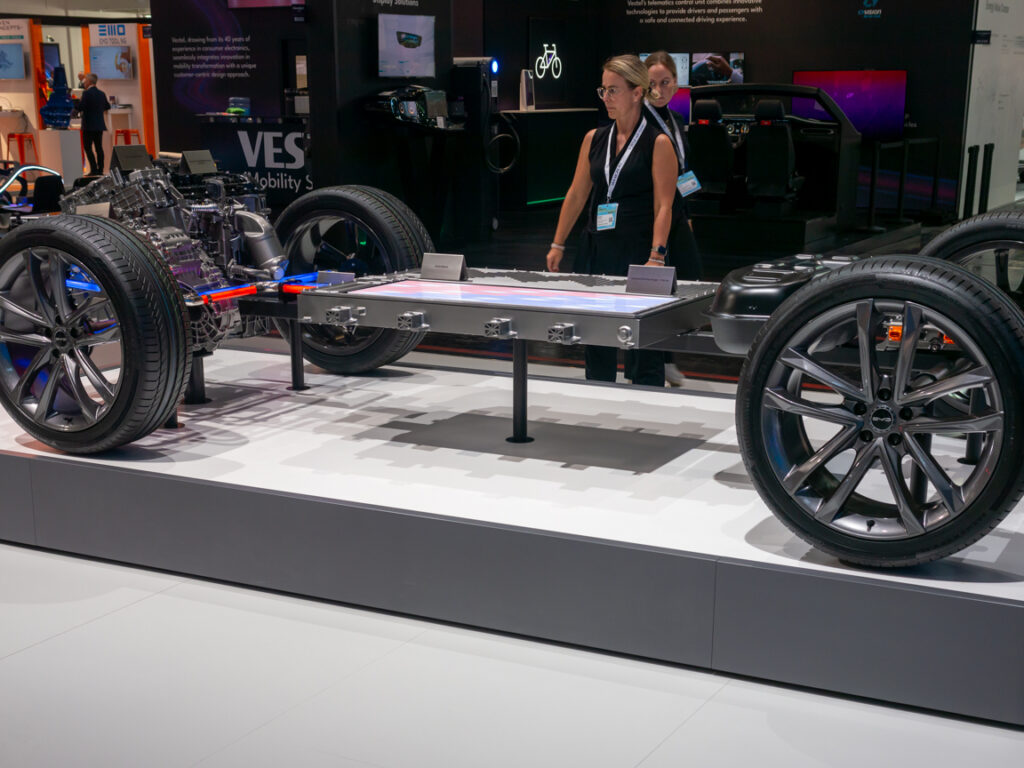
Featured image credit: Image: Matti Blume via Wikimedia Commons (CC BY-SA 4.0). Source
By Piyush P. Yadav
Every electric vehicle sold in India uses a lithium-ion battery, but the phrase hides a split that decides how long the pack lasts, how you should charge it, how it behaves in a 45-degree May afternoon and what it costs to replace. Almost every Tata, Mahindra, MG, Maruti and BYD car now uses lithium iron phosphate, or LFP. Hyundai’s Creta Electric, Mahindra’s older XUV400 and most premium scooters from Ather, Ola’s earlier generations, TVS and Vida use nickel manganese cobalt, or NMC. This guide explains the difference in plain terms, lists which chemistry is in each mainstream Indian EV, and sets out what the choice means for a buyer over eight years of ownership.
What the two chemistries actually are
Both are lithium-ion cells. The difference is the material of the positive electrode, the cathode, which stores the lithium ions when the cell is discharged. In an NMC cell the cathode is a layered oxide of nickel, manganese and cobalt. In an LFP cell it is lithium iron phosphate, a crystal structure with no nickel or cobalt. That single change drives every practical difference.
| Property | NMC | LFP | Why it matters |
|---|---|---|---|
| Cell energy density | 190 to 260 Wh/kg | About 110 to 170 Wh/kg in current cells | LFP packs are heavier for the same kWh, so LFP cars carry more weight or offer less range |
| Cycle life to 80 per cent capacity | 1,000 to 2,000 cycles | 2,500 to 4,000-plus cycles | An LFP pack can outlast the car |
| Thermal runaway onset | Around 200 to 250 degrees C | Around 270 degrees C or higher, with far less oxygen release | LFP is more tolerant of heat and abuse |
| Charging to 100 per cent | Accelerates ageing; 80 per cent daily is advised | Tolerated; manufacturers recommend weekly full charges to calibrate the gauge | Changes your daily routine |
| Cost per kWh at cell level | Higher; nickel and cobalt are expensive | Roughly 20 to 30 per cent lower | Why sub-Rs 20 lakh EVs are LFP |
| Cold-weather performance | Better | Range and charge rate drop more below about 10 degrees C | Matters in Himachal, Kashmir and Ladakh winters, less elsewhere |
| State-of-charge gauge accuracy | Easier; voltage varies with charge | Harder; voltage is flat between 20 and 90 per cent | Why LFP cars occasionally show odd range jumps |
Which chemistry is in which Indian EV
The table below is compiled from manufacturer specifications, supplier announcements and reviews. Where a maker has not disclosed chemistry, we say so.
Electric cars
| Model | Chemistry | Cell source (where known) |
|---|---|---|
| Tata Tiago EV, Punch EV, Nexon EV, Curvv EV, Harrier EV, Sierra EV | LFP | Imported prismatic cells packed by Tata AutoComp; Agratas cells from 2027 |
| Mahindra BE 6, XEV 9e, XEV 9S | LFP | BYD Blade cells in the INGLO pack |
| Mahindra XUV400 | NMC | Imported |
| MG Windsor EV and Windsor Pro | LFP | Prismatic cells, packed at Halol |
| MG ZS EV (50.3 kWh) | LFP | Switched to LFP with the 2022 update |
| MG Comet EV | LFP | 17.3 kWh prismatic pack |
| Maruti Suzuki e Vitara, Toyota Urban Cruiser Ebella | LFP | BYD Blade cells, 49 and 61 kWh packs |
| Hyundai Creta Electric | NMC | Cells assembled into packs at Hyundai’s Chennai plant; same chemistry family as Ioniq 5 |
| Kia Syros EV, Carens Clavis EV | NMC | Shared Hyundai-Kia supply chain |
| BYD Atto 3, Seal, Sealion 7, eMax 7 | LFP | BYD’s own Blade cells |
| VinFast VF6, VF7 | NMC | Imported |
| BMW i7, iX, i4; Mercedes EQS | NMC | Imported |
Electric scooters and motorcycles
| Model | Chemistry | Notes |
|---|---|---|
| Ather 450 series, Rizta, Konarc | NMC | 21700 cylindrical cells |
| Ola S1 Pro, S1 X (Gen 3) | NMC | Earlier packs used imported cells; Gen 3 introduced Ola’s 4680 Bharat Cell |
| Ola S1 Z, S1 Z Plus | LFP | Ola states the S1 Z uses an in-house LFP Bharat Cell pack |
| TVS iQube | NMC | Cylindrical cells |
| Bajaj Chetak | NMC | Bajaj does not publish chemistry; supplier and teardown reports indicate NMC |
| Hero Vida VX2, V2 | NMC | Removable packs |
| Ampere (Greaves) Nexus, Magnus | LFP | Greaves has publicly moved its range to LFP |
| Oben Rorr | LFP | One of the first Indian motorcycles to adopt LFP |
| Ultraviolette F77 | NMC | Performance application |
The pattern is clear. Carmakers chasing volume below Rs 25 lakh have standardised on LFP because it is cheaper, safer in Indian heat and lasts longer. Premium cars and most premium scooters stay on NMC because energy density decides range in a small package. Ola’s move to LFP on its cheapest scooter while keeping NMC on the S1 Pro is the segmentation logic in one company.
What it means for how you charge
This is the practical difference most owners never hear about at the showroom.
- NMC: the cathode degrades faster when held at high voltage. Manufacturers and independent studies agree that charging to 80 per cent for daily use and reserving 100 per cent for long trips extends life materially. Hyundai’s Creta Electric manual, for example, lets you set an AC charge limit. Frequent DC fast charging also ages NMC cells faster than AC charging.
- LFP: the flat voltage curve means the battery management system struggles to know exactly how full the pack is unless it periodically sees 100 per cent. Tata, MG and BYD recommend a full charge at least once a week, and there is no meaningful penalty for doing it daily. LFP also tolerates DC fast charging better, though it charges more slowly below about 10 degrees C.
If you own a Tata, Mahindra INGLO, MG, Maruti or BYD EV, charge to 100 per cent without worry. If you own a Creta Electric, an XUV400, a VinFast or an Ather, set the limit to 80 per cent for the daily commute.
What it means for battery life and warranty
The cycle-life gap explains why the warranties differ. A 3,000-cycle LFP pack in a Nexon EV with a 45 kWh battery and about 350 km of real range covers roughly 10 lakh km before reaching 80 per cent capacity in laboratory conditions; the car will be scrapped first. An NMC pack rated at 1,500 cycles in a Creta Electric covers perhaps 4 to 5 lakh km on the same basis, still well beyond typical Indian private use of 10,000 to 15,000 km a year. In practice, calendar ageing from heat matters as much as cycles, and this is where LFP’s thermal stability shows: real-world state-of-health data from Indian fleets, which we examined in our EV battery degradation report, show LFP packs in Tata cars losing capacity more slowly than NMC packs in comparable use.
Tata and MG’s lifetime battery warranties on select models, detailed in our EV battery warranty comparison, are commercially possible only because those packs are LFP. No NMC car in India carries a lifetime warranty.
What it means for safety
The scooter fire incidents of 2022, which prompted the government’s AIS-156 battery safety amendments, largely involved NMC packs with inadequate thermal management. NMC cells release oxygen when they fail, which feeds the fire; LFP cells do not, and their thermal runaway threshold is higher. This does not make LFP fireproof, and a badly built LFP pack can still fail, but it is a large part of why Greaves, Oben and Ola’s budget line have moved to LFP and why every mass-market car brand has. AIS-156 and the Battery Pack Aadhaar identification scheme, which we explained in our Battery Pack Aadhaar explainer, apply to both chemistries.
What it means for replacement cost and resale
LFP cells cost 20 to 30 per cent less per kWh, and that flows through to replacement pricing. Out-of-warranty pack replacements quoted by dealers in 2026 run roughly Rs 5 to 7 lakh for a 40 to 45 kWh Tata or MG pack, against Rs 7 to 9 lakh for the Creta Electric’s 51.4 kWh NMC pack. For scooters the range is Rs 45,000 to 1.2 lakh depending on capacity, with LFP packs at the lower end. On the used market, a car with an LFP pack and a lifetime warranty holds value better than an NMC car whose warranty is running down, a dynamic we covered in our used electric car values guide.
Where the chemistries go next
LFP is not standing still. Lithium manganese iron phosphate, or LMFP, adds manganese to raise energy density by 15 to 20 per cent while keeping most of LFP’s stability, and several Chinese cell makers have it in production. BYD’s second-generation Blade cell has narrowed the density gap further. On the NMC side, high-nickel chemistries with reduced cobalt improve density and cost but not thermal tolerance. Sodium-ion, which India’s Ministry of New and Renewable Energy rates at technology readiness level 7, sits below LFP on density but above it on cost and cold-weather performance, and is likely to appear first in e-rickshaws and stationary storage. India’s own cell plants, from Ola’s Krishnagiri line to Exide’s Bengaluru factory and Tata’s Agratas plant at Sanand, are tooling for both LFP and NMC, with LFP the larger share.
A buyer’s checklist
- Ask the dealer which chemistry the pack uses. If they do not know, the model table above is a starting point.
- If it is NMC, ask whether the car lets you set a charge limit, and use it.
- If it is LFP, do not be alarmed by a range estimate that jumps after a full charge; that is the gauge recalibrating.
- Compare warranty terms with chemistry in mind: an eight-year warranty on an NMC pack is more valuable than the same warranty on LFP, because the NMC pack is more likely to need it.
- For a car kept in Rajasthan, Vidarbha or Telangana summers, weight LFP’s heat tolerance heavily. For a car kept in Shimla or Srinagar, NMC’s cold-weather charging is a real advantage.
Sources & Further Reading
- MeraEV: EV battery types explained, LFP, NMC and what powers your electric car
- Autocar India: Maruti Suzuki and Toyota India EVs to get BYD Blade cell technology
- Autocar India: Hyundai Creta Electric batteries assembled at Chennai plant
- Ampere by Greaves: Why LFP batteries are becoming popular in Indian EV scooters
- BikeWale: LFP vs NMC batteries, which one is better for you
Frequently Asked Questions
Which Indian electric cars use LFP batteries?
All current Tata EVs (Tiago, Punch, Nexon, Curvv, Harrier, Sierra), the Mahindra BE 6, XEV 9e and XEV 9S, the MG Windsor, ZS EV and Comet, the Maruti e Vitara and Toyota Urban Cruiser Ebella, and every BYD model use LFP. The Hyundai Creta Electric, Kia Syros EV, Mahindra XUV400, VinFast VF6 and VF7 and the German luxury EVs use NMC.
Should I charge an LFP battery to 100 per cent?
Yes. LFP chemistry tolerates full charging without meaningful extra wear, and manufacturers recommend charging to 100 per cent at least weekly so the battery management system can calibrate its state-of-charge estimate. NMC packs, by contrast, last longer if kept at 80 per cent for daily use.
Which battery lasts longer, LFP or NMC?
LFP. Typical cycle life to 80 per cent capacity is 2,500 to 4,000-plus cycles for LFP against 1,000 to 2,000 for NMC, and LFP also ages more slowly in heat. This is why Tata and MG can offer lifetime battery warranties on LFP cars and no manufacturer offers one on an NMC car.
Is LFP safer than NMC in Indian summers?
Generally yes. LFP has a higher thermal runaway threshold and does not release oxygen when it fails, which limits fire propagation. NMC packs can be made safe with good thermal management, but the margin is smaller, which is one reason mass-market Indian EVs have shifted to LFP.
Is LFP worse in cold weather, and does that matter in India?
Yes, LFP is the weaker chemistry below roughly 5 to 10 degrees Celsius. Lower ionic conductivity and a very flat voltage curve mean a larger winter range drop and noticeably slower DC charging until the pack has warmed up. For most of India this is irrelevant; it matters if you drive in Delhi, Punjab, Haryana or the hills, where January mornings sit in single digits. The mitigation is the car rather than the chemistry, so look for a battery heater or heat pump and precondition the pack while it is still plugged in.
Does an LFP car charge slower on a DC fast charger than an NMC car?
Usually a little, yes. LFP polarises more at high current, so peak DC rates tend to sit below a comparable NMC pack, and the flat voltage curve makes state of charge harder for the battery management system to read precisely near the top. On the 40 to 50 kWh packs that dominate the Indian market the real-world difference is small, and which charger you find and what it actually delivers will matter far more than the chemistry. The gap widens on large high-voltage long-range packs, which is one reason those trims still lean NMC.
Why does an LFP car usually have less range than an NMC car of similar size?
Energy density. At pack level LFP sits around 125 to 145 Wh/kg against roughly 140 to 180 Wh/kg for NMC, so matching an NMC car’s range on LFP means a physically larger and heavier pack, which costs packaging space and consumes part of the chemistry’s cost advantage. That is why Indian manufacturers tend to put LFP in entry and mid trims where price is decisive, and reserve NMC for the long-range variants at the top of the lineup.