

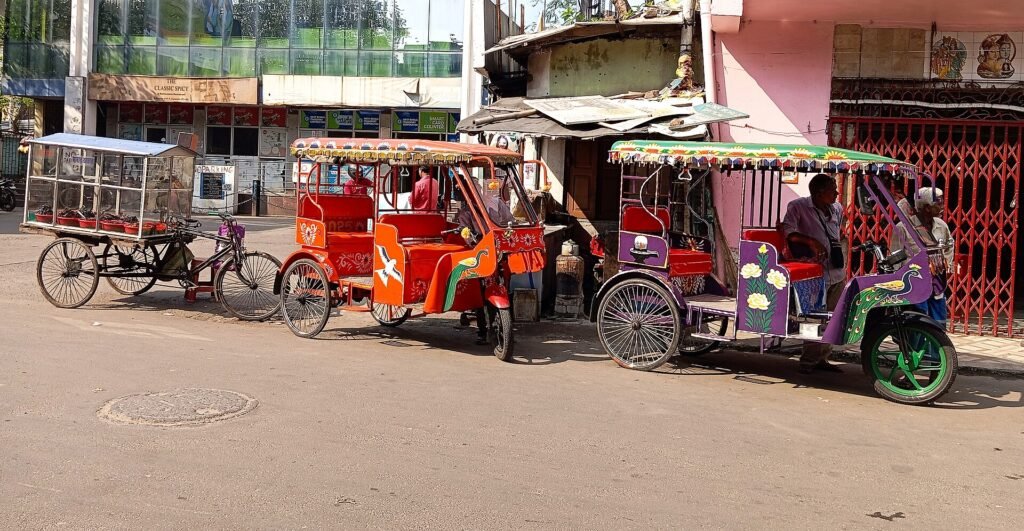
Featured image credit: Image: Salil Kumar Mukherjee via Wikimedia Commons (CC BY-SA 4.0). Source
By Piyush P. Yadav
While the electric truck story in India is still about proving financing models, the electric three-wheeler and small commercial vehicle segment is already a working business for tens of thousands of operators. Electric autos and cargo three-wheelers now compete on upfront price with their petrol and CNG equivalents in many cities, and small electric vans are replacing diesel Tata Aces on last-mile delivery routes. This is a practical buying guide to what is actually on sale, what it costs, and how the economics work for a small operator or fleet.
Electric passenger three-wheelers (e-autos)
| Model | Ex-showroom price | Battery | Claimed range | Warranty |
|---|---|---|---|---|
| Mahindra Treo | Rs 3.23 lakh to Rs 3.38 lakh | 7.37 kWh lithium-ion | Up to 139 km | Battery: minimum 5-year life, backed by 3-year standard warranty |
| Bajaj RE E TEC 9.0 | Check current dealer pricing | Not disclosed in public specs | Up to 178 km | Standard Bajaj commercial vehicle terms |
| Piaggio Ape E-City | Rs 2.84 lakh to Rs 2.89 lakh | 4.5 kWh | About 68 km | Standard Piaggio commercial terms |
The Mahindra Treo remains the segment’s reference point on range and is backed by Mahindra’s fleet-service network, which matters more for a three-wheeler than a private car since these vehicles run 100 to 150 km a day, six or seven days a week. The Piaggio Ape E-City’s shorter 68 km range and smaller 4.5 kWh pack make it a better fit for short, dense-city routes with midday charging opportunities than for a driver doing long shifts without a break.
Electric cargo three-wheelers
| Model | Ex-showroom price | Notes |
|---|---|---|
| Mahindra Treo Zor | Rs 3.13 lakh to Rs 3.94 lakh, depending on flat-bed or delivery-van body | Purpose-built cargo platform, popular with e-commerce and FMCG distribution |
Cargo three-wheelers have become the backbone of last-mile e-commerce delivery in Indian cities, and that segment has been growing faster than any other part of the EV market. We covered the record e-3-wheeler sales volumes alongside Amazon’s fleet commitments in our report on Amazon’s electric truck order and record e-3W sales. Electric three-wheelers already have EV penetration above 60 per cent of new sales in the category, by far the highest of any vehicle segment in India, which means the buying decision today is less “should I go electric” and more “which model and financing structure suits my route.”
Small electric commercial vehicles (four-wheeler SCVs)
| Model | Ex-showroom price | Battery | Range | Payload |
|---|---|---|---|---|
| Tata Ace EV (standard) | Rs 10.51 lakh | 21.3 kWh LFP | 154 km (ARAI-certified) | 600 kg |
| Tata Ace EV 1000 | Rs 11.27 lakh to Rs 11.40 lakh | Larger pack (specifics vary by variant) | Broadly similar to standard Ace EV | 1,000 kg |
| Tata Ace Pro EV | Rs 6.50 lakh | Smaller pack, entry-level variant | Lower than the full-size Ace EV | Lower payload than standard Ace EV |
| Mahindra Zeo | Rs 7.52 lakh to Rs 7.88 lakh | Permanent magnet synchronous motor, 30 kW / 114 Nm | 160 km certified; up to 100 km added in 60 minutes via DC fast charging | Under 2 tonnes; Mahindra cites 32 per cent gradeability, the highest in its segment |
The Tata Ace EV, India’s first electric four-wheeler small commercial vehicle, carries the “Chhota Hathi” brand recognition that has made the diesel Ace ubiquitous in Indian cities for two decades, and that legacy matters for resale and driver familiarity. Its 21.3 kWh LFP pack and 105-minute full charge time suit depot-based delivery operations with predictable downtime between runs. The Mahindra Zeo undercuts the full-size Ace EV on price while offering a longer certified range and notably better gradeability, a real advantage for operators in hilly cities or those regularly loading ramps.
Running-cost comparison: electric vs diesel/CNG small commercial vehicle
| Item | Diesel Tata Ace (for comparison) | Tata Ace EV |
|---|---|---|
| Fuel/energy cost per km | Roughly Rs 6 to Rs 8 at current diesel prices and typical mileage | Roughly Rs 1.50 to Rs 2.50 on home or depot charging |
| Daily running (100 km) | Rs 600 to Rs 800 | Rs 150 to Rs 250 |
| Maintenance | Regular engine oil, filter, clutch and exhaust servicing | Minimal — no engine, fewer wearing parts |
| Purchase price premium | Baseline | Roughly Rs 3 lakh to Rs 4 lakh higher upfront |
At 100 km a day and roughly 300 working days a year, the fuel saving alone is in the range of Rs 1.35 lakh to Rs 1.65 lakh annually, which recovers a Rs 3 lakh to Rs 4 lakh purchase premium in about two to three years for an operator running the vehicle hard. This is a faster payback than passenger electric cars typically achieve, precisely because commercial vehicles rack up far more kilometres per year, which is also why three-wheelers and small commercial EVs have led India’s EV adoption by percentage penetration even as electric trucks, covered in our report on why India’s electric truck market hasn’t started, remain a rounding error.
Which model for which use case
- Short, dense-city passenger routes with midday charging access: Piaggio Ape E-City, where its shorter range is not a constraint.
- Longer daily shifts without a midday break: Mahindra Treo, for its longer certified range and 5-year battery life.
- E-commerce and FMCG cargo delivery: Mahindra Treo Zor for three-wheeler routes, or the Tata Ace EV / Mahindra Zeo for four-wheeler routes needing higher payload.
- Hilly terrain or frequent loading-dock ramps: Mahindra Zeo, for its class-leading gradeability.
- Tight upfront budget on a four-wheeler SCV: Tata Ace Pro EV at Rs 6.50 lakh, accepting a lower payload than the full-size Ace EV.
Sources & Further Reading
- CarDekho Trucks: Mahindra Treo price and specifications, 2026
- 91Trucks: Tata Ace EV mini truck price, specs and range, 2026
- Mahindra: Mahindra Last Mile Mobility launches the Zeo electric SCV
FAQ
What is the cheapest electric three-wheeler in India?
The Piaggio Ape E-City at Rs 2.84 lakh to Rs 2.89 lakh ex-showroom, though its 68 km claimed range suits short routes rather than long shifts.
What is the range of the Mahindra Treo?
Up to 139 km on a 7.37 kWh lithium-ion battery, with a minimum 5-year battery life backed by a 3-year standard warranty.
How much does the Tata Ace EV cost?
The standard Ace EV is Rs 10.51 lakh ex-showroom with 600 kg payload and 154 km ARAI-certified range; the Ace Pro EV starts lower at Rs 6.50 lakh with reduced payload and range.
Is an electric small commercial vehicle cheaper to run than diesel?
Yes, substantially. Energy cost per kilometre is roughly a quarter to a third of diesel’s, and a typical operator running 100 km a day recovers the purchase premium in about two to three years.