

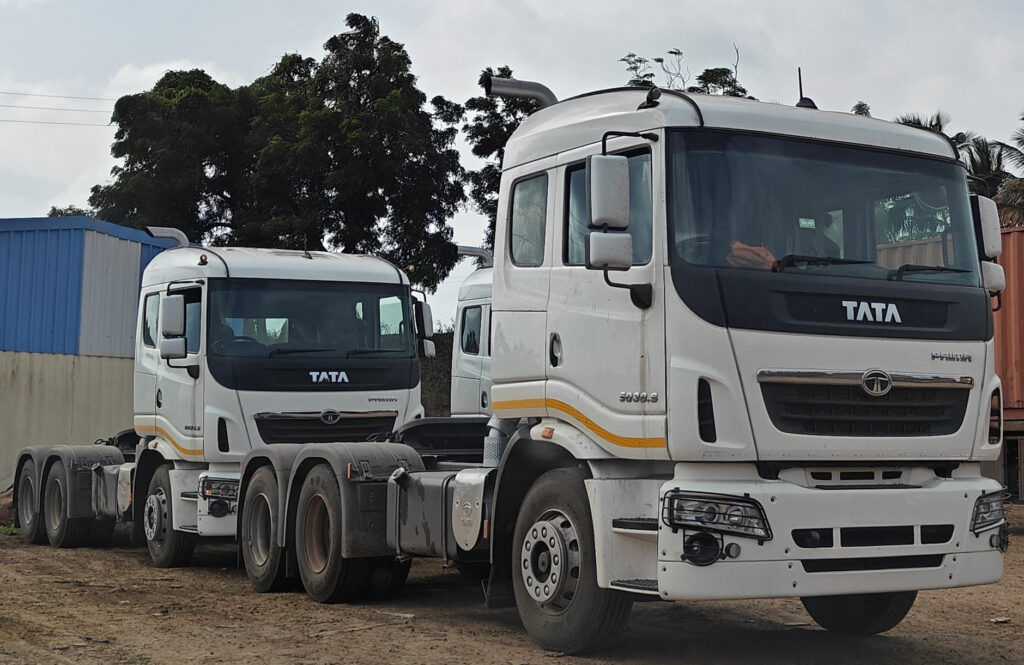
Featured image credit: Image: Trucksindiawiki via Wikimedia Commons (CC0). Source
By Piyush P. Yadav
India registered about 2.34 million electric vehicles in 2025. Of those, 573 were electric trucks. That figure, cited by the Ministry of Heavy Industries at the India Clean Transportation Summit on September 1, works out to 0.02 per cent of the EV market, in a country where road freight moves around two-thirds of all goods and trucks account for a disproportionate share of transport emissions. The ministry’s answer is a proposed Rs 9,852 crore scheme for 100,000 heavy-duty EVs, half of them trucks, built around loan subsidies and a credit guarantee. This article is about the other half of the question: why the e-truck market has not started despite a per-vehicle subsidy of up to Rs 9.6 lakh already on the table, what the handful of operators who have bought electric trucks have learned, and what the fleet economics look like for an operator deciding whether to order in 2026 or wait for 2027.
The market in numbers
| Metric | Figure |
|---|---|
| Electric trucks registered in India, 2025 | 573 (0.02 per cent of 2.34 million EVs) |
| Electric buses registered, 2025 | 4,615 (0.20 per cent) |
| PM E-DRIVE e-truck allocation | Rs 500 crore for 5,643 e-trucks |
| PM E-DRIVE per-truck incentive | Rs 2.7 lakh to Rs 9.6 lakh by gross vehicle weight, conditional on scrapping an old truck |
| Parliamentary committee finding (March 2026) | E-truck component “preparatory”; one model certified |
| Proposed new scheme | 50,000 e-trucks and 50,000 e-buses over five years, Rs 9,852 crore |
The gap between the PM E-DRIVE target of 5,643 trucks and the 573 actually sold in the scheme’s first full year is the whole story. The subsidy exists. The trucks exist. The buyers, so far, do not.
Why a Rs 9.6 lakh subsidy did not move the market
The e-truck guidelines under PM E-DRIVE were notified on July 11, 2025. They offer Rs 2.7 lakh to Rs 9.6 lakh per truck depending on gross vehicle weight, targeting ports, logistics, cement and steel, and they require a valid scrapping certificate for an old diesel truck from a MoRTH-authorised facility. Three things have limited uptake.
- The subsidy is small relative to the price gap. A 55-tonne electric prime mover with a 450 kWh battery costs several times a diesel equivalent. A Rs 9.6 lakh incentive on a vehicle that may cost Rs 1.5 crore to Rs 2 crore is a 5 to 6 per cent discount. For a scooter, the equivalent subsidy is 10 to 15 per cent.
- Scrappage is a real constraint. The operators most likely to buy an electric truck are large, modern fleets whose trucks are not old enough to scrap. The operators with old trucks to scrap are small owner-drivers who cannot finance an electric one.
- Financing, not price, is the barrier. As the ministry itself acknowledged on September 1, banks perceive very high risk in heavy EV loans and few are being made. No subsidy on the sticker price helps an operator who cannot get a loan.
What the early adopters have done
The largest real-world e-truck deployment in India so far is BillionE Mobility’s fleet of Tata Prima E.55S prime movers. Tata began deliveries in April 2026 and announced an additional order of 250 units at the same time, with BillionE citing an acquisition pipeline of 1,500 heavy-duty electric vehicles over six to eighteen months. The trucks are being deployed on freight corridors in Gujarat, Rajasthan, Tamil Nadu, Karnataka, Maharashtra, Delhi NCR and Haryana, hauling steel, cement and industrial goods.
BillionE’s model is instructive because it is not a conventional fleet. It is an electric mobility-as-a-service provider: it owns the trucks, the charging and the drivers, and sells transport per tonne-kilometre to shippers such as steel and cement producers. That structure solves the financing problem by concentrating it in a specialist that can raise equity and negotiate with lenders at scale, rather than asking a thousand small transporters to each borrow Rs 1.5 crore. It also matches the first users of e-trucks: captive, repetitive, high-utilisation routes between a plant and a port or a plant and a distribution hub, where the truck can return to a known charger every cycle.
Tata’s overall electric CV order book, which reached more than 3,400 units in June across small commercial vehicles, pick-ups, trucks and buses, and Amazon’s 1,000-truck commitment that we covered in our report on Amazon’s electric truck order and record e-3W sales, follow the same logic: a large, creditworthy shipper or fleet operator underwrites the volume.
The trucks on offer
| Model | Segment | Battery | Claimed range | Notable |
|---|---|---|---|---|
| Tata Prima E.55S | 55-tonne prime mover | 450 kWh | Up to 350 km | Integrated e-axle, 3-speed automated shift, dual-gun fast charging |
| Tata Ultra E.12 | Light-duty truck | Not disclosed | Not disclosed | Unveiled alongside Tata’s 17-model truck line-up |
| Tata Ace EV | Small commercial vehicle | Around 21 kWh | Around 150 km | The volume electric CV; e-SCV penetration near 10 per cent |
| Ashok Leyland / Switch Mobility IeV range | Light and intermediate | Varies | Varies | Switch benefits from Ashok Leyland’s manufacturing base |
The Prima E.55S is the important one because it is the first Indian heavy electric truck with the battery and range to do a real long-haul shift. A 450 kWh pack at 350 km claimed implies roughly 1.3 kWh per kilometre loaded, which is consistent with international heavy e-trucks. On a typical 250 to 300 km plant-to-port cycle it can complete a leg, charge at the depot and return. What it cannot yet do is a 1,000 km inter-state run without a highway charging network sized for trucks, and that network does not exist.
Fleet economics: a worked example
The numbers below are illustrative, based on public specifications and typical Indian operating assumptions, not on any operator’s actual accounts. They compare a 55-tonne diesel prime mover with an electric equivalent on a captive 280 km daily cycle, 300 days a year, or 84,000 km annually.
| Item | Diesel 55-tonne | Electric 55-tonne (450 kWh) |
|---|---|---|
| Energy consumption | About 2.8 km per litre loaded | About 1.3 kWh per km loaded |
| Energy cost per km | Rs 32 to Rs 34 at Rs 90 to Rs 95 per litre | Rs 10 to Rs 13 at Rs 8 to Rs 10 per unit (depot, commercial tariff) |
| Annual energy cost (84,000 km) | Rs 27 lakh to Rs 29 lakh | Rs 8.5 lakh to Rs 11 lakh |
| Annual energy saving | Rs 16 lakh to Rs 20 lakh in favour of electric | |
| Maintenance | Higher (engine, gearbox, clutch, exhaust after-treatment) | Lower (fewer moving parts), but battery warranty terms matter |
| Vehicle price premium | Roughly Rs 1 crore or more for electric, before the Rs 9.6 lakh PM E-DRIVE incentive | |
| Simple payback on premium | Around five to six years on energy saving alone; shorter with maintenance savings and higher utilisation | |
The energy saving is large and real, but it does not by itself repay a Rs 1 crore premium fast enough for a transporter borrowing at 12 to 14 per cent. That is where the proposed scheme’s interest subsidy and credit guarantee come in. If the guarantee brings the loan rate down to 8 to 9 per cent and the tenure out to seven years, the annual interest saving on a Rs 1.5 crore loan is roughly Rs 6 lakh to Rs 8 lakh, which stacks on top of the energy saving and pulls payback toward three to four years. That is the threshold at which fleet operators historically switch technologies. We covered the policy design in our analysis of the proposed Rs 9,852 crore heavy-duty EV scheme.
Charging is the second bottleneck
A 450 kWh truck battery needs a charger of at least 240 kW to refill in under two hours, and realistically a depot with several trucks needs a megawatt-class connection. India’s public charging network is overwhelmingly built for cars and two-wheelers; as we reported from the Rubix data in our September 2026 charger analysis, 73 per cent of the country’s chargers are rated below 30 kW. Truck electrification will therefore be depot-led for years. The proposed scheme’s interest subvention for charging infrastructure is aimed at exactly this: helping operators finance the transformer, the land and the high-power chargers at their own yards.
The localisation wrinkle
From September 1, 2026, e-trucks and e-buses claiming PM E-DRIVE incentives must meet stricter domestic-content rules for traction motors. As we reported in our coverage of the September 1 e-bus and e-truck localisation deadline, the industry asked for more time and did not get it. For truck buyers this means checking that the specific model and variant on order is certified as compliant, because a non-compliant truck loses the Rs 9.6 lakh incentive entirely.
Should a fleet order now or wait?
- Order now if you run a captive, repetitive route under 300 km with depot charging on both ends and a creditworthy shipper willing to sign a multi-year contract. The energy saving is available today and the PM E-DRIVE incentive is live.
- Wait for the new scheme if your constraint is the loan. The interest subsidy and credit guarantee are the instruments that change bank behaviour, and the ministry has signalled they are coming.
- Consider the service model instead of ownership. Operators such as BillionE sell electric freight capacity per tonne-kilometre, which lets a shipper decarbonise without buying trucks or building chargers.
- Do not plan around highway charging for at least two years. Long-haul electric freight in India is a depot-to-depot proposition today.
Sources & Further Reading
- electrive: India mulls new scheme to support 100,000 heavy-duty EVs
- Business Standard: Government launches PM E-DRIVE e-truck incentives of up to Rs 9.6 lakh
- Autocar Professional: Tata Motors delivers first electric Prima E.55S trucks to BillionE Mobility
- ICCT: Why India’s e-truck incentive scheme can be a gamechanger
FAQ
How many electric trucks were sold in India in 2025?
About 573, or 0.02 per cent of the roughly 2.34 million EVs registered that year, according to figures cited by the Ministry of Heavy Industries on September 1, 2026.
What subsidy is available on electric trucks in India?
PM E-DRIVE offers Rs 2.7 lakh to Rs 9.6 lakh per e-truck depending on gross vehicle weight, from a Rs 500 crore allocation for 5,643 trucks, conditional on scrapping an old diesel truck. A new scheme with interest subsidies and a credit guarantee has been proposed but not yet approved.
What is the range of the Tata Prima E.55S electric truck?
Tata claims up to 350 km on a charge from its 450 kWh battery pack, with dual-gun fast charging.
Are electric trucks cheaper to run than diesel?
Yes, substantially. On a typical loaded cycle the energy cost per kilometre is roughly a third of diesel’s, but the purchase premium and the cost of financing it mean payback depends heavily on utilisation and loan terms.