

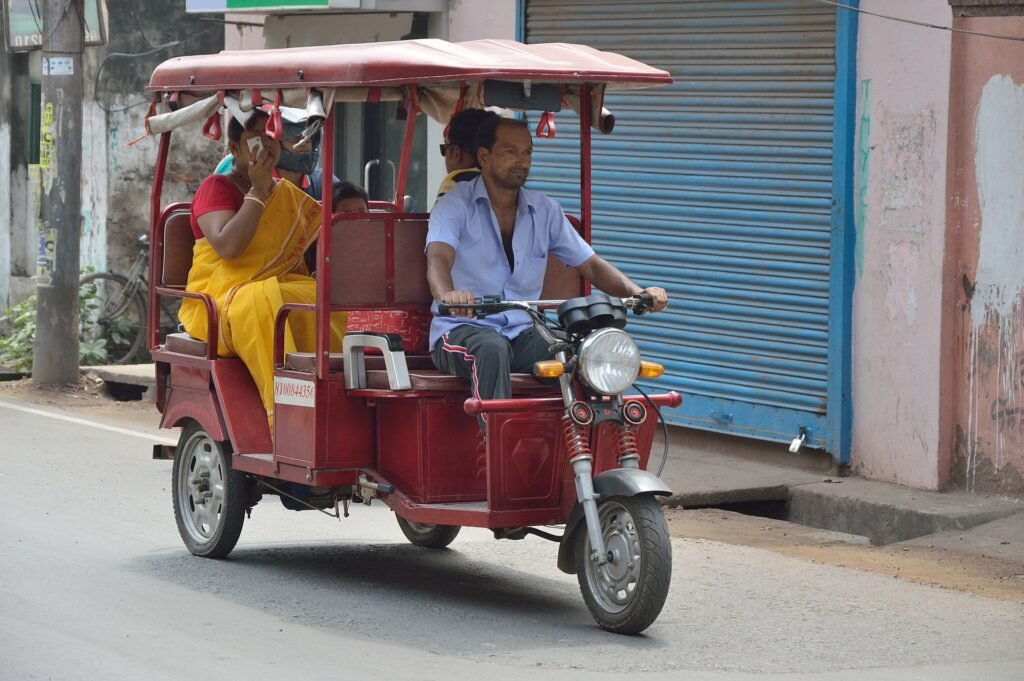
Featured image credit: Image: Biswarup Ganguly via Wikimedia Commons (CC BY 3.0). Source
By Piyush P. Yadav
If you are financing an electric auto-rickshaw in India in September 2026, the two numbers that decide whether the business works are the interest rate on the loan and the monthly sinking fund for the battery — not the on-road price everyone quotes first. NBFC and bank rates for e-rickshaw loans run from about 9 to 24 per cent a year depending on the lender type, and a driver taking a 36-month loan at 20 per cent down on a Rs 3 lakh lithium e-rickshaw pays an EMI of roughly Rs 8,200 a month. That is almost half of gross daily earnings once you count running costs. This piece works out what that actually does to take-home income, compares it against the lead-acid financing maths, and flags something several finance-company blogs still get wrong: the PM E-DRIVE subsidy that used to knock money off the purchase price for e-rickshaws is gone. The L5 three-wheeler component of the scheme closed on 26 December 2025, so anyone financing today is paying the full sticker price.
How we worked this out
The earnings and running-cost figures below are pulled directly from EV Auto India’s own verified auto-rickshaw profitability data (published 12 September 2026), which used a 26-working-day, 37.2 km-a-day driver survey. The loan and EMI figures come from two specialist lender guides checked on 14 September 2026: Manba Finance, an NBFC that has financed more than 9 lakh vehicles, and a documented worked EMI table from DriviOTrucks’s finance guide. The PM E-DRIVE closure date is taken from EV Auto India’s own coverage of the scheme’s extension to March 2028. Vehicle prices are from EV Auto India’s own electric auto-rickshaw comparison. We have not assumed any interest rate or subsidy that we could not source to a named lender or a government notification.
What e-rickshaw loans actually cost
Financing an e-rickshaw is a commercial-vehicle loan, not a consumer auto loan, and the rate you get depends heavily on who is lending:
- Banks and larger NBFCs (Manba Finance and similar) quote 9–14 per cent a year for borrowers with a clean credit history, funding 85–90 per cent of the on-road price.
- Smaller NBFCs and dealer-tie-up financiers commonly charge 14–24 per cent a year, especially for first-time borrowers with thin credit files — a large share of e-rickshaw buyers.
- Some lenders quote a flat rate rather than a reducing-balance rate. A “12 per cent flat” loan works out close to 21–22 per cent on a reducing basis, so always ask which method is being used before comparing two offers.
Tenures run 12 to 48 months, and lenders typically ask for 10–30 per cent down. The paperwork is standard commercial-loan documentation — Aadhaar, PAN, address proof, bank statements or UPI history, a vehicle proforma invoice, and increasingly a commercial driving badge where the state mandates one.
The worked EMI table
Take a representative lithium e-rickshaw on the higher end of the comparison table — Mahindra’s Treo Plus or Piaggio’s Ape E-City, both priced close to Rs 3 lakh on-road — financed at 14 per cent a year, a typical bank/NBFC blended rate:
| Down payment | Loan amount | Tenure | Monthly EMI |
|---|---|---|---|
| Rs 60,000 (20%) | Rs 2,40,000 | 36 months | Rs 8,200 |
| Rs 90,000 (30%) | Rs 2,10,000 | 36 months | Rs 7,180 |
| Rs 60,000 (20%) | Rs 2,40,000 | 48 months | Rs 6,560 |
What the EMI does to real earnings
EV Auto India’s own driver-survey data puts gross monthly revenue for an owner-driver at Rs 28,600 (26 days at Rs 1,100 a day). Running costs differ sharply by battery chemistry, which is the part most financing guides skip:
- Lead-acid: pack costs Rs 40,000–60,000 and needs replacing every 12–18 months, working out to a Rs 3,333 monthly sinking fund.
- Lithium: pack costs Rs 50,000–80,000 but lasts 4–5 years, so the monthly sinking fund is only Rs 1,204 — a saving of roughly Rs 2,129 every month versus lead-acid.
Add electricity (Rs 1,000–1,500) and tyres/servicing/permit costs (Rs 1,500), and a lithium e-rickshaw’s non-EMI running cost is about Rs 3,954 a month, leaving Rs 24,646 before the loan payment. Run that against the three EMI scenarios above:
| Financing scenario | Net monthly income |
|---|---|
| 36 months, 20% down | Rs 16,446 |
| 36 months, 30% down | Rs 17,466 |
| 48 months, 20% down | Rs 18,086 |
For comparison, EV Auto India’s own lead-acid profitability calculation — a smaller Rs 1.4 lakh loan at 15 per cent over 36 months, EMI Rs 4,850 — nets Rs 17,667 a month. The counter-intuitive result: stretching a lithium e-rickshaw’s larger loan to 48 months nets more take-home income than a cheaper lead-acid vehicle on a 36-month loan, because the battery sinking-fund saving outweighs the bigger EMI once the tenure is long enough. On a 36-month lithium loan with only 20 per cent down, though, the higher EMI eats into that advantage and a driver actually takes home less than the lead-acid scenario in year one to three — it only pays off from the fourth year, once the lead-acid buyer has sunk one or two full battery replacements (Rs 40,000–60,000 each) into their vehicle and the lithium buyer has not.
The subsidy trap: PM E-DRIVE is closed for e-rickshaws
Several finance-company blogs, including one of the lender guides checked for this article, still quote the PM E-DRIVE incentive of Rs 2,500 per kWh of battery capacity, capped at Rs 12,500 per vehicle, as if it is currently claimable. It is not. EV Auto India’s own reporting on the scheme’s extension to March 2028 confirms the L5 electric three-wheeler component was already closed on 26 December 2025, months before this fund-limited scheme’s other components ran out. If you are budgeting a purchase around a subsidy you read about online, check the dealer’s actual on-road quote first — you are very likely paying the unsubsidised price, which changes every EMI calculation in this article if you had budgeted otherwise.
Manba Finance’s new battery-replacement loan
One genuinely new option as of this month: on 22 July 2026, Manba Finance launched a dedicated battery-replacement loan for electric three-wheeler owner-operators, financing new lithium-ion packs through tie-ups with certified OEMs, using IoT-enabled batteries and e-mandate auto-repayments to manage the credit risk on these small, uncollateralised loans. It is aimed initially at Manba’s existing customers before a wider rollout. For an owner running a lead-acid e-rickshaw who cannot afford to switch vehicles but wants the lithium sinking-fund saving, financing just the battery upgrade rather than a whole new vehicle is worth asking your existing lender about.
Who this is for — and who should not follow this maths
This is aimed at first-time e-rickshaw buyers and existing lead-acid owners weighing a lithium upgrade, using average survey earnings and a representative 14 per cent interest rate. Your actual numbers will move with your city’s fare structure, route congestion, and your specific lender’s rate and processing fees — get a written, reducing-balance EMI schedule from the lender before signing, not a flat-rate quote. Drivers in cities with municipal e-rickshaw subsidy schemes (several states still run their own, separate from the closed PM E-DRIVE component) should check their state transport department directly, since that changes the effective purchase price used in this calculation.
Sources & Further Reading
- Manba Finance – E-Rickshaw Loan: Costs, EMI & Business Profits
- DriviOTrucks – E-Rickshaw Finance Guide
- Sahi.com – Manba Finance Launches Battery Replacement Loans for Electric Three-Wheelers
People also ask
How much does an electric auto-rickshaw cost in India?
Lead-acid e-rickshaws run Rs 1.5–2.2 lakh, while branded lithium models from Piaggio, TVS, Mahindra and Bajaj range from about Rs 3.25 lakh to Rs 4.41 lakh ex-showroom as of September 2026, depending on battery size and certified range.
Is an electric auto-rickshaw a profitable business?
Yes, for most owner-drivers, but the margin depends heavily on financing terms. Using survey data, a financed lead-acid driver nets around Rs 17,667 a month after EMI and running costs; a financed lithium driver on a longer tenure can net more once the lower battery sinking fund is factored in.
Which electric auto-rickshaw is best in India?
It depends on the priority: the Bajaj WEGO P9018 has the longest certified range at 296 km, the Mahindra Udo and TVS King EV Max carry six-year warranties, and the Piaggio Ape E-City offers the longest distance-based cover at 5 years/2 lakh km.
How much down payment do I need for an e-rickshaw loan?
Lenders typically finance 70–90 per cent of the on-road price, so expect to arrange 10–30 per cent as a down payment — roughly Rs 25,000 to Rs 90,000 depending on the model and lender.
Is the PM E-DRIVE subsidy still available for e-rickshaws?
No. The scheme’s L5 electric three-wheeler component closed on 26 December 2025 after its fund allocation was exhausted, even though PM E-DRIVE itself has since been extended to March 2028 for other vehicle categories.
Should I finance a lead-acid or lithium e-rickshaw?
Lithium costs more upfront and carries a higher EMI, but its battery lasts 4–5 years against 12–18 months for lead-acid, so the monthly sinking fund is about Rs 2,129 lower. On a loan of 48 months or longer, lithium usually nets more take-home income; on a tight 36-month loan with a small down payment, lead-acid can be cheaper for the first two to three years.