

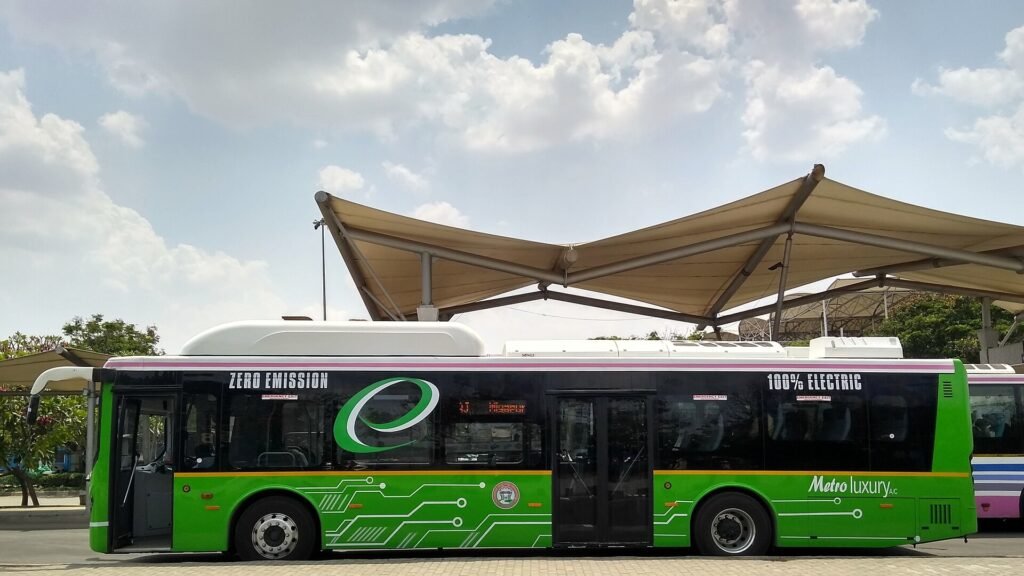
Featured image credit: Image: LoveofZ via Wikimedia Commons (CC BY-SA 4.0). Source
By Piyush P. Yadav
Delhi’s state transport undertaking now runs the largest electric bus fleet anywhere in India, and the gap over the next-biggest city operator is not a close one. On September 4, 2026, Chief Minister Rekha Gupta flagged off 50 new electric buses at the Delhi Transport Corporation’s (DTC) Tehkhand Depot, opened an automated fitness-testing station on the same site, and launched an interstate electric bus service linking Dhaula Kuan to Rewari in Haryana. Those additions took Delhi’s total public bus fleet to around 6,840 vehicles, of which roughly 5,088 are electric and the remaining 1,752 run on CNG. For a category that usually gets discussed in terms of subsidy schemes and per-kilometre contracts, this is one of the few concrete data points showing what a fully committed city rollout actually looks like on the ground.
What Changed in Delhi on September 4, 2026
Three separate pieces of transport infrastructure went live on the same day, which is unusual and worth unpacking individually.
50 more electric buses on the road
The 50 buses flagged off at Tehkhand are part of DTC’s ongoing induction of AC electric buses procured under the gross-cost-contract (GCC) model, where private operators own and maintain the buses while DTC pays a fixed rate per kilometre run. This is the same commercial structure covered in detail in an earlier explainer on how much an electric bus actually costs in India, where most operators pay closer to Rs 55 a kilometre than the roughly Rs 1-2.2 crore sticker price of the vehicle itself.
An automated testing station built for scale
The Tehkhand Automated Testing Station (ATS) is a four-lane facility designed to process up to 72,000 vehicle fitness checks a year, covering heavy vehicles, light motor vehicles and two-wheelers. As electric bus fleets scale into the thousands, the bottleneck often shifts from vehicle procurement to depot infrastructure — charging capacity, maintenance bays and now fitness certification throughput. Delhi’s decision to open a dedicated automated station at the same depot where new e-buses were commissioned signals that this second-order infrastructure problem is being addressed alongside fleet expansion, not after it.
An interstate route that changes the use case
The Dhaula Kuan-Rewari e-bus service is notable because most of India’s electric bus deployment so far has been intracity — short, predictable routes ideal for smaller battery packs and depot charging. An interstate route into Haryana implies longer duty cycles and range requirements closer to what intercity diesel coaches handle today, and it is an early signal of electric buses moving beyond the easiest use case.
How Delhi Got to the Largest Electric Bus Fleet in India
Delhi’s climb has been steady rather than sudden. The city’s fleet crossed several thousand electric buses through successive induction batches over the past two years, including a batch of 500 buses flagged off in February 2026. With the latest addition, DTC and Delhi’s cluster bus system between them now run more electric buses than any other Indian city operator, and the government’s stated target is to take the combined fleet to around 14,000 buses by 2028-29 — implying several thousand more electric inductions over the next two to three years.
Nationally, this fits inside the broader push under the proposed Rs 9,852 crore scheme for 50,000 electric buses and trucks, which is structured around loan guarantees rather than direct purchase subsidies. Delhi’s fleet, however, has largely been built through the earlier FAME-II and state-funded procurement rounds plus the PM-eBus Sewa scheme, rather than waiting on this newer credit-guarantee mechanism.
City by City: How India’s Bus Fleets Compare
Public disclosures on exact electric bus counts vary by source and month, since fleets are inducted in batches and operators sometimes count buses on order alongside buses in service. The table below uses the most recent confirmed figures for each city as reported in 2026.
| City / Operator | Total Bus Fleet | Electric Buses (confirmed) | Electric Share | Stated Target |
|---|---|---|---|---|
| Delhi (DTC + cluster) | ~6,840 | ~5,088 | ~74% | ~14,000 total by 2028-29 |
| Bengaluru (BMTC) | ~7,000+ | 1,700+ | ~24% | Ongoing induction; 120 more AC e-buses planned |
| Mumbai (BEST) | Fleet being electrified | ~711-1,324 (varies by report) | Rising | 8,000 electric buses by 2027; 50%+ electric by March 2026 |
Two things stand out. First, Delhi’s electric share of its total fleet is far ahead of Bengaluru’s, even though BMTC’s overall bus fleet is comparable in size or larger — Bengaluru has simply not converted as much of its existing diesel and CNG fleet yet. Second, Mumbai’s BEST has the most ambitious stated target of the three (8,000 electric buses by 2027) but is starting from a much smaller confirmed base today, so the next 18 months of delivery will determine whether that target is realistic.
The National Layer: PM-eBus Sewa
Delhi, Bengaluru and Mumbai are each running their own procurement, but a large share of India’s mid-sized city electrification is riding on the central PM-eBus Sewa scheme, which has sanctioned 10,000 air-conditioned electric buses across 116 cities in 20 states and 6 union territories, at a total estimated project cost of Rs 57,613 crore with Rs 20,000 crore of central support. As of 2026, concession agreements have been signed for 3,167 of those buses across 38 cities, and operations have started in Guwahati, Bhavnagar, Nagpur and Chandigarh — with Chandigarh receiving the single largest city allocation at 328 buses.
This two-track pattern — metro operators like Delhi and Bengaluru running their own large-scale procurement, while smaller cities depend on the centrally sanctioned scheme to get their first electric buses at all — is likely to persist for the next few years. It also means the traction motor localisation rules that took effect on September 1, 2026, and are explained in this breakdown of the new PM E-DRIVE local-content requirements, will affect both tracks simultaneously, since manufacturers supplying Delhi’s GCC operators and PM-eBus Sewa concessionaires draw from the same domestic motor and battery supply chain.
What Fleet Operators and Financiers Should Watch
Behind every headline bus count sits a financing structure that decides whether the induction pace can actually be sustained. Under the gross-cost-contract model that DTC, BMTC and most PM-eBus Sewa cities use, a private operator buys or leases the buses, runs the depot, hires and trains drivers and conductors, and gets paid a fixed rate per kilometre operated, regardless of ticket revenue collected. That shifts fare-box risk onto the transport corporation and route-planning and battery-performance risk onto the operator — which is why operator solvency, not just vehicle price, has become as important a variable as the headline subsidy number.
Three practical bottlenecks tend to show up once a city fleet crosses a few thousand electric buses, and Delhi’s September 4 announcements map onto all three. The first is depot charging capacity: overnight depot charging for 5,000-plus buses needs a substantial dedicated power draw and transformer capacity that most depots were never built for, so expansions typically go hand in hand with new bus inductions rather than after them. The second is fitness and maintenance throughput, which is exactly what the new Tehkhand Automated Testing Station is meant to solve — a fleet this size cannot rely on manual inspection queues without creating a backlog that keeps buses off the road. The third is duty-cycle diversification: once the easy intracity routes are electrified, operators have to start planning for longer, higher-speed, interstate-type routes such as Dhaula Kuan-Rewari, which demand different battery sizing, charging-stop planning and driver rostering than a 20-kilometre city loop.
For financiers and component suppliers, the practical takeaway is that bus fleet electrification in India is no longer a single national curve — it is at least three different curves (Delhi-style metro GCC fleets, BMTC/BEST-style city corporations converting existing large fleets, and PM-eBus Sewa cities getting their first electric buses at all) moving at different speeds and financed through different structures. A supplier or investor tracking “India’s electric bus market” as one number will miss which of those three tracks is actually accelerating in a given quarter.
Why This Matters Beyond Buses
Bus fleet electrification is one of three fronts in India’s commercial EV transition, alongside electric trucks and e-3W last-mile delivery fleets. Corporate logistics electrification, such as UltraTech Cement’s rollout of over 600 electric trucks announced earlier this month, tends to move faster because a single corporate buyer controls procurement, financing and route planning end to end. City bus fleets involve a state transport undertaking, a private GCC operator, a financier and often a central scheme administrator all in the same contract — which is part of why Delhi’s steady, multi-year build-up is the more typical pattern than a single large corporate order.
The comparison table above also illustrates a point fleet planners in other cities should note: raw fleet size is a weaker signal than electric share of the total fleet. Bengaluru’s BMTC operates more total buses than most cities in the world, but its 24 percent electric share means the bulk of its daily emissions and fuel costs are still tied to diesel and CNG. Delhi’s 74 percent electric share is a better proxy for how far a genuine transition has actually progressed.
Sources & Further Reading
- Delhi adds 50 electric buses, launches e-bus service to Rewari (ANI News)
- CM opens automated vehicle testing station (Millennium Post)
- One in five buses in Bangalore now electric as BMTC fleet surpasses 7,000 units (Sustainable Bus)
- PM-eBus Sewa Scheme: 10,000 AC E-Buses Across 116 Cities by 2027 (Angel One)
Frequently Asked Questions
Which city has the largest electric bus fleet in India?
Delhi, through DTC and its cluster bus system, now runs the largest electric bus fleet in the country, with roughly 5,088 electric buses out of a total public bus fleet of about 6,840 as of September 2026.
How many electric buses has India sanctioned under PM-eBus Sewa?
The PM-eBus Sewa scheme has sanctioned 10,000 air-conditioned electric buses across 116 cities in 20 states and 6 union territories, with concession agreements signed for 3,167 buses across 38 cities as of 2026.
Is Bengaluru’s BMTC electric bus fleet bigger than Mumbai’s?
Yes, on confirmed 2026 figures. BMTC operates more than 1,700 electric buses out of a total fleet exceeding 7,000, while Mumbai’s BEST has reported figures in the 711-1,324 range for electric buses, though BEST has set a target of 8,000 electric buses by 2027.
What is the Automated Testing Station at DTC’s Tehkhand Depot?
It is a four-lane automated vehicle fitness testing facility opened on September 4, 2026, capable of processing up to 72,000 vehicle checks a year across heavy vehicles, light motor vehicles and two-wheelers, built to support Delhi’s growing electric bus fleet with faster fitness certification.