

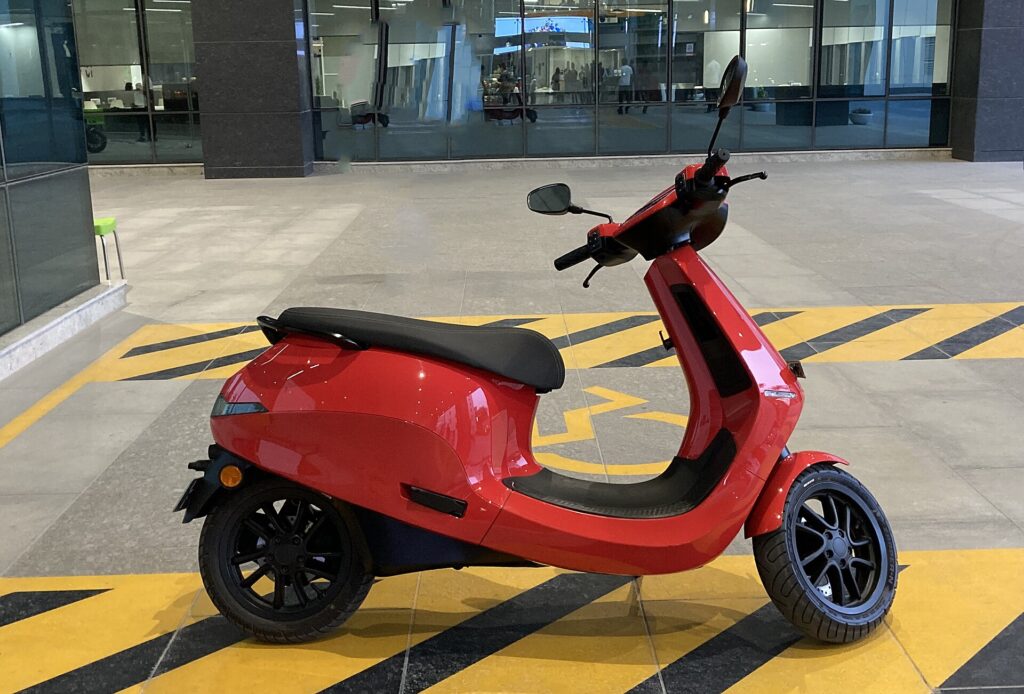
Featured image credit: Image: SnapMeUp via Wikimedia Commons (CC BY-SA 4.0). Source
By Piyush P. Yadav
Here is the uncomfortable fact behind this question: every major Indian electric scooter warranty is written around a 70 percent state-of-health threshold, and almost none of them will show you your state of health. Ather, Ola, TVS and Bajaj all promise to repair or replace a pack that falls below roughly 70 percent of original capacity within the warranty period — but the consumer apps do not publish a clean SoH percentage, so the owner has no way of knowing whether they have a claim. You can work it out yourself with a Rs 400 plug-in energy meter and one evening, and this article shows you exactly how.
How we worked this out
We took the published warranty terms for the four highest-volume Indian e-scooter brands from manufacturer pages and trade reporting, and checked what each brand’s consumer app actually surfaces against what owners and independent workshops report seeing. Terms were checked on 12 September 2026. The measurement method below is arithmetic, not a manufacturer procedure: it estimates usable pack energy from wall-side consumption, with a stated charging-loss assumption, and it is deliberately conservative. It will not match a dealer diagnostic tool to the decimal, and it is not a substitute for one when you are making a warranty claim — it is there so you know whether a claim is worth pursuing before you spend a morning at the service centre.
What the warranty promises, and what the app shows
| Brand | Standard battery warranty | Longest option | SoH threshold | SoH percentage in the consumer app? |
|---|---|---|---|---|
| Ather | 3 years / 30,000 km | 8 years / 80,000 km (Eight70, Rs 4,999, Pro Pack only) | 70% | No clear SoH figure |
| Ola | 3 years / 50,000 km | Up to 8 years / 80,000–125,000 km on extended plans | 70% | No clean SoH figure on the standard dashboard |
| TVS iQube | 3 years / 50,000 km (battery, controller, charger, motor) | 5 years / 70,000 km extended | Not published as a single figure | SmartXonnect shows charge, range and ride data, not raw SoH |
| Bajaj Chetak | 3 years / 50,000 km | Up to 5 years / 70,000 km extended | At least 70% of original capacity at end of warranty | Not published |
Read the last two columns together. Three of the four brands sell you a number — 70 percent — and none of them gives you the instrument to read it. That asymmetry is the whole problem, and it is worse for used buyers than for first owners, because a second-hand scooter arrives with no service history and no way to verify what is left in the pack.
Method 1: the metered charge test (best)
This is the only home method that measures energy rather than guessing from range. You need a plug-in energy meter — the kind sold for Rs 300 to 600 to measure appliance consumption.
- Ride the scooter down to a fixed, repeatable low state of charge. Ten percent is a good target; whatever you pick, use the same number every time.
- Plug the charger into the energy meter and the meter into the wall. Reset the meter.
- Charge to 100 percent without interruption, in a comparable ambient temperature. Record the kWh the meter reports.
- Multiply by your charging efficiency. Assume 0.88 — roughly 12 percent is lost in the charger and as heat in the pack — to get energy that actually reached the battery.
- Divide by the fraction of the pack you refilled (0.90 if you went 10 to 100), then divide by the scooter’s nominal pack size.
Worked example
Take a scooter with a 3.7 kWh nominal pack. A 10-to-100 percent charge refills 90 percent of it, so a healthy pack should accept about 3.33 kWh — which, with 12 percent losses, means the wall meter should read around 3.78 kWh.
| Wall meter reading (10→100%) | Energy into pack (×0.88) | Implied full capacity (÷0.90) | State of health | Verdict |
|---|---|---|---|---|
| 3.78 kWh | 3.33 kWh | 3.70 kWh | 100% | As new |
| 3.40 kWh | 2.99 kWh | 3.32 kWh | 90% | Normal for 2–3 years |
| 3.02 kWh | 2.66 kWh | 2.95 kWh | 80% | Watch it; log quarterly |
| 2.65 kWh | 2.33 kWh | 2.59 kWh | 70% | At the warranty threshold — book a service diagnostic now |
If your meter reads near the bottom row and you are still inside the warranty period and kilometre limit, that is the moment to act, not after the warranty expires. Take the reading, take photographs of the meter, and ask the service centre in writing for a battery health report.
Two cautions. Do the test in mild weather, because a cold or very hot pack accepts charge differently — the same effect that makes winter range drop, which we cover for cars in our piece on EV battery degradation and state of health in India. And repeat it twice; a single reading with a different starting SoC than you thought will mislead you.
Method 2: the range log (no equipment)
If you cannot get a meter, measure consistently instead of precisely. Once a month, on the same route, with the same rider weight and riding mode, record the actual kilometres from a 100 percent charge to the same low-battery warning. Not the indicated range — the odometer distance.
Compare month to the same month a year earlier, never month to month, because temperature swamps degradation in the short term. A 5 to 8 percent decline over the first two or three years is ordinary. A sudden double-digit fall in one quarter is not degradation; it is a fault, and it should be diagnosed. Remember also that indicated range is calculated, not measured, which is why we separate the terms in our explainer on IDC range versus TrueRange versus real range.
Method 3: ask the service centre, in writing
The dealer diagnostic tool reads true pack health, cell-level balance and stored fault codes — things no app exposes. Three rules make this work. Ask for the report in writing or as a screenshot, not a verbal “battery is fine”. Ask before, not after, a warranty milestone. And if you are buying used, make the sale conditional on the seller producing a dated health report from an authorised centre, in the same way you would insist on a service record for a petrol scooter.
What actually protects the pack
Degradation is mostly driven by heat, time at very high or very low charge, and fast-charge frequency. In Indian conditions the practical rules are boring and effective: park in shade rather than on a concrete terrace in May, avoid leaving the scooter at 100 percent for days at a stretch, do not routinely run it to zero, and treat fast charging as an occasional convenience rather than the default. None of this is dramatic, and it is worth more over four years than any accessory — see our breakdown of electric scooter maintenance and running costs in India.
If your scooter is on a battery-subscription plan rather than an owned pack, none of this is your problem in the same way: pack health is the provider’s responsibility, which is one of the underrated arguments in our look at battery-as-a-service subscription maths.
Who this is for, and its limits
This is for owners and used buyers who want a number before they walk into a service centre. It is not a certified measurement, and no manufacturer will accept a home meter reading as evidence for a warranty claim — the dealer diagnostic is the only reading that counts contractually. The 88 percent charging-efficiency assumption is a reasonable average for Indian home charging but will vary with charger, cable length and temperature, so treat the output as accurate to a few percentage points, not to the decimal. Do not open a pack, do not use a non-OEM charger for the test, and if the scooter has any swelling, smell, heat or error code, stop testing and take it in.
Sources & Further Reading
- Autocar India: Ather’s 8-year/80,000 km battery warranty option
- Ola Electric: battery warranty terms
- TVS Motor: iQube warranty and ownership FAQ
- Autocar India: Bajaj Chetak battery warranty and service details
People also ask
How do you check an electric scooter’s battery health in India?
The most accurate home method is a metered charge test: run the pack to a fixed low state of charge, charge to 100 percent through a plug-in energy meter, multiply the reading by about 0.88 for charging losses, and compare the result with the scooter’s nominal pack size. For a contractual figure, request a battery health report from an authorised service centre, which reads true pack SoH.
How long does an electric scooter battery last in India?
Warranty terms give the floor rather than the life: three years or 30,000 to 50,000 km as standard, extending to eight years or 80,000 km on Ather’s Eight70 plan and Ola’s longest extended cover. Most brands guarantee at least 70 percent of original capacity within that window, and a decline of 5 to 8 percent over the first two or three years is normal.
How do you maintain an electric scooter battery?
Keep it cool and away from the extremes of charge. Park in shade rather than direct sun, avoid leaving it sitting at 100 percent for days, do not routinely run it to zero, and use fast charging occasionally rather than by default. Heat and time spent at very high or very low state of charge do more damage than kilometres do.
Which electric scooter has the best battery warranty in India?
On duration, Ather’s Eight70 option at 8 years or 80,000 km with a 70 percent health promise, priced at Rs 4,999 and available only with the Pro Pack, and Ola’s extended plans reaching 8 years and up to 125,000 km. TVS and Bajaj top out at 5 years and 70,000 km on extended cover, against 3-year standard terms across the board.
How much does an electric scooter battery cost to replace?
Enough that the warranty threshold matters more than the sticker price of the scooter. Because replacement pricing varies widely by brand, variant and whether the pack is repaired at module level or swapped whole, get a written quote from the authorised service centre for your specific model rather than relying on a generic figure.
Is an electric scooter battery replaceable?
Yes, and on several Indian models it is removable as well, which makes charging easier in apartments. Replacement is usually done at an authorised service centre, either at module level or as a complete pack, and fitting a non-OEM pack will normally void the remaining warranty and can void insurance add-ons too.