

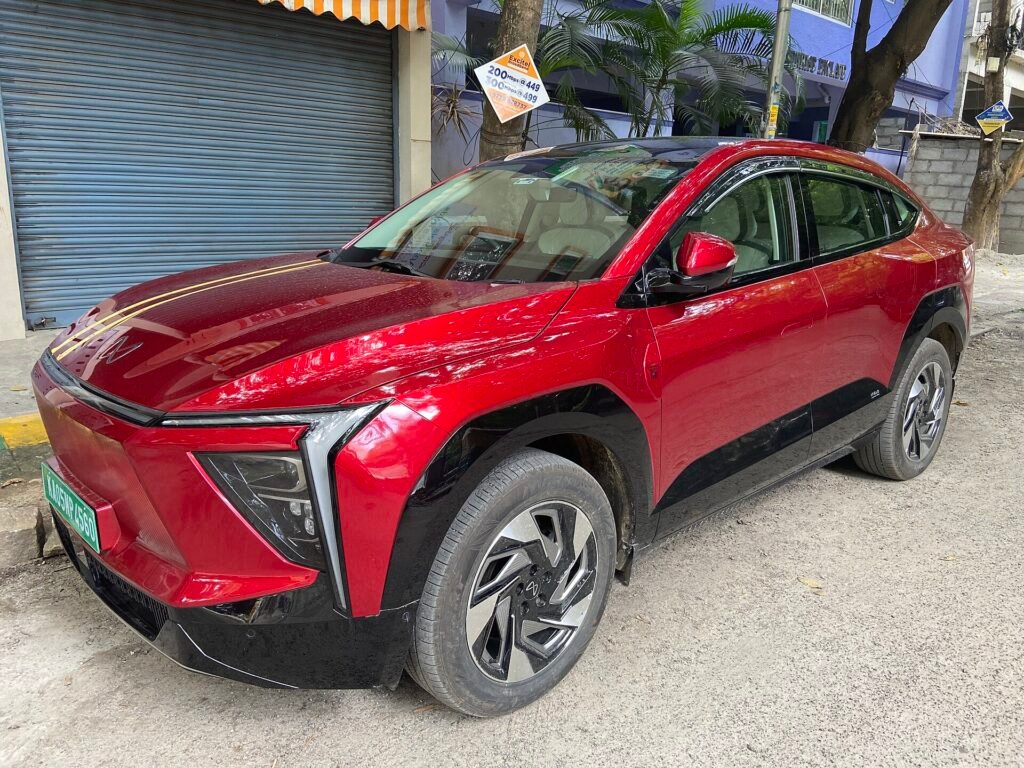
Featured image credit: Image: Cppfront via Wikimedia Commons (CC0). Source
For most Indian buyers, the single biggest obstacle to an electric car has never been range or charging. It has been the sticker price. A battery pack is roughly 35-40% of what an electric SUV costs to build, and that cost lands on the showroom invoice in one lump. Battery-as-a-Service, or BaaS, is the industry’s attempt to break that lump apart: you buy the car, you rent the battery, and you pay for the battery by the kilometre you actually drive.
On 29 August 2026, Mahindra extended BaaS pricing across its full Electric Origin SUV range, including the seven-seat XEV 9S and the XEV 9e. The headline number was striking. The XEV 9S, which normally opens at Rs 20.65 lakh ex-showroom, now has an entry price of Rs 12.65 lakh under BaaS. That is Rs 8 lakh off the number on the price list, in exchange for a battery subscription of Rs 3.75 per kilometre.
This guide works through what BaaS actually costs over a realistic ownership period, who it genuinely suits, and where the maths quietly turns against you. By Piyush P. Yadav.
What Battery-as-a-Service actually is
Under a conventional purchase, you own every part of the car including the battery pack, and you carry the risk that the pack degrades or fails outside warranty. Under BaaS, the battery is legally owned by a financing partner. You take delivery of the same physical car, with the same pack bolted in, but you pay a recurring usage charge for the energy storage rather than buying it outright.
Three things follow from that structure, and buyers routinely miss at least one of them.
- The upfront price drops sharply, because the most expensive single component has been carved out of the transaction.
- The running cost rises, because the per-kilometre battery charge stacks on top of your electricity cost.
- Battery risk transfers away from you. If the pack underperforms, that is the battery owner’s problem, not yours, for as long as the subscription runs.
That third point matters more than it sounds. Indian buyers have been nervous about long-term pack health for years, and the question of what a degraded pack does to a car’s value is only now being addressed by regulators. Our explainer on India’s proposed battery health disclosure standard for used EVs covers why that disclosure gap has kept resale prices soft.
Mahindra’s BaaS pricing, model by model
Mahindra’s August expansion covered both Electric Origin SUVs and their variants. The structure is the same across the range: a reduced ex-showroom price plus a fixed per-kilometre battery charge.
| Model | Standard start price (ex-showroom) | BaaS start price (ex-showroom) | Upfront reduction | Battery charge |
|---|---|---|---|---|
| Mahindra XEV 9S | Rs 20.65 lakh | Rs 12.65 lakh | Rs 8.00 lakh | Rs 3.75/km |
| Mahindra XEV 9e | Rs 21.90 lakh | Rs 13.90 lakh | Rs 8.00 lakh | Rs 3.75/km |
The XEV 9S BaaS range runs from Rs 12.65 lakh to Rs 19.95 lakh across variants, against a standard range of Rs 20.65 lakh to Rs 30.90 lakh. The per-kilometre battery charge of Rs 3.75 stays constant across all XEV 9S variants, which is an important detail: the subscription does not scale with pack size, so the larger batteries extract more value from the same rate.
The honest cost maths
Here is where buyers need to be careful. Rs 3.75 per kilometre is not a small number when you set it against what an electric SUV costs to run on electricity alone.
Charging an electric SUV at home on a domestic tariff typically works out somewhere in the Rs 1.50 to Rs 2.50 per kilometre band depending on your slab and your real-world efficiency. Our breakdown of how EV home charging affects your electricity bill and tariff slabs goes through that calculation in detail. Add Rs 3.75 for the battery subscription and your effective running cost lands in the Rs 5.25 to Rs 6.25 per kilometre range.
That is no longer dramatically cheaper than a well-driven petrol SUV. So the question becomes: does the Rs 8 lakh you saved upfront outrun the per-kilometre charge you are now paying?
| Annual running | Battery charge per year | Years to consume Rs 8 lakh saving |
|---|---|---|
| 8,000 km | Rs 30,000 | About 26.7 years |
| 12,000 km | Rs 45,000 | About 17.8 years |
| 15,000 km | Rs 56,250 | About 14.2 years |
| 20,000 km | Rs 75,000 | About 10.7 years |
| 30,000 km | Rs 1,12,500 | About 7.1 years |
| 40,000 km | Rs 1,50,000 | About 5.3 years |
Read that table carefully, because it is the whole argument. At ordinary private-car mileage, roughly 10,000 to 15,000 km a year, the subscription takes well over a decade to eat the upfront saving. At high commercial mileage, it takes about five years.
But the table is deliberately simplified. It ignores the financing cost on the Rs 8 lakh you did not borrow, and it ignores what happens to the car’s resale value when the battery is not yours to sell. Both of those cut in opposite directions.
The interest you did not pay
If you would have financed that Rs 8 lakh at, say, 9% over seven years, you would have paid meaningful interest on it. Avoiding that borrowing is a genuine saving that the simple table above does not credit. For a buyer who is EMI-constrained rather than cash-constrained, BaaS materially changes what car they can reach.
The resale question
Cutting the other way: when you sell a BaaS car, you are selling a vehicle without a battery, and the subscription has to transfer to the next owner or be settled. The used-EV market in India is still immature at pricing this. Anyone weighing a purchase should read our analysis of whether the long-range battery is worth it across the Nexon EV, Creta Electric, Windsor EV and BE 6, because the same cost-per-km logic applies here.
Who BaaS genuinely suits
It suits you if:
- You drive modest annual distances but want a bigger, better-equipped car than your budget allows. This is the strongest case. Low mileage means the per-kilometre charge stays small while the Rs 8 lakh saving is immediate and complete.
- Your constraint is monthly outflow and down payment rather than lifetime cost.
- You are genuinely worried about pack degradation and want that risk sitting with somebody else.
- You expect to change cars within three to four years, so long-run subscription totals never accumulate.
It does not suit you if:
- You run high annual mileage. A fleet operator or a heavy intercity user will pay far more in subscription than the battery would have cost outright.
- You intend to keep the car for a decade. Ownership wins comfortably over that horizon.
- You want a clean, unencumbered asset to sell later with no third-party contract attached.
How this compares to the rest of the market
Mahindra is not alone in trying to lower the entry barrier, but its approach is the most structurally aggressive. Other manufacturers have leaned on price cuts, longer warranties and variant engineering instead.
| Approach | Who uses it | Effect on upfront price | Effect on running cost |
|---|---|---|---|
| Battery-as-a-Service | Mahindra Electric Origin SUVs | Large reduction | Rises significantly |
| Smaller battery variants | Tata, Hyundai, MG | Moderate reduction | Unchanged |
| Lifetime battery warranty | Several OEMs on private registration | None | Unchanged, risk reduced |
| Direct price cuts | Broad market | Moderate reduction | Unchanged |
The smaller-battery route is the most common alternative, and for many buyers it is the more rational one: you simply buy less range for less money and keep full ownership. Whether that trade works depends heavily on your actual daily distance rather than your imagined worst-case trip.
Questions to ask before you sign
BaaS contracts are financing contracts, and the fine print carries real consequences. Before committing, establish the following in writing.
- Minimum tenure and exit terms. Can you close the subscription early, and at what cost?
- Buyout option. Is there a path to purchasing the pack outright later, and is the price formula fixed now or determined at the time?
- Transfer on resale. What exactly happens when you sell, and does the buyer need to qualify separately?
- Minimum monthly billing. Some per-kilometre structures carry a floor, meaning a low-usage month still bills a minimum.
- Degradation guarantee. What state of health is assured, and what is the remedy if the pack falls below it?
None of these are reasons to avoid BaaS. They are reasons to read the agreement properly, which is advice that applies to any vehicle finance product. If you are still deciding between buying now and waiting for the festive launches, our guide on whether to buy an EV now or wait for Diwali 2026 lays out the upcoming launch calendar.
The bigger picture
BaaS is best understood not as a discount but as a re-allocation. The money does not disappear; it moves from a one-time capital payment into a recurring operating payment, and it moves battery risk from the owner to a financier. For a market where affordability is the binding constraint and battery anxiety is widespread, that re-allocation is genuinely useful.
What it is not is free. A buyer who reads Rs 12.65 lakh and mentally files the XEV 9S alongside cars costing Rs 12.65 lakh has misread the product. The right comparison is total cost over the period you actually intend to own the car, at the mileage you actually drive.
Sources & Further Reading
- Mahindra press release: Battery-as-a-Service across the Electric Origin SUV portfolio
- Autocar India: Mahindra XEV 9e and XEV 9S now available with BaaS
- CarDekho: Mahindra expands BaaS pricing to XEV 9S, XEV 9e and variants
Frequently Asked Questions
What is the Mahindra XEV 9S BaaS price?
Under Battery-as-a-Service, the XEV 9S starts at Rs 12.65 lakh ex-showroom, against a standard start price of Rs 20.65 lakh. The BaaS range across variants runs from Rs 12.65 lakh to Rs 19.95 lakh. A battery subscription charge of Rs 3.75 per kilometre applies on top.
Is BaaS cheaper than buying the battery outright?
It depends entirely on your annual mileage and how long you keep the car. At 12,000 km a year, the Rs 3.75 per km charge costs about Rs 45,000 annually, so it takes roughly 18 years to consume the Rs 8 lakh upfront saving. At 30,000 km a year it takes about seven years. Low-mileage, short-tenure owners benefit most.
Who owns the battery under BaaS?
The battery pack is owned by the financing partner, not the vehicle buyer. You take delivery of the complete car and use the pack under a subscription agreement. Degradation and failure risk sits with the battery owner for the duration of that agreement.
Can I sell a car bought under BaaS?
Yes, but the battery subscription must either transfer to the new owner or be settled at the point of sale. Confirm the exact transfer mechanism, any buyer qualification requirements, and early-exit charges in writing before signing, since these terms vary by financing partner.