

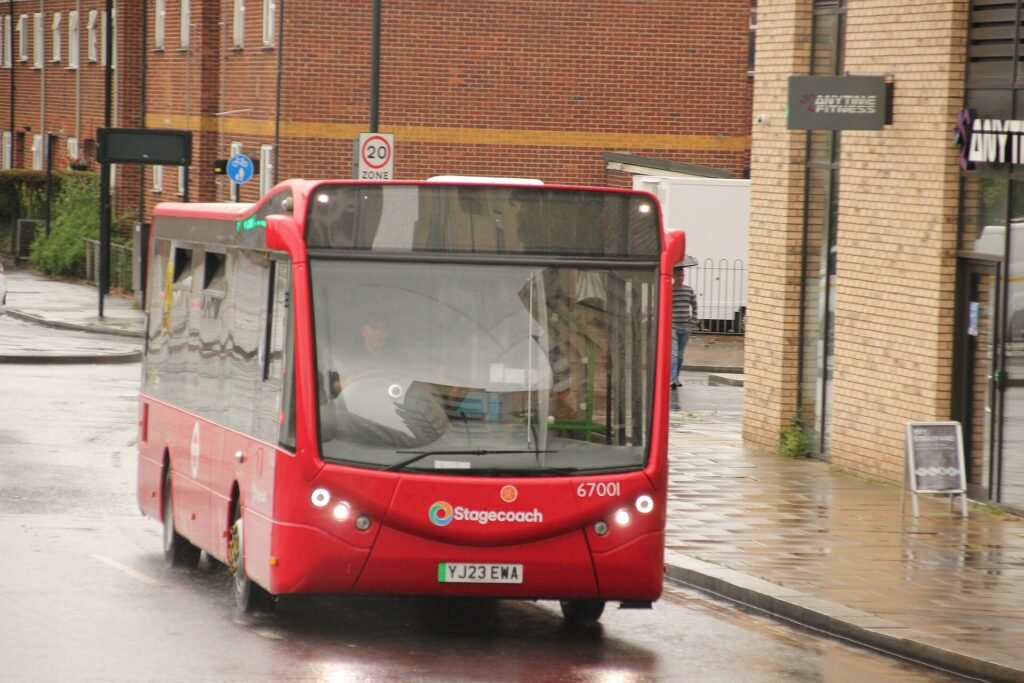
Featured image credit: Image: Matthew Black via Wikimedia Commons (CC BY-SA 2.0). Source
India’s new EV motor localisation rule officially took effect on September 1, 2026 — but the industry body representing every major electric bus and truck maker had asked the government for a seven-month extension, and as the deadline arrived, no approval had been announced. The result: electric commercial vehicle manufacturers are now operating in a compliance grey zone, unsure whether to halt import-dependent production or continue and risk losing PM E-DRIVE subsidy eligibility. By Piyush P. Yadav.
What the Rule Requires
Under PM E-DRIVE, electric buses and trucks must use traction motors and motor controller systems that meet new domestic localisation thresholds to remain eligible for purchase subsidies. The rule was originally due to take effect earlier in 2026, but the Ministry of Heavy Industries granted a relaxation in March 2026, allowing manufacturers to keep importing traction motors built with rare-earth magnets until August 31, 2026 — effectively pushing the real deadline to September 1.
Why SIAM Wants More Time
The Society of Indian Automobile Manufacturers (SIAM), in a letter to the Ministry of Heavy Industries dated July 22, 2026, requested that the localisation deadline for traction motors and motor controllers be pushed back a further seven months, from September 1, 2026 to April 1, 2027. SIAM’s core argument centres on rare-earth supply: China’s export restrictions on heavy rare-earth elements such as dysprosium and terbium — critical inputs for the permanent magnets used in traction motors — have disrupted global supply chains in ways that make immediate full localisation impractical for most manufacturers.
This is not a new complaint. India’s broader EV sector has been grappling with rare-earth magnet dependency through 2026, with the country still importing effectively all of its EV motor magnets and the government separately announcing a Rs 7,280 crore plan to build domestic rare-earth and magnet-free motor capacity — a program that will take years to mature, not months.
What Happened at the Deadline
As of September 1, 2026, the Ministry of Heavy Industries had not publicly announced a decision on SIAM’s extension request. That leaves electric bus and truck makers in what industry reporting has described as a “quandary”: companies that cannot yet source enough localised motor components face a choice between pausing subsidy-linked sales, absorbing the cost of losing PM E-DRIVE incentives on affected models, or continuing to import components and hoping for a retroactive relaxation.
Timeline of the Localisation Rule
| Date | Development |
|---|---|
| 2025 | PM E-DRIVE localisation requirement for e-bus/e-truck traction motors first proposed |
| March 2026 | Ministry of Heavy Industries grants relaxation, allowing rare-earth magnet motor imports until August 31, 2026 |
| July 22, 2026 | SIAM formally requests a further extension to April 1, 2027, citing rare-earth supply disruption |
| September 1, 2026 | Localisation deadline arrives with no announced extension; e-CV makers face compliance uncertainty |
Who Is Affected
The rule applies specifically to electric buses and electric trucks under PM E-DRIVE — not to electric cars, two-wheelers, or three-wheelers, which fall under different (and in most cases already-met) localisation norms. That means the immediate impact is concentrated among commercial vehicle makers supplying state transport undertakings and fleet operators, including manufacturers competing for the large CESL-administered electric bus tenders currently underway across Indian cities.
Within the commercial vehicle segment itself, the impact is not evenly distributed. Larger manufacturers with more diversified supply chains — those that had already begun qualifying alternate, non-rare-earth motor suppliers or investing in in-house motor assembly — are better positioned to absorb the September 1 deadline than smaller or newer entrants that relied more heavily on a narrow set of imported components. This could inadvertently accelerate consolidation in India’s electric bus and truck manufacturing space, favouring companies with the balance sheet to weather a compliance gap over those without it.
The Precedent This Sets
How the Ministry of Heavy Industries ultimately resolves this standoff — whether by granting SIAM’s requested extension retroactively, offering a partial or conditional relaxation, or holding firm on the September 1 deadline and letting non-compliant manufacturers lose subsidy eligibility — will set an important precedent for how India’s EV policy apparatus handles the gap between ambitious localisation targets and the realities of global supply chains it does not control. A hard line sends a strong signal to manufacturers to accelerate their own supply-chain diversification, but risks disrupting bus and truck deliveries to state transport undertakings that are themselves operating on tight procurement and rollout timelines tied to the CESL tenders. A lenient approach protects near-term deployment volumes but risks becoming a recurring pattern where localisation deadlines are treated as soft targets rather than firm requirements — undermining the policy’s original purpose of building durable domestic manufacturing capacity.
What Fleet Operators and Buyers Should Watch
For state transport undertakings and private fleet operators with electric bus or truck orders in the pipeline, the practical question is whether subsidy-linked pricing on existing orders will hold if the manufacturer’s compliance status is unresolved. Buyers should ask suppliers directly whether their specific vehicle model’s traction motor already meets the localisation threshold, rather than assuming blanket compliance across a manufacturer’s full range — the rule bites at the component level, not the brand level. It is also worth asking suppliers for this confirmation in writing as part of the procurement contract, since subsidy eligibility tied to a component that later fails a compliance audit could expose the buyer, not just the manufacturer, to unexpected cost or delay.
How This Compares to Past Localisation Rollouts
India’s EV policy has a mixed track record on holding firm to localisation deadlines. Earlier rounds of FAME-II incentive rules saw periodic relaxations when component-level localisation proved harder than manufacturers initially projected, and the March 2026 relaxation on this very rule — extending the import allowance from an earlier date to August 31 — is itself evidence that the government has already shown willingness to adjust once when supply-chain constraints were judged genuine rather than manufacturers simply seeking easier terms. That history makes a further extension plausible, but not guaranteed, since repeated relaxations can also erode the credibility of future deadlines across the broader PM E-DRIVE programme, including the separate two-wheeler and three-wheeler localisation milestones still ahead.
Officials at the Ministry of Heavy Industries have not publicly detailed their reasoning for the delay in responding to SIAM’s request, which itself is unusual — prior localisation relaxation decisions in 2026 were typically communicated with more lead time before a deadline arrived. Whether this reflects internal disagreement over how to balance domestic manufacturing goals against near-term deployment continuity, or simply administrative delay, is not publicly known.
The Larger Policy Tension
This standoff illustrates a recurring pattern in India’s EV policy in 2026: the government’s push for domestic manufacturing self-reliance is colliding with a global rare-earth supply chain that India does not yet control. Similar tension is playing out in the passenger EV motor magnet story, where India remains almost entirely import-dependent despite a large domestic incentive push. Until India’s own rare-earth and magnet-free motor capacity comes online — a multi-year undertaking — localisation deadlines like this one are likely to keep colliding with supply-chain reality, forcing repeated rounds of relaxation, extension requests, and uncertainty for manufacturers caught in between.
Related Reading
- September 1 Localisation Deadline Hits E-Bus and E-Truck Makers: SIAM’s Plea and August E-3W Sales
- India Imports 100% of Its EV Motor Magnets: The Rs 7,280 Crore Rare Earth Plan
- Inside CESL’s 6,230-Bus Tender and Its Localisation Complication
- PM E-DRIVE Extended to March 2028: Subsidy Changes and the September 1 Localisation Rule Explained
Frequently Asked Questions
What is the PM E-DRIVE localisation rule for electric buses and trucks?
It requires traction motors and motor controller systems in electric buses and trucks to meet domestic localisation thresholds to remain eligible for PM E-DRIVE purchase subsidies, effective from September 1, 2026.
Did the government extend the localisation deadline?
As of the September 1, 2026 deadline, the Ministry of Heavy Industries had not announced approval of SIAM’s request for a seven-month extension to April 1, 2027. Manufacturers should check directly with the ministry for the latest status.
Why is rare-earth magnet supply a problem for Indian EV makers?
China’s export restrictions on heavy rare-earth elements like dysprosium and terbium have disrupted global supply of the permanent magnets used in EV traction motors, and India currently imports nearly all of its EV motor magnets, making rapid localisation difficult.
Does this rule affect electric cars and two-wheelers too?
No, this specific localisation deadline applies to electric buses and trucks under PM E-DRIVE. Electric cars, two-wheelers, and three-wheelers are governed by separate localisation norms.
Has the government issued any new localisation rules since the September 1 deadline?
Yes. On September 3, 2026, two days after the deadline passed, the Ministry of Heavy Industries notified a revised Phased Manufacturing Programme that tightens the requirement further from April 1, 2027. From that date, e-bus and e-truck traction motors must be domestically manufactured including magnet and shaft fitment, going beyond the rotor and stator assembly, bearing, enclosure, connector and cable fitment required from September 1, 2026. The same notification also brings traction motor controllers into scope from April 2027, covering assembly of electronic components, semiconductors and connectors on the printed circuit board along with high-voltage connector, cable, heatsink and enclosure fitment and firmware flashing.
Is PM E-DRIVE still offering subsidies on electric buses and trucks?
Yes. The Ministry of Heavy Industries extended the scheme by two years for e-buses, e-trucks, e-ambulances and charging infrastructure, which stay eligible for support until March 31, 2028, within PM E-DRIVE’s overall Rs 10,900 crore outlay. Subsidies for electric two-wheelers and three-wheelers, by contrast, ran only to March 2026. That is why localisation compliance now matters most for exactly the segments that still have subsidy money left to claim, and why a compliance gap in the e-bus and e-truck segment carries real commercial consequences rather than being a paperwork issue.
Will electric bus and truck prices rise because of the localisation rule?
Two forces pull in opposite directions. Losing PM E-DRIVE support on a non-compliant model effectively raises its landed price for the buyer, and domestically assembled traction motors built at low initial volumes generally cost more per unit than imported ones until scale builds. Against that, the incentive is demand-linked, so manufacturers that do comply gain a pricing advantage when bidding for CESL and state transport tenders. The realistic near-term outcome is price differentiation between compliant and non-compliant models competing for the same tender, rather than a uniform market-wide increase.