

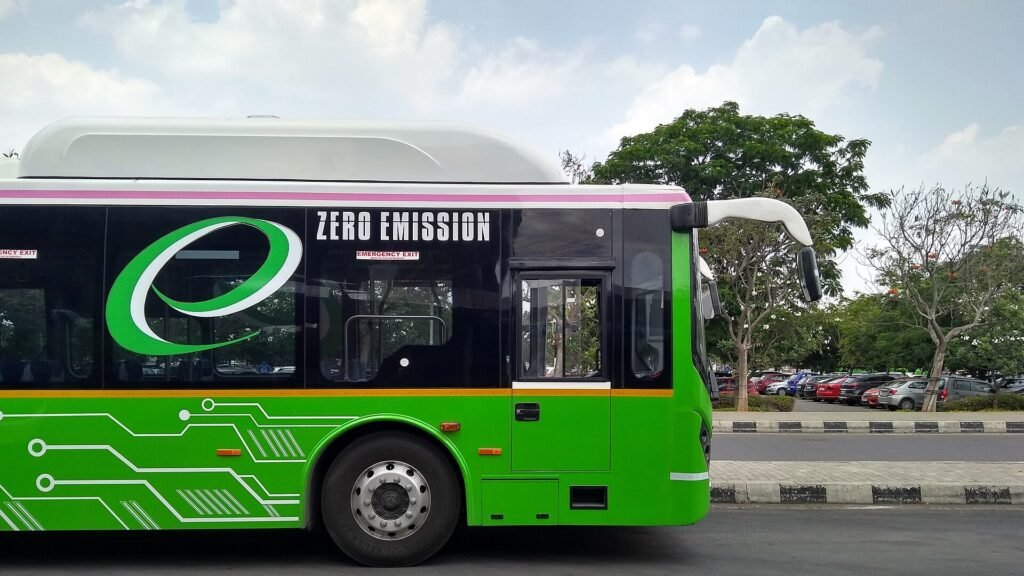
Featured image credit: Image: LoveofZ via Wikimedia Commons (CC BY-SA 4.0). Source
By Piyush P. Yadav
India’s next big EV subsidy is not for scooters or cars. Speaking at the India Clean Transportation Summit 2026 in New Delhi on September 1, Dr Hanif Qureshi, Additional Secretary at the Ministry of Heavy Industries, laid out a proposed scheme to put 100,000 heavy-duty electric vehicles on Indian roads over five years: 50,000 electric buses and 50,000 electric trucks, backed by a total outlay pegged at Rs 9,852 crore. What makes the proposal different from every scheme before it is where the money goes. Instead of the upfront purchase subsidies that FAME and PM E-DRIVE relied on, the new scheme is built around interest subsidies on loans, a partial credit guarantee for lenders and interest subvention for charging infrastructure. In short, it targets the reason heavy EVs have not sold: nobody will finance them.
What was proposed, in numbers
| Item | Proposal (as presented September 1, 2026) |
|---|---|
| Total outlay | Rs 9,852 crore (about 896 million euros) |
| Vehicles targeted | 100,000 heavy-duty EVs over five years |
| Split | 50,000 electric buses and 50,000 electric trucks |
| Support mechanism 1 | Interest subsidy on vehicle loans |
| Support mechanism 2 | Partial credit guarantee for lenders (industry reports suggest up to 80 per cent of outstanding loan) |
| Support mechanism 3 | Interest subvention for charging infrastructure |
| Status | Proposed; under discussion within the ministry, not yet approved by Cabinet |
The scheme has not been notified. The figures above are what the ministry presented publicly and what industry participants have reported hearing; the final design, including the credit-guarantee percentage, could change before approval.
Why this is different from PM E-DRIVE
Every previous central EV scheme has worked on demand incentives: a fixed rupee amount per vehicle, paid to the manufacturer and passed on as a price cut. That model worked spectacularly for two- and three-wheelers, where a Rs 5,000 to Rs 25,000 incentive is a meaningful share of the price and the buyer pays mostly in cash. It has barely moved the needle for buses and trucks, where the vehicle costs Rs 1 crore to Rs 2 crore, the buyer is a fleet operator who borrows the money, and the problem is not the sticker price but the loan.
Dr Qureshi was blunt about this. He noted that not many loans are being extended to heavy EV buyers because banks perceive very high risk. Lenders have no resale-value history for a 12-metre electric bus or a 55-tonne electric prime mover, no confidence in battery life across a 10-year loan, and no repossession market if the operator defaults. So they either refuse or price the loan so high that the total cost of ownership advantage disappears.
A partial credit guarantee attacks that directly. If the government stands behind up to 80 per cent of the outstanding loan, the bank’s exposure on a Rs 1.5 crore truck drops to Rs 30 lakh, which it can price like a conventional commercial vehicle. Add an interest subsidy and the operator’s EMI falls further. That is the logic, and it borrows from how the government has supported MSME lending rather than from how it has supported EVs so far.
The record so far: how many heavy EVs the government has backed
Dr Qureshi listed the cumulative support to date across schemes, which gives a useful baseline for the new target.
| Scheme | Heavy EVs supported or sanctioned |
|---|---|
| FAME I and II | Over 7,000 electric buses |
| PM E-DRIVE | 14,028 electric buses and 5,643 electric trucks (targets) |
| PM e-Bus Sewa | 10,000 electric buses |
| Total prior commitment | More than 31,000 buses and trucks |
| New proposal | 100,000 buses and trucks over five years |
The new scheme would therefore be roughly three times the size of everything that came before, combined. And the mix is different: earlier schemes were almost entirely buses, bought by state transport undertakings under gross-cost contracts. Half of the new target is trucks, which are bought by private logistics operators who have to make the economics work without a government counterparty.
How small the heavy-EV market actually is
The scale of the challenge shows up in 2025 registrations. India sold about 2.34 million EVs across all segments last year. Of those, electric trucks accounted for 573 units, or 0.02 per cent, and electric buses for 4,615 units, or 0.20 per cent. To hit 10,000 trucks a year, the market would need to grow more than seventeen-fold from its 2025 base.
The Parliamentary Standing Committee on Industry made the same point in its 332nd report on the 2026-27 Demands for Grants, tabled on March 11, 2026. It found that the e-bus component of PM E-DRIVE had nil physical achievement and no expenditure, that the e-truck component was still preparatory with one model certified, and that e-ambulances were under preparation. As of January 31, 2026, PM E-DRIVE had incentivised 16.56 lakh vehicles against a revised target of 28.26 lakh, with almost all of the achievement in two-wheelers (14.31 lakh) and three-wheelers (2.21 lakh). The committee also warned that the demand-incentive allocation for 2026-27 had dropped from Rs 1,129.85 crore to Rs 313.59 crore, which could dampen adoption momentum.
The proposal announced on September 1 is, in effect, the ministry’s response to that criticism. PM E-DRIVE’s heavy-vehicle money has not been spent because purchase subsidies do not solve the financing problem, so the ministry is designing a scheme that does.
The localisation complication
The new scheme arrives one day after a rule that makes heavy EVs harder to build. From September 1, 2026, stricter domestic-manufacturing requirements for traction motors apply to e-buses and e-trucks under PM E-DRIVE, and the industry body SIAM’s request for an extension was not granted. We covered the deadline in detail in our report on the September 1 localisation deadline for e-bus and e-truck makers and the aftermath in what happens now that the motor localisation deadline has passed.
The tension is real. India currently imports essentially all of the rare-earth magnets used in EV traction motors, and a Rs 7,280 crore scheme to build 6,000 tonnes of domestic magnet capacity has only just closed bids. Until that capacity exists, manufacturers meeting the localisation rule are doing so with imported magnets in locally assembled motors, at a cost. A financing scheme that makes heavy EVs cheaper to buy will be partly offset by a localisation rule that makes them dearer to build, at least for the next two to three years.
What it means for the bus market
For buses the new scheme overlaps with an already large pipeline. CESL is running a 6,230-bus procurement, which we analysed in our breakdown of CESL’s 6,230-bus tender, and state transport undertakings are steadily converting fleets under PM e-Bus Sewa. Where the new scheme could matter most is for private operators, intercity services and school and staff transport, which have never had access to gross-cost-contract economics and have therefore stayed diesel. An interest subsidy plus a credit guarantee is exactly the instrument that lets a private intercity operator finance a Rs 1.5 crore electric coach.
What it means for trucks
Trucks are the harder half of the target. PM E-DRIVE already offers Rs 2.7 lakh to Rs 9.6 lakh per e-truck, conditional on scrapping an old diesel truck, and that has produced a few hundred sales. The economics of long-haul electric freight are improving, with 450 kWh trucks now claiming 350 km on a charge, but operators face a financing gap, a charging gap on highways and residual-value uncertainty all at once. The new scheme addresses the first directly and the second partly through charging-infrastructure subvention. Residual value will only be solved by time and volume.
Open questions before approval
- Who carries the guarantee? A partial credit guarantee needs a fund and a guarantor. Whether that is a new trust, an existing one such as the MSME credit-guarantee fund, or a public-sector bank consortium will determine how fast lenders adopt it.
- Does the interest subsidy stack with PM E-DRIVE’s purchase incentive? If a truck buyer can take both, the effective support could exceed Rs 15 lakh per vehicle. If not, the new scheme may simply replace the unspent heavy-vehicle allocation.
- Which vehicles qualify? Localisation thresholds, battery-warranty minimums and gross-vehicle-weight bands will all need to be specified.
- Cabinet timing. The ministry has floated a design; it still needs Expenditure Finance Committee and Cabinet approval, and that has historically taken six to twelve months.
The direction is clear even if the details are not. India has decided that the way to electrify heavy transport is to de-risk the loan, not to discount the vehicle. For fleet operators who have been waiting on the sidelines, the signal is that 2027 is when the financing math changes.
Sources & Further Reading
- electrive: India mulls new scheme to support 100,000 heavy-duty EVs
- ICCT: India Clean Transportation Summit 2026
- The Week: Parliamentary committee report on PM E-DRIVE’s lopsided progress
- Ministry of Heavy Industries: PM E-DRIVE official portal
FAQ
What is India’s proposed heavy-duty EV scheme?
A scheme floated by the Ministry of Heavy Industries on September 1, 2026, with a proposed outlay of Rs 9,852 crore to support 100,000 heavy-duty EVs (50,000 e-buses and 50,000 e-trucks) over five years through interest subsidies, a partial credit guarantee and charging-infrastructure interest subvention.
Has the scheme been approved?
No. It was presented as a proposal under discussion and has not received Cabinet approval or been notified.
How is it different from PM E-DRIVE?
PM E-DRIVE pays a fixed purchase incentive per vehicle. The new scheme instead subsidises loan interest and guarantees part of the loan to lenders, targeting the financing barrier that has kept heavy EV sales tiny.
How many electric trucks and buses does India sell today?
In 2025 India registered 573 electric trucks and 4,615 electric buses out of about 2.34 million total EVs.
What incentives can an electric truck buyer actually claim today?
The heavy-duty scheme is still a proposal, so the operative support is the e-truck component of PM E-DRIVE: Rs 500 crore earmarked to back about 5,643 electric trucks, with a maximum incentive of Rs 9.6 lakh per vehicle scaled by gross vehicle weight — up to Rs 2.7 lakh for N2 trucks of 3.5 to 7.5 tonnes, Rs 3.6 lakh for 7.5 to 12 tonnes and Rs 7.8 lakh for N3 trucks of 12 to 18.5 tonnes. The incentive is conditional on producing a scrapping certificate for an old vehicle from a MoRTH-approved Registered Vehicle Scrapping Facility.
What is a partial credit guarantee, and why would it matter more than a purchase subsidy?
A partial credit guarantee means the government absorbs a defined share of the lender’s loss if the borrower defaults, so the bank prices the loan against a smaller downside instead of against an asset it cannot value. That attacks the real blockage in heavy EVs: conventional truck loans run roughly 9-11% a year at nationalised banks for a clean transport borrower and about 11-15% at NBFCs, while electric trucks are quoted materially higher. A purchase subsidy cuts the sticker price once; a guarantee plus interest subvention changes the rate on every EMI for the life of the loan.
Why are lenders so cautious about electric trucks specifically?
Because there is almost no resale market to underwrite against. With 573 electric trucks registered in India in 2025, there is no depreciation curve, no auction price history and no settled view of what a five-year-old pack is worth at the end of a loan. Layer on battery replacement cost uncertainty and the thin margins in road freight, and the advance looks like an asset-risk bet rather than a routine commercial vehicle loan — which is why the proposal pairs a guarantee with interest subvention instead of simply raising the per-vehicle subsidy.