

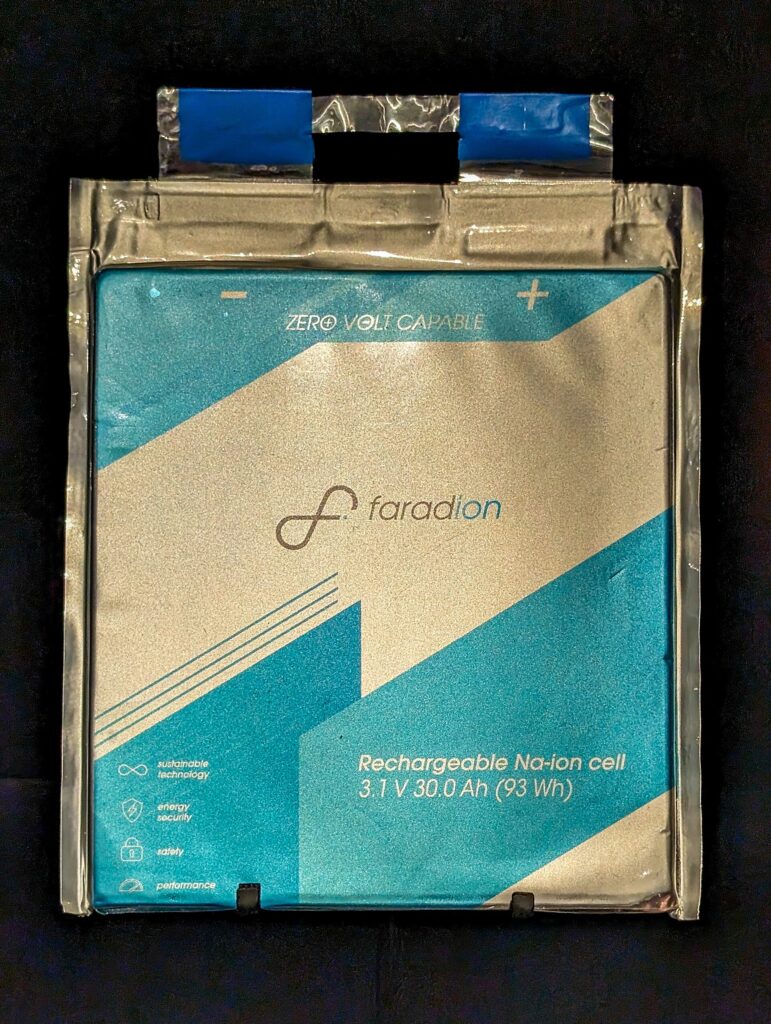
Featured image credit: Image: The wub via Wikimedia Commons (CC BY-SA 4.0). Source
By Piyush P. Yadav
Two developments in the last fortnight mark a shift in India’s battery story from announcements to shipments. On August 25, Renewable Energy Secretary Santosh Kumar Sarangi told the BloombergNEF summit that sodium-ion battery technology in India has reached Technology Readiness Level 7 and above, and that it could move from pilots to commercial-scale production within two to three years. Days earlier, Exide Industries confirmed that its 6 GWh lithium-ion cell plant in Bengaluru has begun shipping sample cells to customers and will book commercial revenue in the second half of this financial year. Together they answer the two questions that have hung over Indian battery manufacturing since the PLI scheme was announced: will India ever actually make cells at scale, and will it be locked into lithium chemistries it cannot source?
What TRL 7 means, and why the secretary’s timeline matters
Technology Readiness Level is a nine-point scale originally developed for aerospace. TRL 7 means a system prototype has been demonstrated in an operational environment, which is the point at which a technology stops being a lab result and starts being an engineering-and-manufacturing problem. Sarangi’s remark was that technologies at TRL 7 typically take two to three years to move from pilot projects to commercial production, and that India’s sodium-ion work has crossed that threshold.
The context was grid storage, not cars. India needs roughly 411 GWh of energy storage by 2031-32 to balance its renewable build-out, and about 156 GWh of battery energy storage systems are currently in tendering, processing or implementation. The secretary also mentioned NTPC Green Energy’s order for 100 MW of vanadium flow batteries as another example of the government’s interest in non-lithium chemistries. But the EV relevance is direct: any cell chemistry that reaches commercial scale for stationary storage in India becomes a candidate for two- and three-wheelers within a product cycle, because the volumes and the manufacturing lines are shared.
Sodium-ion vs lithium-ion: the trade-offs
| Attribute | Sodium-ion | Lithium iron phosphate (LFP) | Nickel manganese cobalt (NMC) |
|---|---|---|---|
| Raw material availability | Sodium is abundant and cheap; no lithium, cobalt or nickel | Needs lithium; no cobalt or nickel | Needs lithium, nickel, cobalt |
| Energy density (cell level) | Lower than LFP; improving each generation | Moderate | Highest |
| Cold-weather performance | Generally better than lithium chemistries | Weak below 0 C | Moderate |
| Safety | Can be shipped at zero volts; low thermal-runaway risk | Very good | Requires more thermal management |
| Cost trajectory | Potentially lowest at scale; not yet at scale | Lowest today at volume | Highest |
| Best EV fit | Low-cost 2W/3W, entry cars, swap batteries | Mass-market cars, 3W, buses | Long-range cars, premium 2W |
The reason India in particular cares about sodium-ion is on the first row. India has no meaningful lithium production, its one large reserve in Jammu and Kashmir is years from mining, and the lithium-carbonate imports that feed cell plants arrive through ports mostly from China, Chile and Australia. Sodium is available from salt. A sodium-ion supply chain could, in principle, be entirely domestic, which is the same strategic logic that drives the rare-earth-magnet scheme we described in our report on India’s dependence on imported EV motor magnets.
The trade-off is energy density. A sodium-ion pack of the same capacity is heavier and bulkier than an LFP pack, which rules it out for long-range cars for now. For an electric rickshaw, a 2 kWh scooter battery or a swappable pack for last-mile delivery, weight matters less than cost and cycle life, and that is where sodium-ion will land first. China’s CATL has already begun deploying sodium-ion cells in Changan passenger cars in 2026, which shows the chemistry has crossed into automotive use at least at the entry level.
Exide: India’s first large lithium cell plant goes commercial
While sodium-ion is the future, the present is Exide Energy Solutions, Exide Industries’ wholly owned cell subsidiary. Its Bengaluru gigafactory has 6 GWh of installed Phase 1 capacity across four production lines, making both NMC cylindrical cells and LFP prismatic cells, with expansion to 12 GWh planned. The key milestones from the company’s most recent update:
| Milestone | Status |
|---|---|
| Equipment installation | 100 per cent complete |
| Customer sample supplies | Begun (NMC cylindrical and LFP prismatic) |
| Commercial revenue | Expected from Q3 FY27 (October to December 2026) |
| Year-one plant utilisation | 25 to 30 per cent expected |
| Cumulative equity invested (to July 31, 2026) | Rs 4,902 crore |
| FY27 approved capex | Rs 1,400 crore, including Rs 100 crore infused in July |
| Customer engagement | Three major OEMs representing about 80 per cent of India’s EV volume; one or two passenger-car makers |
| First commercial segment | Three-wheeler aftermarket retrofit |
| Four-wheeler line | To be commissioned by end of FY27 |
Two things are notable. First, Exide is starting with three-wheeler retrofit rather than with a marquee car programme. That is a sensible choice: the three-wheeler aftermarket is enormous, price-sensitive and forgiving of a new supplier, and it lets Exide build cycle-life data before a car OEM commits to a multi-year programme. Second, the 25 to 30 per cent year-one utilisation figure is an honest acknowledgement that qualification takes time. A 6 GWh plant running at 30 per cent produces about 1.8 GWh, enough for roughly 600,000 three-wheeler packs or 40,000 mid-size car packs.
Where the other cell makers stand
Exide’s progress is sharper against the backdrop of delays elsewhere. Amara Raja’s 1 GWh NMC line in Telangana, part of a planned Rs 9,500 crore gigafactory, is now targeted for production by the end of FY27, with a commercial pilot plant for customer qualification due by the end of FY26. Ola Electric, which had planned 20 GWh by mid-2026, has capped its cell capacity at 5 GWh until FY29, citing slower EV growth, although it received revised timelines under the ACC PLI scheme and estimates Rs 7,240 crore in accessible incentives through 2031. Reliance’s 40 GWh gigafactory, which we covered in our report on Reliance commissioning its battery plant, is the largest by nameplate but has not yet disclosed EV-cell shipments.
The Parliamentary Standing Committee on Industry summarised the gap in March: of the 40 GWh of capacity awarded under the ACC PLI scheme, only 1 GWh had been commissioned. Exide’s Bengaluru plant, which is outside the PLI programme, is now the closest India has to a running cell factory at gigawatt-hour scale.
Why the two stories are connected
Chinese export controls on battery technology and equipment have stalled several Indian gigafactory plans, because the manufacturing lines, the cathode precursors and much of the process know-how come from China. As we noted in our piece on Zenergize’s funding and India’s shift toward battery software, the industry has been moving investment toward parts of the value chain that are less exposed to those controls. Sodium-ion is attractive for the same reason. Because the chemistry is newer, the equipment ecosystem is less consolidated, Indian labs have been working on it for years, and there is no incumbent Chinese supply chain to displace. If India is going to own a cell chemistry end to end, sodium-ion is the most plausible candidate.
Exide’s plant, meanwhile, shows that the lithium route is possible if a company is willing to spend Rs 5,000 crore and wait five years. The two paths are not alternatives. A realistic 2030 picture is LFP and NMC cells from Exide, Amara Raja and Reliance for cars and premium two-wheelers, and domestic sodium-ion for low-cost scooters, rickshaws and grid storage.
What it means for EV buyers
- Cell prices in India should fall as domestic supply comes online and import duties, freight and working-capital costs drop out of the pack price. Exide’s own guidance that it is working with OEMs covering 80 per cent of EV volume suggests those savings will show up across brands, not just one.
- Battery-as-a-service pricing, such as the per-kilometre models we analysed in our Mahindra BaaS cost explainer, becomes more attractive to OEMs when the pack is sourced locally, because the residual-value risk is easier to manage.
- Sodium-ion scooters and rickshaws are a 2028 to 2029 prospect on the secretary’s timeline, not a 2027 one. Expect the first products to be swap-network batteries and entry-level three-wheelers.
- Warranty terms may diverge by chemistry. LFP and sodium-ion cells tolerate more cycles than NMC, so expect longer battery warranties on products that use them.
Sources & Further Reading
- KNN India: Sodium-ion batteries could reach commercial scale in India within 2-3 years, says Renewable Energy Secretary
- Chemical Industry Digest: Sodium-ion batteries set for commercialisation in India within three years
- Power Peak Digest: Exide begins lithium-ion cell sample supplies, targets FY27 commercial revenue
- S&P Global AutoTechInsight: Amara Raja delays lithium-ion cell production to FY2027
FAQ
What did the Renewable Energy Secretary say about sodium-ion batteries?
Santosh Kumar Sarangi said on August 25, 2026 that Indian sodium-ion battery technology has reached TRL 7 and above and could move from pilot projects to commercial-scale production within two to three years.
Are sodium-ion batteries used in EVs yet?
Yes, at the entry level. CATL began deploying sodium-ion cells in Changan passenger cars in China in 2026. In India the first uses are expected in grid storage, swap batteries and low-cost two- and three-wheelers.
When will Exide’s Bengaluru cell plant start commercial supply?
Exide has begun customer sample supplies and expects commercial revenue from the third quarter of FY27, with year-one utilisation of 25 to 30 per cent of the 6 GWh capacity.
Why does India want sodium-ion specifically?
Sodium is abundant domestically while lithium, nickel and cobalt are imported, and Chinese export controls on lithium-ion technology have delayed Indian gigafactories. Sodium-ion offers a chemistry India could own end to end.
Are sodium-ion batteries cheaper than lithium-ion batteries right now?
Not yet, despite the raw-material story. Industry cell-price surveys through 2026 put average sodium-ion cells at roughly $55 to $60 per kWh against about $52 for established LFP, because LFP has a decade of manufacturing scale behind it and sodium-ion does not. The cost advantage is a scale argument rather than a present-day one: forecasts put sodium-ion in the low $40s per kWh once volume production matures, which is when the abundant-sodium supply chain starts showing up in the price.
Which Indian companies are working on sodium-ion cells?
Reliance is the largest, having acquired UK-based Faradion outright in 2021 for about £94 million and earmarked sodium-ion for its Jamnagar energy complex. KPIT Technologies unveiled an indigenous sodium-ion chemistry and in 2025 transferred it to Trentar, which is building roughly 3 GWh of capacity. Startups including Indi Energy, which makes hard-carbon anodes from agricultural waste, and GODI are at pilot scale. None is in commercial-volume production yet, which is precisely the gap the secretary’s two-to-three-year timeline refers to.
How many charge cycles does a sodium-ion battery last?
Published figures range widely — roughly 2,000 to 6,000 cycles for cells shipping today, with newer designs claiming considerably more — and that spread is itself a sign the chemistry is not yet standardised the way LFP is. On density, CATL’s mass-produced NaXtra sodium-ion cells are rated around 175 Wh/kg, which sits inside the typical LFP band of 160 to 180 Wh/kg, so the gap at cell level is narrower than the “up to 40 per cent lower” figure often quoted from earlier sodium-ion generations.