

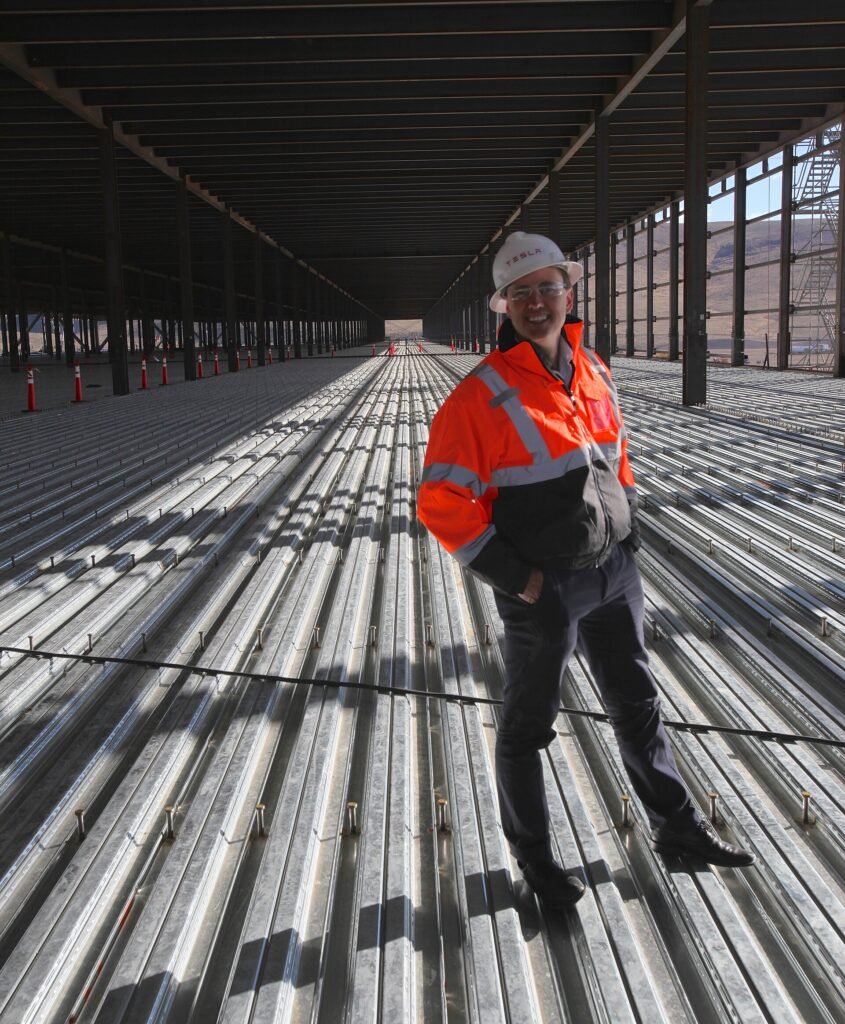
Featured image credit: Image: Steve Jurvetson from Menlo Park, USA via Wikimedia Commons (CC BY 2.0). Source
By Piyush P. Yadav
Tata Motors’ battery arm, Agratas Energy Storage Solutions, passed a visible construction milestone in August 2026: the completion of the massive steel structure for its gigafactory at Sanand, Gujarat, marking the shift from site preparation to actual industrialisation. It is easy to miss amid the flurry of EV launch news, but this is arguably the single most consequential piece of India’s battery supply chain, because Agratas is the in-house cell supplier for the country’s largest EV manufacturer and for Jaguar Land Rover. Here is what is actually being built, on what timeline, and why it matters more than another gigafactory announcement.
The Sanand facility, in numbers
| Detail | Figure |
|---|---|
| Location | Sanand, Gujarat |
| Site area | About 1.05 lakh square metres, on a roughly 320-acre campus |
| Phase 1 capacity | 20 GWh a year |
| Total planned capacity | Up to 40 GWh across phased development |
| August 2026 milestone | Completion of the main steel structure, marking transition from civil construction to equipment installation |
| Equipment sourcing | Orders placed with South Korean manufacturers, delivery targeted for the first half of 2026 |
| Cell production target | 2027, per the most recent public timelines |
| Anchor customers | Tata Motors and Jaguar Land Rover |
Twenty gigawatt-hours a year is enough cells, at typical mid-size EV pack sizes of 40 to 50 kWh, for roughly 400,000 to 500,000 electric cars annually — comfortably more than Tata Motors’ entire current EV sales volume, which gives a sense of how much this single plant is meant to cover, both for Tata’s domestic range and for JLR’s electrification push in Britain.
Where this fits among India’s other battery plants
| Company | Location | Phase 1 / current capacity | Status as of September 2026 |
|---|---|---|---|
| Agratas (Tata) | Sanand, Gujarat | 20 GWh (of up to 40 GWh planned) | Steel structure complete; equipment installation phase; cell production targeted 2027 |
| Exide Energy Solutions | Bengaluru, Karnataka | 6 GWh (of up to 12 GWh planned) | Equipment 100 per cent installed; customer sample supplies begun; commercial revenue targeted Q3 FY27 |
| Reliance Industries | Multiple sites | 40 GWh initial, scaling toward 100 GWh | Commissioned; EV-specific cell shipment volumes not yet disclosed |
| Ola Electric Gigafactory | Tamil Nadu | 5 GWh Phase 1 (NMC, 4680 form factor) | In production; capped near-term expansion to 5 GWh until FY29 |
| Amara Raja | Telangana | 1 GWh planned | Delayed to end of FY27 |
We covered Exide’s plant going commercial in our report on sodium-ion progress and Exide’s cell shipments, and Reliance’s commissioning in our earlier gigafactory coverage. Agratas is different from both in one important respect: it is a captive supplier, built specifically to feed Tata Motors and JLR rather than to sell cells competitively on the open market the way Exide is positioning itself to three OEMs covering 80 per cent of India’s EV volume. That captive model gives Tata more control over its own battery cost and supply security, at the cost of not participating in the broader Indian cell market the way Exide or Amara Raja eventually will.
Why the timeline matters for Tata’s EV range
Tata currently imports the LFP and NMC cells that go into the Nexon EV, Curvv EV, Punch EV, Tiago EV and the rest of its electric line-up, which we mapped in our Tata Motors EV brand deep-dive. Every imported cell carries freight cost, duty exposure and rupee-dollar risk, all of which show up in the price increases we covered in this September’s Tata and Hyundai price hikes. Once Agratas reaches commercial cell production, expected in 2027, Tata gains the option to source a meaningful share of its battery volume domestically, which is the single biggest lever available to reduce EV manufacturing cost in India. It will not happen overnight — ramping a new gigafactory to full yield typically takes several years past first production — but 2027 is the point at which the input-cost pressure behind recent price hikes could start to ease, at least for Tata’s own range.
The bigger supply-chain picture
Agratas’ progress sits alongside a broader domestic push covered in our reporting on India’s rare-earth magnet dependence and motor localisation and the shift of investment toward battery software and less China-exposed parts of the value chain. Cells, magnets and software are the three legs of India’s EV-component localisation effort, and of the three, cells are furthest along in committed capital even though actual production remains the furthest out. Agratas’ South Korean equipment orders are also notable: they suggest India’s gigafactories are, for now, largely importing manufacturing technology rather than building it domestically, which is a dependency that will take longer to unwind than the cell-import dependency itself.
What to watch next
- Equipment delivery through H1 2026 from South Korean suppliers — delays here would be the clearest early signal of a slip in the 2027 cell-production target.
- Whether Agratas cells first appear in Tata’s domestic range or in JLR’s UK-market vehicles. Given JLR’s higher margins and stricter European battery-sourcing pressure, it would not be surprising if JLR gets priority allocation initially.
- Whether Tata passes any early cost benefit to Indian buyers, or uses domestic cells primarily to protect margin during a period of rising input costs.
Sources & Further Reading
- Industrial Automation India: Agratas completes massive steel structure for Sanand battery plant
- PV Magazine India: Agratas advances 20 GWh Sanand battery facility
- Mercom India: Tata Group to build 20 GWh battery manufacturing plant in Gujarat
FAQ
What is Agratas and who owns it?
Agratas Energy Storage Solutions is Tata Motors’ captive battery cell manufacturing arm, building a gigafactory at Sanand, Gujarat to supply Tata Motors and Jaguar Land Rover.
When will Agratas start producing battery cells?
Commercial cell production is targeted for 2027. As of August 2026, the plant’s main steel structure was completed and the project is moving into equipment installation.
How big is the Agratas Sanand gigafactory?
Phase 1 capacity is 20 GWh a year, on a roughly 320-acre site, with total planned capacity of up to 40 GWh across phased development.
Will Agratas cells lower Tata EV prices?
Not immediately. Commercial production starts in 2027 at the earliest, and ramping a new gigafactory to full yield typically takes several more years, so any price benefit is a medium-term prospect rather than an immediate one.
What battery chemistry will the Agratas Sanand plant make, LFP or NMC?
Both. Agratas has licensed mature NMC cell technology from Japan’s Automotive Energy Supply Corporation, which lets it skip the early development stages and target commercial NMC output around early 2027, and it is running a pilot line at Sanand for LFP cells based on its own technology. The split matters for buyers: LFP is the cheaper chemistry with longer cycle life and better thermal stability, typically used in entry and mid-range packs, while NMC carries the higher energy density needed for long-range cars and for Jaguar Land Rover’s premium models.
Will Agratas sell battery cells to other carmakers, or only to Tata?
Agratas is a captive supplier, built to feed Tata Motors and Jaguar Land Rover rather than to compete for third-party cell orders. That is the opposite of Exide Energy Solutions, which is positioning its Bengaluru plant as a merchant supplier to multiple OEMs, and of Reliance and Amara Raja, which are also building for the wider market. For anyone buying a non-Tata EV, Agratas changes Tata’s cost base and supply security first and the rest of the Indian market only indirectly.
How many of the battery cells used in Indian EVs are still imported?
Almost all of them. Roughly 99 per cent of the cells that go into Indian-built EVs are imported today, predominantly from China, which is why cell localisation carries so much policy weight. The central ACC PLI scheme committed Rs 18,100 crore towards 50 GWh of domestic capacity, but only a small fraction of that has actually started producing. Agratas’ 20 GWh phase one is the single largest step towards closing the gap, and it only begins to count from 2027.