

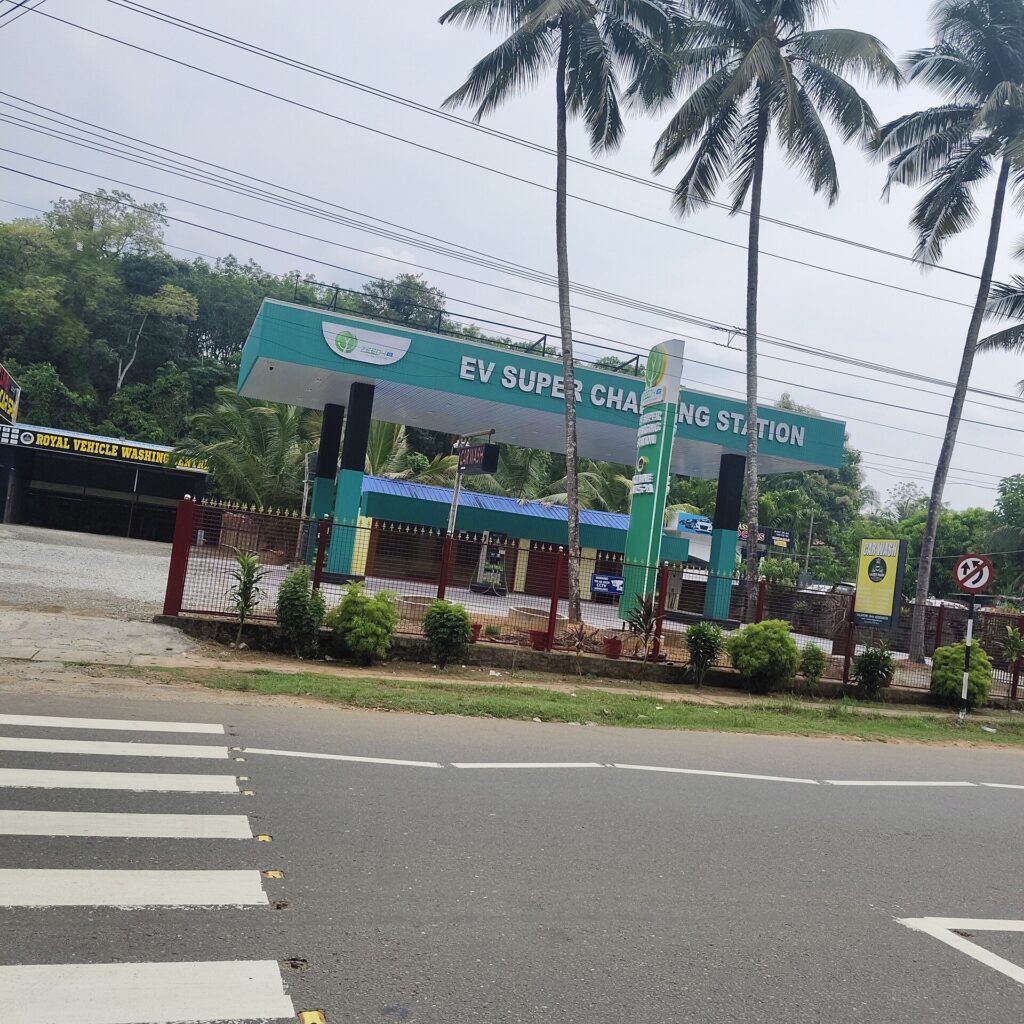
Featured image credit: Image: Sujithshivam511 via Wikimedia Commons (CC BY-SA 4.0). Source
On 10 September 2026, Tata Power and TATA.ev reported that their co-branded Mega Charger hubs had crossed 70,000 charging sessions and more than 85,000 hours of charging. The network delivering that is small: 25 fast chargers, 56 charging guns and 2.7 MW of cumulative capacity, spread across Maharashtra, Telangana, Andhra Pradesh and Uttar Pradesh.
Those two facts sitting together are the whole story of Indian EV charging in 2026. Utilisation is high. Capacity is thin. And the plan to fix the second without breaking the first is the most consequential infrastructure bet in the Indian EV market.
By Piyush P. Yadav
What the numbers actually tell you
Divide the reported figures and the picture sharpens considerably.
| Metric | Reported figure | What it implies |
|---|---|---|
| Charging sessions | Over 70,000 | Around 2,800 sessions per charger |
| Charging hours | Over 85,000 | Average session of roughly 1.2 hours |
| Fast chargers | 25 | Very small network |
| Charging guns | 56 | Roughly 2 guns per charger |
| Cumulative capacity | 2.7 MW | Around 108 kW average per charger |
| States covered | 4 | Corridor-focused, not national |
An average session of about 72 minutes on a roughly 108 kW charger is a meaningful top-up rather than a quick splash, which fits highway use. Around 2,800 sessions per charger says these locations are being found and used, not sitting idle as showpieces.
That is the important signal. India’s charging problem has never been purely about count. Plenty of chargers exist on maps and do not work, or sit in locations nobody stops at, or are blocked by a parked petrol car. A network reporting genuine throughput is demonstrating something different from a network reporting installations.
The expansion plan
TATA.ev has signed memorandums of understanding with four charge point operators, Tata Power, ChargeZone, Statiq and Zeon, to operationalise 500 TATA.ev Mega Chargers over two years in the first phase. The broader stated ambition is to take India’s charging infrastructure to 400,000 charge points.
The structure of that deal is more interesting than the headline number. Tata Motors is not building the network itself. It is aggregating four operators under a single co-branded standard.
| Partner | Network strength |
|---|---|
| Tata Power | Broad national footprint, cities and highway corridors |
| ChargeZone | Highway corridor focus, large capacity commitments |
| Statiq | Premium and commercial locations, strong in Delhi NCR |
| Zeon | Additional coverage and site access |
ChargeZone in particular has been pursuing an aggressive highway strategy, and we examined its approach of contracting demand before building 1,000 highway superchargers. Putting that capacity under a TATA.ev branded standard gives Tata EV owners a coherent experience across networks they do not own.
Why a manufacturer is doing this at all
Car companies do not normally build fuel stations. The reason Tata Motors is effectively curating a charging network comes down to one uncomfortable fact: it sells more electric cars in India than anyone else, and every charging failure its customers experience becomes a Tata problem regardless of who owns the charger.
Three pressures make this worth the investment.
Charging anxiety is now the binding constraint
Range anxiety has largely been solved by product. Most Indian electric cars now offer real-world range that covers ordinary use. What has not been solved is the confidence to drive 400 km to another city, which depends entirely on whether chargers exist, work, and are free when you arrive.
Regulation is about to increase EV supply
CAFE III fleet emission rules take effect from April 2027 and count each electric vehicle as three units toward compliance. That gives every manufacturer a strong reason to push EV volume. More EVs arriving without proportionate charging capacity produces queues, and queues produce the single worst customer experience in electric motoring.
Charging quality is becoming a purchase factor
Buyers increasingly ask which network a brand is aligned with. A co-branded standard is a marketing asset as much as an infrastructure one.
Against the national picture
India’s public charging points have more than doubled in 15 months, passing 18,000. That is genuine growth. It is also a small number against the vehicle parc it serves, and the distribution is heavily skewed toward major cities and a handful of corridors.
Two structural improvements are happening alongside raw capacity growth.
Payment and roaming. The fragmentation problem, where drivers needed a separate app and wallet for every network, is being addressed through the Unified Bharat eCharge platform. We explained how India’s one-app charging platform works via UPI in detail. Interoperability arguably matters more than charger count, because a charger you cannot pay at is not a charger.
Home charging rules. Roughly 80 per cent of EV charging happens at home in most markets, and India is no exception for private car owners. The binding constraint in Indian cities is apartment installation, which we covered in how to install an EV charger in an apartment, including society NOC rules and dedicated EV meter tariffs.
What this means for you as a driver
Highway travel is getting genuinely easier on specific routes
The Mega Charger deployments are corridor-focused across four states. If your regular long drive runs along one of those corridors, the practical experience has improved substantially. If it does not, very little has changed for you yet.
Do not plan around one charger
With roughly two guns per charger and high utilisation, arriving at a single-location plan with 8 per cent charge remaining is a bad idea. Plan to arrive at your charging stop with enough buffer to reach the next one if the first is occupied or faulty.
Public fast charging remains expensive
The cost gap is large and it has not narrowed. Home charging runs roughly Rs 1 to Rs 1.5 per kilometre for a typical car. Public DC fast charging runs roughly Rs 2.50 to Rs 4 per kilometre.
| Charging type | Typical tariff | Approximate cost per km |
|---|---|---|
| Home, residential tariff | Rs 6 to Rs 10 per kWh | Rs 1 to Rs 1.5 |
| Public AC charging | Rs 12 to Rs 18 per kWh | Rs 2 to Rs 2.8 |
| Public DC fast charging | Rs 15 to Rs 26 per kWh | Rs 2.5 to Rs 4 |
| Petrol car for comparison | Fuel price dependent | Rs 7 to Rs 9 |
Even the most expensive public fast charging is roughly half the running cost of petrol. But an EV owner who relies entirely on public DC charging gives up most of the savings that justified the purchase price premium. The running-cost case for an electric car in India is fundamentally a home-charging case, which is why the slab maths on your home electricity bill matters more than any public network announcement.
The honest assessment
A 25-charger network reporting 70,000 sessions is a proof of concept, not infrastructure. The 500-charger phase one target over two years is credible because it is spread across four operators who are building anyway. The 400,000 charge point ambition is a direction of travel rather than a plan with a date.
What has genuinely changed is the model. India spent years treating charging as something charge point operators would solve if subsidies were right. The evidence of 2026 is that it takes a vehicle manufacturer with skin in the game to enforce a standard, aggregate operators, and take responsibility for whether the charger actually works when its customer arrives.
That is a better structure than what came before. It is still building out from a base of 18,000 public chargers in a country of 1.4 billion people, and the gap between that and adequacy is measured in years.
Sources & Further Reading
- Business News This Week — Tata Power and TATA.ev expand fast-charging footprint, clock 70,000-plus sessions
- Tata Motors — TATA.ev to boost India’s charging infrastructure to 400,000 charge points
- EV Charging & Infrastructure — TATA.ev charging infrastructure expansion
- Pulse Energy — EV charging rates in India 2026
Frequently Asked Questions
What is a TATA.ev Mega Charger?
It is a co-branded high-power charging hub operated in partnership with charge point operators including Tata Power, ChargeZone, Statiq and Zeon. As of 10 September 2026 the Tata Power co-branded hubs comprised 25 fast chargers with 56 guns and 2.7 MW of cumulative capacity across Maharashtra, Telangana, Andhra Pradesh and Uttar Pradesh.
How many public EV chargers does India have?
India’s public charging points have more than doubled in roughly 15 months and now exceed 18,000. Distribution is uneven, concentrated in major cities and specific highway corridors, so national totals understate how patchy coverage is on many routes.
Is public fast charging much more expensive than charging at home?
Yes, typically two to three times more per kilometre. Home charging on residential tariffs of Rs 6 to Rs 10 per kWh works out to roughly Rs 1 to Rs 1.5 per km. Public DC fast charging at Rs 15 to Rs 26 per kWh works out to roughly Rs 2.5 to Rs 4 per km. Both remain cheaper than petrol.
Can I use a TATA.ev Mega Charger if I do not drive a Tata EV?
The chargers are operated by commercial charge point operators and use standard connectors, so other EVs can generally use them. The co-branding relates to the standard, experience and partnership rather than exclusive access, though app integration and any pricing benefits may favour Tata vehicle owners.
Which app shows real-time EV charger availability in India?
There is no single national app yet. Live gun status comes from each operator’s own platform, so the Mega Charger hubs are visible through Tata Power’s EZ Charge app, and the other large networks run Jio-bp Pulse, Statiq and ChargeZone. The Unified Bharat eCharge platform is meant to collapse payment and roaming into one UPI-based layer, but availability data still originates with the operator and can be stale. Treat an “available” marker as indicative, not a reservation, and always identify a second hub on the route before you set off.
How long does a DC fast charger take to go from 10 to 80 per cent?
On this network the average session runs about 72 minutes at roughly 108 kW of installed capacity per charger, which reflects real highway top-ups rather than best-case figures. For a typical 40 to 45 kWh Indian electric car on a 50 kW charger, 10 to 80 per cent takes roughly 55 to 60 minutes; Tata quotes 56 minutes for the Nexon EV on a 50 kW DC charger. A 100 kW-plus hub only helps if the car can accept that power, and most mass-market Indian EVs are capped well below the charger’s rating, so the vehicle, not the hub, is usually the limiting factor.
Does using DC fast chargers often damage the battery?
It accelerates wear measurably but gradually rather than causing sudden damage. Geotab’s analysis of about 22,700 electric vehicles found cars that used DC fast charging for under 12 per cent of sessions lost around 1.5 per cent of capacity a year, heavy DC users around 2.5 per cent, and those where more than 40 per cent of DC sessions ran above 100 kW around 3 per cent. Occasional highway fast charging is exactly what the car is engineered for; making it your primary method costs you both capacity and, at Rs 2.50 to Rs 4 per kilometre against Rs 1 to Rs 1.5 at home, most of the running-cost advantage.