

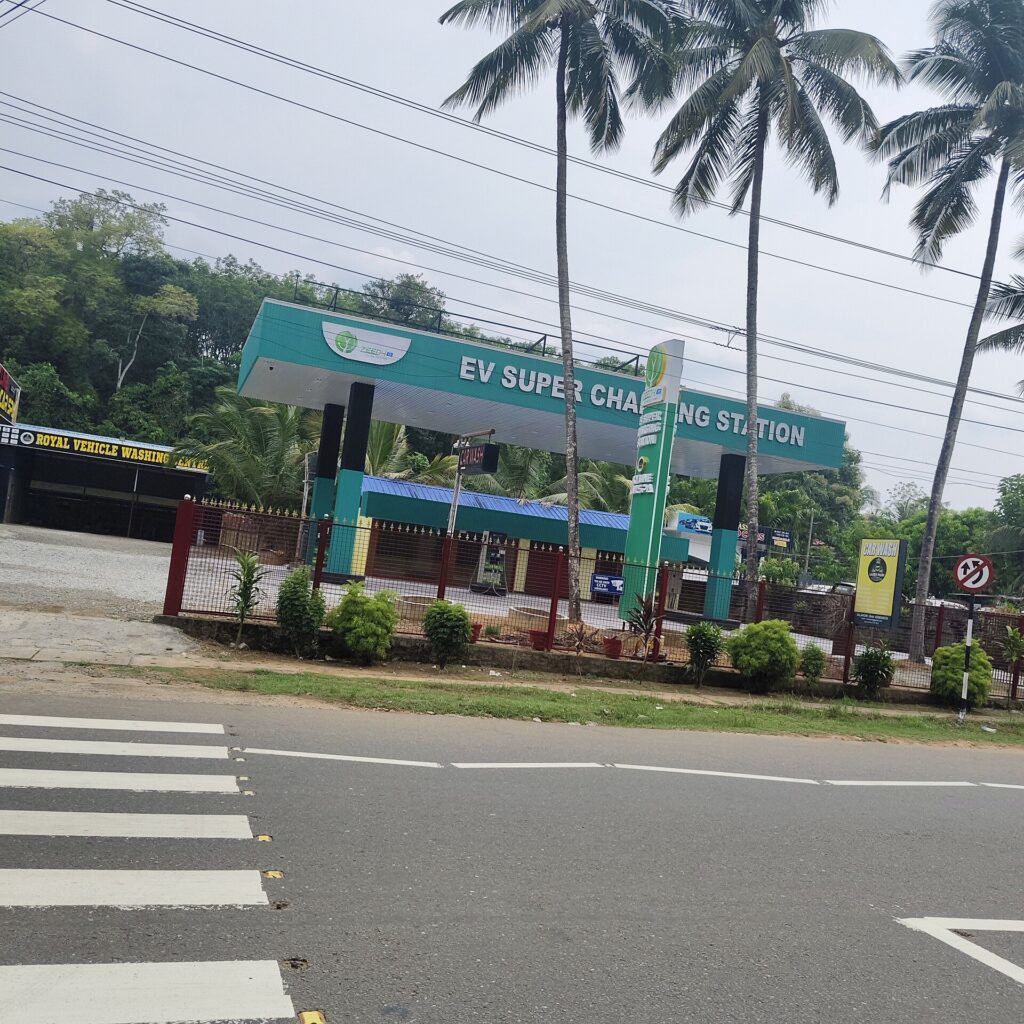
Featured image credit: Image: Sujithshivam511 via Wikimedia Commons (CC BY-SA 4.0). Source
India’s public charging industry has spent three years solving the wrong problem. Operators built chargers where land was available and footfall looked plausible, then discovered that utilisation sat somewhere between 1% and 5% and that a charger nobody uses is an expensive piece of street furniture.
ChargeZone has taken a different route, and in September 2026 it disclosed the result: long-term energy contracts worth more than USD 1 billion, roughly Rs 10,500 crore, signed across intercity electric buses, trucks and commercial car fleets. On the back of that contracted demand, the company plans more than 1,000 supercharging stations along national highway corridors by the end of FY2027.
The order of those two facts is the whole story. The demand was contracted first. The chargers follow. By Piyush P. Yadav.
What ChargeZone has announced
The disclosure covers a financing and deployment package rather than a single project.
| Element | Figure |
|---|---|
| Contracted energy value | More than USD 1 billion (about Rs 10,500 crore) |
| New stations planned | More than 1,000 by end of FY2027 |
| Added charging capacity | 180 MW |
| Network capacity after expansion | From 120 MW to 300 MW |
| Expected annual energy delivered | About 700 GWh |
| Expected daily charging sessions | More than 15,000 |
| Debt raised | USD 25 million (about Rs 250 crore) from Indian banks |
| Further capital planned | USD 100 million during 2026-27 |
The deployment uses a Dealer Owned, Company Operated model, usually shortened to DOCO. A franchise partner provides the site and the capital for the physical installation; ChargeZone operates the station, manages the technology and holds the customer relationship.
Why contracted demand changes the economics
To see why this matters, look at what the rest of the industry is dealing with.
India had 67,657 chargers installed as of August 2026, including battery swapping stations, spread across more than 200 charge point operators. Utilisation across that base is reported at 1% to 3% by an SBI assessment and around 5% by S&P Global. Meanwhile operators pay electricity tariffs of Rs 6 to Rs 15 per kWh, carry site acquisition costs and must meet a 98% uptime requirement.
A charger running at 3% utilisation generates almost no revenue while incurring nearly all of its costs. That is the structural problem we examined in our analysis of Indian EV charger utilisation and charge point operator economics, and it explains why so many operators have struggled to reach break-even.
A long-term energy contract inverts that risk. Instead of building a charger and hoping vehicles arrive, the operator knows in advance roughly how much energy a known fleet will consume, over a known period, at a known location. That converts a speculative asset into something closer to contracted infrastructure, which is precisely what makes bank debt available at sensible rates.
Why fleets and not private cars
ChargeZone’s contracts cover intercity electric buses, trucks and commercial car fleets. That choice is deliberate and worth understanding, because it reflects where the energy actually is.
| Vehicle type | Typical daily energy need | Charging predictability |
|---|---|---|
| Private electric car | Low, often charged at home | Irregular, discretionary |
| Commercial car fleet | Moderate to high | Routed and schedulable |
| Intercity electric bus | Very high | Fixed route and timetable |
| Electric truck | Very high | Fixed corridors, repeat trips |
A single intercity electric bus consumes more energy in a day than several private cars consume in a week, and it does so on a timetable. An electric truck running a fixed corridor between a plant and a distribution centre passes the same point repeatedly. That predictability is what makes a long-term energy contract possible in the first place.
It also explains the highway focus. Private cars mostly charge at home or at destination, as the charging behaviour data we covered in our piece on Bolt.Earth’s State of Charge findings makes clear. Heavy vehicles cannot. They need high-power charging on the corridors they run, and there is currently very little of it.
What 180 MW actually buys
Capacity figures in megawatts are easy to skim past, so it is worth grounding them.
Adding 180 MW takes the network from 120 MW to 300 MW, a 2.5-fold increase. At roughly 700 GWh of expected annual delivery and more than 15,000 daily sessions, the average works out to a meaningful amount of energy per session, consistent with heavy vehicles rather than cars topping up.
Spread across more than 1,000 stations, 180 MW averages to about 180 kW per station. That is a real supercharging specification, not a slow AC point. It stands in sharp contrast to the national picture, where roughly 73% of installed chargers are rated below 30 kW, a skew we examined in our report on India’s charger mix and why most of the installed base is low-power.
That mismatch is the gap ChargeZone is aiming at. India has plenty of slow chargers and very few of the high-power units that buses and trucks require.
The DOCO model, and its trade-offs
Franchising solves two problems that have slowed charging network growth: capital and land.
- Capital is distributed. The franchise partner funds the site build, so the operator can expand faster than its own balance sheet would allow.
- Land comes with local knowledge. A dealer or landowner already on a highway corridor understands traffic patterns better than a remote site-selection team.
- Operations stay centralised. Uptime, pricing, payments and network software remain with the operator, which protects consistency.
The trade-off is that franchise partners take on real risk. Their returns depend on the contracted fleet demand actually materialising at their specific site. If a corridor underperforms or a fleet contract is restructured, the partner carries that exposure. Anyone evaluating such a franchise should model it carefully, and our breakdown of whether an EV charging station is profitable in India sets out the cost structure and break-even arithmetic involved.
How this fits the national build-out
India needs an estimated 1.32 million public charging points by 2030, against 67,657 installed in August 2026. That is roughly a twentyfold increase, based on a planning ratio of about one charger per 40 electric vehicles.
A thousand stations is a small fraction of that gap in unit terms. In capacity and energy terms it is more significant, because high-power highway chargers deliver far more energy per unit than the low-power chargers that dominate the current count.
The installed base is also geographically concentrated. Karnataka alone accounts for about 21% of installed stations and Maharashtra about 14%, with the top ten states holding nearly 78% of national infrastructure. Highway corridor charging is one of the few approaches that necessarily spreads infrastructure across state lines, since a corridor cannot be built in one state only. Tata Power has been pursuing a comparable logic, as covered in our piece on its tier-2, tier-3 and highway expansion plan.
What to watch
- Whether stations get built on schedule. FY2027 is a tight window for more than 1,000 sites, and construction, grid connection and approvals all take time.
- Grid capacity at corridor locations. A 180 kW station needs a substantial connection, and rural highway points are not always ready for it.
- Whether fleet electrification keeps pace. The contracts assume buses and trucks arrive in the numbers projected.
- Franchise partner returns in the first cohort of stations, which will determine whether the model scales or stalls.
- Whether competitors copy the approach, contracting demand before deploying capital.
The bottom line
The significant thing here is not the station count. It is the sequencing. Indian charging infrastructure has been built largely on the assumption that supply creates demand, and utilisation figures of 1% to 5% show how that assumption has fared.
Contracting energy offtake before deploying capital is a more disciplined model, and it is the model that made commercial sense in other infrastructure sectors long before charging existed. If ChargeZone delivers on schedule and its franchise partners earn acceptable returns, the approach will likely be copied. If the stations arrive but the contracted fleets do not, the industry will have learned an expensive lesson about a different kind of optimism.
Sources & Further Reading
- EVreporter: ChargeZone secures energy contracts worth Rs 10,500 crore
- Autocar Professional: ChargeZone plans 1,000 franchise supercharging stations by FY2027
- EMobility+: India’s charging network, utilisation and operating costs
- IANS: India needs 1.32 million EV charging points by 2030
Frequently Asked Questions
What has ChargeZone announced?
ChargeZone has secured long-term EV charging energy contracts worth more than USD 1 billion, about Rs 10,500 crore, covering intercity electric buses, trucks and commercial car fleets. It plans more than 1,000 supercharging stations on national highway corridors by the end of FY2027, adding 180 MW and taking network capacity from 120 MW to 300 MW.
What is the DOCO franchise model?
Dealer Owned, Company Operated means the franchise partner provides the site and funds the physical installation, while ChargeZone operates the station, manages the technology and holds the customer relationship. It distributes capital requirements and brings local site knowledge, but the partner carries the risk that demand at their specific location materialises.
Why do charging operators in India struggle with utilisation?
Reported utilisation runs at 1% to 3% by an SBI assessment and around 5% by S&P Global, while operators face electricity tariffs of Rs 6 to Rs 15 per kWh, site acquisition costs and a 98% uptime requirement. Building capacity ahead of confirmed demand leaves expensive assets idle.
How many charging points does India need by 2030?
An estimated 1.32 million public charging points by 2030, against 67,657 installed as of August 2026. That is roughly a twentyfold increase, based on a planning ratio of about one charger per 40 electric vehicles. The existing base is concentrated, with Karnataka at about 21% and Maharashtra at about 14% of installed stations.
How much does it cost to charge an EV at a highway fast charger in India?
Expect roughly Rs 18-25 per kWh on the big CPO networks including ChargeZone, Statiq and Tata Power, with oil-marketing-company highway chargers often cheaper at about Rs 15-20 per kWh. For a mass-market electric SUV that works out to roughly Rs 3-4 per km, against about Rs 1-1.5 per km charging at home on a domestic tariff. Rates move with the state electricity tariff and with charger speed, so the same network can be meaningfully dearer on a 150 kW unit than on a 30 kW one.
Will a 150 kW or higher supercharger actually charge my electric car in minutes?
Not for most cars sold in India. The session is governed by whichever is lower, the station’s output or the vehicle’s own acceptance rate, and mass-market Indian EVs peak at roughly 50-75 kW and average only about 42-55 kW across a 10-80% session — so 20-80% still takes 35-60 minutes at a 150 kW post. High-power corridors matter most for electric buses and trucks, for the handful of cars that accept 150 kW or more, and for letting several vehicles charge simultaneously without each one being throttled.
What does it cost to open a ChargeZone franchise charging station?
ChargeZone’s partner programme spans roughly Rs 20 lakh to Rs 10 crore depending on site size and installed capacity, with financing of up to 75% of setup cost from about 6.7% interest and tenures up to seven years. Under the DOCO structure the partner provides the land and funds the installation while ChargeZone runs the station, which means the partner carries the location-specific demand risk — the critical variable in a market where reported charger utilisation is still only 1% to 5%.