

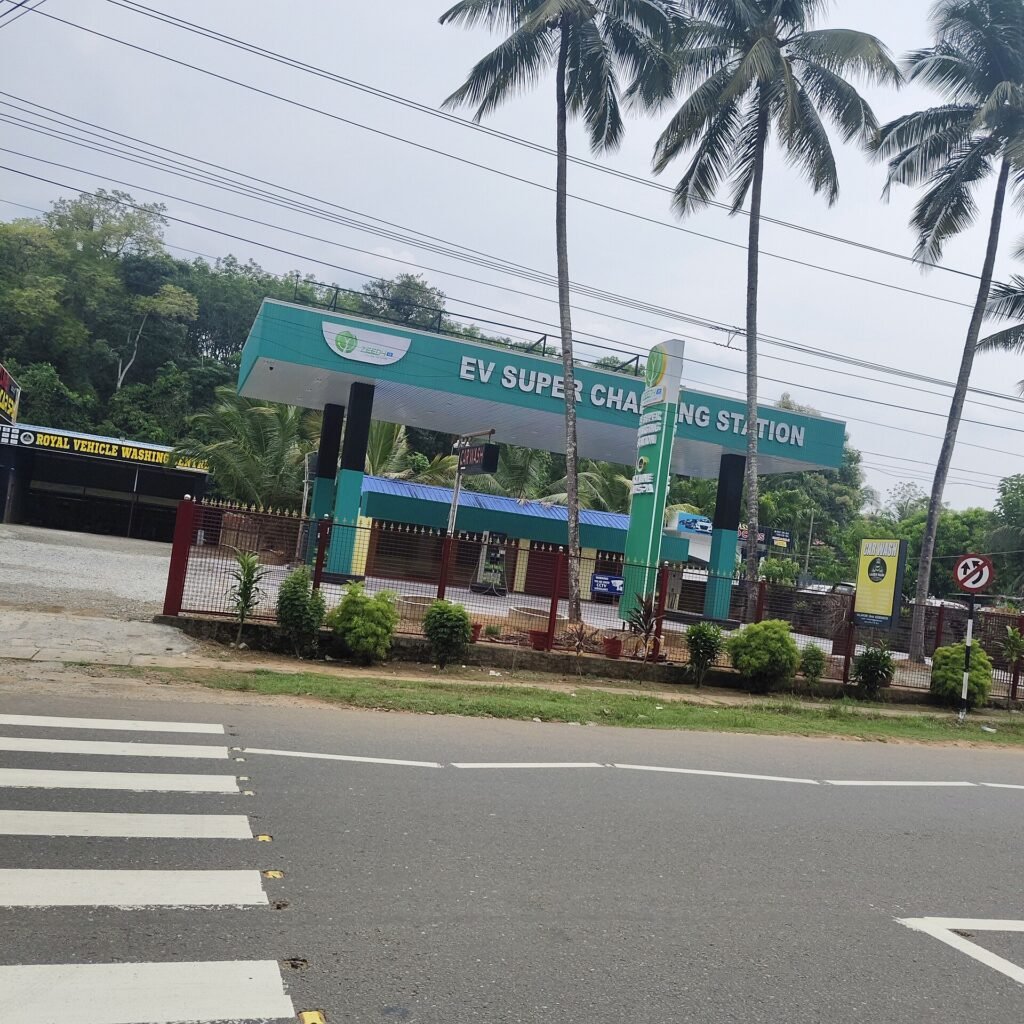
Featured image credit: Image: Sujithshivam511 via Wikimedia Commons (CC BY-SA 4.0). Source
By Piyush P. Yadav
Yes, charging an EV at home raises your electricity bill — but almost every calculation you will find online gets the number wrong, because it uses the cheapest slab rate instead of the one you will actually pay. In a telescopic tariff, your EV’s units are not billed at Rs 3 a unit. They are billed at whatever slab your household has already climbed into. Run the maths properly for a Delhi home doing 1,000 km a month and the marginal cost is close to Rs 5.94 a unit, not Rs 3 — about Rs 1,070 a month, or Rs 1.07 per kilometre. That is still far cheaper than petrol. It is also about 30 percent more than the figure most charger companies quote.
How we worked this out
We took the published domestic tariff slabs for three DISCOM regions with clear telescopic structures — Delhi (BSES/TPDDL), Maharashtra (MSEDCL) and Tamil Nadu (TANGEDCO) — and the separate EV-charging tariff categories set by DERC in Delhi and MERC in Maharashtra. All rates were checked on 12 September 2026. The worked example assumes a 45 kWh car driven 1,000 km a month at a real-world 6 km per kWh, plus 10 percent AC charging loss between the wall and the pack, which is the realistic loss on a 3.3 kW or 7.2 kW home charger. Where we assume something — installation cost, household baseline consumption — we say so in the line itself. We have deliberately left out states where the published slab structure and the flat-rate structure are reported inconsistently, rather than print a rate we cannot stand behind.
The mistake: average rate versus marginal rate
Indian domestic tariffs are mostly telescopic. Each slab rate applies only to the units inside that band, and the bands stack. So the question is never “what does a unit cost in my state?” It is “what does the next unit cost, on top of what my house already uses?”
That distinction is the whole article. An EV adds its consumption to the top of your existing bill, so it is billed at your highest slab. A household already at 350 units a month is not buying EV power at the 0–200 rate. It is buying it at the 201–400 rate and then, once the EV pushes it past 400, at the 401–800 rate.
Delhi, worked line by line
Delhi’s BSES and Tata Power-DDL domestic energy charges run Rs 3.00 a unit for the first 200 units, Rs 4.50 for 201–400, Rs 6.50 for 401–800, Rs 7.00 for 801–1,200 and Rs 8.00 above that. Take a household using 350 units a month before it buys an EV.
| Step | Without EV (350 units) | With EV (530 units) |
|---|---|---|
| First 200 units @ Rs 3.00 | Rs 600 | Rs 600 |
| 201–400 units @ Rs 4.50 | 150 units = Rs 675 | 200 units = Rs 900 |
| 401–800 units @ Rs 6.50 | — | 130 units = Rs 845 |
| Energy charge | Rs 1,275 | Rs 2,345 |
| Extra paid for 180 EV units | Rs 1,070 — an effective Rs 5.94 per unit | |
The car drew 180 units: 1,000 km at 6 km/kWh is 167 kWh at the pack, and roughly 183 units at the meter after charging losses. The bill went up by Rs 1,070, which works out to Rs 1.07 per kilometre. Note what did not happen: nobody paid Rs 3 a unit for EV charging. The lowest slab was already spent on the fridge and the fans.
Fixed charges, PPAC and electricity duty sit on top of this and vary by sanctioned load, so treat Rs 1,070 as the energy-charge delta, not the whole bill delta. If the extra load pushes you past your sanctioned load and you have to upgrade it, fixed charges rise too — which is one of the reasons our guide to installing an EV charger in an apartment or housing society starts with the load sanction rather than the charger.
The separate EV meter, and whether it pays back
Delhi is one of the states where you can escape this entirely. DERC bills EV charging under a dedicated category — charging stations for e-rickshaws and e-vehicles on single-point delivery — at Rs 4.50 per kWh on LT supply and Rs 4.00 per kVAh on HT, with no fixed charges. That rate was cut to its present level from Rs 5.50 and Rs 5.00 respectively, and it is flat: it does not climb with consumption.
The catch is that your existing domestic meter does not get it. The concessional rate needs a separate, dedicated EV connection. So the real question is whether the saving pays for the connection.
| Charging route (Delhi, 180 units/month) | Effective rate | Monthly cost | Per km |
|---|---|---|---|
| Existing domestic meter, household at 350 units | Rs 5.94/unit marginal | Rs 1,070 | Rs 1.07 |
| Existing domestic meter, household at 150 units | Rs 4.08/unit marginal | Rs 735 | Rs 0.74 |
| Separate DERC EV meter | Rs 4.50/unit flat | Rs 810 | Rs 0.81 |
Read that table carefully, because it contains the surprising result. A separate EV meter saves a heavy-consumption Delhi household about Rs 260 a month. It costs a light-consumption household about Rs 75 a month, because a small user’s marginal units are cheaper than the flat EV rate. The dedicated meter is not universally a good idea; it is a good idea if your house already burns more than about 400 units a month.
On payback: if the new connection, meter and wiring cost you Rs 10,000 all-in — an assumption, since DISCOM charges depend on sanctioned load and distance — the heavy user recovers it in roughly 38 months. At Rs 5,000 it is about 19 months. At Rs 20,000 it is over six years, by which point you should just leave it on the domestic meter.
Other states, and why the answer changes
| State / DISCOM | Domestic slab range | Dedicated EV-charging rate |
|---|---|---|
| Delhi (BSES, TPDDL) | Rs 3.00 to Rs 8.00 per unit | Rs 4.50/kWh LT, Rs 4.00/kVAh HT, no fixed charge |
| Maharashtra (MSEDCL LT-I) | About Rs 4.74 to Rs 12.66 per unit all-in | Rs 9.25/unit for residential premises and housing-society chargers (MERC, March 2026) |
| Tamil Nadu (TANGEDCO) | Rs 2.25 to Rs 6.40 per unit, billed bi-monthly and telescopic | No comparable concessional domestic EV slab published |
Maharashtra is the instructive case. Its top domestic slab, all charges included, runs to around Rs 12.66 a unit — well above the Rs 9.25 rate MERC set for EV charging in residential premises and housing societies in its March 2026 order. In Mumbai and Pune, a high-consumption flat charging on its domestic meter can genuinely be paying more per EV unit than a society charger next to it. In Delhi the gap runs the other way for light users. There is no national answer; there is only your slab.
Tamil Nadu’s bi-monthly, telescopic structure with free-unit quotas makes the arithmetic messier still, and an EV that pushes a household past the free-unit threshold can cost far more than the headline per-unit rate suggests.
How to cut the number
Three things actually move the needle, and one does not. Charging to 80 rather than 100 percent on a daily basis does not save you money per kilometre — you still buy the kWh you use. What does help: shifting to a time-of-day tariff where your DISCOM offers one, because off-peak night units are cheaper and an EV is the perfect off-peak load; getting the separate EV connection if you are a heavy user in a state with a concessional EV rate; and rooftop solar with net metering, which turns your marginal unit into your generation cost. Using a 7.2 kW AC charger rather than the bundled 3.3 kW portable cable also trims the charging loss slightly, because the fixed overheads run for fewer hours — our explainer on home EV charger connector types in India covers what you can actually install.
And however the number lands, keep the comparison honest. Even at the worst Delhi marginal rate of Rs 5.94 a unit, Rs 1.07 per kilometre is roughly a third of what a petrol hatchback costs to run, which is the gap our five-year cost of ownership comparison is built on. Home charging also remains far cheaper than the public network, where service charges apply on top of energy — see our breakdown of public EV charging tariff rules in India.
Limitations
These are energy-charge calculations. Fixed charges, PPAC, fuel adjustment and electricity duty vary by DISCOM, by sanctioned load and by month, and state subsidies — Delhi’s free-units scheme for eligible consumers, Tamil Nadu’s free-unit quota — can change your marginal rate substantially. If you are in a state where the domestic tariff is a flat rate rather than telescopic, the marginal-rate argument in this article does not apply to you at all: your EV units cost exactly what every other unit costs. Check your last bill for the slab you actually finished in, and run the arithmetic on that number rather than ours.
Sources & Further Reading
- Mercom India: Delhi slashes tariffs for EV charging
- MERC press note: MSEDCL multi-year tariff order
- SolarQuarter: MERC issues final order on MSEDCL tariff review, March 2026
- Delhi domestic electricity tariff schedule
People also ask
Does EV charging increase your electricity bill?
Yes, and by more than most people expect, because the units are added at the top of a telescopic tariff. A Delhi household already using 350 units a month and adding 180 units of EV charging pays about Rs 1,070 more — an effective Rs 5.94 a unit, not the Rs 3 first-slab rate. The bill rises; the per-kilometre cost is still about a third of petrol.
How much does EV charging cost in India?
At home it depends entirely on which slab your household finishes in. Realistic marginal rates run from about Rs 4.08 a unit for a light user in Delhi to over Rs 12 a unit at the top of Maharashtra’s domestic tariff. Dedicated EV tariffs where they exist are flat: Rs 4.50 per kWh in Delhi, Rs 9.25 per unit for residential and society chargers in Maharashtra.
How much does EV charging cost per km in India?
For a 45 kWh car doing a real-world 6 km per kWh, expect roughly Rs 0.74 to Rs 1.07 per kilometre on a home meter in Delhi, depending on your existing consumption, and around Rs 0.81 per km on a dedicated DERC EV connection. Public DC fast charging costs considerably more once service charges are added.
How much does EV charging cost per month?
Driving 1,000 km a month in a 45 kWh car draws about 180 units at the meter after charging losses. In Delhi that is roughly Rs 735 a month for a light-consumption household, Rs 810 on a dedicated EV meter, and about Rs 1,070 for a household already using 350 units a month.
Is home EV charging cheaper than public charging?
Almost always. Home charging is billed at your domestic or EV-category energy rate with no service charge, while public charge point operators add a service margin on top of a commercial energy tariff. The only situation where public charging competes is a heavy-consumption household sitting in a state’s top domestic slab with no access to a concessional EV connection.
When is EV charging cheapest?
Overnight, in any state where your DISCOM offers a time-of-day domestic tariff, because off-peak night units are priced below the day rate and an EV is an ideal shiftable load. Where no ToD option exists, the cheapest route is a dedicated EV connection at the flat concessional rate if your household already runs into the upper slabs.
How many units of electricity does a full EV charge use?
Roughly the battery’s kWh rating plus 10 to 15 per cent, because the meter counts what you draw, not what reaches the cells. A 30 kWh pack takes about 33 to 35 units from empty, a 45 kWh pack about 50 to 52, and a 3.2 kWh scooter pack about 3.5. Those losses are the gap between a spec-sheet cost per kWh and what the bill actually says, and they are why any monthly estimate worked out straight off battery capacity comes out too low.
How much does it cost to charge an electric scooter at home per month?
Far less than a car, and usually small enough to disappear into the bill. A 3 to 3.5 kWh scooter pack draws about 3.5 to 4 units at the meter for a full charge, so Rs 22 to Rs 36 at domestic rates of Rs 6 to 9 a unit. Riding 1,000 km a month at a real-world 35 to 40 Wh per km means roughly 40 to 45 units, or Rs 250 to Rs 400 — against about Rs 2,250 for the same distance on a 45 kmpl petrol scooter at Rs 102 a litre. On most connections that addition is too small to move the household into a higher slab on its own.
Does rooftop solar make EV charging cheaper?
It can cut the marginal cost close to zero, which is precisely where telescopic slabs hurt most. A 3 kW rooftop system generates roughly 12 to 15 units a day across most of India, more than a car doing 1,000 km a month needs, and the PM Surya Ghar Muft Bijli Yojana subsidy is Rs 30,000 for 1 kW, Rs 60,000 for 2 kW and Rs 78,000 for 3 kW and above. The catch is timing: solar generates at midday, when the car is usually out, so the saving depends on your state’s net-metering rules letting you bank daytime exports against overnight charging. Confirm that treatment with your DISCOM before sizing a system around the car.