

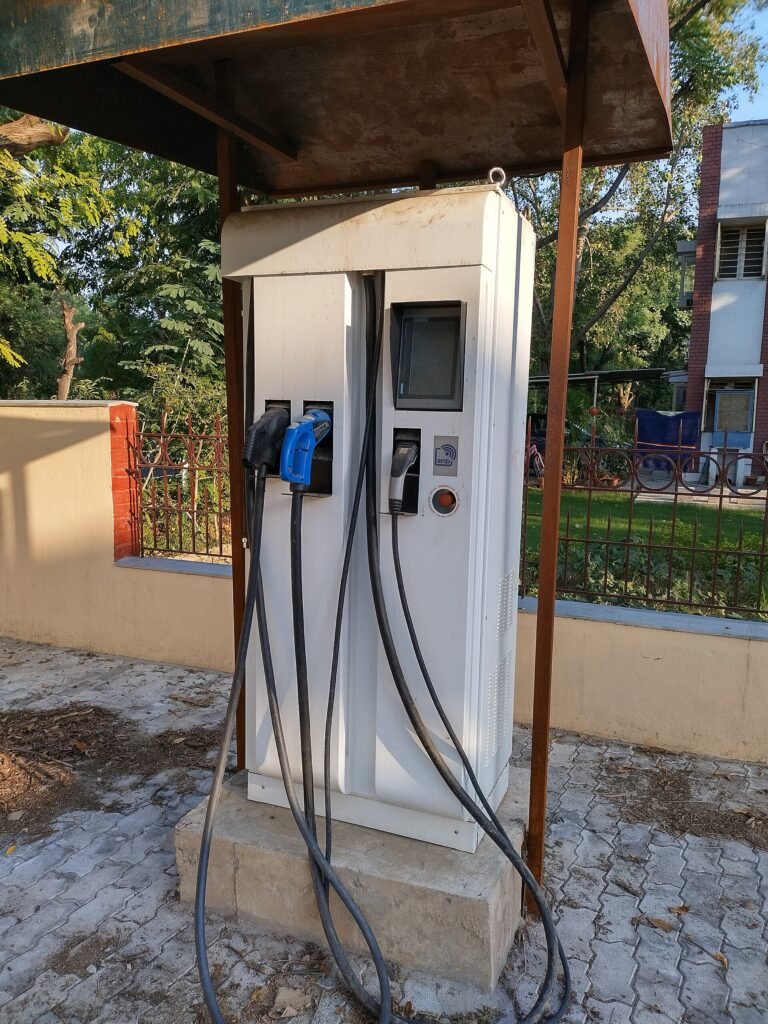
Featured image credit: Image: Dr Vinamra via Wikimedia Commons (CC BY-SA 4.0). Source
By Piyush P. Yadav
For years, the biggest complaint about public EV charging in India has had nothing to do with electricity — it has been about apps. A driver going from Delhi to Jaipur could pass a Tata Power EZ Charge point, a Statiq hub and a ChargeZone site in the space of 200 km, and needed three different apps, three separate top-up wallets and three logins to use any of them. In 2026, the government’s answer to that problem finally started going live: Unified Bharat eCharge (UBC), a single interoperable platform that lets a driver find, start and pay for a charging session at almost any network using nothing more than a UPI app such as BHIM.
What Is Unified Bharat eCharge?
Unified Bharat eCharge is a national interoperability layer for EV charging, built jointly by the Ministry of Heavy Industries (MHI), Bharat Heavy Electricals Limited (BHEL) as the nodal project implementation agency, and the National Payments Corporation of India (NPCI). It was announced on 12 May 2026 at a national EV charging infrastructure conference in Bengaluru, where Union Minister H.D. Kumaraswamy also confirmed approval of Rs 503.86 crore in funding for 4,874 new public chargers under the PM E-DRIVE scheme. The platform itself began going live for drivers around India’s 80th Independence Day, 15 August 2026, with certified technology partners onboarding charge point operators (CPOs) through the following weeks.
The core idea is simple: instead of every charging network building and marketing its own app, UBC lets any UPI-based app — starting with NPCI’s own BHIM app — discover chargers, show live availability and pricing, and complete payment across networks it has never directly integrated with. A driver opens BHIM, scans the QR code fixed to a charging point, and pays directly from their bank account. No operator-specific account, no prepaid wallet, no new sign-up.
Built on the Same Plumbing as ONDC
UBC is not a new payment network from scratch — it runs on the open Beckn Protocol, the same decentralised architecture that underpins the Open Network for Digital Commerce (ONDC). In Beckn’s terms, a driver’s app (like BHIM) acts as a Beckn Application Provider (BAP). When the driver searches for a charger, the BAP sends the query to a Beckn Gateway, which broadcasts it to every connected charging network — each acting as a Beckn Platform Provider (BPP). Every operator’s system responds directly with its own availability and price, and the actual UPI payment flows straight between the driver’s bank account and the operator, with no central body sitting in the middle of the money. The digital public infrastructure layer itself was built by the Network for Humanity (NFH) team, in the same design philosophy as UPI and ONDC.
Which Charging Networks Have Already Joined
Within weeks of the August 2026 rollout, several of India’s largest charge point operators had begun onboarding. Tata Power EZ Charge, Statiq and ChargeZone — three of the networks most Indian EV owners already juggle apps for — are among roughly nine major operators reported to be integrating, alongside Bolt.Earth, and the public-sector oil marketing companies IOCL, BPCL and HPCL, which control highway-corridor charging across around 50 national routes. Vehicle-side networks from Maruti Suzuki and Mahindra are also part of the rollout.
The clearest early proof point came from Pulse Energy, a charging-technology aggregator that was named one of UBC’s first certified technology enablers. Pulse Energy already works with more than 100 charge point operators and, as of August 2026, had connected a network of over 10,000 EV chargers to BHIM UPI through UBC — letting operators keep their own hardware and branding while plugging into the shared interoperability layer. Kazam, another charging technology provider, ran a free seven-day UBC integration programme for CPOs starting 14 July 2026 to speed up onboarding. NPCI’s BHIM CEO Lalitha Nataraj summed up the pitch for drivers plainly: discover a charger on the BHIM app, charge, pay and go.
Before vs After: What Actually Changes for a Driver
| What you had to do | Before UBC | After UBC (as it rolls out) |
|---|---|---|
| Finding a charger | Check separate apps for Tata Power, Statiq, ChargeZone, Jio-bp etc. one by one | Search once inside a UBC-enabled app like BHIM; results pulled from every connected network |
| Paying | Load a prepaid wallet or link a card separately with each operator | Pay directly by UPI from your existing bank account, no wallet top-up |
| Sign-up | New account and KYC on every network you use | No new account needed if your UPI app already supports UBC discovery |
| Fleet/business billing | Reconcile invoices from multiple CPOs manually | Consolidated visibility across operators (rolling out for fleet users) |
| Roaming on RFID cards | Card usually tied to one operator’s network | RFID roaming compatibility planned as more CPOs onboard |
UBC Is Part of a Much Bigger Push: 72,300 Public Chargers
The interoperability platform is being layered on top of a large hardware build-out. Under the PM E-DRIVE scheme’s public charging component, the government’s target is more than 72,300 public EV charging stations nationwide, backed by roughly Rs 2,000 crore of the scheme’s overall Rs 10,900 crore outlay. That is a sharp step up from the previous FAME-II programme, under which only 8,932 public chargers were actually installed; India’s total public charger count stood at 27,737 as of March 2026, according to industry estimates. The Rs 503.86 crore approved in May 2026 for 4,874 new chargers is one tranche of that rollout, with public-sector oil companies HPCL, IOCL and BPCL participating alongside state governments including Rajasthan, Andhra Pradesh, Uttar Pradesh, Gujarat, Kerala, Telangana, Karnataka and Tamil Nadu.
The subsidy structure varies by where a charger is installed, which matters if you are evaluating whether a charging site pencils out financially:
- Government premises (offices, residential colonies, hospitals, schools): 100 per cent subsidy on upstream infrastructure and charging equipment, conditional on free public access.
- High-traffic public sites (railway and airport terminals, metro stations, municipal parking, oil company retail outlets, NHAI toll plazas): 80 per cent of upstream infrastructure cost plus 70 per cent of equipment cost.
- Commercial sites (malls, markets, highway and expressway facilities): 80 per cent upstream infrastructure subsidy.
- Battery swapping or charging stations at any location: 80 per cent upstream cost support.
Priority for these subsidies goes to cities with a population above one million, state capitals, designated smart cities, metro-linked satellite towns, and high-density transport corridors — geography that overlaps closely with where operators like Tata Power EZ Charge are already pushing beyond the metros. Funding is released to approved projects in two tranches, tied to compliance and performance milestones rather than paid upfront in full.
Why This Matters More on Highways Than in Cities
UBC’s app-agnostic model is arguably most useful on inter-city routes, where a driver has the least ability to predict which network’s charger they will meet next. It is no coincidence that highway-corridor operators such as ChargeZone, which is contracting energy supply ahead of building out 1,000 highway superchargers, sit among the first wave of networks onboarding to UBC alongside the oil marketing companies that already dominate highway real estate through their fuel-retail network. If UPI-based discovery and payment genuinely work across all of these simultaneously, the practical effect for a road-tripping EV owner is closer to how petrol refuelling already works today: pull in, pay, leave — regardless of brand.
It is worth being realistic about timing, though. As of the platform’s initial rollout, the dedicated UBC app itself was not yet broadly public, with most access coming through BHIM and a handful of certified technology partners’ own apps; full RFID roaming and complete network coverage are described by the organisations involved as being rolled out progressively rather than switched on everywhere at once.
Sources & Further Reading
- Autocar Professional — Pulse Energy Joins Unified Bharat eCharge as Certified Tech Enabler
- electrive.com — India Approves Nearly 4,900 EV Chargers Under PM E-Drive Scheme
- Carhp India — Unified Bharat e-Charge (UBC) Explained
- All India Radio News — Centre Issues Guidelines for Rollout of 72,300 EV Charging Stations Under PM E-DRIVE
Frequently Asked Questions
What is Unified Bharat eCharge (UBC)?
UBC is a government-backed interoperability platform, built by the Ministry of Heavy Industries, BHEL and NPCI on the open Beckn Protocol, that lets EV drivers find, start and pay for charging sessions across multiple networks using a single UPI-based app such as BHIM, instead of separate apps for each charging operator.
Do I need a new app to use Unified Bharat eCharge?
No new dedicated app is required for most drivers. Access currently works through NPCI’s BHIM app and select certified partner apps that have integrated with the UBC network — you scan the charger’s QR code and pay via UPI from your existing bank account.
Which charging networks currently support UBC?
Reported early participants include Tata Power EZ Charge, Statiq, ChargeZone, Bolt.Earth, IOCL, BPCL, HPCL, and vehicle-linked networks from Maruti Suzuki and Mahindra, with technology enablers like Pulse Energy and Kazam onboarding charge point operators in the background. Coverage is expanding progressively rather than covering every charger nationwide at once.
How many public EV chargers does India plan to add under PM E-DRIVE?
The PM E-DRIVE scheme targets more than 72,300 public EV charging stations nationwide, backed by about Rs 2,000 crore of subsidy funding, with an initial tranche of Rs 503.86 crore approved in May 2026 for 4,874 chargers across states including Rajasthan, Gujarat, Karnataka, Tamil Nadu and Uttar Pradesh.
How do I actually pay for EV charging with BHIM UPI at a UBC charger?
Open a UBC-enabled UPI app — NPCI’s BHIM is the first one live — search for a charger and pick one from the results, then scan the QR code fixed to that charging point and authorise the payment from your bank account like any other UPI transaction. There is no operator account to create, no network KYC and no prepaid wallet to top up, because the money moves directly from your bank to the charge point operator with no central body holding it in between.
Does Unified Bharat eCharge add an extra fee, and who sets the charging tariff?
UBC is an interoperability and discovery layer, not a reseller of electricity: the tariff is set by the charge point operator running that site, and it varies by network and between AC and DC chargers. Because UBC works over the Beckn Protocol, each operator’s own system answers your app’s search directly with its live price and availability, so you see that operator’s rate rather than a marked-up platform price, and the UPI payment settles straight into the operator’s account.
What happens if the UPI payment goes through but the charging session does not start?
Treat it as an ordinary failed merchant UPI transaction rather than a charging dispute. Keep the UPI reference number along with the charger or session ID, then raise it both with the charge point operator and through the failed-transaction flow in your UPI app. Under the RBI’s harmonised turnaround-time framework, unsuccessful transactions must be auto-reversed within prescribed timelines and the bank owes the customer compensation for each day of delay beyond them — so recovering a stuck debit does not depend on the operator agreeing to refund it.