

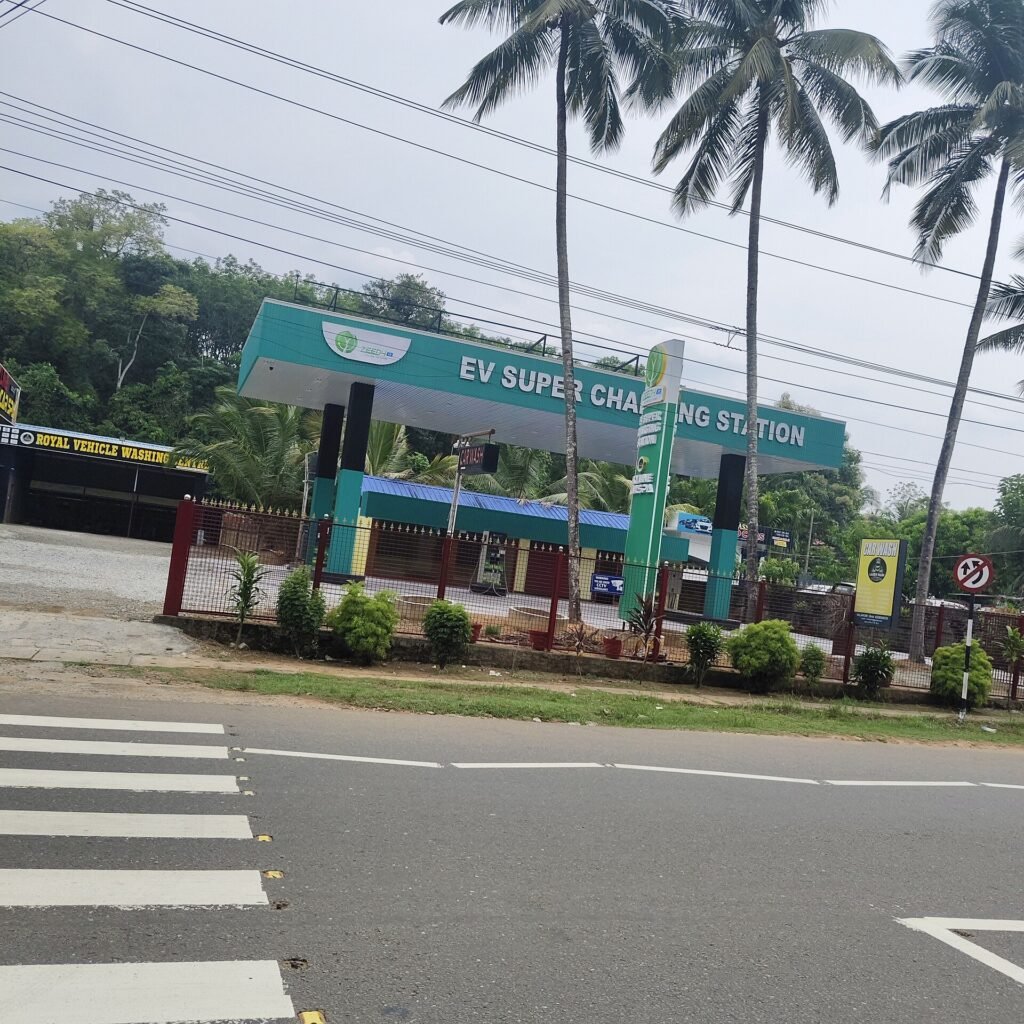
Featured image credit: Image: Sujithshivam511 via Wikimedia Commons (CC BY-SA 4.0). Source
By Piyush P. Yadav
Yes – charging an electric vehicle in basement parking is broadly legal in India today, and your housing society generally cannot refuse you outright. The Ministry of Power’s Guidelines for Installation and Operation of Electric Vehicle Charging Infrastructure-2024, issued on 17 September 2024, expressly require a group housing society to allow a flat owner to install a private charging point in their allotted parking space, drawing power through the existing meter or a separate sub-meter. But two things complicate that clean answer: a draft amendment to the National Building Code proposed by the Bureau of Indian Standards in October 2025 would restrict basement EV charging, and some state fire departments have already acted. This piece sets out what is actually in force in September 2026, what is only proposed, and what you can do if your RWA says no.
How we worked this out
The national position comes from the Ministry of Power’s 2024 guidelines as reported by Business Today on 26 May 2026 and as summarised in the pleadings of a pending Supreme Court writ covered by LiveLaw. The Maharashtra position, the most developed of any state, comes from the Cyril Amarchand Mangaldas dispute resolution blog’s analysis of the Co-operative Commissioner’s circular and the state fire guidelines. The draft National Building Code provisions come from EVIndia’s report on the BIS proposal. All checked on 15 September 2026. Where a rule is a draft rather than law, we say so – that distinction is the whole point here.
Where the rules stand, September 2026
| Jurisdiction | Position on private basement charging | Instrument and date | Status |
|---|---|---|---|
| National (Ministry of Power) | Society must allow a private charger in an allotted bay; de-licensed activity; existing meter or sub-meter | Guidelines for Installation and Operation of EV Charging Infrastructure-2024, 17 Sep 2024 | In force |
| Maharashtra | Private charging allowed on all podium floors; public and semi-public limited to first basement with ramps, ground floor, first podium. NOC due in 7 days | Co-operative Commissioner circular, Nov 2022; state fire guidelines, 18 Jul 2024 | In force |
| Haryana (Gurugram, Faridabad) | Fire department restricted the use of basements for EV charging stations | Haryana Fire Department; amendments proposed to Haryana Building Code 2017 | Restriction applied; code change proposed |
| National (BIS draft) | Charging only at ground level or, if permitted, first basement, in isolated compartments of up to 200 sq m | Draft National Building Code amendment, Oct 2025 | Draft only – not law |
| Supreme Court of India | Petition seeking enforcement of the 2024 guidelines against a society that refused an NOC | W.P.(C) No. 186/2026, filed 24 Feb 2026; notice issued | Pending |
1. The Ministry of Power guidelines say a society must allow it
The September 2024 guidelines treat setting up EV charging as a de-licensed activity and state that private charging at residences and offices is permitted, with DISCOMs to facilitate it. A group housing society must allow the owner of a flat to install private charging points in their allotted parking space, drawing supply from an existing meter or a separate sub-meter. Societies may also put in a mix of community chargers in consultation with the distribution licensee.
Nothing in those guidelines carves out basements. The restriction you actually run into is rarely the national rule – it is the local fire code, and the society’s reading of it.
2. Maharashtra draws a line between private and public charging
Maharashtra is the state that has thought this through most carefully, and the distinction it draws is the single most useful thing an Indian EV owner can know. On the analysis of the state fire guidelines set out by Cyril Amarchand Mangaldas, private charging is permitted on all podium floors, with slow and moderate power charging stations allowed in the building’s parking areas. Semi-public and public charging stations, by contrast, are permitted only in the first basement with ramps, on the ground floor, and on the first podium level.
Most RWAs that quote “fire rules” at a resident are quoting the public-charging restriction and applying it to a private charger. Those are different categories. Maharashtra’s Co-operative Commissioner also issued a circular in November 2022 requiring societies to issue a no-objection certificate within seven days where the applicant meets fire safety standards, and in January 2025 a Divisional Joint Registrar upheld a member’s right to install a private charger on a fifth podium level.
3. Haryana has restricted basement charging stations
The counter-example matters. Business Today reported that the Haryana Fire Department restricted the use of basements for EV charging stations, directly affecting apartment residents in Gurugram and Faridabad. Haryana has since proposed amendments to the Haryana Building Code 2017 mandating EV charging infrastructure across residential and commercial buildings. So in Haryana the answer today is materially more restrictive than in Maharashtra, and it is moving.
What is proposed but not law: the NBC draft
In October 2025 the Bureau of Indian Standards proposed amendments to the National Building Code that would restrict the parking and charging of EVs and hybrids in basements of residential and commercial buildings on fire safety grounds. Under the draft, charging would be allowed on the ground floor or, where permitted, in the first basement only, and only in isolated compartments of no more than 200 square metres.
To put 200 square metres in perspective: a standard Indian car parking bay is roughly 2.5 m by 5 m, or 12.5 square metres, and once you add circulation space a basement typically consumes 25 to 30 square metres per car. A 200 square metre fire compartment therefore accommodates on the order of six to eight cars. For a tower with 200 flats and a three-level basement, that is not a rounding error – it is a hard cap on how many residents can ever charge where they park, unless the builder compartmentalises multiple zones.
That is why manufacturers pushed back, arguing the restriction will deter developers from building charging into shopping centres, high-rises and apartment complexes – a concern sharpest in Bengaluru, Delhi and Mumbai, where most cars park below ground. Note carefully: this is a draft. It is not the rule you are governed by today, and an RWA quoting it as settled law is overreaching.
The case that may settle it: a writ in the Supreme Court
The most consequential development here is a petition most EV owners have never heard of. On 24 February 2026, Rachit Katyal, a resident of Nirala Estate Phase 3 in Greater Noida, filed W.P.(C) No. 186/2026 in the Supreme Court against the Union of India, the State of Uttar Pradesh and his housing society, after the society refused an NOC for a private charger in his own parking bay.
The petition asks the Court to direct states to implement the 2024 guidelines properly, or in the alternative to direct the society to grant the NOC, and to have the Union frame comprehensive EV infrastructure guidelines. It invokes Articles 14, 15, 16 and 21, and cites the Model Building Bye-laws 2016 and URDPFI amendments alongside the Central Electricity Authority Regulations 2023. A bench of CJI Surya Kant and Justice Joymalya Bagchi issued notice to all parties, with the matter listed for 13 April 2026. There is no substantive ruling yet, but live proceedings are themselves a useful fact to put in a letter to your RWA.
What to do if your society refuses
- Ask for the refusal in writing, with reasons. A written refusal that cites no specific rule is the strongest document you can hold.
- Separate private from public. Say plainly that this is a private charger in your own allotted bay, not a public station, and ask which fire provision they say applies to private charging.
- Do the DISCOM piece first. An approved connection or sub-meter and compliance with the CEA safety regulations of 2023 removes the technical objection before the political one.
- Cite the guidelines by name and date. Guidelines for Installation and Operation of Electric Vehicle Charging Infrastructure-2024, 17 September 2024, Ministry of Power.
- In Maharashtra, start the seven-day clock. The Co-operative Commissioner’s November 2022 circular requires an NOC within seven days once safety norms are met.
The procedural mechanics – meter versus sub-meter, the tariff you will be billed on, the earthing and RCD kit, and what it realistically costs – are set out in our step-by-step guide to installing an EV charger in an Indian apartment. What it does to your monthly bill, slab by slab, is covered in does charging an EV at home raise your electricity bill. And if the objection you are hearing is specifically about fire risk, the actual certification a pack must pass is explained in our piece on the AIS-156 and AIS-038 battery safety standards. If you cannot win the argument, our comparison of India’s public charging networks is the fallback plan.
Who this applies to, and who should not rely on it
This is written for an owner-resident installing a single private charger in their own allotted bay. If you are a tenant your position is weaker and depends on your landlord’s consent as well as the society’s. If you are a builder, RWA or facility manager planning a bank of chargers for common use, you are in the semi-public or public category and the stricter fire rules genuinely do apply – do not use this article to argue otherwise.
Two limitations. Fire and building rules are state and municipal subjects, so the Maharashtra analysis above is Maharashtra law, not national law. And the NBC amendment is a draft while the Supreme Court matter is pending, so this framework can change. Confirm with your local fire officer and DISCOM before spending money, and do not treat an installer’s assurance as a legal opinion.
Sources & Further Reading
- Business Today – What EV owners can do if housing societies stop charger installation in basement parking
- LiveLaw – Owner moves Supreme Court to enforce Power Ministry EV charging guidelines
- Cyril Amarchand Mangaldas – Can housing societies withhold permission to install EV chargers?
- EVIndia – Proposal to amend the building code on basement EV charging
People also ask
Is EV charging allowed in basement parking in India?
Yes, as of September 2026 private charging in a basement is broadly permitted, and the Ministry of Power’s 2024 guidelines require housing societies to allow a private charger in an allotted bay. The exceptions are local: Haryana’s fire department has restricted basement charging stations, and a draft National Building Code amendment would limit charging to the first basement in compartments of up to 200 square metres.
Can I install an EV charger at home?
Yes. The Ministry of Power’s Guidelines for Installation and Operation of Electric Vehicle Charging Infrastructure-2024, dated 17 September 2024, make private charging at residences a de-licensed activity and require group housing societies to permit it in your dedicated parking space. Supply may come through your existing meter or a separate sub-meter, subject to DISCOM approval.
Can I install an EV charger myself?
No, not the fixed wall unit. The installation must comply with the Central Electricity Authority safety regulations of 2023 and your state supply code, which means a licensed electrical contractor, proper earthing and residual current protection. A self-wired charger will also give your society and your insurer a legitimate objection, which is the last thing you want.
Are home EV chargers safe?
A correctly installed unit on a dedicated circuit with earthing and an RCD is safe, and the battery packs themselves must be certified to AIS-156 in India. Most real incidents trace back to improvised extension leads, shared circuits and poor earthing rather than to the charger. That is precisely why fire officers scrutinise basement installations.
Is home EV charging cheaper than public charging?
Almost always, yes. Home charging is billed on your domestic tariff slab, while public DC fast charging carries the operator’s margin, demand charges and service fees on top of the energy cost. The gap is the main reason residents fight their societies for a basement point rather than simply using a nearby public charger.
Can a home EV charger be outside?
Yes, most home units are rated for outdoor mounting, and an open or stilt parking bay actually sidesteps the basement fire-code argument entirely. Check the unit’s ingress protection rating, mount it under cover where possible, and make sure the cable route and socket are protected from standing water during the monsoon.
Can my housing society charge extra for the electricity my EV charger uses?
If the charger is wired to your own flat meter, the DISCOM bills you at your domestic slab and the society has no basis for an additional levy on those units. Where the point draws from a common-area connection, the society can recover its actual cost, and the Ministry of Power guidelines expect such charges to be transparent and cost-based rather than arbitrary. A flat monthly “EV fee” unrelated to consumption, or a per-unit rate well above what the society itself pays, is exactly the kind of condition residents have challenged successfully.
Do I need a separate electricity meter for an EV charger in society parking?
No. The central charging-infrastructure guidelines let a resident charge on the existing domestic connection, provided the sanctioned load can absorb the extra 3.3 to 7.4 kW a typical home charger draws; most DISCOMs handle this as a load enhancement rather than a new connection. A separate metered EV connection is optional and mainly pays off where your state has notified a dedicated EV tariff, weighed against the cost of the second connection and a cable run from the meter room to your bay.
Is a fire department NOC required to install an EV charger in a basement?
It depends on the city and on whether the point is private. A single charger in your own bay is generally treated as part of the building’s electrical installation, and the stricter basement restrictions in city fire guidelines — including Mumbai’s 2022 advisory — are read as applying to semi-public and public charging rather than to a resident’s own private point. Some municipalities and DISCOMs still ask for a fire-services NOC alongside the utility approval, so confirm the local position before you order equipment.