

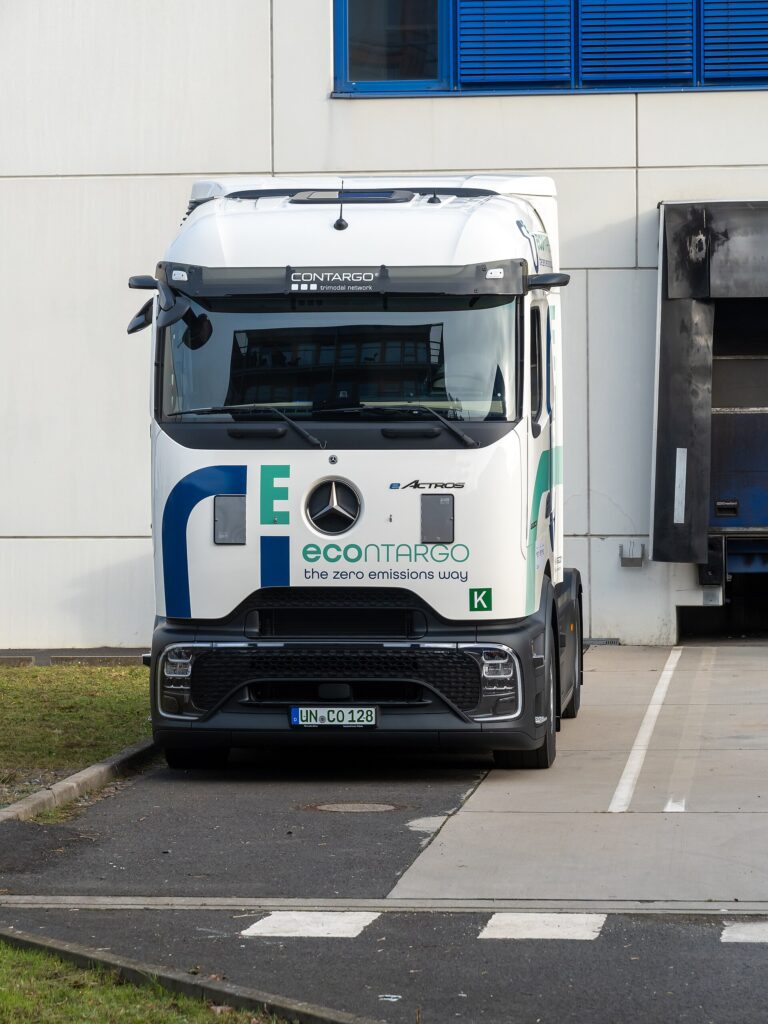
Featured image credit: Image: Matti Blume via Wikimedia Commons (CC BY-SA 4.0). Source
Cement is one of the hardest industries in the world to decarbonise. Most of its emissions come from the chemistry of making clinker, not from burning fuel, and no amount of clean electricity fixes that. But a cement company’s logistics are a different matter, and logistics is where UltraTech Cement has decided to move.
In early September 2026, UltraTech confirmed plans to expand its fleet to more than 600 heavy-duty electric trucks by December 2026. The fleet will carry around five million tonnes of clinker and other key materials every year across seven states, and once fully operational is expected to cut net annual carbon dioxide emissions by more than 117,000 tonnes.
That last figure is equivalent to displacing roughly 39 million litres of diesel a year. For India’s electric truck sector, which has spent years stuck in pilot projects, this is one of the clearest signals yet that heavy electric freight has moved past the demonstration stage. By Piyush P. Yadav.
The numbers
| Metric | Figure |
|---|---|
| Electric trucks by December 2026 | More than 600 heavy-duty units |
| Annual material moved | About 5 million tonnes of clinker and key materials |
| States covered | Gujarat, Uttar Pradesh, Madhya Pradesh, Rajasthan, Chhattisgarh, Maharashtra, Odisha |
| Expected annual CO2 reduction | More than 117,000 tonnes |
| Diesel displaced | About 39 million litres a year |
| Current green logistics fleet | More than 850 CNG and electric vehicles |
UltraTech introduced CNG trucks in 2021 and began deploying heavy-duty electric trucks in 2024. The current expansion is therefore the third phase of a programme that has been running for five years, not a standing start.
Who is supplying the trucks
UltraTech has signed service contracts with a mix of established commercial vehicle manufacturers and specialist electric truck companies, along with their subsidiaries and third-party logistics providers.
- Tata Motors, India’s largest commercial vehicle maker
- Ashok Leyland, the second-largest domestic truck manufacturer
- IPLTech Electric, a specialist heavy electric truck company
- Energy in Motion
- Sany, with a significant presence in Indian construction and heavy equipment
Spreading the order across five suppliers rather than standardising on one is a deliberate choice. It reduces dependence on any single manufacturer’s delivery schedule in a segment where production capacity is still ramping, and it lets UltraTech compare real-world performance across platforms before committing to a larger fleet.
The structure is also notable: these are service contracts rather than outright purchases, with third-party logistics providers involved. That keeps vehicle ownership and residual value risk away from UltraTech’s balance sheet, which matters in a segment where resale values for used electric trucks are essentially unestablished.
Why cement logistics suits electric trucks
Heavy electric trucks do not work everywhere. They work extremely well in a specific set of conditions, and cement logistics happens to tick every box.
| Requirement for viable e-trucking | Cement logistics |
|---|---|
| Fixed, repeated routes | Plant to grinding unit, plant to depot, repeated daily |
| Predictable daily distance | Known corridors with known lengths |
| Return to base for charging | Trucks cycle back to company facilities |
| High annual utilisation | Continuous year-round operation |
| Charging infrastructure control | Chargers installed on company premises |
That fifth row is the decisive one. The central obstacle to electric trucking in India is the near-total absence of high-power public charging on freight corridors. A company moving goods between its own facilities can sidestep that entirely by installing depot charging, which is faster to build, cheaper per unit of energy delivered and fully under its own control.
General-purpose long-haul freight, where a truck may end a day anywhere in the country, cannot do this. That is why electric trucks in India are arriving first in captive industrial logistics rather than in open freight markets. The broader effort to organise that market, which we covered in our piece on NITI Aayog’s pact on zero-emission truck marketplaces, is aimed squarely at the harder case.
The economics behind the decision
UltraTech has not disclosed its cost calculations, but the shape of the arithmetic in captive heavy-vehicle logistics is well understood.
An electric truck costs substantially more to buy than a diesel equivalent. It costs considerably less to run, because electricity at industrial or depot rates is cheaper per kilometre than diesel and because an electric drivetrain has far fewer maintenance items. The payback therefore depends almost entirely on annual utilisation.
- Low annual mileage: the purchase premium never gets recovered.
- High annual mileage on fixed routes: fuel and maintenance savings compound quickly and payback arrives within the asset’s life.
A truck hauling clinker continuously across a fixed corridor sits firmly in the second category. Add the service-contract structure, which converts capital cost into an operating charge, and the financial case becomes considerably easier to approve. Our examination of electric bus pricing and the per-kilometre contract model covers the same underlying logic in passenger transport, where it has already become the dominant procurement approach.
What this signals for the sector
Three things are worth drawing out.
Demand is becoming visible to manufacturers
Truck makers have been reluctant to invest in electric heavy-vehicle capacity without confirmed orders. Commitments of this size make production planning possible. Tata Motors has separately reported securing more than 3,400 electric commercial vehicle orders across small commercial vehicles, pickups, trucks and buses, indicating that UltraTech is part of a wider pattern rather than an isolated case.
Corporate sustainability targets are driving real procurement
A 117,000 tonne annual CO2 reduction is a substantial, auditable figure that appears in sustainability reporting. As disclosure requirements tighten, large industrial buyers have growing reason to electrify the parts of their operations that can be electrified. Cement’s process emissions cannot be, which arguably raises the pressure on logistics to deliver.
Localisation rules now shape supply
From 1 September 2026, stricter traction-motor localisation requirements took effect for electric buses and trucks seeking PM E-DRIVE incentives. Any manufacturer supplying into fleets of this scale must now meet those process requirements, as we set out in our explainer on India’s new traction motor localisation rules. The government’s broader heavy-duty EV scheme covering 50,000 electric buses and trucks is designed to accelerate exactly this kind of deployment.
What remains unproven
Some caution is warranted. Several questions about heavy electric trucking in India have no answer yet.
- Battery life under heavy load. A fully laden truck on Indian road and temperature conditions stresses a pack far harder than a car. Multi-year degradation data barely exists.
- Residual values. Nobody knows what a five-year-old electric truck is worth, because none have been sold.
- Uptime and service response. A stranded truck halts a supply chain. Service networks for electric heavy vehicles are thin.
- Grid capacity at depots. Charging dozens of heavy trucks simultaneously requires serious electrical infrastructure and may need network upgrades.
- Payload penalty. Battery weight reduces usable payload, which directly affects cost per tonne-kilometre.
The service-contract structure suggests UltraTech is aware of at least some of these and has chosen to let suppliers carry the risk while the answers emerge.
The bottom line
More than 600 electric trucks is a significant fleet by Indian standards, and 117,000 tonnes of avoided CO2 is a serious number. But the most useful thing about this deployment is what it demonstrates rather than what it abates.
It shows that heavy electric freight works today in captive, fixed-route, high-utilisation industrial logistics, and that the economics stack up well enough for a listed company to commit at scale. That is a narrower claim than electric trucks working everywhere, and it is the correct one. Open-market long-haul freight still needs corridor charging that does not yet exist. What UltraTech has proven is that the segment where electric trucks already make sense is bigger than the industry has been treating it.
Sources & Further Reading
- Electrive: UltraTech to intensify supply chain electrification with 600+ eHGVs
- EMobility+: UltraTech Cement to scale up electric truck fleet by December 2026
- Indian Cement Review: UltraTech expands green logistics with 600+ electric trucks
- Autocar Professional: Tata Motors secures over 3,400 electric commercial vehicle orders
Frequently Asked Questions
How many electric trucks is UltraTech deploying?
UltraTech Cement plans to expand its fleet to more than 600 heavy-duty electric trucks by December 2026. The fleet will move around five million tonnes of clinker and other key materials annually across Gujarat, Uttar Pradesh, Madhya Pradesh, Rajasthan, Chhattisgarh, Maharashtra and Odisha.
Which manufacturers are supplying the trucks?
UltraTech has signed service contracts with Tata Motors, Ashok Leyland, IPLTech Electric, Energy in Motion and Sany, along with their subsidiaries and third-party logistics providers. Spreading the order across five suppliers reduces delivery risk and allows performance comparison across platforms.
How much carbon will the fleet save?
Once fully operational, the fleet is expected to reduce net annual carbon dioxide emissions by more than 117,000 tonnes, displacing the equivalent of about 39 million litres of diesel consumption every year.
Why do electric trucks work for cement logistics?
Cement logistics involves fixed, repeated routes with predictable daily distances, trucks returning to company facilities, and continuous high utilisation. Crucially, the company can install depot charging on its own premises rather than depending on public highway charging, which barely exists for heavy vehicles in India.