

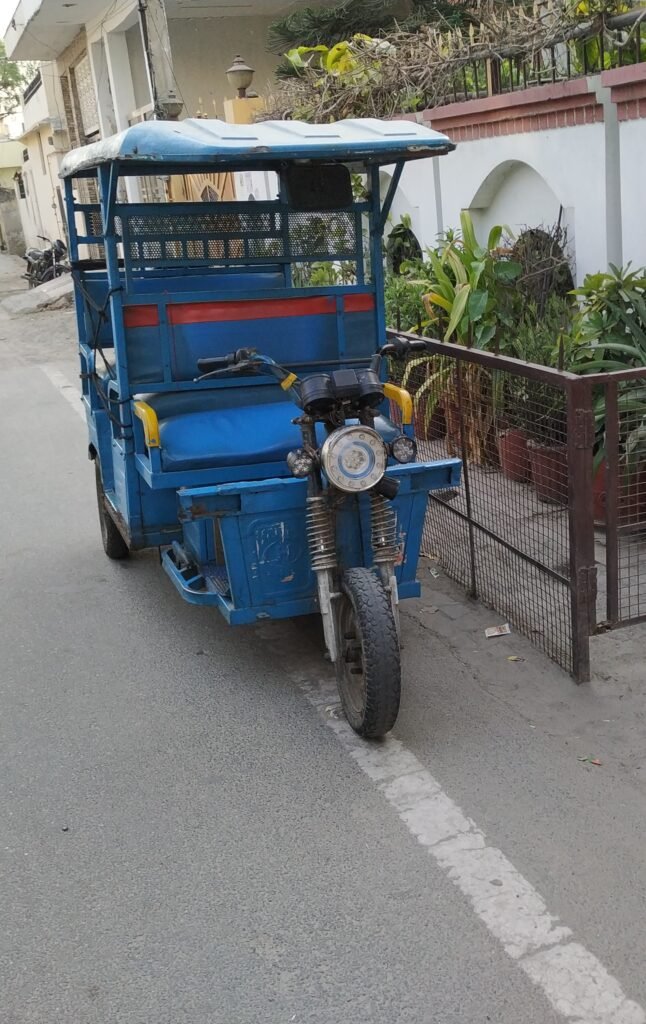
Featured image credit: Image: Libreravi via Wikimedia Commons (CC BY-SA 4.0). Source
By Piyush P. Yadav
Yes, an electric three-wheeler is profitable in India — but roughly Rs 17,700 a month profitable for a financed owner-driver, not the Rs 65,000 that manufacturer blogs advertise. A peer-reviewed 2026 survey of Delhi e-rickshaw drivers found average gross earnings of Rs 1,100 a day over 37.2 km, which is about Rs 30 per kilometre. Work that down through the costs nobody writes about — chiefly a lead-acid battery set that needs replacing every 12 to 18 months at Rs 40,000 to Rs 60,000 — and the picture is solid but far less spectacular than the sales pitch. The single biggest lever on that profit is not the fare. It is the battery chemistry.
How we worked this out
Almost every “e-rickshaw profit” page on the Indian internet is published by someone selling e-rickshaws, and the numbers vary by a factor of three. So we anchored the revenue side on an independent source: a 2026 study in a peer-reviewed journal on the economy of owning and operating an electric rickshaw in Delhi, based on driver surveys in Uttam Nagar and Karol Bagh. Vehicle prices and battery specifications are taken from current manufacturer and dealer listings checked on 12 September 2026. Energy costs are computed from published pack sizes and certified ranges, with a stated 15 percent charging loss and a Rs 8 per unit electricity rate; where a cost is an assumption rather than a sourced figure, the table says so. The study explicitly modelled owner-drivers without loans, so the EMI line below is ours, not theirs.
The revenue side, from the survey
The Delhi study found drivers earning an average of Rs 1,100 a day and covering 37.2 km, which works out to roughly Rs 30 per kilometre of gross fare. Two caveats travel with that number. It is gross, before any cost at all. And the authors note the findings represent the surveyed localities rather than the whole city, since earnings vary with local market conditions — a driver working a metro feeder route earns differently from one on a residential loop.
At 26 working days, Rs 1,100 a day is Rs 28,600 a month of gross revenue against 967 km driven. That is the top line. Everything below is what the sales pages leave out.
The monthly P&L nobody publishes
| Line | Per month | Basis |
|---|---|---|
| Gross fare revenue | Rs 28,600 | Rs 1,100/day × 26 days (survey average) |
| Electricity | − Rs 1,250 | Reported real-world range of Rs 1,000–1,500/month |
| Battery sinking fund (lead-acid) | − Rs 3,333 | Rs 50,000 set replaced every 15 months |
| Tyres, servicing, permit, sundries | − Rs 1,500 | Assumption — not a sourced figure |
| Loan EMI | − Rs 4,850 | Rs 1.4 lakh financed, 36 months at 15% |
| Net to the driver | Rs 17,667 |
Look at the third row. The battery sinking fund is Rs 3,333 a month — two-thirds the size of the EMI, and it never appears on a dealer’s projection sheet, because it does not arrive as a bill until month 13. Drivers who budget only for the EMI discover the battery cost as a sudden Rs 50,000 shock in the second year, and that is the point at which financed e-rickshaws get surrendered.
Note also what this P&L does not include: the driver’s own labour. If the owner drives the vehicle, Rs 17,667 is income for a full working month, not a return on capital. If they hire a driver, the wage comes out of the same Rs 17,667.
The chemistry decision is the profit decision
Run the same vehicle on lithium instead of lead-acid and the arithmetic changes materially. A lithium pack for an e-rickshaw costs roughly Rs 50,000 to Rs 80,000 and lasts around four to five years, against Rs 40,000 to Rs 60,000 every 12 to 18 months for lead-acid.
| Lead-acid | Lithium | |
|---|---|---|
| Pack cost | Rs 50,000 | Rs 65,000 |
| Replacement interval | 15 months | 54 months |
| Monthly sinking fund | Rs 3,333 | Rs 1,204 |
| Five-year battery spend | Rs 200,000 | Rs 72,000 |
That is a Rs 2,129 a month difference — roughly Rs 25,500 a year, or about 12 percent added to the driver’s take-home — for a pack that costs Rs 15,000 more up front. Over five years the lead-acid owner spends nearly three times as much on batteries. This is why the lithium transition in the L3 segment is happening from the bottom up, driven by drivers doing the sum, and it is the core of our explainer on the Indian e-rickshaw market and the lead-acid versus lithium question.
E-rickshaw or a proper L5 electric auto?
The other decision is whether to buy an L3 e-rickshaw at all, or step up to a registered L5 electric auto. The energy economics are counter-intuitive, because lead-acid’s poor charge efficiency makes the cheap vehicle the expensive one to run per kilometre.
| Vehicle | Ex-showroom | Pack | Certified range | Energy cost per km |
|---|---|---|---|---|
| Typical lead-acid e-rickshaw | ~Rs 1.75 lakh | 48V lead-acid set | — | ~Rs 1.29 (from reported running cost) |
| Piaggio Ape E City | Rs 2.84 lakh | 4.5 kWh | 68 km | ~Rs 0.75 |
| Mahindra Treo | Rs 3.23–3.38 lakh | 7.37 kWh | 141 km | ~Rs 0.62 |
| Bajaj GoGo | Premium segment | 12.1 kWh | up to 251 km | — |
The per-km figures assume real-world range at about 80 percent of certified, a 15 percent charging loss and Rs 8 a unit. On those assumptions a Treo costs roughly half as much per kilometre to move as a lead-acid e-rickshaw, before you count the battery sinking fund — where the gap widens further, because the Treo’s lithium pack carries a manufacturer warranty and the e-rickshaw’s does not. Against that, the L5 costs Rs 1.5 lakh more to buy, needs a commercial licence and permit, and carries a bigger EMI. Our comparison of the best electric auto rickshaws in India goes model by model, and the electric three-wheeler and SCV buying guide covers the cargo variants.
What actually kills the profit
Three things, in order. Utilisation: the survey’s 37.2 km a day is modest, and fixed costs per kilometre fall sharply as daily distance rises, which is why aggregator-attached drivers do better. Battery abuse: the same study found tyre life collapsing from 4.5 years at 20 km a day to about a year at 80–100 km a day, and lead-acid packs degrade on the same curve under irregular charging. And finance terms: at 15 percent over three years the EMI is manageable, but informal lending at far higher effective rates is common in this segment and will take the whole margin.
Who this is for, and who should not follow it
This is for an individual buying one vehicle to drive themselves, in a metro with an established e-rickshaw market. It will not describe a fleet operator’s economics, where scale changes charging, maintenance and financing costs entirely, and it will not describe a small-town market with lower fares per kilometre. The revenue figures are Delhi survey averages from two specific localities, not a national number; if you are in Patna or Coimbatore, spend a week riding with a working driver and collect your own fare data before committing to an EMI. And treat the maintenance line in our table as the placeholder it is: it is the one number we could not source, and it is the one most likely to be wrong for your route.
Sources & Further Reading
- Economy of owning and operating an electric rickshaw in Delhi, India (2026)
- Mahindra Treo price and specifications
- Piaggio Ape E City price, range and features
- E-rickshaw battery prices, types and backup
People also ask
Is an electric auto rickshaw profitable in India?
Yes, but modestly. Working from Delhi survey data of Rs 1,100 gross a day over 37.2 km, a financed owner-driver nets around Rs 17,700 a month after electricity, a lead-acid battery sinking fund of about Rs 3,300, maintenance and an EMI. That is income for a full working month, not a passive return, and it assumes formal finance rather than informal lending.
How much does an electric auto rickshaw cost in India?
A lead-acid e-rickshaw typically sits around Rs 1.5–2.2 lakh. Registered L5 electric autos cost more: the Piaggio Ape E City is about Rs 2.84 lakh ex-showroom with a 4.5 kWh pack, and the Mahindra Treo runs Rs 3.23–3.38 lakh with a 7.37 kWh pack and 141 km certified range.
How much electricity does an e-rickshaw consume?
Operators report roughly Rs 1,000–1,500 a month on charging, which at a survey-average 967 km a month works out near Rs 1.29 per kilometre. That is higher than a lithium L5 auto: a Mahindra Treo works out to roughly Rs 0.62 per km on the same electricity rate, because lithium charges far more efficiently than lead-acid.
Which electric auto rickshaw is best in India?
It depends on daily distance. For short residential routes the Piaggio Ape E City is the cheapest way in at about Rs 2.84 lakh. For long shifts the Mahindra Treo’s 7.37 kWh pack and 141 km certified range lowers cost per kilometre, and the Bajaj GoGo’s 12.1 kWh pack pushes range to as much as 251 km for high-utilisation operators.
How do you charge an electric auto rickshaw?
Almost always overnight from a domestic or small commercial connection, using the on-board or portable charger supplied with the vehicle, over six to eight hours. The economics in this article assume that. Charging from a public commercial point costs considerably more per unit and will compress the margins shown above.
How long does an e-rickshaw battery last?
A lead-acid set typically needs full replacement every 12 to 18 months at Rs 40,000 to Rs 60,000, and sooner on hilly routes or with irregular charging. A lithium pack costs Rs 50,000 to Rs 80,000 but lasts around four to five years, which cuts the monthly battery provision from about Rs 3,333 to about Rs 1,204.