

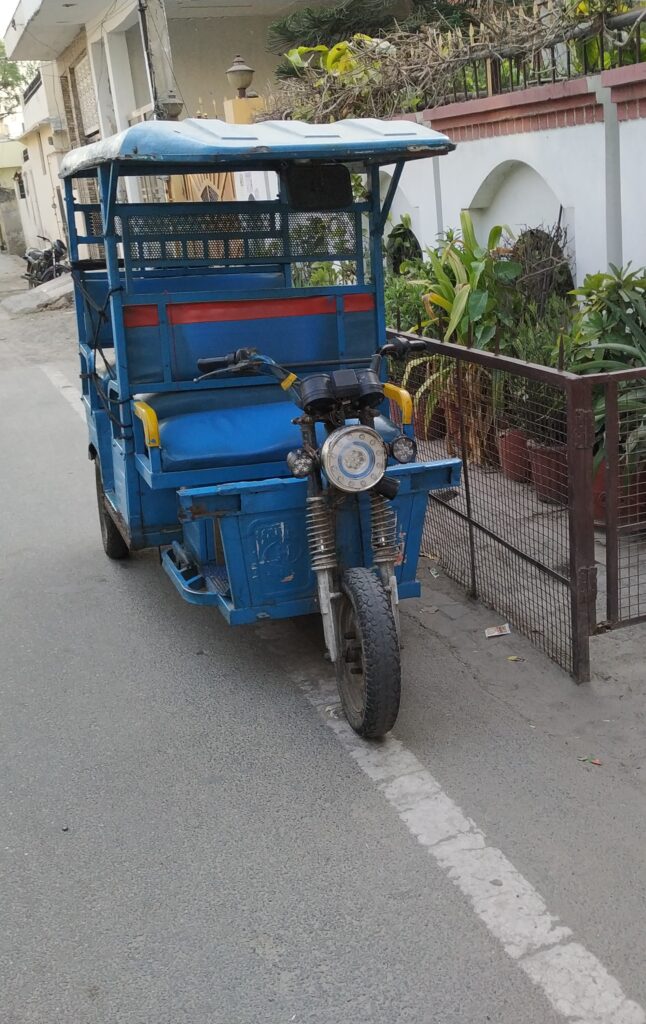
Featured image credit: Image: Libreravi via Wikimedia Commons (CC BY-SA 4.0). Source
By Piyush P. Yadav | 11 September 2026
More than half of the passenger auto-rickshaws sold in India are now electric, and the choice for a driver or fleet owner has widened from two or three models to a full field: Mahindra’s Treo and the new Udo, Bajaj’s GoGo range and the long-range WEGO, TVS’s King EV Max and Piaggio’s Ape E-City. They differ by more than a lakh in price, by a factor of two in battery size and range, and by a year and 30,000 km in warranty. This guide puts the six main L5 passenger electric autos side by side on the numbers that decide a driver’s income: what it costs, how far it goes on a charge, how long it takes to charge, what the warranty covers, and, most importantly, how the range translates into shifts and rupees. Prices are ex-showroom as listed by the manufacturers and by CarDekho Trucks and Tractor Junction in September 2026; on-road prices vary by state and by the PM E-DRIVE and state subsidies that apply.
The six contenders at a glance
| Model | Ex-showroom price | Battery | Certified range | Peak power | Full charge time | Warranty |
|---|---|---|---|---|---|---|
| Piaggio Ape E-City FX Max | Rs 3.25 to 3.30 lakh | 8 kWh | Up to 145 km | Not stated | About 3 hours 45 minutes | 5 years or 2 lakh km (Piaggio) |
| TVS King EV Max | From Rs 3.28 lakh | 9.2 kWh | 179 km | 11 kW | 3 hours 30 minutes | 6 years or 1.5 lakh km, 3 years free maintenance |
| Mahindra Treo Plus | Rs 3.69 to 3.78 lakh | 10.24 kWh | 167 km ARAI | 8 kW | Not stated | 5 years or 1.2 lakh km |
| Mahindra Udo | Rs 3.84 lakh (Rs 3.59 lakh introductory) | 11.7 kWh | 265 km ARAI, 200 km real-world claimed | 10 kW | Not stated | 6 years or 1.5 lakh km; free service to 1 lakh km |
| Bajaj GoGo P7012 | From Rs 3.83 lakh | 12.1 kWh | 259 km | 5.5 kW | 4 hours 30 minutes, 80 per cent in under 4 | 5 years or 1.2 lakh km |
| Bajaj WEGO P9018 | Rs 4.41 lakh | 17.7 kWh | 296 km | Not stated | 6 hours, 80 per cent in under 4 | 5 years or 1.2 lakh km |
Three tiers are visible. At the bottom, the Ape E-City and King EV Max at Rs 3.25 to 3.30 lakh are the budget choice with 8 to 9 kWh packs and 145 to 180 km of certified range. In the middle, the Treo Plus, Udo and GoGo P7012 at Rs 3.6 to 3.85 lakh carry 10 to 12 kWh and 167 to 265 km. At the top, the WEGO P9018 at Rs 4.41 lakh has a 17.7 kWh pack, the largest in any Indian three-wheeler, and a certified 296 km.
Range is income: the shift maths
A passenger auto in a big city covers 120 to 180 km on a full-day shift, and a driver on a two-shift rental model may need 200 km-plus. Certified ranges are measured on a test cycle with a light load; real-world range with three passengers, luggage, a fan and Indian traffic is typically 70 to 75 per cent of the ARAI figure. The table applies a 72 per cent factor and then asks the practical question: does the auto complete a shift without a midday charge?
| Model | Certified range | Realistic loaded range (72 per cent) | Single 150 km shift? | Two shifts, 220 km? |
|---|---|---|---|---|
| Ape E-City FX Max | 145 km | About 105 km | No, needs a midday top-up | No |
| TVS King EV Max | 179 km | About 130 km | Marginal | No |
| Mahindra Treo Plus | 167 km | About 120 km | Marginal | No |
| Mahindra Udo | 265 km | About 190 km | Yes | Marginal |
| Bajaj GoGo P7012 | 259 km | About 185 km | Yes | Marginal |
| Bajaj WEGO P9018 | 296 km | About 215 km | Yes | Yes |
This is why the price gap matters less than it looks. A midday charging stop costs a driver 90 minutes to two hours of fares, which in a metro is Rs 300 to 500 of gross income a day. Over 300 working days that is Rs 90,000 to 1.5 lakh a year, which is more than the entire price difference between the cheapest and the most expensive auto on this list. For a single-shift owner-driver in a smaller city doing 100 to 120 km a day, the budget autos are perfectly adequate and the extra battery is dead weight. For a two-shift rental auto in Delhi, Bengaluru or Hyderabad, the WEGO’s 17.7 kWh pack is the only one that avoids a daytime charge altogether.
Running cost per kilometre
Electricity cost is almost identical across the field, because every model here uses about 45 to 60 Wh per kilometre. At a home or depot tariff of Rs 7 per kWh, that is roughly 35 to 45 paise per kilometre; at a public charger at Rs 15 per kWh it is 70 to 90 paise. A CNG auto at current Delhi prices costs about Rs 2.20 to 2.50 per kilometre in fuel. On 150 km a day the electric auto saves roughly Rs 250 to 300 a day against CNG, which pays back the higher purchase price in under two years even before subsidies. We covered the market shift that this economics has produced in our report on electric three-wheelers reaching 55.5 per cent of L5 autos in August 2026.
Where the models do differ is on charging speed relative to pack size. The King EV Max refills its 9.2 kWh in about 3.5 hours; the WEGO takes 6 hours for 17.7 kWh but gets to 80 per cent in under 4. Both Bajaj models and the Udo support fast charging to 80 per cent, which is what makes a midday top-up practical if it is ever needed. For a rental fleet that charges overnight in a depot, the 6-hour full charge is irrelevant; for an owner-driver charging from a home socket, it matters because a 15 A domestic socket delivers only about 3 kW, and a 17.7 kWh pack from empty will take most of the night.
Warranty: the number that decides resale
The battery is 35 to 45 per cent of the cost of an electric auto, and the warranty on it is the single biggest factor in what the vehicle is worth after three years. Piaggio quotes the longest distance cover at 5 years or 2 lakh km on the Ape E-City FX Max. Mahindra’s Udo and the TVS King EV Max both offer 6 years or 1.5 lakh km, with the Udo adding free service to 1 lakh km and a Rs 20 lakh accidental insurance cover under Mahindra’s UDAY NXT scheme, and TVS adding three years of free maintenance and roadside assistance. The Treo Plus, GoGo P7012 and WEGO P9018 carry 5 years or 1.2 lakh km. The kilometre cap matters more than the years for a working auto: one doing 45,000 km a year will exhaust a 1.2 lakh km cover in under three years and a 1.5 lakh km cover in a little over three, while Piaggio’s 2 lakh km lasts about four and a half. Ask for the battery warranty in writing and check whether it is a full-replacement or a pro-rated cover, because the two can differ by a lakh or more at claim time.
The financing angle
Most autos are bought on loans, and the electric versions have two advantages. First, the PM E-DRIVE scheme pays a demand incentive on L5 electric three-wheelers at the dealer, reducing the loan principal; the amount has stepped down each year of the scheme and depends on battery size, so confirm the current figure with the dealer. Second, several state policies waive road tax and registration on electric autos outright. Against that, lenders still charge higher rates on electric autos than CNG ones because of resale uncertainty, which is another reason the long warranties on the Udo and WEGO matter: a lender’s residual-value assumption is tied directly to how much of the battery’s life is covered.
For cargo variants of these same platforms, the calculation is different because payload, not passenger count, sets the income, and we worked through it in our electric three-wheeler cargo buying guide. For the lower-cost e-rickshaw segment, which is a different vehicle class with different rules, see our e-rickshaw market explainer.
Which one to buy
- Single-shift owner-driver, under 120 km a day, tight budget: TVS King EV Max. It is the cheapest auto with a 179 km certified range, the most powerful motor in the segment at 11 kW, which helps on flyovers with three passengers, and a 6-year, 1.5 lakh km warranty.
- Single shift, 150 km a day, wants range and warranty: Mahindra Udo at the introductory Rs 3.59 lakh. The 265 km ARAI range clears a shift with margin and the 6-year, 1.5 lakh km warranty with free service to 1 lakh km is the strongest overall package.
- Two-shift rental, 200 km-plus a day: Bajaj WEGO P9018. It is the only auto that can do two shifts without a daytime charge, and the Rs 60,000 premium over the GoGo P7012 is recovered in a few months of avoided charging downtime.
- Fleet operator with depot charging: Mahindra Treo Plus or Bajaj GoGo P7012, depending on which brand’s service network is denser in your city. Both are proven volume products with parts availability.
- Value buyer in a smaller city: Piaggio Ape E-City FX Max. The cheapest entry and adequate for 100 km days, with Piaggio’s long-standing three-wheeler dealer base.
Sources & Further Reading
- Mahindra press release: Mahindra Udo launch, price and specifications
- Autocar Professional: Bajaj Auto launches Rs 4.41 lakh WEGO P9018
- CarDekho Trucks: Bajaj GoGo P7012 vs TVS King EV Max
- Tractor Junction: Mahindra Treo Plus price and specifications
Frequently Asked Questions
Which electric auto-rickshaw has the longest range in India?
The Bajaj WEGO P9018, with a 17.7 kWh battery and a certified 296 km, priced at Rs 4.41 lakh ex-showroom. The Mahindra Udo is next at 265 km ARAI, followed by the Bajaj GoGo P7012 at 259 km.
What is the cheapest L5 electric auto?
The Piaggio Ape E-City FX Max at Rs 3.25 to 3.30 lakh ex-showroom, followed closely by the TVS King EV Max from Rs 3.28 lakh. Both carry 8 to 9.2 kWh batteries with 145 to 179 km certified range.
How much does an electric auto cost to run per kilometre?
Roughly 35 to 45 paise per kilometre on a Rs 7 per kWh home or depot tariff, and 70 to 90 paise on a Rs 15 per kWh public charger, against about Rs 2.20 to 2.50 per kilometre for a CNG auto. On 150 km a day that saves about Rs 250 to 300 daily.
Which electric auto has the best warranty?
By distance, the Piaggio Ape E-City FX Max at 5 years or 2 lakh km. By years, the Mahindra Udo and TVS King EV Max at 6 years or 1.5 lakh km, with the Udo adding free servicing to 1 lakh km. The Treo Plus, GoGo P7012 and WEGO P9018 offer 5 years or 1.2 lakh km.