

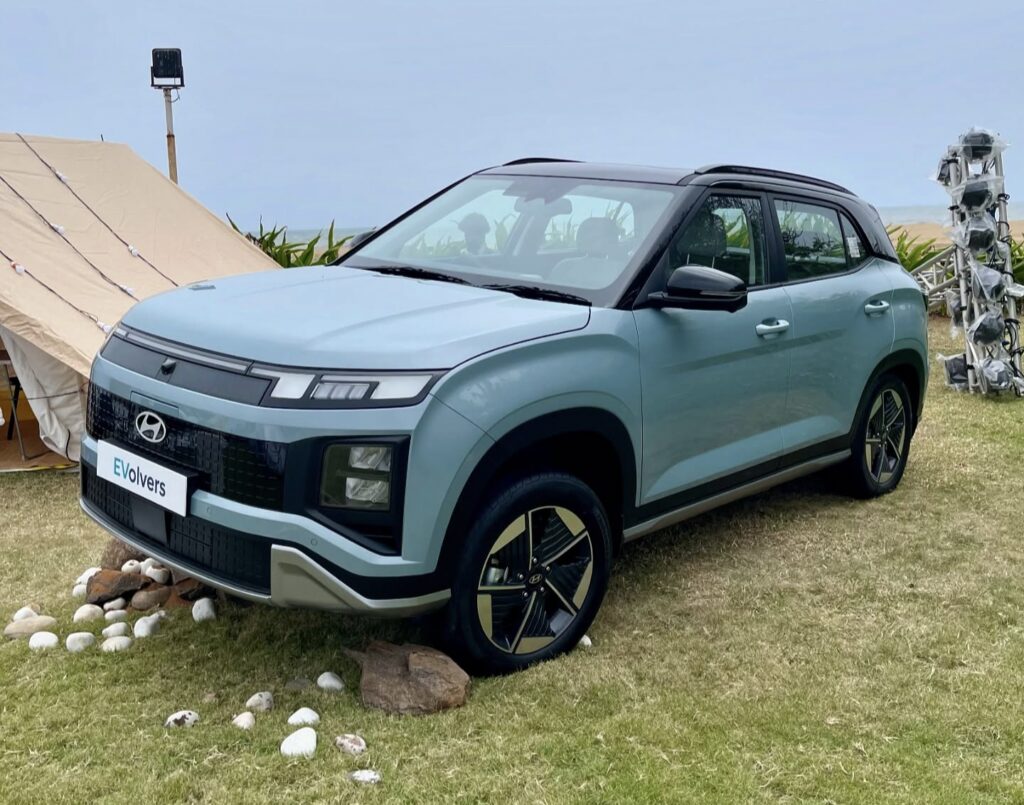
Featured image credit: Image: Avante2025 via Wikimedia Commons (CC BY 4.0). Source
By Piyush P. Yadav
The question Indian buyers with Rs 17 to 21 lakh to spend on a family SUV are asking in 2026 is not electric versus petrol. It is electric versus strong hybrid. A Maruti Grand Vitara or Toyota Urban Cruiser Hyryder with the self-charging hybrid system costs about the same as a Hyundai Creta Electric or a Tata Curvv EV, needs no charger, returns 22 to 25 km a litre in the real world, and holds its value. The electric car costs a quarter as much per kilometre to run and pays no road tax in most states, but costs more to insure, more to buy in the states that have withdrawn EV concessions, and loses more of its value at resale. This guide works the five-year cost of both for two direct price matches, with petrol at Rs 102.12 a litre and home electricity at Rs 8 a unit, and then shows how the answer changes with your annual distance, your state and whether you can charge at home. The result is closer than either camp admits.
The assumptions
We have used the same method as our electric versus petrol five-year cost guide, so the numbers can be compared across the two articles. Where a figure is uncertain we have chosen the value that favours the hybrid.
| Input | Value used | Basis |
|---|---|---|
| Distance | 12,000 km a year; 60,000 km over five years | Typical urban owner; sensitivity below covers 6,000 to 20,000 km |
| Petrol | Rs 102.12 a litre, flat | Delhi, September 2026 |
| Electricity | Rs 8 a unit, flat, home charging | Delhi domestic slab; most states Rs 6 to 9 |
| Hybrid fuel economy | 23 km/l | Real-world 22 to 25 km/l against a 27.97 km/l certified figure; we use the lower half |
| EV efficiency | Creta Electric 8.4 km/kWh; Curvv EV 7.8 km/kWh, both less 10 per cent charging loss | Tested figures from our claimed versus real-world range guide |
| Road tax and registration | Delhi: EV exempt; hybrid at 10 per cent of ex-showroom (over Rs 10 lakh) | Delhi EV Policy 2026 does not extend the waiver to strong hybrids; see state section |
| Insurance | EV 20 per cent higher than the hybrid on the same insured value; about 2.5 per cent of ex-showroom in year one, declining | Higher repair cost and insured value on EVs |
| Maintenance | Hybrid Rs 7,000 a year; EV Rs 4,000 a year | Hybrids need oil, filters and plugs; EVs do not |
| Resale after five years | Hybrid 52 per cent of ex-showroom; Creta Electric 40 per cent; Curvv EV 42 per cent | From our used EV values guide; Maruti and Toyota hybrids hold value well |
| Financing | Excluded | Same rate on a larger principal adds interest; see our EV loans guide |
Matchup 1: Grand Vitara hybrid versus Creta Electric
The Grand Vitara’s entry strong-hybrid variant is Rs 16.63 lakh ex-showroom. The Creta Electric’s entry 42 kWh variant is Rs 18.20 lakh after Hyundai’s September increase. Both are mid-size SUVs of similar footprint and equipment.
| Five-year cost, Delhi | Grand Vitara strong hybrid | Creta Electric 42 kWh |
|---|---|---|
| Ex-showroom | Rs 16,63,000 | Rs 18,20,000 |
| Road tax and registration | Rs 1,66,300 | Rs 0 |
| Fuel or electricity, 60,000 km | Rs 2,66,400 | Rs 63,600 |
| Maintenance | Rs 35,000 | Rs 20,000 |
| Insurance, five years | Rs 1,66,000 | Rs 2,18,000 |
| Less resale | -Rs 8,64,800 | -Rs 7,28,000 |
| Net five-year cost | Rs 14,31,900 | Rs 13,93,600 |
| Cost per km, all-in | Rs 23.87 | Rs 23.23 |
In Delhi, at 12,000 km a year, the electric Creta is ahead by about Rs 38,000 over five years. That is a rounding error on a Rs 14 lakh outlay, and it depends entirely on two things: the Rs 1.66 lakh road tax the hybrid pays and the EV does not, and the Rs 2 lakh fuel saving. Take away either and the hybrid wins.
Matchup 2: Hyryder hybrid versus Curvv EV
At the top of the range the numbers move in the EV’s favour. The Hyryder’s top hybrid variant is Rs 20.19 lakh; the Curvv EV’s top variant, with the 55 kWh battery, is Rs 19.69 lakh, so the electric car is cheaper to begin with and Tata EVs hold value better than most.
| Five-year cost, Delhi | Hyryder strong hybrid (top) | Curvv EV 55 kWh (top) |
|---|---|---|
| Ex-showroom | Rs 20,19,000 | Rs 19,69,000 |
| Road tax and registration | Rs 2,01,900 | Rs 0 |
| Fuel or electricity, 60,000 km | Rs 2,66,400 | Rs 68,400 |
| Maintenance | Rs 35,000 | Rs 20,000 |
| Insurance, five years | Rs 2,01,900 | Rs 2,35,900 |
| Less resale | -Rs 10,49,900 | -Rs 8,27,000 |
| Net five-year cost | Rs 16,74,300 | Rs 14,66,300 |
| Cost per km, all-in | Rs 27.91 | Rs 24.44 |
Here the Curvv EV is ahead by about Rs 2.08 lakh, because it starts cheaper, pays no road tax and has a smaller resale penalty. The hybrid’s only advantages in this matchup are the ones that do not appear in a spreadsheet: no charging, no range planning and a dealer in every town.
How the answer changes with distance
Every 1,000 km you drive costs about Rs 4,440 in the hybrid and Rs 1,060 to Rs 1,140 in the EV. The EV’s fixed-cost penalty, mostly insurance and resale, is roughly constant. So the distance you drive decides the winner in the close matchup.
| Annual distance | Five-year fuel saving, EV over hybrid | Matchup 1 result (Delhi) | Matchup 2 result (Delhi) |
|---|---|---|---|
| 6,000 km | Rs 1,01,000 | Hybrid ahead by about Rs 64,000 | EV ahead by about Rs 1.09 lakh |
| 12,000 km | Rs 2,03,000 | EV ahead by about Rs 38,000 | EV ahead by about Rs 2.08 lakh |
| 15,000 km | Rs 2,53,000 | EV ahead by about Rs 89,000 | EV ahead by about Rs 2.58 lakh |
| 20,000 km | Rs 3,38,000 | EV ahead by about Rs 1.73 lakh | EV ahead by about Rs 3.40 lakh |
Below about 9,000 km a year, a Grand Vitara hybrid is the cheaper car to own than a Creta Electric in Delhi. Above it, the electric car pulls away at about Rs 3,400 for every 1,000 km.
How the answer changes with your state
Road tax is the swing factor, and it varies more than any other input. Our state-by-state guide to EV road tax exemptions has the full picture; the three cases that matter here are below, applied to Matchup 1.
| State scenario | Hybrid road tax | EV road tax | Matchup 1 result, 12,000 km |
|---|---|---|---|
| Delhi (EV exempt to Rs 30 lakh; hybrid pays full) | Rs 1,66,300 | Rs 0 | EV ahead by Rs 38,000 |
| Uttar Pradesh (strong hybrids and EVs both exempt) | Rs 0 | Rs 0 | Hybrid ahead by about Rs 1.28 lakh |
| Karnataka (EV exemption withdrawn; 10 per cent band on both) | Rs 1,66,300 | Rs 1,82,000 | Hybrid ahead by about Rs 1.44 lakh |
Uttar Pradesh is the state that changes the answer most, because it waived registration tax on strong hybrids in 2024 and the EV therefore has nothing to offset its higher price, insurance and depreciation. In any state that has ended its EV concession, the hybrid wins comfortably at ordinary distances.
The things the spreadsheet does not price
- Home charging. Every EV figure above assumes a home charger at Rs 8 a unit. If you rely on public fast charging at Rs 18 to 24 a unit, the EV’s energy cost triples and the hybrid wins every matchup. We worked those numbers in our comparison of home versus public charging costs.
- Highway use. A hybrid returns its best economy in town and its worst on the highway, where the engine does the work. An EV is the opposite. If most of your kilometres are intercity, the hybrid’s real-world figure drops toward 18 km/l and the EV’s toward 6.5 km/kWh; the EV still wins on energy, but the charging stops start to cost time.
- Insurance add-ons. The EV premiums above include zero-depreciation and battery cover, which we treat as essential. Our EV loans and insurance guide explains why.
- Boot space. The hybrid battery under the boot floor costs the Grand Vitara and Hyryder about 250 litres of luggage space against their petrol versions. The Creta Electric and Curvv EV lose nothing.
- Resale risk. We have used 40 to 42 per cent for the EVs. If a battery-health disclosure standard arrives, well-kept EVs should hold value better; if it does not, the figure could be lower. The hybrid’s 52 per cent is the safer assumption.
Who should buy which
Buy the strong hybrid if you drive under 9,000 km a year, live in a state that taxes EVs or waives tax on hybrids, cannot install a home charger, or make regular 500 km-plus trips where you do not want to plan around chargers. The Grand Vitara and Hyryder are the same car under the skin; the Honda City e:HEV at Rs 21.04 lakh is the only strong-hybrid sedan and has no electric equivalent to compare against.
Buy the electric car if you drive over 12,000 km a year, have a home charger, live in Delhi or another state that still exempts EVs, and either want the top-of-range variant or are comparing against the hybrid’s top trim. At Rs 19.69 lakh the Curvv EV is the clearest win in this guide, and it is the car we would point most buyers at Rs 20 lakh towards.
Sources & Further Reading
- CarDekho: Top 5 strong hybrid cars in India, prices and mileage
- Autofy: Best strong hybrid cars in India 2026, real-world mileage and running cost
- CarWale: Hyundai Creta Electric prices and variants
- ZigWheels: Tata electric car prices and specifications
Frequently asked questions
Is a strong hybrid cheaper to own than an electric car in India?
It depends on distance and state. At 12,000 km a year in Delhi a Creta Electric is about Rs 38,000 cheaper than a Grand Vitara hybrid over five years; in Uttar Pradesh, where hybrids also pay no road tax, the hybrid is about Rs 1.28 lakh cheaper. A Curvv EV beats a top Hyryder hybrid by about Rs 2 lakh in Delhi.
What is the real-world mileage of a Grand Vitara or Hyryder strong hybrid?
About 22 to 25 km a litre in mixed use against a certified 27.97 km/l. On the highway the figure drops toward 18 to 20 km/l. We used 23 km/l in this guide.
How much does a strong hybrid cost per km to run?
About Rs 4.44 per km on fuel at Rs 102.12 a litre and 23 km/l. A Creta Electric charged at home at Rs 8 a unit costs about Rs 1.06 per km; a Curvv EV about Rs 1.14 per km.
Do strong hybrids get EV road tax exemptions?
Not in Delhi, whose 2026 EV policy exempts only battery electric vehicles. Uttar Pradesh waives registration tax on strong hybrids. In states that have withdrawn EV concessions, such as Karnataka, both pay similar road tax and the hybrid’s lower purchase price and depreciation usually win.
Do strong hybrids hold better resale value than electric cars in India?
Yes, as the used market stands today. A strong hybrid resells much like a petrol car of the same age because the engine is familiar and there is no battery question hanging over it, while used-car buyers discount EVs harder — trade estimates put hybrid residuals roughly 15 to 20 per cent ahead of comparable electric cars at the three-to-five-year mark. The gap is driven almost entirely by uncertainty about pack state of health: an EV that has slipped below the 70 per cent SoH threshold most Indian manufacturers write into their eight-year warranty is valued against a replacement bill that can run to a third of what the car cost new. Our five-year maths above does not turn on resale, so if you intend to sell at year five rather than keep the car, tilt the answer further toward the hybrid.
Is GST lower on electric cars than on strong hybrids in India?
Much lower, and it is the single biggest reason this comparison is as close as it is. Battery electrics are taxed at 5 per cent GST with no cess, a rate the GST Council left untouched through the September 2025 overhaul. Strong hybrids get no concession at all — they sit in the same slab as their petrol equivalents, which for SUVs of the Grand Vitara and Hyryder’s size means a flat 40 per cent from 22 September 2025, down from an effective 43 per cent under the old GST-plus-cess structure. That roughly 35-point tax gap is what lets an EV’s ex-showroom price undercut a similarly equipped hybrid despite a far more expensive powertrain.
Do strong hybrids need to be plugged in and charged?
No, and this is the most common confusion in the category. A strong hybrid such as the Grand Vitara or Hyryder e-CVT carries a small traction battery — 0.76 kWh at launch, quietly cut to 0.60 kWh in a 2025 update — that is filled by the engine and by regenerative braking, and the car has no charging port at all. Only a plug-in hybrid needs charging to deliver its electric range. The practical consequence for a cost comparison is that the hybrid skips the setup the EV cannot: no 7.2 kW wall box at roughly Rs 25,000 to Rs 35,000 plus installation, no sanctioned-load increase, and no housing-society NOC.