

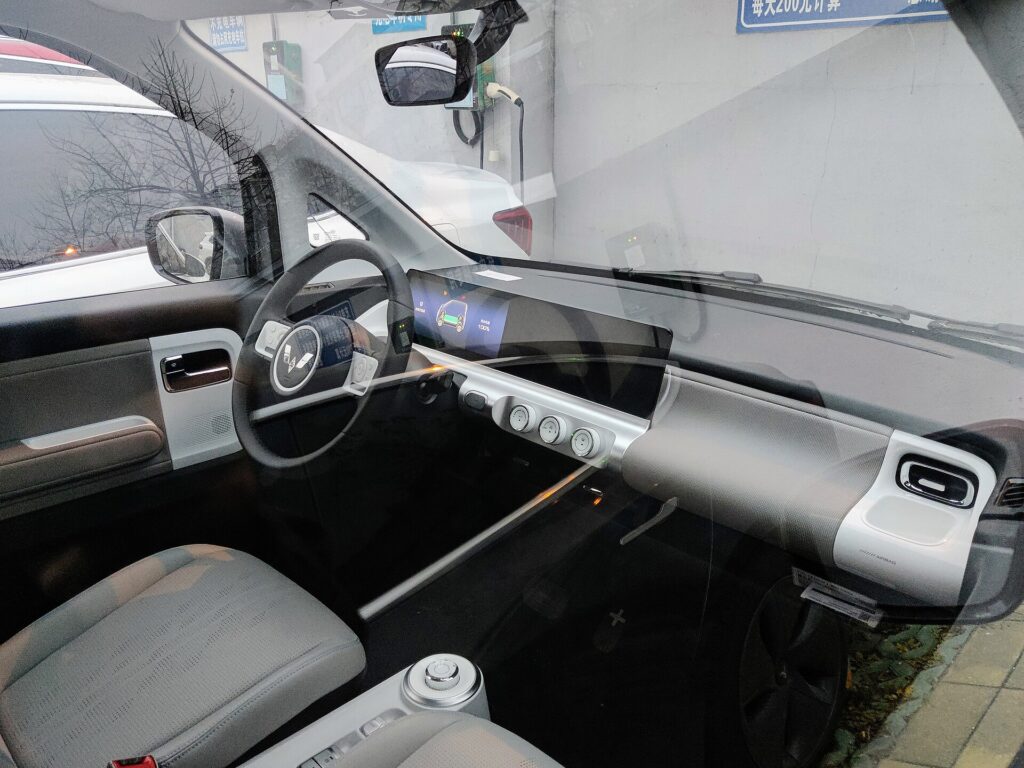
Featured image credit: Image: Zotyefan via Wikimedia Commons (CC BY-SA 4.0). Source
By Piyush P. Yadav
Search “electric car under 5 lakh” in India and you get lists that quietly mix two different kinds of vehicle. The straight answer, checked on 15 September 2026: there is no ordinary four-seat electric car on sale in India below Rs 5 lakh ex-showroom. The cheapest proper electric car you can drive home today is the Tata Tiago EV at Rs 6.99 lakh. What you can buy under Rs 5 lakh is an electric quadricycle – a two-seat, roughly 70 kmph class that is legally not a car – such as the PMV EaS-E at Rs 4.79 lakh. One more route exists: the MG Comet EV is advertised from Rs 4.99 lakh, but only if you rent the battery at Rs 3.2 per kilometre. Here is what each option really costs.
How we worked this out
Every price below was read off the manufacturer’s own India website or a launch report from Autocar India or Autocar Professional on 15 September 2026, and all prices are ex-showroom unless stated otherwise. The MG Comet EV figures – Rs 7,79,800 for the entry Executive variant, and the Battery-as-a-Service price of “4.99 lakh + Rs 3.2/km” – come straight from JSW MG Motor India’s Comet EV page. The Tiago EV’s Rs 6.99 lakh start comes from Tata.ev’s price page. The PMV EaS-E price and its quadricycle classification come from Autocar India’s launch report, and the category rules from Autocar India’s report on the MoRTH notification that created the class.
The break-even calculation later assumes you keep the vehicle, pay for electricity separately – battery rental does not include the charging cost – and it ignores interest and insurance, which are broadly similar across both payment routes for the same car.
The distinction everything hinges on: quadricycle vs car
India has a vehicle category called the quadricycle, approved by MoRTH as a class separate from passenger cars. To qualify, a vehicle must have a kerb weight under 475 kg and clear a distinct set of safety and emission tests written for the category. The consequences for a buyer are severe, and almost never spelled out in “under 5 lakh” listicles:
- Quadricycles on sale here are limited to around 70 kmph top speed. That effectively rules out comfortable expressway use.
- They seat two, not four or five.
- They are tested to the quadricycle safety standard, not the passenger-car regime Bharat NCAP ratings sit on top of.
- Until November 2018 they could only be registered commercially. MoRTH then moved quadricycles into the non-transport (private) category, which is the only reason you can buy one personally.
So when a page tells you an “electric car” costs Rs 4.79 lakh, check the category before the colour options. It is a real, road-legal, registrable vehicle – just not a car.
What Rs 5 lakh actually buys in September 2026
| Vehicle | Category | Price (ex-showroom) | Seats | Claimed range | Top speed | Status |
|---|---|---|---|---|---|---|
| Vayve Eva | Electric quadricycle | From Rs 3.25 lakh (to Rs 5.99 lakh) | 2 adults + child | Up to 250 km (18 kWh pack) | 70 kmph | Deliveries slated for H2 2026 |
| PMV EaS-E | Electric quadricycle | From Rs 4.79 lakh | 2 | 120 / 160 / 200 km variants | 70 kmph | On sale |
| MG Comet EV (BaaS) | Passenger car | Rs 4.99 lakh + Rs 3.2/km battery rental | 4 | 230 km (ARAI) | Not quadricycle-limited | On sale |
| MG Comet EV (outright) | Passenger car | Rs 7,79,800 to Rs 10,06,800 | 4 | 230 km (ARAI) | Not quadricycle-limited | On sale |
| Tata Tiago EV | Passenger car | From Rs 6.99 lakh | 5 | 19 kWh and 24 kWh packs | Not quadricycle-limited | On sale |
PMV EaS-E: the genuine sub-Rs 5 lakh option you can buy today
PMV Electric’s EaS-E launched at Rs 4.79 lakh as a two-seat microcar that Autocar India described plainly: it “isn’t a full-fledged passenger car and is classified as a quadricycle.” It uses a 48V lithium-iron-phosphate battery and a 13 hp, 50 Nm motor, claims 0-40 kph in under 5 seconds and a 70 kph top speed, and comes in 120 km, 160 km and 200 km range versions. As a second vehicle for a 15 km city office run, that is a coherent product. As a family’s only vehicle it is not.
Vayve Eva: cheapest on paper, not yet in driveways
Vayve Mobility’s Eva, shown at the Bharat Mobility expo and reported by Autocar Professional, opens at Rs 3.25 lakh with 9 kWh, 12.6 kWh and 18 kWh battery options running up to Rs 5.99 lakh, a claimed 250 km on the largest pack, a 70 kph top speed and an optional solar roof the company says can contribute up to 3,000 km of charging a year. Bookings have been open at Rs 5,000. The honest caveat: deliveries were scheduled for the second half of 2026, so this is a price you can book against, not a vehicle you can drive out of a showroom today.
The MG Comet’s Rs 4.99 lakh: the worked calculation nobody publishes
MG’s own site advertises the Comet EV “starting at 4.99 lakh + Rs 3.2/km” under Battery-as-a-Service. This is a genuine way to get a four-seat passenger car for under Rs 5 lakh up front. You simply do not own the 17.4 kWh battery, and you pay for the kilometres you drive. Here is the arithmetic:
- Outright entry price (Executive): Rs 7,79,800
- BaaS entry price: Rs 4,99,000
- Up-front saving: Rs 2,80,800
- Battery rental: Rs 3.2 per km
- Break-even distance: Rs 2,80,800 divided by Rs 3.2 = 87,750 km
At a typical city usage of 1,000 km a month, 87,750 km takes roughly seven years and four months. Over five years at that usage you would cover 60,000 km and pay Rs 1,92,000 in rental, a total outlay of Rs 6,91,000 against Rs 7,79,800 outright – about Rs 88,800 less, at the cost of not owning the pack. Drive 1,500 km a month and you cross break-even inside five years, at which point BaaS is the dearer route.
Two caveats. The rental does not cover electricity: you still pay your DISCOM for every unit, which is the ground covered in our comparison of the five-year cost of owning an electric car versus a petrol one. And resale differs, because you are selling a car without a battery. How these schemes are structured, including Mahindra’s version, is set out in our explainer on Battery-as-a-Service for electric cars in India.
Why the floor for a real car sits near Rs 7 lakh
The reason a proper electric hatchback cannot currently be sold here at Rs 4 lakh is structural. The battery pack is the single largest line in the bill of materials, and a 19-24 kWh pack of the kind fitted to a Tiago EV costs more than the entire drivetrain of an equivalent petrol hatchback. On top of that sit the passenger-car homologation, crash and equipment requirements a quadricycle does not have to meet. We unpacked that whole cost stack in why electric cars still cost more than petrol cars in India.
Remember too that ex-showroom is not what leaves your account. Registration, road tax where a state still levies it, insurance and handling sit on top and vary sharply by state, as our breakdown of how the on-road price of an electric car is built up, city by city shows.
Who this is for, and who should ignore it
A sub-Rs 5 lakh electric quadricycle makes sense for a specific buyer: someone in a dense city with a short, repeatable daily route, who already has a family car for highway trips, who can charge at home or at work, and who rarely carries more than one passenger. If that is you, the PMV EaS-E is a rational purchase and the Vayve Eva is worth watching once deliveries are running.
Ignore this advice if you need to carry four or five people, if you use highways regularly – doing 70 kmph on a National Highway is a safety problem, not an inconvenience – if you want the crash-protection regime that applies to passenger cars, or if this will be your household’s only vehicle. In all of those cases the honest budget is Rs 7 lakh or more ex-showroom, and the Tiago EV is where the market genuinely starts.
Limitations of this comparison
We left the Strom Motors R3 out of the table even though several aggregators list it around Rs 4.5 lakh: its published specifications differ wildly between portals – one large aggregator currently shows a 30 kWh battery, which is not plausible at that size and price – and we could not verify a manufacturer-confirmed figure on the day of writing. All prices are ex-showroom as published on 15 September 2026 and change often; quadricycle rules are national, but registration practice varies by RTO, so confirm locally before booking.
Sources & Further Reading
- JSW MG Motor India – MG Comet EV official page
- Tata.ev – Tiago EV price page
- Autocar India – PMV Eas-E electric microcar launched at Rs 4.79 lakh
- Autocar Professional – Vayve Mobility introduces solar-powered electric car at Rs 3.25 lakh
- Autocar India – MoRTH approves quadricycle as new vehicle category
People also ask
What is the cheapest electric car price in India?
The cheapest full passenger car is the Tata Tiago EV at Rs 6.99 lakh ex-showroom. If you count battery rental, the MG Comet EV is advertised from Rs 4.99 lakh plus Rs 3.2 per km. Below that, the cheapest road-legal four-wheelers are electric quadricycles such as the PMV EaS-E at Rs 4.79 lakh, which seats two and tops out near 70 kmph.
Which EV car is lowest price in India?
By ex-showroom sticker among genuine cars, the Tata Tiago EV at Rs 6.99 lakh. The MG Comet EV’s own entry variant is Rs 7,79,800 outright, rising to Rs 10,06,800 for the Exclusive FC. Anything cheaper than the Tiago EV that is being described to you as a car is either a quadricycle or a battery-rental price that excludes the pack.
Is it worth buying an electric car in India at this price level?
It depends entirely on how you drive. A Rs 4.79 lakh quadricycle is worth it for a short, repeatable city commute as a second vehicle. As a household’s only car it is not, because of two seats and a 70 kmph ceiling. At Rs 6.99 lakh the Tiago EV competes head-on with petrol hatchbacks, and there the running-cost gap over five years is what decides it.
How much does an EV car cost per km in India?
Energy is the small part. Charging a 17.4 kWh pack at a domestic slab of roughly Rs 8 per unit costs about Rs 139 for a claimed 230 km, or close to Rs 0.60 per km. The bigger variable is the purchase route: on the MG Comet’s Battery-as-a-Service plan you add Rs 3.2 per km of battery rental on top of that electricity.
When will electric car prices drop in India?
Nobody can give you a date, and pages that offer one are guessing. What is observable is where the cost actually sits: the battery pack dominates the bill of materials, so meaningful price falls track cell prices and local cell manufacturing rather than announcements. Until domestically made cells are supplying volume models, expect the entry point for a real electric car to stay close to Rs 7 lakh.
Is an electric car under Rs 5 lakh available in India right now?
Yes, but only as a quadricycle or on a battery-rental plan. The PMV EaS-E at Rs 4.79 lakh is on sale and is classified as a quadricycle. The Vayve Eva is bookable from Rs 3.25 lakh with deliveries scheduled for the second half of 2026. The MG Comet EV at Rs 4.99 lakh is a genuine four-seat car, but the battery is rented at Rs 3.2 per km.