

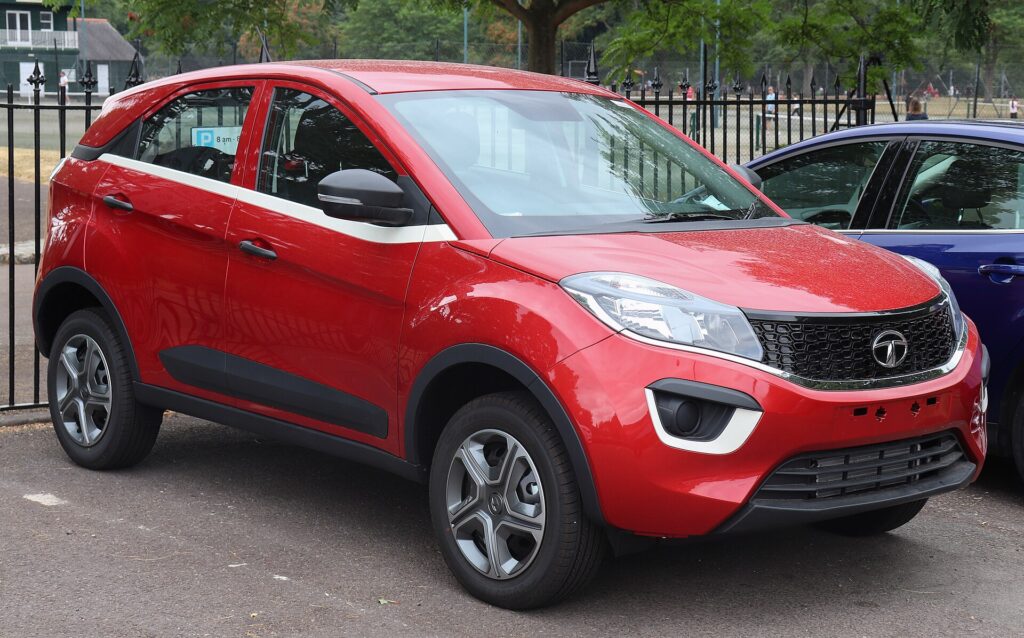
Featured image credit: Image: Vauxford via Wikimedia Commons (CC BY-SA 4.0). Source
By Piyush P. Yadav
The gap between a petrol car and its electric twin has never been easier to measure in India, because three of the best-selling nameplates now come in both forms. A Tata Punch starts at Rs 5.75 lakh and a Punch EV at Rs 8.16 lakh. A Nexon starts at Rs 7.40 lakh and a Nexon EV at Rs 12.49 lakh. A Hyundai Creta starts at Rs 11.01 lakh and a Creta Electric at Rs 18.20 lakh. In each case the electric car costs Rs 2.4 lakh to Rs 7.2 lakh more on the sticker, and in each case it costs a fraction as much to run. This guide works the five-year cost of ownership for all three pairs with petrol at Rs 102.12 a litre, the Delhi price on 8 September 2026, and home electricity at Rs 8 a unit, with every assumption stated so you can substitute your own distance, tariff and city. The conclusion is not the same for all three cars, and the distance at which the electric car pulls ahead ranges from under two years to beyond the five-year horizon.
Assumptions
Where a figure is uncertain we have chosen the value that favours the petrol car, so the electric result is a floor rather than a ceiling.
| Input | Value used | Basis |
|---|---|---|
| Distance | 12,000 km a year; 60,000 km over five years | Typical urban owner; sensitivity table below covers 6,000 to 20,000 km |
| Petrol | Rs 102.12 a litre, flat | Delhi, 8 September 2026 |
| Electricity | Rs 8 per unit, flat, home charging | Delhi domestic slab; most states Rs 6 to 9 |
| Petrol mileage | 85 per cent of the ARAI figure | Real-world discount used by most Indian tests |
| EV efficiency | Autocar India tested km/kWh, plus 10 per cent charging loss | From our real-world range guide |
| Comparison variants | Entry EV variant against the mid petrol variant nearest in equipment | Base petrol variants lack the EV’s standard kit |
| Registration and road tax | Delhi: EV exempt; petrol at 4 per cent (under Rs 6 lakh) to 10 per cent (over Rs 10 lakh) of ex-showroom, as in the Delhi EV Policy 2026 | State-specific; several states have withdrawn EV exemptions |
| Insurance | EV 20 per cent higher than petrol on the same car; both about 2.5 per cent of ex-showroom in year one, declining | Higher insured value and repair cost |
| Maintenance | Petrol Rs 8,000 a year; EV Rs 4,000 a year | Manufacturer service schedules; EVs have no oil, plugs, clutch |
| Resale after five years | Petrol 50 per cent of ex-showroom; EV 45 per cent for Nexon EV, 40 per cent for Punch EV and Creta Electric | From our used-EV values guide; Nexon EV holds value better |
| Financing | Excluded | Same loan rate on a bigger principal adds Rs 15,000 to 45,000 in interest; see our EV loans guide |
The three pairs
| Car | Ex-showroom (Delhi, Sept 2026) | Energy | Real-world figure used | Energy cost per km |
|---|---|---|---|---|
| Tata Punch petrol (mid variant, 1.2 MT) | Rs 7.50 lakh | 20.0 km/l ARAI | 17.0 km/l | Rs 6.01 |
| Tata Punch EV (entry, 25 kWh) | Rs 8.16 lakh | 25 kWh LFP | 7.8 km/kWh, less 10 per cent for losses | Rs 1.14 |
| Tata Nexon petrol (mid variant, 1.2 turbo MT) | Rs 10.00 lakh | 17.0 km/l ARAI | 14.5 km/l | Rs 7.04 |
| Tata Nexon EV (entry, 45 kWh) | Rs 12.49 lakh | 45 kWh LFP | 7.8 km/kWh tested | Rs 1.14 |
| Hyundai Creta petrol (mid variant, 1.5 MT) | Rs 14.00 lakh | 17.4 km/l ARAI | 14.8 km/l | Rs 6.90 |
| Hyundai Creta Electric (entry, 42 kWh) | Rs 18.20 lakh | 42 kWh NMC | 8.4 km/kWh tested | Rs 1.05 |
The petrol prices are approximate mid-variant figures from the September 2026 ranges (Punch Rs 5.75 to 10.77 lakh; Nexon Rs 7.40 to 14.52 lakh; Creta Rs 11.01 to 20.15 lakh). The EV prices are the September starting prices after this month’s increases, which we detailed in our report on the Tata and Hyundai EV price hikes. The efficiency figures are the Autocar India tested numbers we tabulated in our guide to claimed versus real-world EV range; the Punch EV was not in that test, so we have used the Nexon EV’s 7.8 km/kWh, which is conservative for a lighter car.
Five-year running costs
At 12,000 km a year the numbers separate quickly. The petrol Nexon burns about 4,140 litres over five years, or Rs 4.23 lakh at today’s price. The Nexon EV uses about 8,550 units, or Rs 68,000.
| Five-year running cost | Punch petrol | Punch EV | Nexon petrol | Nexon EV | Creta petrol | Creta Electric |
|---|---|---|---|---|---|---|
| Fuel or electricity | Rs 3,60,400 | Rs 68,400 | Rs 4,22,600 | Rs 68,400 | Rs 4,14,000 | Rs 63,500 |
| Maintenance | Rs 40,000 | Rs 20,000 | Rs 40,000 | Rs 20,000 | Rs 40,000 | Rs 20,000 |
| Insurance (five years) | Rs 75,000 | Rs 98,000 | Rs 1,00,000 | Rs 1,50,000 | Rs 1,40,000 | Rs 2,18,000 |
| Total running | Rs 4,75,400 | Rs 1,86,400 | Rs 5,62,600 | Rs 2,38,400 | Rs 5,94,000 | Rs 3,01,500 |
| Running saving, EV | Rs 2,89,000 | Rs 3,24,200 | Rs 2,92,500 | |||
Insurance is the one running cost where the EV loses, and by more than most buyers expect: over five years the Creta Electric costs about Rs 78,000 more to insure than the petrol Creta because the insured value is Rs 4 lakh higher and EV repair costs push premiums up. Our guide to EV loans and insurance covers the add-ons that are worth paying for.
The full five-year picture
Adding the purchase price and Delhi registration, then subtracting resale, gives the net cost of owning each car for five years.
| Five-year total | Punch petrol | Punch EV | Nexon petrol | Nexon EV | Creta petrol | Creta Electric |
|---|---|---|---|---|---|---|
| Ex-showroom | Rs 7,50,000 | Rs 8,16,000 | Rs 10,00,000 | Rs 12,49,000 | Rs 14,00,000 | Rs 18,20,000 |
| Road tax and registration (Delhi) | Rs 52,500 | Rs 0 | Rs 70,000 | Rs 0 | Rs 1,40,000 | Rs 0 |
| Running (from above) | Rs 4,75,400 | Rs 1,86,400 | Rs 5,62,600 | Rs 2,38,400 | Rs 5,94,000 | Rs 3,01,500 |
| Less resale | -Rs 3,75,000 | -Rs 3,26,400 | -Rs 5,00,000 | -Rs 5,62,050 | -Rs 7,00,000 | -Rs 7,28,000 |
| Net five-year cost | Rs 9,02,900 | Rs 6,76,000 | Rs 11,32,600 | Rs 9,25,350 | Rs 14,34,000 | Rs 13,93,500 |
| EV advantage | Rs 2,26,900 | Rs 2,07,250 | Rs 40,500 | |||
| Cost per km, all-in | Rs 15.05 | Rs 11.27 | Rs 18.88 | Rs 15.42 | Rs 23.90 | Rs 23.23 |
Three different answers. The Punch EV, with the smallest price premium, is cheaper by about Rs 2.3 lakh over five years and pays back its premium in well under two years. The Nexon EV, with a Rs 2.5 lakh premium but the best resale of any Indian EV, is ahead by about Rs 2.1 lakh. The Creta Electric, with a Rs 4.2 lakh premium, higher insurance and weaker resale, is ahead by only about Rs 40,000 at 12,000 km a year in Delhi; move it to a state that taxes EVs, or drop the annual distance, and the petrol Creta wins.
Distance changes everything
Because the EV’s advantage is almost entirely per-kilometre, the annual distance is the single most important input. The table recalculates the five-year advantage for each pair at different annual distances, holding everything else constant.
| Annual distance | Punch EV vs Punch | Nexon EV vs Nexon | Creta Electric vs Creta |
|---|---|---|---|
| 6,000 km | Rs 80,800 | Rs 30,200 | -Rs 1,35,000 (petrol cheaper) |
| 9,000 km | Rs 1,53,900 | Rs 1,18,700 | -Rs 47,300 (petrol cheaper) |
| 12,000 km | Rs 2,26,900 | Rs 2,07,250 | Rs 40,500 |
| 15,000 km | Rs 3,00,000 | Rs 2,95,700 | Rs 1,28,200 |
| 20,000 km | Rs 4,21,800 | Rs 4,43,300 | Rs 2,74,400 |
The Creta Electric needs about 10,600 km a year in Delhi to break even over five years; the Nexon EV about 4,900 km; the Punch EV under 3,000 km. A buyer doing 6,000 km a year, which describes a great many second cars in Indian households, should buy the petrol Creta and think hard about the Nexon EV, but can buy the Punch EV with confidence.
What moves the numbers
- Public charging instead of home. At Rs 16 to 24 a unit on public DC chargers, the EV’s energy cost doubles or triples. A Nexon EV owner charging entirely at public units pays Rs 1.4 to 2 lakh over five years instead of Rs 68,000, which halves the advantage. Our comparison of home versus public charging costs works this through; home charging is the assumption every EV business case rests on.
- State road tax. Delhi’s exemption is worth Rs 52,000 to 1.4 lakh in the tables above. In a state charging full tax on EVs the Creta Electric’s advantage disappears and the Nexon EV’s shrinks to about Rs 1.3 lakh.
- Discounts. September’s festive offers of Rs 2 to 3 lakh on selected EVs, which we tracked in our September 2026 EV discount round-up, are larger than the entire five-year Creta Electric advantage and turn the Creta comparison decisively.
- Resale. We have assumed EVs retain 40 to 45 per cent after five years. If the used market improves to petrol parity, add Rs 50,000 to 1 lakh to each EV’s advantage; if it worsens to 30 per cent, subtract a similar amount. Our guide to used electric car values explains why the Nexon EV holds value and others do not.
- Petrol price. Each Rs 5 change in the litre price moves the five-year fuel bill by about Rs 20,000 for these cars.
- Ownership horizon. Every year beyond five adds Rs 55,000 to 70,000 to the EV’s advantage, because the purchase premium has already been absorbed and only the running-cost gap remains.
The verdict, car by car
- Punch EV against Punch: the electric car wins at almost any distance, because the premium is small, road tax is waived and the fuel saving is Rs 58,000 a year. This is the clearest case for an EV in India today.
- Nexon EV against Nexon: the electric car wins above about 5,000 km a year, helped by the strongest resale value in the segment. At typical distances the advantage is about Rs 2 lakh.
- Creta Electric against Creta: the electric car wins only for higher-mileage owners charging at home in a state that waives road tax, or when a discount closes the price gap. At 6,000 to 9,000 km a year the petrol Creta is cheaper to own.
Sources & Further Reading
- Goodreturns: Petrol price in New Delhi, 8 September 2026
- CarWale: Tata Nexon price, variants and mileage
- CarDekho: Tata Punch 2026 price and mileage
- EVSelect: Petrol vs electric car in India, five-year total cost of ownership (2026)
- Business Standard: Delhi government notifies EV Policy 2026, road tax and registration exemptions
FAQ
Is an electric car cheaper than a petrol car over five years in India?
For the Punch EV and Nexon EV at typical distances of 12,000 km a year, yes, by about Rs 2 to 2.3 lakh in Delhi with home charging. For the Creta Electric the advantage is only about Rs 40,000 at that distance and turns negative below roughly 10,000 km a year.
How many kilometres a year do I need to drive for an EV to pay off?
Under 3,000 km for a Punch EV, about 5,000 km for a Nexon EV and about 10,600 km for a Creta Electric, over a five-year horizon in Delhi with road-tax exemption and home charging. In states that tax EVs, add 2,000 to 4,000 km to each figure.
What does it cost per kilometre to run an electric car in India?
About Rs 1.05 to 1.15 per kilometre for electricity on home charging at Rs 8 a unit, against Rs 6 to 7 for petrol at Rs 102 a litre. All-in, including purchase, insurance, maintenance and depreciation, Rs 11 to 23 per kilometre for the EVs in this guide against Rs 15 to 24 for their petrol twins.
Why is the Creta Electric’s advantage so small?
A Rs 4.2 lakh price premium, insurance that costs about Rs 78,000 more over five years and a resale assumption of 40 per cent absorb most of the Rs 3.5 lakh fuel saving. A festive discount or a longer ownership period changes the answer.
How much cheaper is servicing an electric car than a petrol car in India?
Roughly half. A Nexon EV annual service runs about Rs 1,500 to Rs 3,000 at a Tata workshop against Rs 3,000 to Rs 4,500 for the petrol Nexon, because there is no engine oil, oil filter, spark plugs or fuel filter to replace. Across five years that is a saving of roughly Rs 10,000 to Rs 12,000 — real, but small next to the fuel gap, and partly eaten back by tyres, which wear faster on the heavier EV.
Does an electric car still work out cheaper if I charge mostly at public fast chargers?
It stays cheaper, but much less so. Public DC tariffs of Rs 14 to Rs 24 a unit against about Rs 8 at home push the energy cost from roughly Rs 1.10 a kilometre to between Rs 2.50 and Rs 3.45, against Rs 6 to Rs 7 for petrol. The per-kilometre saving falls from about Rs 5.40 to between Rs 3.20 and Rs 4, which pushes every break-even distance in this guide up by roughly a third to two-thirds. An EV bought without a home or society charge point is a different financial proposition from the one modelled here.
Can I still claim the Section 80EEB tax deduction on an electric car loan?
Not on a new loan. Section 80EEB, worth up to Rs 1.5 lakh a year on EV loan interest, applied only to loans sanctioned between 1 April 2019 and 31 March 2023, and only under the old tax regime; buyers still repaying a loan from that window can keep claiming it. What remains for a 2026 buyer is the green car loan concession — SBI and several public-sector banks price EV loans about 0.25 percentage points below a standard car loan, worth under Rs 15,000 across five years on a Rs 15 lakh loan. It does not change any verdict in this guide.