

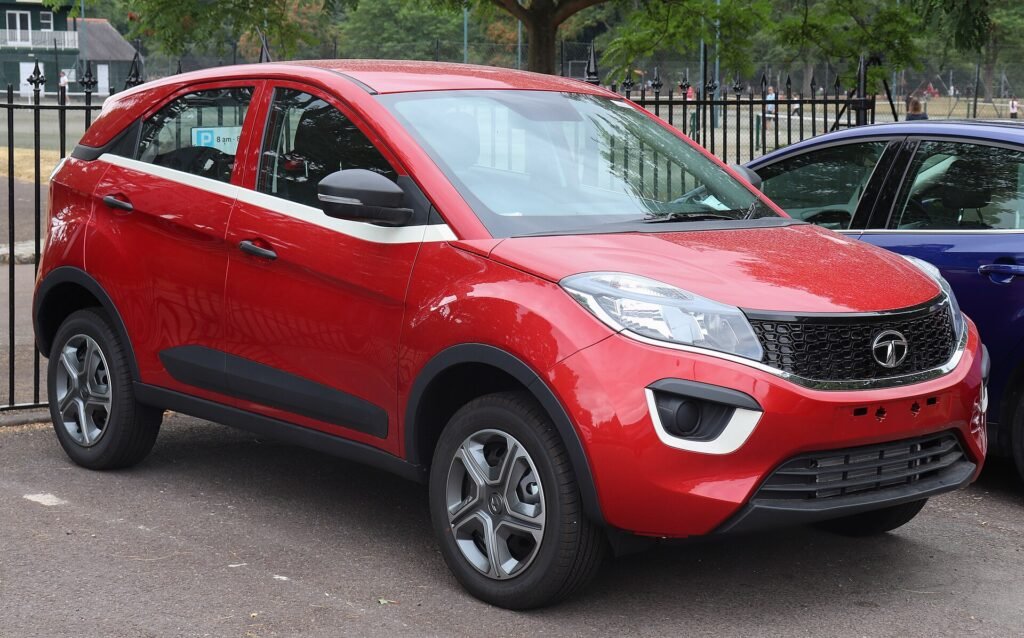
Featured image credit: Image: Vauxford via Wikimedia Commons (CC BY-SA 4.0). Source
By Piyush P. Yadav
Ask why an electric car costs more than the petrol car parked next to it in the same showroom and you will usually be told “because the battery is expensive”. That is true, but it is only half the answer, and the half that is missing changes the conclusion. India taxes an electric car at 5 per cent GST and a large petrol SUV at 40 per cent, so the price you see on the windscreen already flatters the EV heavily. Strip the tax out of both stickers and the real factory-gate gap is much wider than the showroom gap. On the Hyundai Creta, the top petrol variant and the top electric variant are separated by Rs 4.76 lakh on the price list, but by roughly Rs 9.41 lakh before tax. That is the number that actually explains why EVs cost what they cost in India, and why the gap is closing slowly.
How we worked this out
Every ex-showroom price in this article is the New Delhi figure listed on CarDekho’s model pages and was checked on 13 September 2026. GST rates are the GST 2.0 rates that took effect on 22 September 2025: 5 per cent on electric vehicles, 18 per cent on petrol cars up to 1,200 cc and under 4 m (and diesels up to 1,500 cc), and 40 per cent on everything larger, with the compensation cess abolished. Battery pack costs use BloombergNEF’s annual battery price survey published on 9 December 2025, which put the global volume-weighted average battery-electric-vehicle pack at USD 99 per kWh, converted at the rupee’s 12 September 2026 level of about 95.6 to the dollar.
One assumption matters and we are stating it plainly: an ex-showroom price is quoted inclusive of GST, so dividing it by 1.18, 1.40 or 1.05 gives an approximation of the pre-tax price, with the dealer margin sitting inside the taxable value. It is not the manufacturer’s invoice value, and no carmaker publishes that. The direction and the order of magnitude are reliable; the last decimal place is not. We have also compared entry variant with entry variant and top variant with top variant, which is fair on price but not perfectly fair on equipment, because electric variants usually launch better equipped.
The sticker gap versus the real gap
Here is what happens to three well-matched pairs when the tax comes out.
| Model pair (ex-showroom, Delhi) | Petrol or diesel | Electric | Sticker gap | Pre-tax gap |
|---|---|---|---|---|
| Tata Punch, entry variant | Rs 5.75 lakh (18% GST) | Rs 9.79 lakh (5% GST) | Rs 4.04 lakh | Rs 4.45 lakh |
| Tata Punch, top variant | Rs 10.77 lakh | Rs 12.99 lakh | Rs 2.22 lakh | Rs 3.24 lakh |
| Tata Nexon, entry variant | Rs 7.40 lakh (18% GST) | Rs 12.49 lakh (5% GST) | Rs 5.09 lakh | Rs 5.63 lakh |
| Tata Nexon, top variant | Rs 14.52 lakh | Rs 17.89 lakh | Rs 3.37 lakh | Rs 4.73 lakh |
| Hyundai Creta, entry variant | Rs 10.91 lakh (40% GST) | Rs 18.03 lakh (5% GST) | Rs 7.12 lakh | Rs 9.38 lakh |
| Hyundai Creta, top variant | Rs 20.46 lakh | Rs 25.22 lakh | Rs 4.76 lakh | Rs 9.41 lakh |
The pattern is consistent. In every pair the pre-tax gap is larger than the sticker gap, and in the Creta’s case it is nearly twice as large at the top of the range. The Creta is the clearest example because it crosses 4 m and so sits in the 40 per cent slab, while its electric twin sits in the 5 per cent slab.
The worked calculation nobody shows you
Take the two top variants of the Creta family. On a Rs 20.46 lakh petrol Creta, about Rs 5.85 lakh of that windscreen price is GST. On a Rs 25.22 lakh Creta Electric, about Rs 1.20 lakh is GST. The tax system is therefore handing the electric car an advantage of roughly Rs 4.65 lakh at the point of sale, and the electric car still costs Rs 4.76 lakh more than the petrol one. At parity of taxation the same two cars would be about Rs 9.4 lakh apart. Everything you read about EVs being close to price parity in India is a statement about the tax code, not about the cost of building the car.
So where does the money actually go?
1. The battery, but less of it than you think
At BNEF’s global average of USD 99 per kWh for a battery-electric pack, the raw pack cost works out at roughly Rs 3.79 lakh for the Punch EV’s 40 kWh pack, Rs 4.26 lakh for the Nexon EV’s 45 kWh pack and Rs 4.86 lakh for the Creta Electric’s 51.4 kWh long-range pack. Set that against the Creta’s pre-tax gap of Rs 9.41 lakh and the pack explains a little over half of it at best, and that global average is a floor rather than an Indian price. BNEF found packs cost USD 84 per kWh in China against USD 121 in North America and USD 131 in Europe; India, which still imports most of its cells, does not enjoy the Chinese number. Chemistry matters too: BNEF put LFP packs at USD 81 per kWh and NMC packs at USD 128, which is a large part of why Indian manufacturers have moved towards LFP, as we set out in our guide to LFP versus NMC battery chemistry in Indian EVs.
2. The powertrain the EV adds, minus the one it deletes
The honest comparison is not battery versus nothing. An electric car deletes the engine, gearbox, clutch, exhaust, fuel tank and most of the emissions hardware, and adds a traction motor, an inverter, a DC-DC converter, an on-board charger, a thermal management system and a great deal of high-voltage wiring. The net addition is real, but smaller than the pack price alone suggests, which is precisely why the remaining gap has to be explained by something else.
3. Volume, and the cost of a line that runs half empty
That something else is scale. A petrol Creta shares a production line, a supplier base and a development budget with hundreds of thousands of units a year. An electric Creta amortises its own battery line, its own validation programme and its own supplier tooling over a far smaller number. Fixed cost per car is the quietest and largest item in the gap, and it is the one that falls fastest as volumes rise, which is the real reason to expect prices to converge over the next few years rather than any sudden breakthrough in cell chemistry.
4. Imported cells and the duty stack
India’s cell manufacturing base is still being built. Union Budget 2026 extended the basic customs duty exemption on capital goods used to make lithium-ion cells to equipment for battery energy storage systems as well, and earlier budgets removed duty on lithium oxide, hydroxide and carbonate feedstocks. Those are exemptions on the machines and the raw materials, not on finished imported cells, which continue to carry duty. Until domestic gigafactories reach volume, a meaningful share of the pack cost in an Indian EV is landed cost rather than manufacturing cost. We track that build-out in our report on the Indian EV battery supply chain in 2026.
What this means when you are actually buying
The practical takeaway is that the tax advantage is doing a lot of work for you today, and it is the most fragile part of the equation. GST on EVs has been held at 5 per cent through two rounds of rate reform, but it is a policy choice, not a law of physics; our explainer on GST on electric vehicles in India covers where that concession sits today. On top of the sticker price, state road tax exemptions and registration concessions widen the advantage further at the on-road stage, which we break down city by city in our guide to the real on-road price of an electric car in India. And because the purchase premium is real even after all of that, whether an EV pays back depends on how much you drive; our five-year cost of ownership comparison for the Punch, Nexon and Creta does that arithmetic.
Who this is for, and who should ignore it
This analysis is aimed at a private buyer comparing an EV with its own petrol twin and trying to work out whether the premium is manufacturer greed, tax policy or genuine cost. It is not a buying recommendation and it is not a price forecast. Fleet and commercial buyers face a different tax position, including input tax credit, and should not use these numbers. Note the limits already flagged: the pre-tax figures are derived from retail prices rather than invoice values, variant equipment is not perfectly matched, and the battery pack cost is a global benchmark applied to Indian cars, not a figure any Indian manufacturer has confirmed. Treat the gaps in the table as well-founded estimates of scale, not as accounting.
Sources & Further Reading
- BloombergNEF, Lithium-Ion Battery Pack Prices Fall to USD 108 per Kilowatt-Hour (9 December 2025)
- India Briefing, How Cars in India Became Cheaper under GST 2.0
- Business Today, Budget 2026 customs duty exemption on capital goods for battery storage
- CarDekho model price pages (Tata Punch and Punch EV, Nexon and Nexon EV, Hyundai Creta and Creta Electric)
- Trading Economics, Indian Rupee exchange rate
People also ask
Why are electric cars expensive in India?
Because the battery pack alone is worth roughly Rs 3.8 lakh to Rs 4.9 lakh at BloombergNEF’s global average of USD 99 per kWh, because most cells are still imported and carry duty, and because electric models are built in far smaller volumes than their petrol twins, so fixed costs are spread thinly. Tax works the other way: at 5 per cent GST against 18 or 40 per cent, the tax code narrows the gap you see rather than widening it.
Why is the EV version more expensive than the petrol version of the same car?
On the Tata Nexon the entry electric variant is Rs 5.09 lakh dearer on the sticker, but about Rs 5.63 lakh dearer before tax. The electric car adds a battery, motor, inverter, on-board charger and thermal management, and deletes the engine, gearbox, exhaust and fuel system. The net hardware addition, plus low production volumes, accounts for the difference.
Will electric car prices come down in India?
The direction is down, but slowly. Battery pack prices fell 8 per cent globally in 2025 to an average USD 108 per kWh, and Indian cell plants are still ramping. The larger lever is volume: as electric variants come to share lines and suppliers with high-volume petrol models, fixed cost per car falls. Expect gradual convergence rather than a sudden cut.
How much GST is charged on electric cars in India?
Five per cent, unchanged through the GST 2.0 reform of 22 September 2025. Petrol cars up to 1,200 cc and under 4 m, and diesels up to 1,500 cc, pay 18 per cent; larger cars and SUVs pay 40 per cent, with the old compensation cess abolished. On a Rs 25.22 lakh Creta Electric that is roughly Rs 1.20 lakh of GST, against about Rs 5.85 lakh on a Rs 20.46 lakh petrol Creta.
Is it worth buying an electric car in India?
It depends almost entirely on annual running. The purchase premium is real, between roughly Rs 2.2 lakh and Rs 7.1 lakh on the sticker across the pairs in this article, and it is recovered through cheaper energy and lower maintenance. High-mileage urban drivers with home charging recover it fastest; low-mileage buyers who rely on public fast charging may not recover it at all within a typical ownership period.
Is there an electric car under Rs 5 lakh in India?
No. The cheapest electric car on sale starts well above that, and the arithmetic here explains why: a 30 kWh pack at the global average pack price is already worth roughly Rs 2.8 lakh before a single other component is fitted. Vehicles advertised below Rs 5 lakh are quadricycles or three-wheelers, not passenger cars.