

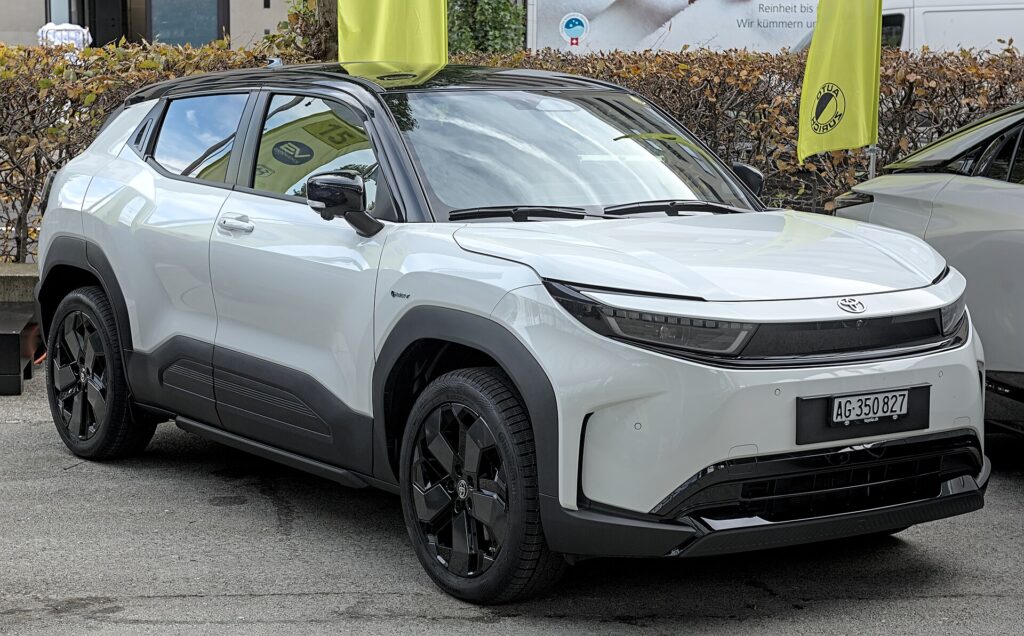
Featured image credit: Image: Alexander Migl via Wikimedia Commons (CC BY-SA 4.0). Source
India’s biggest electric car story in September 2026 is not a launch, a price cut or a festive discount. It is a shipping manifest. The Maruti Suzuki e Vitara, a car that sells in modest numbers in Indian showrooms, has quietly become the single vehicle that carries India’s electric vehicle export business almost on its own. In the first quarter of FY27, the e Vitara accounted for roughly 97 per cent of all electric vehicles exported from India.
On 14 September 2026, Maruti Suzuki announced that cumulative exports of three made-in-India models to Japan alone had crossed 100,000 units. The e Vitara sits in that trio alongside the Jimny 5-door and the Fronx. For a country that has spent a decade debating whether it can build EVs for the world rather than just assemble them for itself, that number is the first real answer.
By Piyush P. Yadav
The numbers behind the export story
The e Vitara is built at Maruti Suzuki’s Gujarat plant and shipped out to roughly 48 countries, with the United Kingdom and European Union markets taking the largest share. Cumulative exports had reached 40,759 units by June 2026. In the August and September window, Maruti shipped just over 6,000 more units of the model.
Set that against the domestic picture and the imbalance is stark. Between January and May 2026, Maruti dispatched 7,097 units of the e Vitara inside India. Over broadly the same period, exports ran several times higher.
| Metric | Figure | Period |
|---|---|---|
| Cumulative e Vitara exports | 40,759 units | To June 2026 |
| Export markets served | Around 48 countries | As of 2026 |
| Share of India’s EV exports | Around 97 per cent | Q1 FY27 |
| Domestic dispatches | 7,097 units | Jan to May 2026 |
| Exports in the Aug to Sep window | Just over 6,000 units | 2026 |
| Japan exports, three models combined | Over 100,000 units | Announced 14 Sep 2026 |
| Manufacturing location | Gujarat plant | Current |
Why one model carries the whole segment
The 97 per cent figure says as much about the rest of the industry as it does about Maruti. India has plenty of electric cars now. Tata, Mahindra, Hyundai, MG, BYD and VinFast all build or assemble EVs here. Very few of them export in volume.
There are three reasons for that.
Homologation is expensive and slow
Selling a car in the European Union means meeting UNECE type approval, Euro NCAP expectations and a long list of market-specific requirements around lighting, emergency call systems and cybersecurity. Doing that work for one model costs real money. Doing it for a model you only intend to sell 500 units of abroad makes no sense. Maruti had an advantage here because the e Vitara was co-developed with Suzuki and Toyota from the start as a global product, not an India-first car adapted later.
Domestic demand absorbs the rest
Indian EV makers have been running close to capacity on models that sell well at home. When India’s electric car sales hit a record high in August 2026, most of that volume came from companies with order books they were still working through. Exporting is what you do when you have spare capacity and a product a foreign buyer already wants.
The supply chain is still import-dependent
Exporting a car built from imported cells and imported magnets is a thinner business than exporting one built from local content. That is the gap India’s Rs 7,280 crore rare-earth magnet scheme is trying to close, and it is the same reason the question of who actually makes the battery cells in Indian electric cars matters more for exports than for domestic sales.
What the Japan milestone actually means
Japan is a difficult market to sell into. It is Suzuki’s home market, quality expectations are unforgiving, and the domestic kei-car and hybrid establishment is entrenched. Crossing 100,000 cumulative units there across the Jimny 5-door, Fronx and e Vitara is a durability signal rather than a volume record.
It tells buyers three things worth noting:
- Build quality clears a high bar. Cars that pass Japanese dealer and customer standards are not being built to a lower domestic specification.
- Parts supply is being maintained internationally. A car exported at this scale needs a spares pipeline that survives a decade, which indirectly benefits Indian owners of the same model.
- The plant is unlikely to be shut or repurposed. Export commitments create production floors that domestic demand swings cannot easily break.
Does this change anything for an Indian buyer?
Yes, but not in the ways people usually assume.
It does not automatically mean a cheaper car
Export volume improves factory utilisation, which helps unit cost. It does not directly cut the showroom price, because the Indian price is set by GST, state incentives and local competition rather than by plant economics alone. The structural reasons electric cars still cost more than petrol cars in India have not moved because of exports.
It does help residual values
A model with a global production run and a long international parts tail tends to hold value better than a India-only model that could be discontinued. If you are weighing electric car resale value in India, the size and geography of a model’s production run is a legitimate input.
It shifts where the waiting periods are
When a plant is running export batches, domestic allocation for specific variants and colours can tighten. Buyers looking at the festive window should check variant-level availability rather than assume the whole range is in stock. That matters if you are trying to work out which festive season EV discounts are actually worth taking.
The capex signal
Maruti Suzuki has signalled capital expenditure of up to roughly one billion US dollars tied to a new EV launch and higher export volumes. That is a meaningful commitment from a company that was, until recently, the most publicly sceptical of the major Indian manufacturers about how fast electric cars would take off.
The strategic logic is straightforward. Maruti dominates the Indian small car market but has a small share of the Indian EV market. Exports let it build EV manufacturing scale and supplier relationships without waiting for Indian EV demand to reach the volumes it is used to operating at. By the time domestic EV demand arrives in Maruti-scale numbers, the production system will already exist.
Where the risk sits
Concentration is the obvious one. A single model providing 97 per cent of a country’s EV exports is a fragile structure. A European regulatory change, a tariff shift, a cell supply disruption or a demand slump in the UK and EU would show up in India’s export statistics immediately and dramatically.
The second risk is that export success masks domestic weakness. India’s EV export numbers look strong. India’s EV manufacturing base is still heavily dependent on imported cells and imported magnets. Those are different problems, and the first can hide the second for a few years.
| Risk | What it would look like | Mitigation in progress |
|---|---|---|
| Single-model concentration | Export volumes swing on one product cycle | New EV launch tied to announced capex |
| Cell import dependence | Margin squeeze, supply delays | Domestic cell plants ramping toward 2027 |
| Rare-earth magnet dependence | Motor production cuts, as seen in 2025 | Rs 7,280 crore magnet scheme |
| EU and UK demand softness | Sharp drop in monthly shipments | Expansion to around 48 markets |
The wider picture
India’s EV conversation is usually domestic: subsidies, charging, range anxiety, running cost. The export number reframes it. It suggests India can build electric cars that meet the toughest regulatory standards in the world, at a cost that works, in volume.
What it does not yet show is that India can do that using Indian cells, Indian magnets and Indian power electronics. That transition is underway but incomplete. Cell plants from Agratas, Amara Raja, Exide and Reliance are moving toward commercial production in the 2026 to 2027 window, and the rare-earth magnet scheme has attracted bidders but has not yet delivered magnets into vehicles.
Until then, the honest description of India’s EV export success is that India has become an extremely good final-assembly and quality-control location for globally engineered electric cars. That is a real achievement and a real business. It is just not the same thing as being an EV manufacturing power.
Sources & Further Reading
- Business Standard — Maruti Suzuki’s Jimny 5-door, Fronx, e Vitara exports to Japan cross 100k
- CarWale — Maruti exported 6,000 units of e Vitara in August and September
- Channel I’m — Maruti e Vitara leads India’s EV exports
- AutoPunditz — Maruti e Vitara sales India and exports analysis
Frequently Asked Questions
Is the exported e Vitara different from the one sold in India?
The core vehicle is the same global product built at the Gujarat plant. Market-specific differences exist in areas such as emergency call systems, lighting regulations and equipment packaging required by European or Japanese rules, but the platform, battery and motor are common.
Why does Maruti export more e Vitaras than it sells in India?
The e Vitara was engineered from the start as a global model with Suzuki and Toyota, so it already met European and Japanese approval requirements. European and UK EV demand is currently deeper than Indian demand in this price and size class, so the volume follows the market.
Does high export volume make the e Vitara cheaper in India?
Not directly. Export scale improves plant utilisation and supplier economics, but the Indian showroom price is driven by GST, state incentives, local competition and dealer margins. Exports help the long-term cost base rather than this month’s price.
Is India actually manufacturing EVs or just assembling them?
Both, depending on the component. Body, paint, assembly and quality control are genuinely Indian. Battery cells and rare-earth magnets for motors remain substantially imported. Domestic cell plants and the rare-earth magnet scheme are intended to close that gap between 2026 and 2028.