

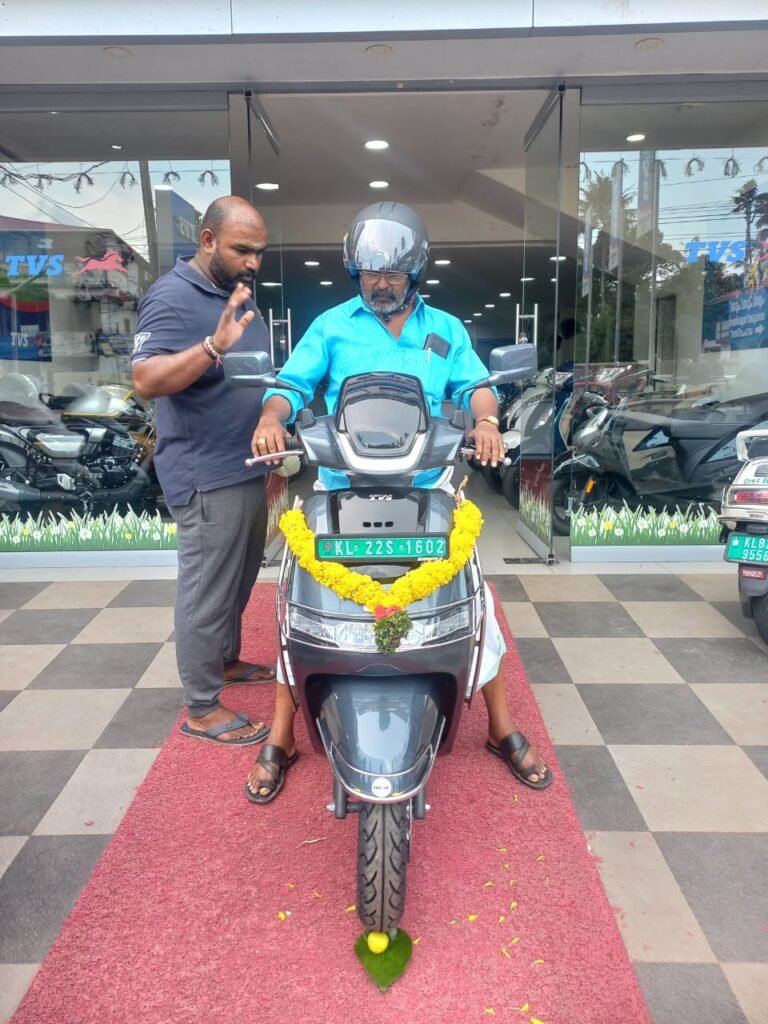
Featured image credit: Image: Maneesh Sreekariyam via Wikimedia Commons (CC BY-SA 4.0). Source
By Piyush P. Yadav
The pitch for an electric scooter is almost always about the cost per kilometre against petrol. What gets left out of that conversation is service and battery replacement, the two costs that show up years after the purchase and that no showroom brochure puts on the price tag. This guide puts real numbers against both, so the running-cost comparison you make on day one still holds up on year five.
Annual service cost: electric vs petrol
| Item | Electric scooter | Petrol scooter |
|---|---|---|
| Typical annual service cost | Rs 1,000 to Rs 2,500 | Rs 2,500 to Rs 3,500 |
| Broader estimate range | Rs 2,000 to Rs 5,000 a year | Higher, driven by oil changes and engine wear parts |
| What’s serviced | Brakes, tyres, suspension, software updates, coolant (liquid-cooled motors), wiring checks | Engine oil, spark plug, air filter, carburettor/fuel injector, clutch, chain or belt, valve clearance |
| Why the gap exists | No engine oil, no combustion parts, no clutch or gearbox to wear | Internal combustion engine has dozens of wearing parts |
The 40 to 60 per cent lower running-cost figure that most EV brands advertise checks out on service bills alone. An electric scooter simply has fewer moving parts: no engine oil to change every 2,000 to 3,000 km, no spark plug, no carburettor or fuel injector to clean, no clutch plates to replace. What it does have is a battery management system, motor controller and software that occasionally need diagnostic attention, but that is a smaller and less frequent expense than routine ICE maintenance.
Tyres: no real difference
Electric and petrol scooters wear tyres at similar rates because tyre life is governed by road conditions, load and riding style more than powertrain. A pair typically lasts 25,000 to 35,000 km under normal use and costs Rs 4,500 to Rs 7,000 to replace on both electric and petrol scooters. One caveat: electric scooters deliver full torque from a standstill, and riders who lean on that instant acceleration at every signal will wear tyres and brake pads somewhat faster than a petrol rider modulating a throttle through a CVT.
The number that matters: battery replacement
This is the cost petrol owners never have to think about and EV owners eventually will. Lithium-ion batteries in Indian e-scooters typically last 5 to 8 years or 50,000 to 80,000 km before capacity fades enough to need replacement, and the cost depends heavily on pack size.
| Battery size / segment | Typical replacement cost (2026) |
|---|---|
| Entry packs (around 2 to 2.2 kWh) — TVS iQube base, Ola S1 X | Rs 45,000 to Rs 50,000 |
| Mid packs (2.7 to 3.7 kWh) — Ather Rizta, Simple Wave, Bajaj Chetak | Roughly Rs 55,000 to Rs 85,000 |
| Large packs (4.3 kWh and above) — Ather 450X, Ola S1 Pro, TVS iQube ST | Roughly Rs 90,000 to Rs 1,20,000 |
On an entry-level scooter that cost Rs 90,000 to Rs 1.10 lakh new, a Rs 45,000 to Rs 50,000 battery replacement in year six or seven is close to half the vehicle’s original price. On a premium scooter costing Rs 1.3 lakh to Rs 1.5 lakh, the replacement cost is proportionally smaller. This is one reason battery warranty terms, typically 3 years or 30,000 to 50,000 km on two-wheelers, matter as much as the headline range figure when comparing models such as the ones in our Simple Wave versus TVS Orbiter, Bajaj Chetak and Ather Rizta comparison.
Does the fuel saving cover the eventual battery cost?
Run the five-year math. A typical Indian petrol-scooter owner riding 8,000 to 10,000 km a year spends roughly Rs 1.5 lakh over five years on fuel and maintenance combined at current petrol prices. An electric-scooter owner covering the same distance spends a fraction of that on electricity, roughly Rs 25,000 to Rs 35,000 over five years at home-charging rates, plus Rs 5,000 to Rs 12,500 in service. Even after adding a full battery replacement toward the end of that period, most owners still come out ahead or roughly break even, and every year after the battery swap is pure saving on a fresh warranty.
The math tightens for low-mileage riders. Someone doing 3,000 to 4,000 km a year saves less on fuel and takes longer to recover a battery-replacement cost, which is the same logic that makes battery-as-a-service pricing, explained in our battery-as-a-service cost breakdown, attractive mainly to low-mileage city riders.
How to extend battery life and cut your eventual bill
- Avoid daily deep discharges. Keeping the battery between roughly 20 and 80 per cent for routine charging, rather than always running it to zero and charging to 100, is the single biggest lever most owners control.
- Charge with the OEM charger. Third-party fast chargers not approved by the manufacturer both void warranty and stress the cells.
- Park out of direct sun where possible. Heat is the largest accelerant of capacity loss in Indian conditions, for two-wheelers as much as for cars.
- Service on schedule even though it’s cheap. A Rs 1,500 service that catches a brake or suspension issue early is far cheaper than the alternative.
Sources & Further Reading
- MeraEV: Electric scooter service cost and schedule, India 2026
- EVFY: Battery replacement cost of EV scooters in India 2026
- Elektree: Electric scooter maintenance cost in India 2026, the real annual bill
FAQ
Is an electric scooter cheaper to maintain than a petrol scooter?
Yes, typically 40 to 60 per cent cheaper on annual service, since there is no engine oil, spark plug or clutch to service. Annual costs run Rs 1,000 to Rs 2,500 for electric versus Rs 2,500 to Rs 3,500 for petrol.
How much does an e-scooter battery replacement cost in India?
Between roughly Rs 45,000 for entry-level packs (2 to 2.2 kWh) and Rs 1,20,000 for large packs (4.3 kWh and above), depending on the model and battery capacity.
How long does an electric scooter battery last?
Typically 5 to 8 years or 50,000 to 80,000 km with normal use before capacity fades enough to warrant replacement.
Do electric scooter tyres wear faster than petrol scooter tyres?
Not meaningfully from the powertrain itself, though instant torque can accelerate wear if a rider habitually accelerates hard from every stop.