

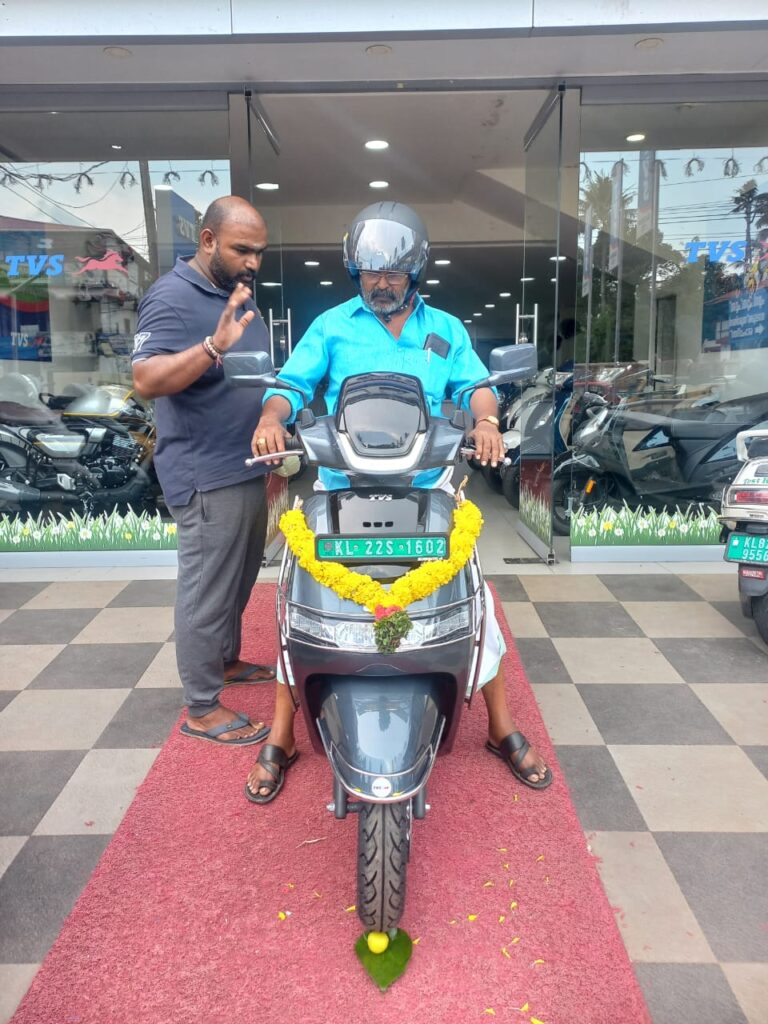
Featured image credit: Image: Maneesh Sreekariyam via Wikimedia Commons (CC BY-SA 4.0). Source
By Piyush P. Yadav
The short answer is that almost every electric scooter you would actually want to buy in India needs a driving licence, an RTO registration, a number plate and third-party insurance. The exemption that the internet talks about is real, but it is narrow and it is an and, not an or: a battery-operated two-wheeler escapes registration, licensing and type approval only if its motor is rated at 250 W or less and its top speed is 25 kmph or less. Miss either limit and it is a motor vehicle in the eyes of the law. And, as this article shows with a simple power calculation, a scooter that genuinely respects both limits can barely hold 25 kmph on level ground with one rider – which is why so many machines sold as “non-RTO” quietly do not comply at all.
How we worked this out
The exemption rests on the Ministry of Road Transport and Highways treating electric two-wheelers with maximum power under 250 W and speed under 25 kmph as outside the type-approval requirement under the Central Motor Vehicles Rules; EVreporter’s investigation into low-speed e-2W sales cites the notification and documents how the segment behaves in practice. Separately, MoRTH’s notification of 2 August 2021 exempted battery-operated vehicles from registration-certificate fees, which is a different thing entirely and applies to scooters that are registered. Specifications and prices for a registered scooter are the TVS iQube figures listed on BikeDekho, checked on 13 September 2026. The power calculation later in this article is ours; every assumption in it is stated so you can redo it with your own numbers. We have not relied on manufacturer marketing claims for any legal statement.
The two categories, side by side
| What applies | Exempt low-speed e-2W (250 W and 25 kmph or less) | Registered e-2W (everything else) |
|---|---|---|
| Legal status | Not a motor vehicle for registration and licensing purposes | Motor vehicle under the Motor Vehicles Act |
| Driving licence | Not required | Required (gearless motorcycle class) |
| RTO registration and number plate | Not required | Required |
| Third-party insurance | Not mandatory | Mandatory |
| Road tax | Not applicable | Applicable, with state EV exemptions in many states |
| Type approval (ARAI or ICAT) | Exemption certificate still expected from the maker | Full type approval required |
| Purchase subsidy | Not claimable – incentives are paid against a registered, type-approved vehicle | Claimable where a central or state scheme is open |
| Typical motor rating | 250 W (0.34 hp) | 3.68 kW on the base TVS iQube |
| Typical top speed | 25 kmph | 68-82 kmph across iQube variants |
| Indicative price | Usually well under Rs 1 lakh | From Rs 1,20,124 ex-showroom for the base iQube |
The calculation that explains the whole market
Here is the part nobody publishes. Ask how much power a scooter actually needs to hold 25 kmph, and the exemption starts to look impossible rather than generous.
Assume a 75 kg rider on a 75 kg scooter, so 150 kg all up. Take a rolling resistance coefficient of 0.015, a frontal area times drag coefficient of about 0.6 m2 for an upright rider, and air density of 1.2 kg/m3. On level ground at 25 kmph (6.94 m/s), rolling resistance is about 22 N and aerodynamic drag is about 17 N, so the scooter needs roughly 39 N of tractive force. Power equals force times speed: 39 x 6.94, or about 274 W at the wheel, before any drivetrain or controller losses.
In other words, a scooter with a genuinely 250 W motor cannot quite sustain 25 kmph on flat tarmac with a single average rider and no wind. Add a pillion, a headwind or a gentle slope and it falls away fast.
Now put it on a 10 per cent gradient – a typical flyover approach ramp. The gravity component alone is 150 x 9.81 x 0.0995, about 146 N, and with rolling resistance the total becomes roughly 168 N. At 250 W, the fastest that motor can climb is 250 divided by 168, or 1.48 m/s. That is 5.3 kmph. Walking pace, on a ramp, in traffic.
This is why the honest conclusion is uncomfortable: a scooter that complies with the exemption is a very limited machine, and a scooter that feels usable in Indian traffic is almost certainly not compliant. EVreporter’s investigation found exactly that, reporting low-speed scooters marketed as exempt that actually reached 50 to 60 kmph, manufacturers who had never obtained the exemption type-approval certificate from ARAI or ICAT, battery packs without valid BIS or AIS certification, and state RTOs unaware the documentation was even required. Its import analysis covered roughly 4 lakh low-speed electric scooters brought in during FY22 and the first quarter of FY23, so the volumes are old but the pattern has not changed; treat those numbers as historical context rather than today’s market size.
What the exemption actually costs you
Buyers are usually sold the exemption as pure upside. It is not.
- No third-party cover. Insurance is not mandatory because the vehicle is not a motor vehicle, which sounds like a saving until you injure someone. Third-party liability for death or injury is not capped, and without a policy it is yours personally.
- No registration certificate. No RC means no clean ownership trail, weak recourse if the scooter is stolen, and effectively no organised resale market.
- No subsidy. Central and state purchase incentives are disbursed against a registered, type-approved vehicle. An exempt scooter cannot claim them, which erodes much of its apparent price advantage against a proper registered model – see our list of the best electric scooters under Rs 1 lakh in India for what the registered end of the market now costs.
- Battery quality is the real gamble. Many exempt scooters still ship lead-acid packs, with the weight, short life and poor cycle count that implies – the same trade-off that shapes the e-rickshaw market, which we cover in our guide to e-rickshaw prices, lead-acid versus lithium and the rules. Where lithium is fitted, the cell certification is the thing to check, and the warranty terms vary wildly; our electric scooter battery warranty comparison shows what the registered brands commit to in writing.
If you are buying a registered scooter, what licence do you need?
Virtually every electric scooter sold in India is twist-and-go with no clutch and no gear lever, so it falls in the gearless motorcycle class – printed on Indian licences as M/CYCL.WOG or MCWOG. The process is the ordinary one: a learner’s licence applied for through the Parivahan portal or your RTO, the written test, then the driving test after the statutory waiting period. Applicants between 16 and 18 can hold a licence for a gearless two-wheeler in the 50 cc class, with parental consent on Form 1A, but be careful here: an electric motor is rated in kilowatts and the equivalence to 50 cc is not defined crisply, so RTOs apply it inconsistently. If a 16-year-old in your household is the intended rider, confirm the position with your own RTO in writing before you buy rather than relying on a dealer’s assurance.
Who this is for, and who should not follow it
This is written for a private buyer in India choosing between a cheap unregistered scooter and a registered one, and for parents being told that a particular model needs no paperwork. It is general information on the regulatory position as it stands on 13 September 2026 and it is not legal advice. Enforcement of the exemption varies by state, and the practical treatment of 16-to-18-year-old riders on electric two-wheelers varies by RTO. If you are buying for commercial use, for a delivery fleet, or for a rider under 18, get the position confirmed locally. If a dealer tells you a scooter needs no registration, ask to see the exemption type-approval certificate and the rated motor power on the vehicle’s own plate; if either is missing, walk away. For the wider money question of whether an electric scooter beats a petrol one at all, our five-year cost of ownership comparison has the arithmetic.
Sources & Further Reading
- EVreporter, Violation of CMVR and CCPA norms in the sale of low-speed electric two-wheelers
- Press Information Bureau, Battery Operated Vehicles exempted from payment of fees (MoRTH)
- BikeDekho, TVS iQube price and specifications
- Acko, Learner’s Licence in India: types, fees and documents
People also ask
Does an electric scooter need a licence in India?
Yes, unless it is rated at 250 W or less and limited to 25 kmph or less. Both conditions must be met together. Every mainstream electric scooter – the TVS iQube’s base variant alone has a 3.68 kW motor and tops out between 68 and 82 kmph depending on variant – is far outside the exemption and needs a gearless motorcycle licence.
Is registration required for an electric scooter in India?
Registration with the RTO is required for any electric two-wheeler above 250 W or 25 kmph. Only the low-speed exempt category avoids registration and a number plate. Note that registered battery-operated vehicles have been exempted from registration-certificate fees since MoRTH’s notification of 2 August 2021, so registering an EV is cheap – it is not a reason to buy an unregistered one.
Which electric scooter can be ridden without a licence in India?
Only one that genuinely meets both limits: a motor rated at 250 W or less and a top speed of 25 kmph or less, backed by an exemption type-approval certificate from ARAI or ICAT. Ask the dealer for that certificate. EVreporter found scooters sold as exempt that in fact reached 50 to 60 kmph, which leaves the rider, not the seller, exposed.
Is insurance mandatory for an electric scooter in India?
For a registered electric scooter, third-party insurance is mandatory, exactly as for a petrol scooter. For an exempt low-speed scooter it is not, because the vehicle is not a motor vehicle. That is a liability you are absorbing yourself: third-party injury and death claims in India are not capped at a fixed figure.
What is the speed limit for a non-RTO electric scooter in India?
25 kmph, and the motor must also be rated at 250 W or less. Our calculation puts the power needed to hold 25 kmph on flat ground with one 75 kg rider at about 274 W at the wheel – slightly more than a compliant 250 W motor can deliver – and shows the same motor managing only about 5 kmph on a 10 per cent gradient. Any “non-RTO” scooter that feels quick in traffic is almost certainly outside the rule.
Can a 16-year-old ride an electric scooter in India?
A 16-to-18-year-old can hold a licence for a gearless two-wheeler in the 50 cc class with parental consent on Form 1A. The difficulty is that electric motors are rated in kilowatts, the equivalence to 50 cc is not defined precisely, and RTOs apply it inconsistently. Confirm the position with your RTO before buying rather than relying on a showroom assurance.