

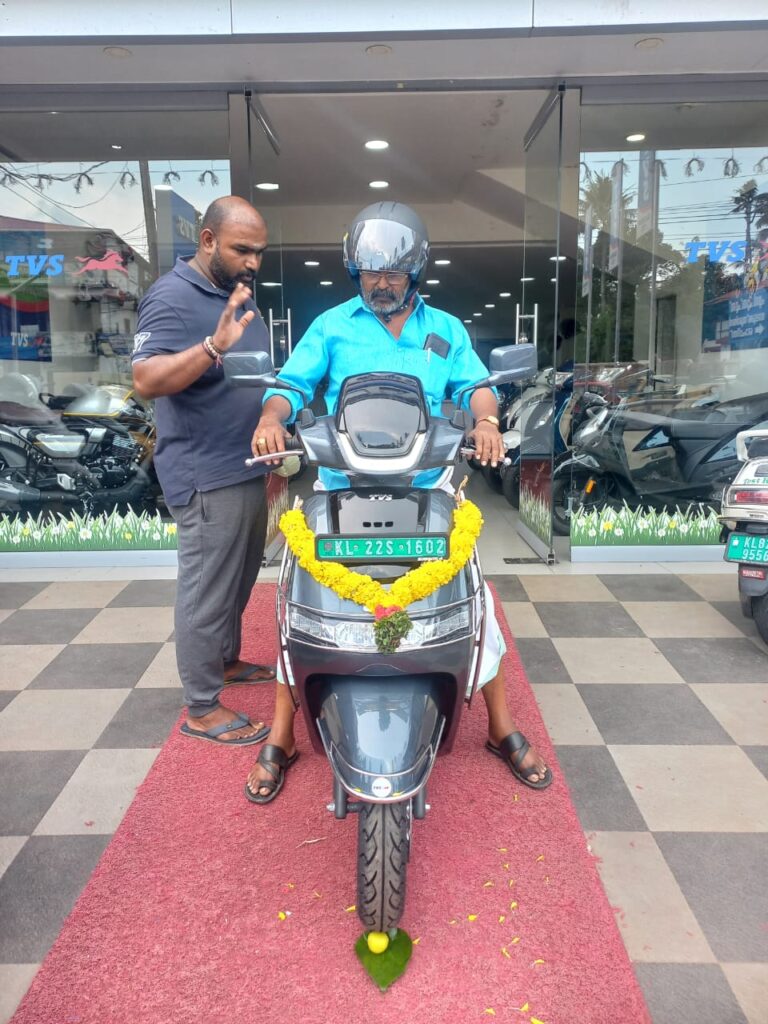
Featured image credit: Image: Maneesh Sreekariyam via Wikimedia Commons (CC BY-SA 4.0). Source
By Piyush P. Yadav
Simple Energy has finally put a price on its family scooter. The Simple Wave went on sale on September 2, 2026 at Rs 1.10 lakh ex-showroom for the entry Wave S, stretching to Rs 1.90 lakh for the long-range Wave +, with deliveries promised from September 25. That puts Bengaluru’s most range-obsessed EV startup squarely into the crowded family-scooter segment where the TVS Orbiter, Bajaj Chetak C25, Ather Rizta and the brand-new Ather Konarc already fight for the same buyer. We previewed the launch in our August 2026 e-scooter sales and launch round-up; now that the numbers are official, here is the complete variant-by-variant breakdown and how the Wave stacks up against every rival on price, range and practicality.
Simple Wave: every variant and price
Simple has split the Wave into three trims across four battery sizes, which is more permutations than any rival offers. The lower two trims are badged Wave S and are limited to 75 kmph; the Wave and Wave + get the full 90 kmph top speed.
| Variant | Battery | Claimed IDC range | Top speed | Display | Ex-showroom price (Bengaluru) |
|---|---|---|---|---|---|
| Wave S | 2.2 kWh | 110 km | 75 kmph | LCD | Rs 1,10,000 |
| Wave S EBN | 2.7 kWh | 132 km | 75 kmph | LCD | Rs 1,40,000 |
| Wave S TFT | 2.7 kWh | 132 km | 75 kmph | 7-inch TFT | Rs 1,50,000 |
| Wave EBN | 3.7 kWh | 171 km | 90 kmph | LCD | Rs 1,60,000 |
| Wave TFT | 3.7 kWh | 171 km | 90 kmph | 7-inch TFT | Rs 1,75,000 |
| Wave + | 5 kWh | 243 km | 90 kmph | 7-inch TFT | Rs 1,90,000 |
The Rs 1.10 lakh headline is real but it buys the smallest battery, the slower motor tune and the basic LCD cluster. The variant most family buyers will gravitate to is the 3.7 kWh Wave at Rs 1.60 lakh, which is the first trim to unlock 90 kmph and a claimed 171 km. The 5 kWh Wave + at Rs 1.90 lakh has a claimed 243 km, which is the longest range in the family-scooter class by a wide margin, though it is also the most expensive scooter here.
Motor, charging and hardware
Every Wave uses Simple’s third-generation 6.4 kW motor, which the company says is 15 per cent smaller than its predecessor. Charging is via a 750 W charger as standard, with 0 to 80 per cent taking 2 hours 15 minutes on the smaller packs. Ride modes are EcoX, Eco, Ride and Sports. Combined braking is standard across the range and GripSense traction control is reserved for higher variants.
The practicality numbers are where Simple has clearly designed for families. Storage totals 70 litres: 63 litres under the seat, 3 litres in the front apron and a 4-litre quick-access pocket. The single-piece seat is 920 mm long. Rear suspension is a conventional twin-shock setup, which is a deliberate departure from the monoshock on the sportier Simple One, and there is a centre stand. The silhouette is rounded rather than angular.
How the Wave compares with the TVS Orbiter, Chetak C25, Rizta and Konarc
Below is the like-for-like picture using current ex-showroom prices. The Orbiter’s prices reflect TVS’s recent increase of Rs 7,000 on the V1 and Rs 13,580 on the V2; the Chetak C25 shows Bajaj’s list price and its Rs 4,299 early-bird effective price.
| Scooter | Battery | Claimed range | Under-seat storage | Ex-showroom price |
|---|---|---|---|---|
| Simple Wave S (base) | 2.2 kWh | 110 km | 63 L (70 L total) | Rs 1,10,000 |
| Simple Wave 3.7 kWh EBN | 3.7 kWh | 171 km | 63 L (70 L total) | Rs 1,60,000 |
| Simple Wave + 5 kWh | 5 kWh | 243 km | 63 L (70 L total) | Rs 1,90,000 |
| TVS Orbiter V1 | 1.8 kWh | 86 km | Not stated | Rs 95,250 |
| TVS Orbiter V2 | 3.1 kWh | 158 km | Not stated | Rs 1,18,480 |
| Bajaj Chetak C25 | 2.5 kWh | 113 km | 25 L | Rs 91,399 (Rs 87,100 early bird) |
| Ather Rizta | 2.9 kWh to 3.7 kWh | Varies by variant | 34 L | Rs 1.21 lakh to Rs 1.80 lakh |
| Ather Konarc | See our review | See our review | See our review | Rs 99,999 |
Three conclusions. First, on pure price the Wave is not the cheapest way into a family e-scooter. The Chetak C25 undercuts the base Wave S by about Rs 19,000 and the Orbiter V1 by about Rs 15,000, and Ather’s Konarc, which we tested in our Ather Konarc review against the Chetak and S1 Pro, sneaks under Rs 1 lakh. Second, on range per rupee the mid-range Wave is competitive: the 3.7 kWh Wave at Rs 1.60 lakh offers 171 km claimed against the Orbiter V2’s 158 km at Rs 1.18 lakh, so TVS wins on value while Simple wins on outright number. Third, on storage the Wave is in a different league. Sixty-three litres under the seat is more than double the Chetak C25’s 25 litres and nearly double the Rizta’s 34 litres, and for a scooter sold on the school-run and grocery-run use case that may be the single most persuasive figure in this article.
The catch: IDC range vs real range
All the range figures above are IDC (Indian Driving Cycle) claims, and IDC is generous. Real-world range on Indian e-scooters typically lands between 60 and 75 per cent of the IDC figure depending on rider weight, mode and traffic. On that basis the base Wave S should deliver roughly 70 to 80 km in daily use, the 3.7 kWh Wave around 105 to 130 km, and the Wave + perhaps 150 to 180 km. Those are still comfortable numbers for a family scooter that rarely does more than 30 to 40 km a day, but buyers should not plan around 243 km.
Simple’s own track record on range claims is mixed. The Simple One was launched with a headline 200-plus km IDC figure that owners found hard to approach in traffic. The Wave’s motor is smaller and its top speed is capped lower on the S variants, which should help efficiency, but until independent tests are in, treat the numbers as ceilings.
Simple Energy’s position in the market
The Wave is the first Simple product aimed at the mass market, which is where the volumes are. As we detailed in our report on Bajaj crossing 3 lakh EV sales and the Chetak versus TVS race, TVS and Bajaj together now own more than half of India’s e-scooter market, and both compete hardest in the Rs 90,000 to Rs 1.30 lakh band. Simple has been a niche premium player with the One, OneS and Ultra. It raised Rs 250 crore through a mix of debt and equity earlier in 2026 to expand manufacturing and retail, and the Wave is what that money is for.
The risk is that Simple has priced the Wave above the segment’s centre of gravity. The Rs 1.10 lakh entry is a marketing number, and the variants that deliver the full 90 kmph experience start at Rs 1.60 lakh, which is Rizta and 450X money. Simple’s bet is that storage, seat length and the 243 km halo variant justify the premium. Its dealer footprint is also far smaller than TVS’s or Bajaj’s, and family buyers tend to prize service access.
Subsidy and running cost
Under the extended PM E-DRIVE scheme, the electric two-wheeler subsidy is Rs 2,500 per kWh capped at Rs 5,000 per vehicle, and it runs until March 31, 2028. Every Wave variant qualifies for the full Rs 5,000 because every battery is at least 2.2 kWh. We explained the scheme’s extension and the halving of the cap in our piece on PM E-DRIVE’s extension to March 2028. Whether the ex-showroom prices above already net off the subsidy is something to confirm at booking; most OEMs display post-subsidy prices.
On running cost, a 3.7 kWh pack charged at home on a Rs 8 per unit domestic tariff costs about Rs 30 for a full charge, which at a realistic 110 km works out to under 30 paise per kilometre. A 110 cc petrol scooter at Rs 105 per litre and 45 kmpl costs roughly Rs 2.30 per kilometre. Over 8,000 km a year that is a saving of about Rs 16,000, which recovers the price premium over a petrol scooter in around three years.
Verdict: who should buy the Wave?
- Buy the Wave 3.7 kWh or Wave + if storage and a long single-piece seat are the priority and you regularly ride two-up with luggage. Nothing else in the class comes close on litres.
- Buy the TVS Orbiter V2 if you want the best range-per-rupee and a dealer on every corner.
- Buy the Chetak C25 or Ather Konarc if the budget is a hard Rs 1 lakh and a metal body or Ather’s software matters more than range.
- Skip the base Wave S unless you truly ride under 60 km a day; the 75 kmph cap and small pack make it the least convincing variant.
Sources & Further Reading
- Autocar India: Simple Wave launched from Rs 1.10 lakh
- Autocar India: TVS Orbiter price and specifications
- Autocar India: Bajaj Chetak C25 gets Rs 4,299 early-bird discount
- The Bike Junction: Simple’s family electric scooter launch on September 2
FAQ
What is the Simple Wave price in India?
The Simple Wave is priced from Rs 1.10 lakh for the 2.2 kWh Wave S to Rs 1.90 lakh for the 5 kWh Wave +, ex-showroom Bengaluru, across six variants.
What is the Simple Wave’s range?
Claimed IDC range is 110 km (2.2 kWh), 132 km (2.7 kWh), 171 km (3.7 kWh) and 243 km (5 kWh). Expect real-world figures of roughly 60 to 75 per cent of those numbers.
When do Simple Wave deliveries start?
Simple Energy has said deliveries will begin on September 25, 2026.
Is the Simple Wave better than the TVS Orbiter?
The Wave offers far more storage (63 litres under seat versus the Orbiter’s smaller bay) and a longer-range top variant, but the Orbiter V2 at Rs 1,18,480 with 158 km claimed range is the better value and has a much larger dealer network.