

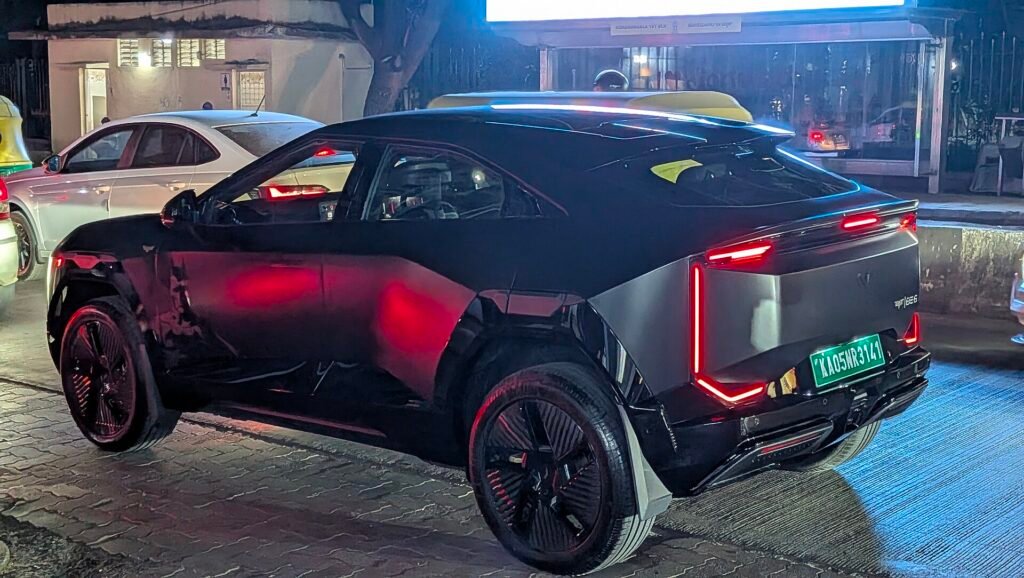
Featured image credit: Image: SerChevalerie via Wikimedia Commons (CC BY-SA 4.0). Source
By Piyush P. Yadav
EV battery preconditioning is the car actively heating or cooling its high-voltage battery pack to the temperature at which it charges fastest and most safely, usually 15 to 35°C, before you plug in to a DC fast charger. In India only a handful of electric cars actually do this today — the Mahindra BE 6 and XEV 9e are the clearest confirmed examples — and it matters twice over in Indian conditions: it recovers cold-weather range and charging speed in the hills in winter, and it also helps protect charging speed and battery health in the 40°C-plus summers most of the country actually lives through, where a battery that has been sitting in the sun can arrive at a fast charger too hot to accept its full rated power.
How we worked this out
This explainer draws on manufacturer-confirmed specifications checked in September 2026, primarily Mahindra’s own Tech Day presentation on the BE 6 and XEV 9e’s thermal management system as reported by Team-BHP, cross-checked against a 29,000 km real-world ownership report from a Team-BHP XEV 9e owner. General preconditioning mechanics and the 15–35°C ideal battery temperature range are drawn from Kia’s own consumer explainer and independent EV-technology coverage from Midtronics and bp pulse. The India-specific summer range-protection figures are attributed to a single secondary source, EVSahiHai, which cites data from the Automotive Research Association of India (ARAI); because we could not independently verify the original ARAI study, that figure is presented as EVSahiHai’s reported claim rather than as independently confirmed fact.
What preconditioning actually does inside the battery
A lithium-ion cell’s internal chemistry works fastest and most safely in a fairly narrow temperature band. Too cold, and the cell’s internal resistance rises, slowing both how much power it can accept while charging and how much it can deliver under acceleration. Too hot, and the battery management system deliberately throttles charging speed to protect the cells from degradation or, in the worst case, thermal runaway. Preconditioning uses the car’s coolant loop, and sometimes a dedicated heat pump, to move the pack into its ideal window before you arrive at a charger, drawing that heating or cooling energy from the grid or from waste heat rather than from the battery you are about to charge. The practical result, confirmed across manufacturer literature from Kia, Hyundai and others globally, is that a preconditioned battery can accept meaningfully higher charging power for longer during a fast-charging session than one that arrives too cold or too hot.
Which electric cars sold in India actually have it
| Car | Preconditioning status | How it is triggered |
|---|---|---|
| Mahindra BE 6 / XEV 9e | Confirmed, presented at Mahindra Tech Day | Automatic when navigating to a mapped fast charger; can also be manually toggled, and one 29,000 km owner reports it “doesn’t always need to be on” for everyday charging |
| Tata Nexon EV | Reported as a feature by at least one independent review; not separately confirmed on Tata’s own India spec sheet | Not publicly documented in detail |
| Hyundai Creta Electric | Bluelink and the myHyundai app support route planning around charging stops; dedicated preconditioning-on-approach is a feature Hyundai has shipped on global models like the Ioniq 5, not separately confirmed for the India-spec Creta Electric | Route-based charging stop planning confirmed; preconditioning trigger unconfirmed for this market |
| Kia EV6 / Hyundai Ioniq 5 (India, CBU) | Standard globally on post-mid-2022 builds; navigation-triggered | Automatic when a mapped DC charger is set as the destination |
| MG ZS EV, BYD Atto 3 | Not confirmed as a distinct preconditioning feature in available manufacturer literature; both do carry active thermal management and, in the Atto 3’s case, a wide-range heat pump | Not documented |
The pattern mirrors our findings on which Indian EVs have a heat pump: it is still concentrated in cars above roughly Rs 18 lakh, with Mahindra’s BYD Blade Battery-based BE 6 and XEV 9e the most clearly documented mass-market examples in India as of September 2026.
Why it matters in an Indian winter
On the Mahindra BE 6 and XEV 9e, the 175 kW DC fast charger can take the battery from 20 to 80 per cent in around 20 minutes under ideal conditions. A cold battery arriving at that same charger without preconditioning will accept a lower peak current and take meaningfully longer to reach the same state of charge, because the charging curve itself is temperature-limited near the bottom end, not just capacity-limited. For an owner driving into Himachal Pradesh, Uttarakhand or Jammu & Kashmir in winter, setting a fast charger as the navigation destination 20 to 30 minutes before arrival lets the car start warming the pack from grid or drive energy while still moving, so it reaches the charger already inside its efficient window instead of spending the first several minutes of a charging stop just warming up.
Why it also matters in an Indian summer
This is the angle most preconditioning explainers, written for European and North American climates, do not cover, and it is arguably the more relevant one for most Indian owners. A car parked in direct sun in Delhi or Chennai in May can see its battery pack sitting well above the 35°C upper end of the ideal charging window before it even reaches a charger, and the battery management system will respond by capping charging power to protect the cells — the same defensive throttling that happens in the cold, just from the opposite direction. EVSahiHai, citing ARAI data, reports that proper shading and preconditioning practices can increase the effective range of EVs by up to 12 per cent in cities such as Delhi and Mumbai where summer temperatures regularly cross 35°C, and separately cites a pilot study finding that pre-cooling a cabin 10 minutes before departure cut cabin temperature by roughly 8°C and conserved around 3 per cent of battery charge that would otherwise go into cabin cooling once underway. We were not able to independently verify the original ARAI study behind these figures, so treat them as a reported estimate rather than a lab-confirmed number, but the underlying mechanism — a battery management system throttling a too-hot pack exactly as it throttles a too-cold one — is well documented and applies squarely to Indian summer driving.
How to actually use it if your car has it
The practical instruction is the same regardless of season: use your car’s built-in navigation, not a third-party maps app, to route to a fast charger, since preconditioning on the cars that support it is triggered by the vehicle recognising a mapped charging stop as the destination. Doing this even 15 to 20 minutes before arrival gives the thermal management system time to bring the pack into range. On a car like the BE 6 or XEV 9e where the feature can also be toggled manually, owners report it is worth leaving off for routine home or slow AC charging, where charging speed is not time-critical, and switching on specifically before a DC fast-charging stop on a longer trip, which is also when comparing a standard-range against a long-range battery pack tends to matter most, since a bigger pack means more fast-charging stops over a long trip and therefore more opportunities for preconditioning to save real time.
Who this is for, and who does not need to worry about it
This matters most to owners who regularly use DC fast charging on highway trips, in hill regions in winter, or in peak summer heat — exactly the conditions where a battery’s temperature drifts furthest from its ideal window before you reach a charger. If you mostly charge overnight at home on a slow AC charger and rarely fast-charge, preconditioning has little practical benefit for you regardless of whether your car has it, since slow AC charging is not power-limited by pack temperature the way DC fast charging is. It is also not a safety feature you need to worry about missing: cars without preconditioning are not unsafe to fast-charge, they simply charge somewhat slower at temperature extremes, the same way any LFP or NMC battery pack in an Indian EV already manages its own thermal limits without driver intervention.
Sources & Further Reading
- Team-BHP: Mahindra Tech Day — Technologies Used in BE 6 and XEV 9e Explained
- Team-BHP: Mahindra XEV 9e Owner Shares 29,000 km EV Experience & Battery Health
- Kia: What Is EV Battery Pre-Conditioning?
- EVSahiHai: 6 Ways to Safeguard EVs in Scorching Summers
People also ask
What is EV battery preconditioning?
Battery preconditioning is when an electric vehicle actively heats or cools its high-voltage battery pack to its ideal operating temperature, typically 15 to 35°C, before a fast-charging stop or a demanding drive, so the battery can accept or deliver power more efficiently.
Which electric cars in India have battery preconditioning?
The Mahindra BE 6 and XEV 9e are the most clearly confirmed mass-market examples in India as of September 2026, with the feature presented at Mahindra’s own Tech Day. Kia EV6 and Hyundai Ioniq 5 units sold in India carry it as a global standard feature. It is reported, but not separately confirmed by the manufacturer’s own India spec sheet, on the Tata Nexon EV.
Does battery preconditioning help in Indian summer heat, not just winter?
Yes. A battery that gets too hot in direct sun has its charging power throttled by the battery management system just as a too-cold battery does. EVSahiHai, citing ARAI data, reports that shading and preconditioning practices can improve effective range by up to 12 per cent in cities like Delhi and Mumbai during summer, though this figure could not be independently verified against the original study.
How do I turn on preconditioning before charging?
On cars that support it, set a mapped DC fast charger as your destination in the car’s own built-in navigation system rather than a third-party maps app, ideally 15 to 20 minutes before you plan to arrive, so the thermal management system has time to bring the battery into its efficient charging range.
Does preconditioning damage the battery or drain range?
No. Preconditioning draws its heating or cooling energy from the grid while charging or from the drivetrain while moving, and is designed specifically to protect the battery from the faster degradation that can result from repeatedly fast-charging at temperature extremes, not to add wear.
Does preconditioning help when charging at home on an AC charger?
Not meaningfully. Preconditioning exists to remove the bottleneck in DC fast charging, where a cold pack can cut accepted power to a fraction of the charger’s rating. A 3.3 kW or 7.2 kW home AC charger asks so little of the battery that even a cold pack accepts it in full, and on most cars the feature only arms itself when a DC fast charger is set as the navigation destination.
How much faster does preconditioning make a DC fast charge?
In genuinely cold conditions the difference is large: a pack that would accept only 20 to 50 kW cold can take well over 100 kW once warmed, turning a 45-minute stop into roughly 20 minutes. In most of India the gain is far smaller, because ambient temperatures already sit inside or above the ideal 15 to 35°C window. The benefit shows up mainly on winter mornings in north India and in the hills.
Do electric scooters in India have battery preconditioning?
No. Indian electric two-wheelers do not offer rider-triggered preconditioning. Most rely on passive air cooling, with Ather among the few using an active cooling system. What they do have is a battery management system that throttles charging current when the pack is hot, which is why charging slows past 80 per cent or straight after a hard ride, so the protection is automatic rather than something you schedule.