

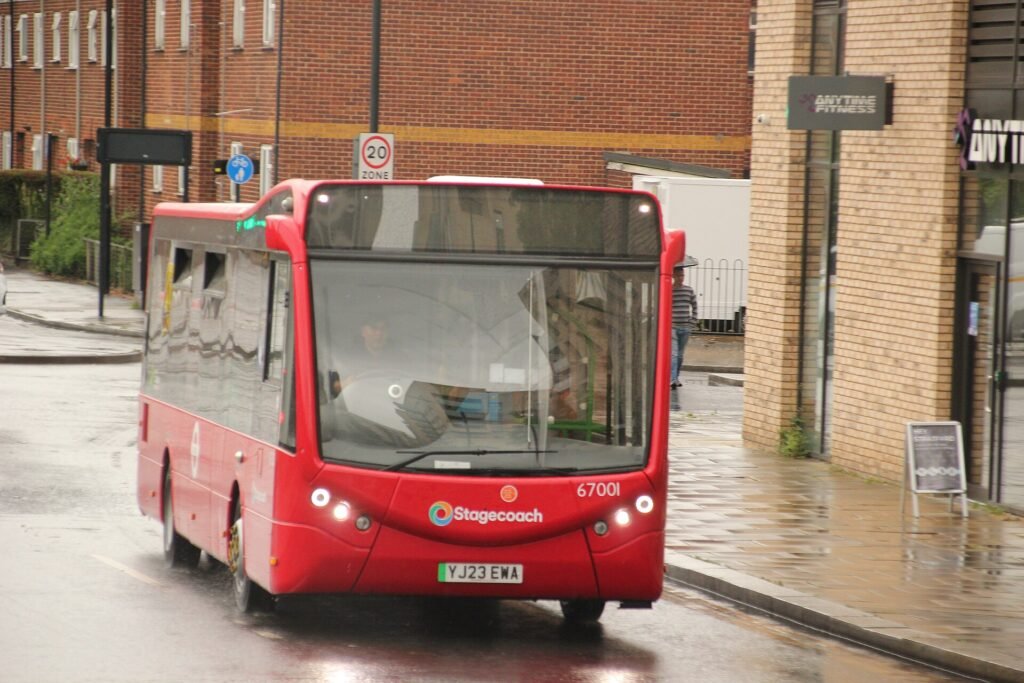
Featured image credit: Image: Matthew Black via Wikimedia Commons (CC BY-SA 2.0). Source
By Piyush P. Yadav
Switch Mobility, the electric bus subsidiary of Ashok Leyland, has won a supply order for 650 nine-metre electric buses for Mumbai and Pune under Phase II of the PM E-DRIVE scheme. The buses go to Sai Green Projects, the operator that won the Convergence Energy Services Limited tender to run them for BEST in Mumbai and PMPML in Pune. Of the 650, 450 are low-floor air-conditioned units for Mumbai and 200 are low-floor non-AC units for Pune. The order was announced at the end of July 2026 and confirmed by electrive on 31 August.
The order matters for three reasons. It is the first large deployment of Switch’s new EiV9, a nine-metre bus the company says was designed from scratch rather than cut down from its 12-metre model. It comes with per-kilometre bid rates that set a new reference for what an electric city bus costs to operate in India. And it lands in the same month the traction-motor localisation rules took effect for e-bus makers, which Switch, with its Ashok Leyland supply chain, is better placed to meet than most. This article sets out the order, the bus, the money and the context.
The order in numbers
| Item | Detail |
|---|---|
| Total buses | 650, all 9-metre low-floor |
| Mumbai (BEST) | 450 air-conditioned |
| Pune (PMPML) | 200 non-air-conditioned |
| Operator | Sai Green Projects Pvt Ltd (tender winner) |
| Tendering agency | Convergence Energy Services Ltd (CESL) |
| Scheme | PM E-DRIVE, Phase II (2,900 buses, concluded May 2026) |
| Bid rate, Pune non-AC | Rs 55.55 per km |
| Bid rate, Mumbai AC | Rs 60.99 per km (second-lowest bid) |
| Bus model | Switch EiV9, unveiled July 2026 at PRAWAAS 5.0 |
PM E-DRIVE’s e-bus component covers 14,028 buses in total. Phase I, which concluded in December 2025, covered 10,900 units; Phase II added 2,900 and closed in May 2026. The 650-bus Switch order is the largest single OEM allocation to emerge publicly from Phase II so far. It is separate from the 6,230-bus CESL tender we analysed on 3 September, which is the next procurement wave and is still in bidding.
The EiV9: a nine-metre bus built as a nine-metre bus
Switch unveiled the EiV9 at PRAWAAS 5.0 in Gandhinagar in July 2026 and was careful to say it is not a shortened EiV12. Nine-metre buses are the workhorse of Indian city transit because they fit narrower roads and lower-density routes, but most OEMs have historically adapted them from 12-metre platforms, which carries excess weight and cost. A purpose-built nine-metre chassis can use a smaller battery for the same range and a lighter body for the same payload.
| Specification | Switch EiV9 |
|---|---|
| Length | 9 metres, low floor |
| Motor | Permanent magnet synchronous, 213 kW |
| Battery options | 183 kWh or 284 kWh |
| Range | More than 200 km per charge (claimed) |
| Suspension | Air suspension front and rear |
| Cabin | Pushback seats, individual USB charging ports |
| Configurations | AC and non-AC |
The two battery options are the practical differentiator. The 183 kWh pack suits Pune’s shorter non-AC routes where depot charging twice a day is feasible; the 284 kWh pack suits Mumbai’s longer AC routes where air conditioning can consume 20 to 30 per cent of energy on a hot day. Switch has not published which pack goes to which city, but the route profiles make the split fairly obvious.
The permanent magnet synchronous motor is the part that connects this order to policy. From 1 September 2026, e-bus and e-truck makers must meet stricter domestic-content rules for traction motors under PM E-DRIVE, a deadline we covered in detail in our report on the September localisation rules and SIAM’s plea for an extension. Permanent magnet motors depend on rare-earth magnets that India imports entirely, so meeting the rule means assembling the motor domestically around imported magnets. Ashok Leyland’s Hosur and Pantnagar supply base gives Switch an existing localisation footprint that newer entrants lack.
What Rs 55.55 and Rs 60.99 per km tell us
PM E-DRIVE buses are procured under gross cost contracts: the operator owns and runs the buses, the state transport undertaking pays a fixed rate per kilometre, and the central subsidy flows to the operator to bring the rate down. We explained how the mechanism works and why the Rs 54 per km benchmark emerged in our piece on electric bus gross cost contracts.
Sai Green’s bids of Rs 55.55 per km for Pune’s non-AC buses and Rs 60.99 per km for Mumbai’s AC buses are close to that benchmark and, for a nine-metre AC bus in a high-cost city, competitive. The Mumbai figure was the second-lowest bid in that lot. For comparison, a diesel nine-metre bus in Mumbai costs BEST roughly Rs 70 to 80 per km to run once fuel, maintenance and driver costs are included, and the diesel figure rises with fuel prices while the electric rate is fixed for the contract term, typically 12 years.
| Bus type | Indicative cost per km | Notes |
|---|---|---|
| Switch EiV9 non-AC, Pune (this order) | Rs 55.55 | Gross cost contract, PM E-DRIVE subsidy included |
| Switch EiV9 AC, Mumbai (this order) | Rs 60.99 | Second-lowest bid |
| PM E-DRIVE Phase I benchmark | About Rs 54 | 12-metre non-AC, mixed cities |
| Diesel 9-metre, metro operation | Rs 70-80 | Fuel, maintenance and driver; rises with diesel price |
The gap between electric and diesel per-kilometre cost is now the main reason state transport undertakings prefer electric buses even without the environmental case. The subsidy makes the capital cost bearable; the operating cost makes the choice obvious.
Switch Mobility’s position
Switch has deployed more than 2,500 electric buses in India and reports a global fleet mileage above 185 million kilometres across urban transit, intercity and specialised transport. It is Ashok Leyland’s electric arm and shares the parent’s manufacturing at Ennore and the dedicated Switch facility in Lucknow. The 650-bus order is among its largest single Indian orders and comes on top of earlier PM E-Bus Sewa and FAME-II deployments in Bengaluru, Chennai and Delhi.
Its competitors in the nine-metre segment are Tata Motors, which has the largest installed e-bus base and, as we reported, crossed 3,400 electric commercial vehicle orders in August; Olectra Greentech, which builds BYD-technology buses in Hyderabad; PMI Electro; and JBM. The Phase II allocations have been split among several of these, and CESL’s next tender will be contested by all of them.
Timeline and what to watch
Neither Switch nor Sai Green has published a delivery schedule. PM E-DRIVE contracts typically require deployment within 12 to 18 months of award, which would put the first EiV9s on Mumbai and Pune roads in the first half of 2027. Depot electrification is the usual bottleneck: 450 AC buses in Mumbai need several dedicated depots with multi-megawatt grid connections, and BEST’s depot upgrade programme has run behind schedule before.
The three things to watch are whether Switch confirms the battery split between the two cities, whether the traction motors are certified as compliant with the September localisation rule on the first batch, and what per-km rates emerge from the 6,230-bus CESL tender. If those come in below Rs 55, the Sai Green bids will look expensive within a year; if they come in above, the Mumbai-Pune contract will have locked in a good rate for a decade.
How the order fits India’s electric bus base
The 650 buses arrive into a national fleet that is growing faster than at any point since FAME-II began. The central government has now sanctioned support for more than 31,000 electric buses across three schemes: over 7,000 under FAME-II, 14,028 under PM E-DRIVE and 10,000 under PM e-Bus Sewa, with a further 50,000 e-buses proposed under the Rs 9,852 crore heavy-duty EV scheme now under consideration. Mumbai and Pune are both existing electric bus cities: BEST already runs several hundred electric buses from Tata and Olectra, and PMPML has one of the larger e-bus fleets outside the metros. The Switch order therefore adds to established depots and operating know-how rather than starting from zero, which should shorten the deployment curve.
The depot arithmetic is still demanding. If each of the 450 Mumbai buses carries the 284 kWh pack and charges once a day, that is about 128 MWh of overnight energy; spread across a six-hour charging window it needs roughly 21 MW of installed charger capacity and grid connection across BEST’s depots. Pune’s 200 buses on the 183 kWh pack need about 37 MWh a day, or around 6 MW over the same window. Those connections are usually the item that slips, and they are the reason a 12-month delivery target often becomes 18.
Sources & Further Reading
- electrive: Switch Mobility wins tender for 650 electric buses in India
- Autocar Professional: Switch Mobility wins 650 electric bus order for Mumbai and Pune
- EMobility+: Switch Mobility secures 650 e-bus order from Sai Green Projects
- Autopunditz: New EV localisation rules take effect from September 1
Frequently Asked Questions
How many electric buses has Switch Mobility been ordered for Mumbai and Pune?
650 nine-metre low-floor buses: 450 air-conditioned units for BEST in Mumbai and 200 non-AC units for PMPML in Pune, supplied to operator Sai Green Projects under PM E-DRIVE Phase II via a CESL tender.
What are the specifications of the Switch EiV9 electric bus?
A purpose-built nine-metre low-floor bus with a 213 kW permanent magnet synchronous motor, a choice of 183 kWh or 284 kWh battery, more than 200 km claimed range, air suspension front and rear, pushback seats and USB ports. It was unveiled in July 2026 at PRAWAAS 5.0.
What is the per-kilometre rate for these buses?
Sai Green Projects bid Rs 55.55 per km for the Pune non-AC buses and Rs 60.99 per km for the Mumbai AC buses under gross cost contracts. A comparable diesel nine-metre bus in a metro costs roughly Rs 70 to 80 per km to operate.
How many buses does PM E-DRIVE cover?
14,028 electric buses in total: 10,900 under Phase I, concluded in December 2025, and 2,900 under Phase II, concluded in May 2026. A separate CESL tender for 6,230 buses is in progress.