

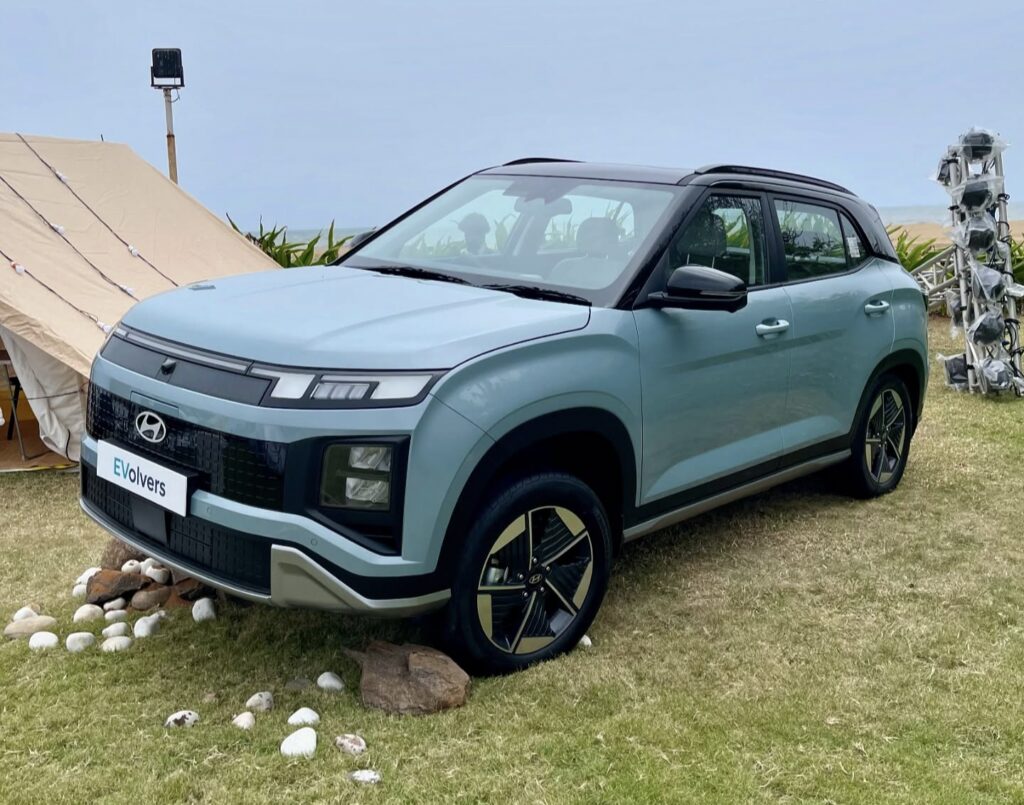
Featured image credit: Image: Avante2025 via Wikimedia Commons (CC BY 4.0). Source
Hyundai is the second-largest car manufacturer in India and has been for two decades. In electric cars it is not close to second. That is about to change, and the vehicle changing it is a compact electric SUV due to debut by the end of 2026, built at Sriperumbudur in Tamil Nadu.
Alongside it, Kia is building toward eight electrified vehicles in India by the end of the decade. Between them, the two Korean brands are making a bet that the Indian electric car market is finally large enough to be worth attacking properly, and they are arriving at the moment new fuel efficiency rules make EV volume compulsory rather than optional.
By Piyush P. Yadav
What Hyundai has said
Tarun Garg, Hyundai Motor India’s managing director and chief executive, has confirmed a compact electric SUV debuting by the end of 2026. The key details disclosed so far:
| Detail | What is confirmed |
|---|---|
| Vehicle type | Compact electric SUV |
| Debut | By end of 2026 |
| Manufacturing | Sriperumbudur, Tamil Nadu |
| Initial cell supply | Svolt |
| Planned cell supply | Exide |
| Driver assistance | Level 2 assisted driving |
| Infotainment | Next-generation system |
| Direct rivals | Tata Nexon EV, Mahindra XUV 3XO EV, Kia Syros EV |
Hyundai expects electric vehicles to account for over 7 per cent of its domestic sales within the next year. Against a current Indian EV market running in low single-digit percentages of total passenger vehicle sales, that is an aggressive internal target.
The cell sourcing detail is the strategic tell
The plan to start with Svolt cells and move to Exide is more revealing than any specification.
Svolt is a Chinese cell manufacturer. Exide is an Indian one, with a lithium-ion cell plant operational in 2026 targeting 4 to 6 GWh of LFP capacity. Hyundai is explicitly planning to switch from an imported cell supply to a domestic one as soon as the domestic option can deliver.
Three motivations sit behind that.
Supply chain risk
India’s EV supply chain has been disrupted through Chinese chokepoints before. The 2025 rare-earth magnet episode forced scooter production cuts. Any manufacturer planning volume in India has learned to treat a single-country dependency as a live operational risk rather than a procurement footnote.
Localisation requirements
Indian incentive schemes and procurement rules increasingly reward local content. A car built with Indian cells scores differently from one built with imported cells, and the direction of policy has been consistently toward more localisation, not less.
Cost trajectory
Domestic cell supply removes import duty, shipping and currency exposure. We mapped where each Indian cell project actually stands in India’s battery gigafactory status for September 2026. Hyundai committing to Exide before those lines are proven is a meaningful vote of confidence.
Where Hyundai currently stands
Hyundai’s Indian electric range today is the Creta Electric and the flagship Ioniq 5. That is a thin lineup for a company of its size, and it explains the gap between Hyundai’s overall market position and its electric market position.
The Creta Electric is the volume product and a sensible one, leveraging the strongest nameplate Hyundai has in India. The Ioniq 5 is a halo car selling in small numbers at a price most Indian buyers will never consider.
What is missing is a product below the Creta Electric. The compact electric SUV fills exactly that hole, in the segment where Tata’s Nexon EV has operated with limited direct competition for years.
Kia’s parallel plan
Kia is running a related but distinct strategy. In India it plans eight electrified vehicles by the end of the decade, including the Syros EV alongside hybrid versions of the Sorento and Carnival. Globally, Kia is expanding to 14 electric models with a target of one million annual EV sales by 2030.
The inclusion of hybrids is the important distinction. Hyundai’s stated India plan is EV-led. Kia’s is electrified-led, which covers hybrids as well as battery electrics.
Under India’s incoming CAFE III fuel efficiency rules, that distinction has direct financial consequences. The rules count each electric vehicle as three units toward the fleet average, a multiplier hybrids do not receive. We explained the mechanism in why CAFE III is an EV mandate in disguise. A hybrid improves your fleet average honestly. An EV improves it three times over.
What they are walking into
The Indian electric car market the Koreans are entering is more competitive than the one they studied when these programmes were approved.
| Player | Position | Key strength |
|---|---|---|
| Tata Motors | Market leader | Breadth of range, charging partnerships, lifetime battery warranty |
| Mahindra | Fast-growing challenger | Strong new products, battery subscription option |
| MG | Established niche | Windsor and Comet in distinct segments |
| Maruti Suzuki | Export-led | Enormous distribution, e Vitara global platform |
| VinFast | New entrant | Local plant at Thoothukudi, expanding dealer network |
| Hyundai and Kia | Underweight, expanding | Brand trust, service network, product quality |
Tata and Mahindra between them dominate the volume segments. Mahindra in particular has moved fast, and we examined the numbers behind its 21.5 per cent share and 56 per cent growth. New entrants are arriving too, with VinFast building out from its Thoothukudi plant.
Hyundai’s genuine advantages
Three things the incumbents cannot easily match.
Service network depth. Hyundai has spent 25 years building dealer and service coverage across India. For a buyer nervous about electric vehicle servicing, a brand with a workshop in their town carries real weight. This is precisely the failure that cost Ola Electric its lead in two-wheelers.
Quality reputation at a mainstream price. Hyundai’s Indian brand equity is built on cars that feel more expensive than they are. Applied to a compact EV, that positioning is directly useful.
Global platform amortisation. Hyundai can spread electric platform development costs across worldwide volume, which a manufacturer selling only in India cannot.
And the real risk
Price. Hyundai’s Indian positioning has consistently been a premium over the segment average, justified by quality and features. In petrol cars, buyers pay it.
In electric cars the calculation is harsher. Tata offers lifetime battery warranty terms on specific models. Mahindra offers a battery subscription that removes battery ownership risk entirely. Both have been in the market long enough for buyers to have seen how the cars behave over time.
Hyundai will need to price the compact EV against the Nexon EV rather than above it, at least initially, and accept thinner margins to establish credibility in a segment where it currently has none. The honest question is whether a company used to commanding a premium is willing to do that.
What buyers should do
If you are considering a compact electric SUV, the calendar matters.
- Buying before December 2026: The Hyundai is not available. Judge the Nexon EV, XUV 3XO EV and Syros EV on their current merits, and take a festive discount if one is genuinely good.
- Able to wait until early 2027: Waiting is defensible. A new entrant in a segment forces pricing responses from incumbents even before it arrives in volume.
- Concerned about long-term support: Hyundai’s service network is a real differentiator and worth weighing against a competitor’s stronger battery warranty terms.
One caution. A debut by the end of 2026 is not the same as deliveries. Indian launch timelines routinely slip, and an end-2026 debut plausibly means meaningful customer deliveries in the first half of 2027. Do not hold a purchase indefinitely against an unconfirmed delivery date.
The bigger significance
Hyundai and Kia entering the Indian EV volume segments properly is a signal about the market rather than about the companies. These are conservative, data-driven manufacturers that commit capital when a market is proven, not when it is promising.
That they are committing plants, platforms and a domestic cell supply agreement means their internal forecasts show Indian EV demand reaching a scale worth serving. Combined with CAFE III taking effect from April 2027, the result is likely to be more electric models in Indian showrooms in 2027 and 2028 than in the entire preceding decade.
For buyers, competition of that kind is the most reliable route to better cars at lower prices that any market offers.
Sources & Further Reading
- Autocar India — Hyundai compact EV to debut by end of 2026
- Team-BHP — Hyundai to debut electric compact SUV by end-2026
- Electrek — Kia reveals new EV plans, including its first SDV and an SUV
- Hyundai India — Current electric car range
Frequently Asked Questions
When is Hyundai’s compact electric SUV launching in India?
Hyundai has confirmed a debut by the end of 2026, with production at its Sriperumbudur facility in Tamil Nadu. A debut is not the same as deliveries, so meaningful customer availability may fall in the first half of 2027.
Which battery cells will Hyundai’s India EV use?
The vehicle will initially use cells from Svolt before moving to Exide, an Indian supplier whose lithium-ion cell plant is operational in 2026 with a 4 to 6 GWh LFP target. The planned switch reflects supply chain risk reduction and localisation requirements.
What will the Hyundai compact EV compete against?
Its stated rivals are the Tata Nexon EV, the Mahindra XUV 3XO EV and the Kia Syros EV. That is the compact electric SUV segment, which is the highest volume part of India’s electric car market.
How many EVs does Kia plan for India?
Kia plans eight electrified vehicles in India by the end of the decade, including the Syros EV plus hybrid versions of the Sorento and Carnival. Globally Kia is expanding to 14 electric models with a target of one million annual EV sales by 2030.