

Featured image credit: Image: ToyotaCamry7834 via Wikimedia Commons (CC BY 4.0). Source
By Piyush P. Yadav
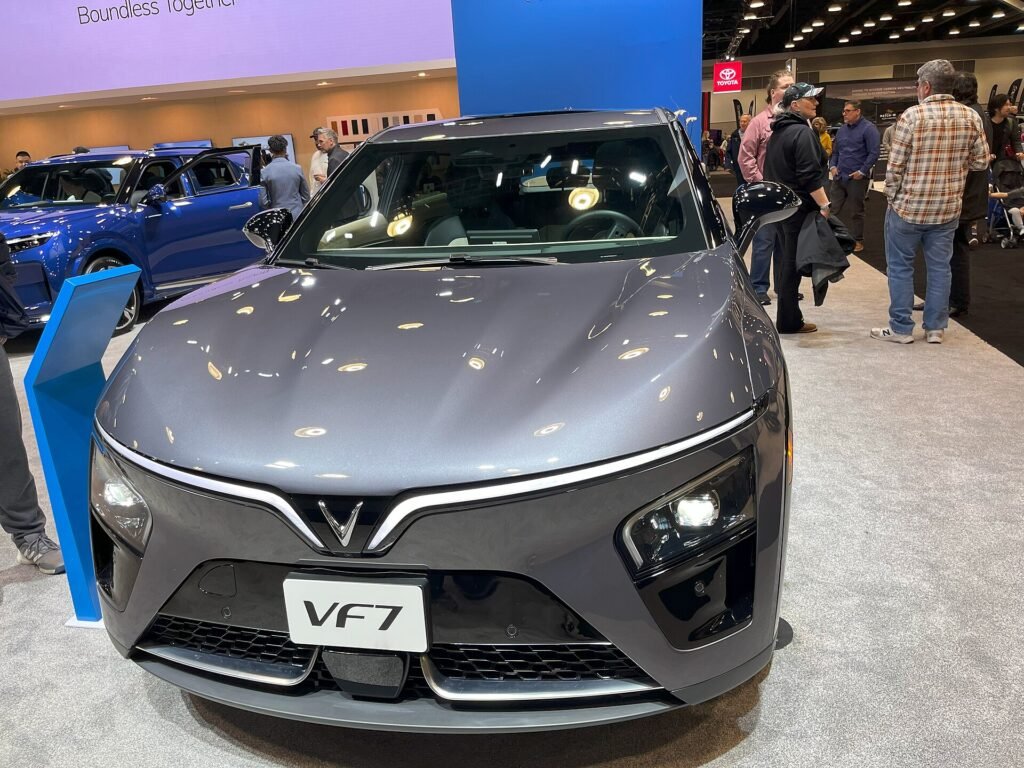
Thirteen months after it opened a plant in Thoothukudi and twelve months after it put the VF 6 and VF 7 on sale, VinFast is India’s fifth-largest electric car brand. The Vietnamese company registered 2,199 cars in August 2026, up 43.5 per cent on July, took roughly 4 per cent of the electric car market, opened its 60th dealership and has already built its 10,000th vehicle in Tamil Nadu. It has also raised prices twice, once when introductory pricing ended in January and again by up to Rs 1.13 lakh this year, has no car under Rs 17 lakh, and depends on two models. This profile sets out what VinFast has built in India, what it sells and at what price, how it compares with the other newcomers, BYD and Maruti, and what the VF 3, the e-bus expansion and the Rs 2 billion commitment mean for the next two years.
Where VinFast stands in September 2026
| Metric | Figure |
|---|---|
| August 2026 registrations (Vahan) | 2,199, up 43.5 per cent on July’s 1,532 |
| Share of all passenger vehicles, August | 0.6 per cent |
| Share of electric cars, August | About 4 per cent |
| January to April 2026 EV sales | 2,840, fourth behind Tata, MG and Mahindra in that period |
| Dealerships | 60, with a target of 75 across more than 60 cities by end-2026 |
| Plant | Thoothukudi, Tamil Nadu; 400 acres in SIPCOT; inaugurated August 2025 |
| Capacity | 50,000 a year initially, scalable to 150,000 |
| Vehicles built | 10,000th unit in May 2026, within the first year |
| Investment | USD 2 billion initial commitment; a further USD 500 million announced December 2025 for e-buses and e-scooters |
| Models on sale | VF 6, VF 7, VF MPV 7 |
| Safety | VF 6 and VF 7 rated five stars by Bharat NCAP |
The August number puts VinFast in the same bracket as Hyundai and Kia in electric cars and well ahead of BYD, which sold 542 cars that month and whose import-ceiling problem we analysed in our profile of BYD in India in September 2026. It is far behind Tata’s 16,549 August EVs and MG’s Windsor-led volumes, and it is fewer cars than Maruti exports in a fortnight. But for a brand that did not exist in India in mid-2025 it is a real foothold, and unlike BYD it is not capped by the 2,500-car annual import limit because it assembles locally.
The line-up and the prices
| Model | Variants | Ex-showroom price, September 2026 | Launch price, September 2025 | Battery and range |
|---|---|---|---|---|
| VF 6 | Earth, Wind, Wind Infinity | Rs 18.19 to 20.09 lakh | Rs 16.49 to 18.29 lakh | 59.6 kWh, 468 km ARAI |
| VF 7 | Earth, Wind, Wind Infinity, Sky AWD, Sky Infinity AWD | Rs 22.99 to 28.09 lakh | Rs 20.89 to 25.49 lakh | 70.8 kWh, up to 532 km ARAI |
| VF MPV 7 | Seven-seat | Launched 2026, above the VF 7 | n/a | Shares VF 7 platform |
Two rounds of increases have added Rs 1.70 lakh to the VF 6 and up to Rs 2.60 lakh to the VF 7 since launch: Rs 80,000 to 90,000 and Rs 1 to 1.3 lakh in January when introductory pricing ended, then a flat Rs 90,000 on the VF 6 and Rs 1.10 to 1.13 lakh on the VF 7 later in the year. That moves the VF 6 out of the Nexon EV and Creta Electric price band it launched in and into the Curvv EV and Syros EV long-range territory, and puts the VF 7 against the BE 6, XEV 9e and Harrier EV. VinFast’s counter is size and equipment: the VF 6 is a 4.24 m SUV with a 59.6 kWh pack, larger than anything at its price except the Mahindra pair, and both cars carry five-star Bharat NCAP ratings, a 10-year or 200,000 km vehicle warranty and a battery warranty with a 70 per cent capacity guarantee.
The plant is the strategy
VinFast chose to build before it sold, which is the opposite of BYD’s approach and the reason the two brands are on different trajectories. The Thoothukudi facility has a body shop, paint shop, assembly line, quality centre and logistics hub, and is designed as an export base for South Asia, the Middle East and Africa as well as a domestic supplier. Local assembly means the cars qualify for the 15 per cent import duty on completely knocked-down kits rather than the 70 to 100 per cent on built-up cars, and it is what lets VinFast price a 70.8 kWh SUV at Rs 23 lakh. It also means the company can, in principle, meet the localisation thresholds for PLI-Auto incentives that fully imported brands cannot, though VinFast has not announced a PLI application.
The December 2025 decision to add electric buses and two-wheelers with a further USD 500 million is the more interesting one. VinFast makes both in Vietnam, India’s e-bus market is growing 40 per cent a year on state contracts, and the electric two-wheeler market is heading for 2 million units in 2026. Neither product has been launched here yet and VinFast has not given a date, but the Tamil Nadu site has room for both.
How it compares with the other challengers
| Brand | August 2026 EV sales | Cheapest EV | Local production | Constraint |
|---|---|---|---|---|
| VinFast | 2,199 | VF 6 at Rs 18.19 lakh | Yes, Thoothukudi | Two models, no sub-Rs 15 lakh car, two price hikes in a year |
| BYD | 542 | Atto 3 above Rs 24 lakh | No; CKD at Chennai contract plant only | 2,500-car import ceiling, plant never approved |
| Maruti Suzuki | About 7,100 home sales in H1 2026 for the e Vitara; most output exported | e Vitara from Rs 16.19 lakh | Yes, Gujarat | One model, export priority |
| Hyundai | Under 500 Creta Electrics a month for much of 2026 | Creta Electric from Rs 17.99 lakh | Yes, Chennai | Waiting for HE1i and local cells |
VinFast’s position is that it is the only one of the four foreign challengers that both builds locally and has a car under Rs 20 lakh. Maruti’s export-first e Vitara strategy, which we examined in our report on Maruti as India’s biggest EV exporter, leaves it selling fewer EVs at home than VinFast in several months of 2026. MG, by contrast, is the model VinFast wants to copy: a single sub-Rs 15 lakh car, the Windsor, built locally in volume and sold with battery-as-a-service, which we described in our piece on JSW MG Motor’s EV strategy. That is where the VF 3 comes in.
The VF 3 and the four-model plan
VinFast’s stated roadmap adds four models: the VF 3 micro-SUV, tentatively in 2026, then the VF e34 and the larger VF 8 and VF 9 in 2027. The VF 3 is the one that matters. It is a 3.19 m two-door-plus-tailgate city car with an 18.6 kWh battery and about 210 km of range in Vietnam, sold there at the equivalent of about Rs 8 lakh. In India it would meet the MG Comet EV and Tata Tiago EV at Rs 7 to 9 lakh, and it is the only way VinFast reaches the volume segment before Hyundai’s HE1i and Tata’s Punch EV facelift redraw it. The company has not confirmed an Indian launch date or whether the VF 3 will be assembled in Thoothukudi, and a CKD car of that size at that price would be a tight business case; it is the announcement to watch for in the next two quarters.
What buyers should weigh
- Strengths: Big batteries for the money, five-star Bharat NCAP, a 10-year vehicle warranty, local assembly with no import cap, and a dealer network that has grown from zero to 60 in a year.
- Risks: Two price rises in twelve months with no assurance of stability; a two-model range with no cheap entry point; an untested resale market, which affects the loan terms a bank will offer; and a parent company that is loss-making globally and financing its Indian expansion from Vingroup capital.
- Service: Sixty 3S outlets is respectable for a new brand but thin outside the south and west; check the nearest workshop before buying in the north or east, where the Bihar outlet opened only this year.
Against Tata’s record share of 43.74 per cent of its own sales in August, documented in our analysis of Tata Motors’ August 2026 EV sales, VinFast is a small player. But it is the first foreign EV start-up to build a plant, a dealer network and a 2,000-a-month run-rate in India inside a year, and the VF 3 decision will determine whether it stays a niche premium-SUV brand or becomes a volume one.
Sources & Further Reading
- Autopunditz: India passenger vehicle registrations August 2026, Vahan data by brand
- Autopunditz: VinFast India crosses 10,000 EV production milestone at Thoothukudi
- Autocar India: VinFast VF6, VF7 prices hiked by up to Rs 1.3 lakh
- RushLane: VinFast VF 6, VF 7 prices hiked by up to Rs 1.13 lakh
- Business Standard: VinFast inaugurates EV plant in Tamil Nadu, eyes South Asia export hub
FAQ
How many cars does VinFast sell in India?
VinFast registered 2,199 cars in August 2026, up 43.5 per cent on July, for about 4 per cent of India’s electric car market and 0.6 per cent of all passenger vehicles. It sold 2,840 cars in the first four months of 2026.
What does the VinFast VF 6 cost in India?
Rs 18.19 to 20.09 lakh ex-showroom in September 2026 after two price increases; it launched at Rs 16.49 to 18.29 lakh in September 2025. The VF 7 is Rs 22.99 to 28.09 lakh.
Is VinFast made in India?
Yes. The VF 6 and VF 7 are assembled at VinFast’s Thoothukudi plant in Tamil Nadu, inaugurated in August 2025 with 50,000 units of initial capacity, scalable to 150,000. The 10,000th vehicle was built in May 2026.
When is the VinFast VF 3 launching in India?
VinFast has indicated 2026 for the VF 3 micro-SUV but has not confirmed a date or price. In Vietnam it has an 18.6 kWh battery and about 210 km of range; in India it would compete with the MG Comet EV and Tata Tiago EV.